Faux Leather vs Vegan Leather: What Spec Sheets Don’t Reveal
This post contains affiliate links. As an Amazon Associate, we earn from qualifying purchases.
Faux leather is a specific synthetic material, usually a polyurethane or polyvinyl chloride coating on a fabric base, designed to imitate leather. Vegan leather is an ethical label applied to any non-animal material made to look like leather, which includes faux leather as well as newer plant-based and bio-based alternatives. The difference hinges on chemistry versus marketing: faux leather names the material, vegan leather names the intent.
That distinction sounds academic. It isn’t. The chemistry of a material dictates its lifespan, how it fails, and what you can do about it. A petroleum-based polyurethane jacket sold as “vegan leather” will peel from hydrolysis in 2-5 years. A premium silicone-coated fabric like Maxim Faux Leather carries a fire-safety certification (NFPA 260) for a hospital waiting room. Both can be called vegan, but they are not the same product.
This guide breaks down the three specs that actually matter: tensile strength for bags, flex cycles for shoes, and chemical stability against humidity. By the end, you’ll be able to read any product’s material listing and know whether it’s built for a decade of use or a single season of fashion.
Key Takeaways
- The label “vegan leather” does not guarantee a specific material. It can cover everything from PVC and polyurethane to cactus leather (Desserto) and pineapple leaf fiber (Pinatex). Always check the listed composition.
- Hydrolysis is the silent killer of polyurethane faux leather. Ambient humidity breaks the polymer bonds, leading to inevitable peeling and cracking, often within 2-5 years. This failure is chemical, not just wear-based.
- Performance data separates marketing from reality. For a shoe upper, the industry standard requires over 80,000 flex cycles. In one peer-reviewed study, only animal leather, Pinatex, and a plain PU-coated textile passed that test.
- Certifications are verification, not marketing. Look for OEKO-TEX for chemical safety or NFPA 260/Cal 117 for upholstery fire resistance. These prove the material was independently tested.
- Plant-based doesn’t mean plastic-free. Many bio-based alternatives still use polyurethane binders or polyester backings. A “cactus leather” bag might be 40% cactus fiber and 60% plastic resin.
The Core Difference: Material vs. Motive
Let’s be clear about one thing. When you see “faux leather,” you’re looking at a description of substance. It’s a layered structure: a fabric backing (usually polyester or cotton) coated with a plastic polymer, most commonly polyurethane (PU) or polyvinyl chloride (PVC). It’s a specific recipe. [Source 9] details this construction. The feel and performance depend entirely on that recipe. PU is generally softer and more breathable, PVC is thicker and more water-resistant.
“Vegan leather” describes an ethical stance, not a chemistry set. It’s a marketing umbrella. Under it, you’ll find traditional faux leather (PU, PVC), innovative plant-based materials (cactus, pineapple, mushroom), and even waxed canvas or cork. The unifying principle is the absence of animal products. This means all traditional faux leather is vegan leather, but not all vegan leather is traditional faux leather.
This is the featured snippet target: The key differentiator between faux leather and vegan leather is category versus composition. Faux leather refers specifically to synthetic materials like polyurethane (PU) or polyvinyl chloride (PVC) laminated onto a fabric backing. Vegan leather is an ethical product category encompassing any non-animal material made to resemble leather, which includes faux leather as well as plant-based and other innovative alternatives.
Understanding this is your first defense against vague marketing. A product boasting “100% vegan leather” tells you nothing about durability. You must dig for the actual material.
Hydrolysis: The Chemical Failure You Can’t See
Real leather wears down. Faux leather falls apart from the inside. The main culprit for polyurethane-based materials is a chemical process called hydrolysis.
Think of the polyurethane coating as a chain of molecular links. Hydrolysis is the reaction where water molecules, from the air, from your skin, from cleaning sprays, break those links. As the chain shortens, the coating loses its elasticity. The bond between the plastic film and the fabric backing weakens until it fails completely. That failure manifests as the peeling you see on old car seats, jackets, and handbags.
This is a guaranteed chemical outcome given enough time and humidity. Heat and sunlight accelerate it. [Source 9] explains that this degradation is driven by ambient humidity and perspiration, causing the coating to lose tensile strength and the layers to separate.You’ll see it start at stress points: the collar of a jacket, the elbow of a sofa, the crease of a bag.
Common mistake: Assuming a peeling faux leather item was poorly made. The peeling is the predictable end-stage of hydrolysis, a chemical reality for polyurethane coatings exposed to moisture over time.
The timeline varies with quality. A low-cost PU item might start showing separation in a year. A high-performance coated textile, like the Illusion 3.0 artificial leather used in healthcare settings, is engineered for better resistance but still faces the same chemical fate over a longer period, typically 5-8 years for mid-tier products.
Peeling, Cracking, and the Point of No Return
When these materials fail, they do so visibly and irreparably. The two most common failure modes are peeling and cracking, and they tell you about the material’s core chemistry.
Peeling is the signature failure of PU-based faux leather. It’s the direct result of hydrolysis severing the bond between the coating and the fabric base. You’ll see the plastic film lift away in sheets or bubbles. Once it starts, it spreads. There is no permanent fix, cosmetic patches or glues are temporary, lasting weeks, not years. For a detailed look at this, see our guide on repair kits for faux leather.
Cracking is more common with stiffer plastics like PVC and very low-grade PU. Instead of separating from the base, the dried-out, inflexible coating fractures under stress, creating a spiderweb of surface breaks. Like peeling, a crack is a terminal diagnosis for the item’s appearance and weather resistance.
Here’s the practical takeaway from years of seeing these failures: real leather can be conditioned, patched, re-dyed, and restored. Synthetic coatings offer no such redemption. Once the surface goes, the item’s functional life is over. This is a core reason the per-wear cost calculus often favors real leather over synthetics, despite the higher initial price.
What the Lab Tests Show: Flex, Breathability, and Strength
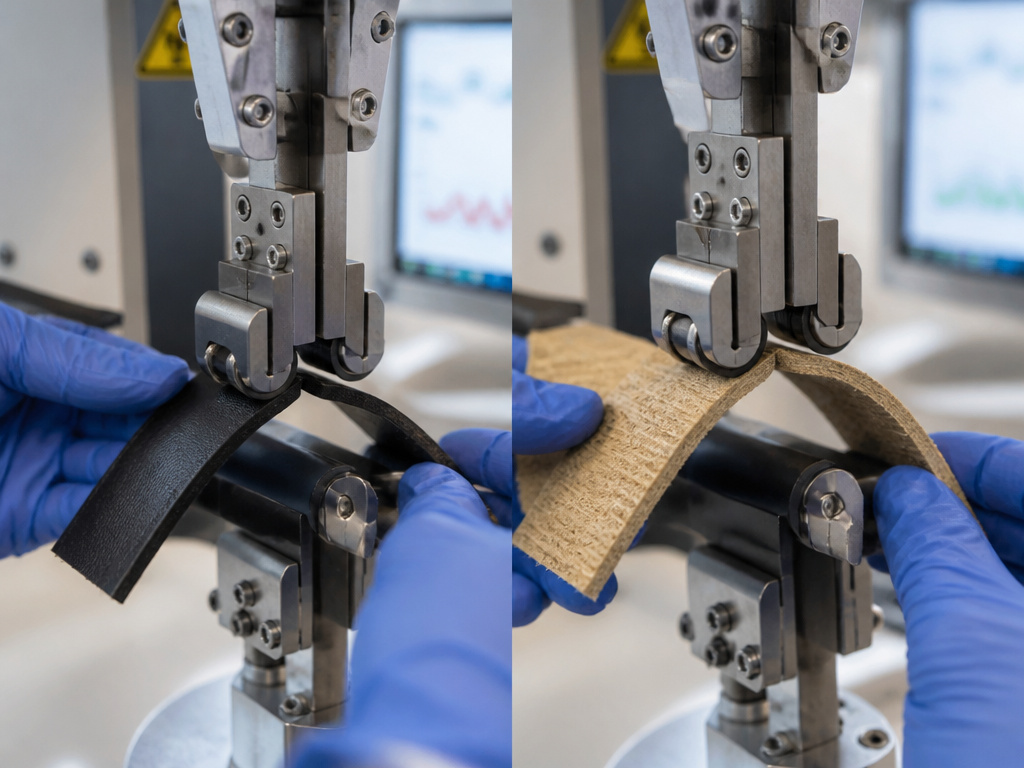
Marketing copy is one thing. Lab data is another. A peer-reviewed study published in the journal Coatings compared the technical performance of leather against several alternatives, providing hard numbers. Let’s break down what matters.
For something like a shoe or a bag, you care about three things: how many times it can bend before it fails (flex resistance), how well it lets moisture vapor through (breathability), and how much force it can take before tearing (tensile and tear strength).
| Material | Tensile Strength (N/mm²) | Flex Cycles to Grade 2 | Water Vapor Permeability (mg/(cm²h)) | Best For |
|---|---|---|---|---|
| Real Leather | 39.5 | >200,000 | 8.4 | Long-term durability, breathable goods |
| Pinatex (Pineapple) | 4.5 | 150,000 | 3.8 | Fashion items requiring high flex |
| Desserto (Cactus) | 20.8 | 30,000 | 2.5 | Structured bags, non-flex critical items |
| PU-Coated Textile | Not specified | >80,000 | Low | Cost-effective vegan footwear |
| Kombucha Leather | 9.7 | 10,000 | 9.2 | Experimental, highly breathable projects |
The footwear industry standard for a shoe upper often calls for more than 80,000 flex cycles. Notice which materials cleared that bar: real leather, Pinatex, and the basic PU-coated textile. The cactus-based Desserto, despite its trendy appeal, failed at 30,000 cycles in this test.
Breathability tells a similar story. Leather scored 8.4 against a common comfort threshold of 0.8. The plant-based alternatives, while better than solid plastic films, still lagged behind. This data, sourced from the Coatings study analysis in [Source 18], is the kind of specific insight that moves you past marketing claims.
The Specialists: When Certifications and Specifics Matter
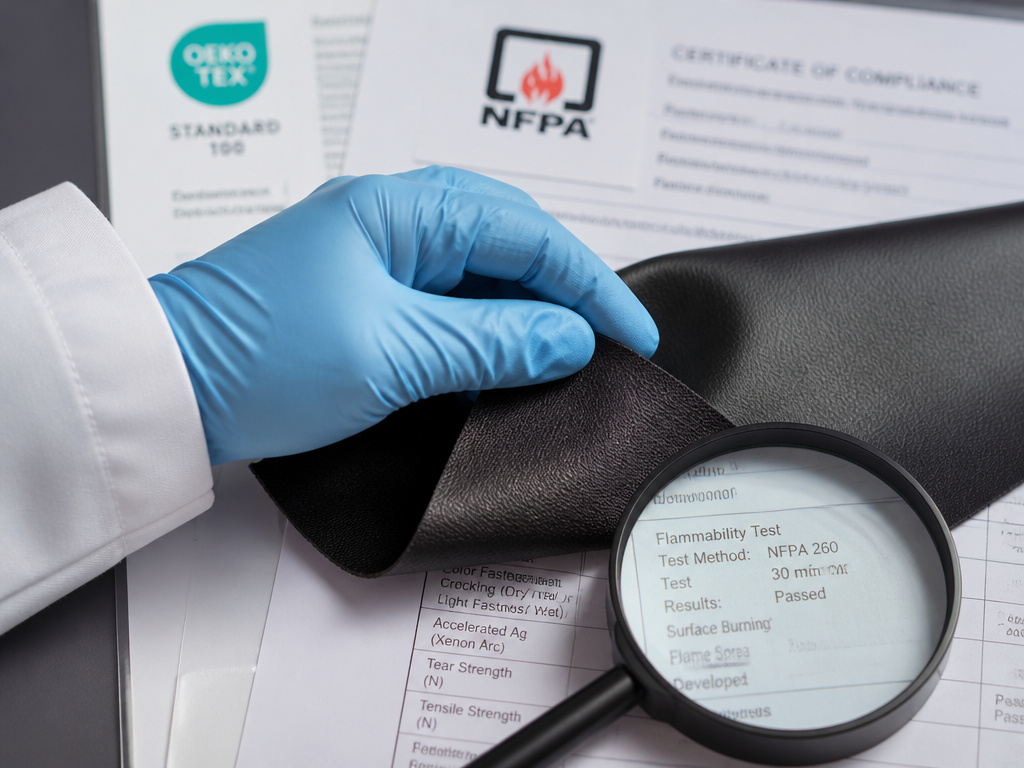
Not all synthetics are created for the same job. This is where looking past the “vegan” label to the actual product specs and certifications pays off.
For upholstery in public or commercial spaces, fire safety is essential. A material like Maxim Faux Leather by LebaTex is 100% silicone over a polyester backing. Its product page [Source 10] specifically notes it passes NFPA 260 and Cal 117 for upholstery end-use. That’s a targeted, high-performance material for a specific, regulated need.
For healthcare, automotive, or marine interiors, cleanability and durability under chemical exposure are key. Illusion 3.0 artificial leather from Nevotex is an OEKO-TEX certified polyurethane designed for these environments [Source 4]. It’s sold with technical specifications and cleaning guidelines, not just fashion photos.
Even in the plant-based world, specifics reign. Fjord artificial leather, another Nevotex product, highlights being 100% solvent-free, water-based PU and phthalate-free [Source 3]. That’s a meaningful differentiation for someone concerned with indoor air quality or chemical sensitivity.
The pattern here is verification. OEKO-TEX certification means the material has been tested for harmful substances. NFPA/Cal fire ratings are earned through independent laboratory testing. These are proof.
How to Choose: Matching Material to Your Actual Need
So, which one should you buy? The answer lives in your use case, not in a simple good/bad binary. Here’s a straightforward guide.
Choose traditional faux leather (PU/PVC) when:
- Budget is the primary constraint. It offers the leather look at the lowest cost.
- The item is short-term or seasonal. A trendy piece for a few wears.
- Waterproofing is the top priority, and breathability can be sacrificed (e.g., rain boots, outdoor cushion covers).
- You need a specific certified performance like the fire-rated Maxim silicone for upholstery.
Look to newer plant-based vegan leathers when:
- You want to reduce fossil-fuel-derived materials but still need a leather-like aesthetic.
- The item is a fashion accessory with moderate durability expectations (e.g., a wallet, a non-structural bag).
- You are supporting material innovation and are comfortable with potential trade-offs in lifespan or repairability.
Consider waxed canvas or heavy-duty cotton as an unsung hero when:
- Durability and repairability are paramount. These fabrics can be patched, re-waxed, and sewn for decades of use.
- You don’t actually need the “leather” look. This is often the most functional and longest-lasting vegan option outside the leather paradigm.
Let me share what I’ve learned from handling these materials. The disappointment rarely comes from the material itself, but from the mismatch between expectation and reality. Buying a PU “vegan leather” jacket expecting it to age and soften like leather is like buying a vinyl record expecting it to stream digitally. They’re different technologies serving different purposes.
Understand leather better to make confident choices. If you want a lifetime companion that changes with you, save for a full-grain leather item. If you need a specific, certified performance for a commercial project, a synthetic like Illusion 3.0 is a professional tool. If you want a stylish, animal-free option for a few years, a plant-based alternative like Pinatex can be a great choice, just know its limits from the lab data.
Frequently Asked Questions
Is vegan leather better than faux leather?
This frames the question wrong. Vegan leather is a category; faux leather (PU/PVC) is a material inside that category. “Better” depends on your goals. For reducing plastic use, a plant-based vegan leather (like cactus or pineapple) is typically better than a plastic-based faux leather. For pure durability and longevity, high-performance faux leathers made for commercial use can outlast some early-generation plant-based materials.
Does vegan leather last longer than faux leather?
Not necessarily. “Vegan leather” includes both durable plant-based materials and lower-quality plastics. A well-constructed PVC faux leather can last longer than a poorly bound plant-based alternative. The key is to compare the specific materials, not the umbrella terms. Research on how durable vegan leather is shows a wide range of lifespans.
How can I tell if my item is faux leather or a plant-based vegan leather?
Check the care label or product description. Legitimate brands will list materials (e.g., “polyurethane,” “cactus leaf fiber with polyurethane binder”). Feel and smell can also be clues, plant-based materials often have a more matte, fibrous feel and lack the strong chemical smell of new PVC. At a cut edge, faux leather shows a clear plastic layer over woven backing; some plant-based materials may show a more homogeneous, non-woven cross-section.
Can you condition vegan leather?
It depends entirely on the surface coating. Most vegan leathers with a polyurethane topcoat cannot absorb traditional leather conditioners (oils, waxes). Using them can create a greasy film or damage adhesives. Specific, water-based synthetic conditioners are designed to keep PU flexible without breaking it down. Always use a product designed for the specific material, like a dedicated faux leather conditioner.
What is the most durable type of vegan leather?
Based on available technical data, Pinatex (pineapple leaf fiber) has shown remarkably high flex resistance (150,000 cycles), making it a strong candidate for items like shoes that undergo repeated bending. For abrasion resistance and structure, some of the newer mycelium-based leathers (like Mylo) are showing high-performance promise in luxury applications, though they are not yet widely available.
Before You Go
The choice between these materials involves understanding a spectrum of options, each with its own balance of ethics, environmental impact, cost, and performance.
Your most sustainable choice is almost always the item you’ll keep the longest. For some, that’s a full-grain leather bag that becomes a decades-long companion. For others, it’s a pair of top-rated vegan leather pants made from Pinatex that get worn weekly for years. And for a specific need, outfitting a hospital waiting room, it’s a fire-certified synthetic like Maxim.
Ignore the marketing copy. Look for the material list, the NSF/ANSI 53 certification, and, when possible, the performance data. Let that guide your choice. That’s how you move past the noise of “vegan vs. Check the product’s abrasion resistance and water repellency to find the right material for the real job in front of you.
