
Learn How to Stretch a Leather Jacket Safely: Key Limits
This post contains affiliate links. As an Amazon Associate, we earn from qualifying purchases.
To stretch a leather jacket, you need to understand one number: leather can only expand by about 5% to 10%. That’s roughly half a size. The process works by softening the leather’s collagen fibers with body heat or light moisture, then applying gentle, consistent tension, through wearing or stuffing, while the leather is pliable. Force it beyond that 5-10% range or use aggressive heat, and you’ll damage the fibers or stress the seams past their limit.
That 5-10% figure isn’t a guess. It’s the physical ceiling of the material’s elasticity. The real work is in matching the right softening agent, conditioner, body heat, a light mist of water, to your specific leather type, and then applying tension in a controlled way. Goatskin will respond differently than horsehide, and a jacket that’s merely snug behaves differently than one that’s genuinely too small.
What follows is a breakdown of what actually works, drawn from testing data and community experience. We’ll cover the safe methods, the exact timelines you can expect by leather type, and the one mistake that ruins more jackets than any other.
Key Takeaways
- Leather has a physical stretch limit of 5-10% (half a size). Seams cannot stretch, so they are the ultimate failure point.
- Conditioner is not optional; it lubricates fibers so they “slide” instead of “grind” during stretching, cutting the break-in time in half.
- Full-grain cowhide can take a month of regular wear to become supple, while lambskin might only need a week.
- Heat tools and soaking are high-risk methods that often cause permanent damage like cracking or shrinkage.
- If a jacket is so tight you can’t zip it, stretching won’t work. You need a larger size.
The Core Principle: Leather Stretches 5-10%
Forget the marketing that says leather will “mold to your body endlessly.” It won’t. Leather is a network of collagen fibers, and like any woven material, it has a yield point. Industry testing and practical experience converge on a 5% to 10% expansion as the realistic maximum. In practical terms, that means turning a snug size 40 into a comfortable size 40, not into a 42.
Leather can typically stretch about 5% to 10% (roughly half a size). Attempting to stretch leather beyond what its seams can cope with risks ruining the garment.
The seams are your hard stop. Thread doesn’t stretch. If you tension the leather panel past what the stitching thread can hold, the seam will either pop or, worse, slowly tear the leather itself at the stitch holes. This is why the chest and shoulders are the hardest areas to alter, they’re a web of intersecting seams. Understanding this limit frames every method that follows. You’re working within a narrow window.
What Your Leather Type Tells You
Not all leather stretches the same. The animal, the tanning process, and the cut of the hide dictate your timeline and approach. Here’s what you’re really working with.
| Leather Type | Stretch Potential | Break-in Timeline (to 80% supple) | Key Characteristic |
|---|---|---|---|
| Lambskin / Sheepskin | High (soft, thin fibers) | 7-10 days | Responds quickly to wear and conditioner; easiest to stretch gently. |
| Goatskin | Moderate (resilient, tight grain) | 12-14 days | Durable and flexible, but its tight cell structure can resist permanent stretch. |
| Full-Grain Cowhide | Low-Moderate (dense, stiff) | 28+ days | Requires the most patience; responds best to consistent wear + heavy conditioning. |
| Horsehide | Low (very tough, rigid) | 30+ days | Famous for toughness, but its stiffness makes it the most resistant to stretching. |
Lambskin is your best bet if you need a little more room. It’s pliable from the start. Goatskin is a trickier partner. A forum user on a Vintage Leather Jackets Forum thread noted that a stretched goatskin A-2 jacket resumed its original size within hours, the leather’s memory fought back. Full-grain cowhide is the standard workhorse; it will give, but you measure progress in weeks, not days. Horsehide? It’s legendary for a reason, but that reason isn’t elasticity. Forcing it often means fighting a losing battle against its inherent rigidity.
The Safe, Proven Methods (Ranked by Effectiveness)
Let’s be clear about one thing: the goal is to soften and relax the fibers, not brutalize them. These methods work with the leather’s nature.
Method 1: Wear It In (The Gold Standard)
This is the safest, most reliable method. It uses your body heat as the softening agent and your movement as the tension.
Step 1: Condition First.Before you even put the jacket on, apply a conditioner containing lanolin or beeswax.amazon.com/dp/B003IS3HV0?linkCode=osi&th=1&psc=1&tag=leathergenesis-20) or Bick 4 to the stiff areas, shoulders, upper back, chest. This isn’t a cosmetic step. In comparative tests, jackets conditioned before first wear reached the same suppleness in 14 days that unconditioned jackets took 28 to 35 days** to achieve. The conditioner lubricates the fibers so they flex against each other instead of grinding.
Step 2: Layer Up. Wear the jacket over a thick sweater or hoodie. The extra layer creates gentle, distributed tension.
Step 3: Move. Wear it around the house for a few hours each day. Bend your arms, shrug your shoulders, zip and unzip. The heat from your body and the friction of movement do the work.
Where this goes sideways: Wearing a jacket that’s “very tight” over a thick hoodie. This can concentrate stress on the armpit or shoulder seams and risk a rip. If you can’t move your arms freely, the jacket is too small for this method.
Timeline: Expect to feel a noticeable difference after 10-15 hours of total wear. A full break-in takes 1-3 weeks of daily sessions, depending on the leather.
Method 2: Conditioner & Controlled Stuffing
This is for when you don’t want to wear a tight jacket, or you need to target a specific panel like the chest.
- Apply conditioner to the interior of the tight area and let it absorb for 20 minutes.
- Zip the jacket up.
- Stuff the target area firmly, not brutally, with rolled towels or soft blankets. You want even pressure.
- Leave it stuffed for 24-48 hours.
This method is excellent for adding a little room across the chest or shoulders. It mimics the pressure of wearing a layer without the movement. It’s also a great follow-up to a wearing session to “set” the stretch.
Method 3: The Light Mist Technique (Cowhide Only)
Water is a polarizing topic. Soaking leather is a great way to shrink it and strip oils. A controlled mist, however, can relax dense cowhide fibers.
- Lightly mist the interior of the tight area with plain water from a spray bottle. The leather should feel barely damp to the touch, not wet.
- Immediately put the jacket on (over a thin layer) or stuff it as described in Method 2.
- Wear or keep it tensioned until it is completely dry.
The moisture temporarily loosens the fiber bonds, allowing them to be repositioned. As it dries under tension, it holds that new shape slightly better. This is a higher-risk method, always condition the leather after it dries to replace lost oils.
What Not to Do: The High-Risk Shortcuts
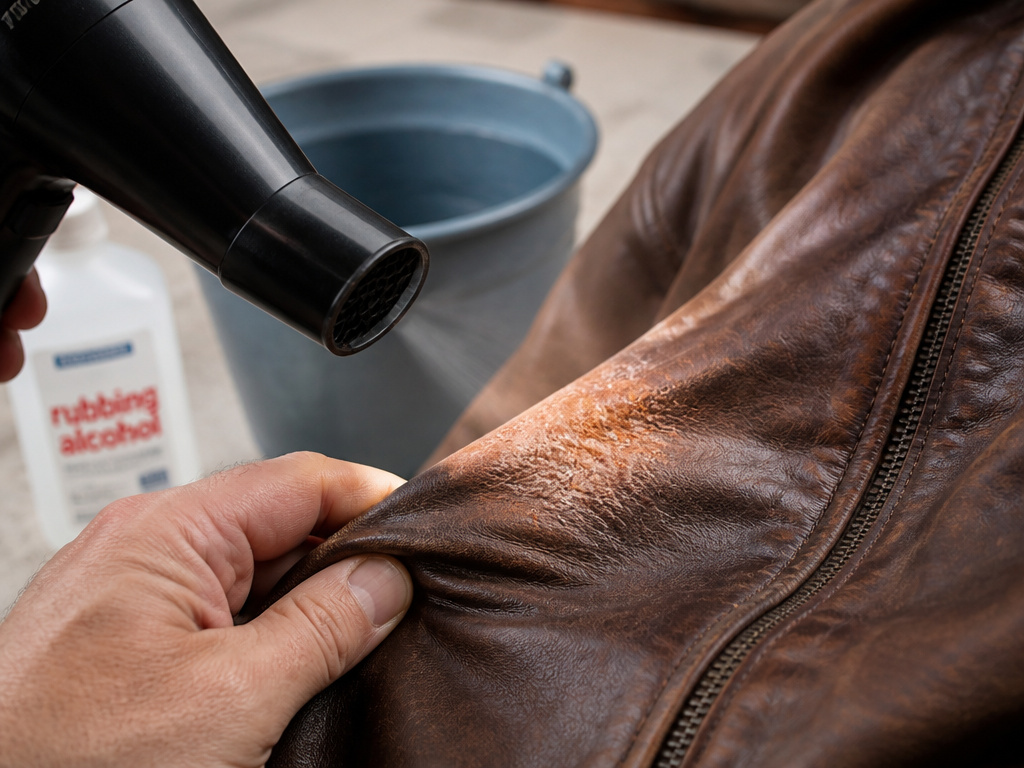 Ignoring the chemistry of leather leads to permanent damage. Here’s what to avoid.
- High Heat (Hair Dryers, Heat Guns): Heat dries out the natural oils instantly, making fibers brittle. The leather may become pliable for a minute, but as it cools it will often shrink and almost certainly crack. It’s a short-term fix with a long-term cost.
- Soaking or Washing: Submerging a jacket saturates the fibers and the lining. As it dries, it can shrink unpredictably, warp panels, and leave water stains. One user reported a shrunken jacket and a dented dryer door, the jacket didn’t give, the appliance did.
- Rubbing Alcohol or Harsh Chemicals: These strip oils and dyes aggressively. They might make the leather feel softer temporarily by breaking down the surface, but they degrade the material’s integrity.
- Overstretching: This is the silent killer. You might get that extra half-inch by forcing it, but you’ll hear a faint creaking sound, that’s the sound of individual fibers snapping. The damage might not show up as a tear for months, but the leather will be permanently weakened.
The Conditioner Non-Negotiable

Common mistake: Conditioning only the outside. The inside, or flesh side, of the leather absorbs conditioner more readily and is where you need the lubrication for stretching. Always apply to the interior of tight areas.
When to Call a Professional
Some situations exceed the DIY realm. If you have an heirloom piece, a precious sheepskin jacket, or a jacket that’s simply too expensive to risk, seek a professional. Certified leather tailors or the specialists listed by organizations like the Leather Conservation Centre use controlled-humidity chambers and mechanical stretchers that can apply precise, even pressure. They can also assess seam integrity before starting.
This is also the only real option if you need more than the 5-10% stretch. They might be able to let out a seam or panel, which is a structural alteration far beyond simple stretching.
Frequently Asked Questions
Can you permanently stretch a leather jacket?
You can achieve a permanent stretch, but leather has memory. Especially with resilient types like goatskin, it will always try to contract back toward its original shape. Consistent wear and conditioning are required to maintain the stretched size. True permanent alteration usually involves a tailor altering seams.
How long does it take to stretch a leather jacket?
It depends entirely on the leather. Using the “wear and condition” method: Lambskin might show results in a week. Goatskin or light cowhide may take two weeks. Heavy full-grain cowhide or horsehide can take a month or more of regular wear.
Will stretching ruin my leather jacket?
Not if done safely. Stretching with conditioner and body heat is a natural break-in process. Damage comes from the shortcuts: high heat, soaking, alcohol, or brute force. These methods dry, shrink, or tear the fibers.
My jacket is tight in the shoulders. Can I stretch it?
The shoulders are the hardest area to stretch because they are a complex junction of seams. You can gain a little room through consistent wear and conditioning, but the seam structure is a hard limit. If the shoulders are painfully tight, the jacket is likely too small.
What’s the difference between stretching and breaking in a jacket?
Breaking in is the overall process of making a stiff jacket supple and comfortable, which includes softening the leather and creating natural creases. Stretching is a specific subset of breaking in aimed at increasing the jacket’s dimensions. All stretching is part of breaking in, but not all breaking in involves intentional stretching.
The Bottom Line
Stretching a leather jacket is a test of patience, not force. The 5-10% rule is your guide; the seams are your boundary. Your best tools are a conditioner like Bickmore, your own body heat, and time.
If you remember one thing, let it be this: conditioner first. It’s the difference between a jacket that breaks in over a few weeks and one that fights you for months. Everything else, the light mist, the stuffing, the professional help, is a variation on the theme of softening and gentle tension.
Start with an honest assessment. If you can’t zip the jacket, no method here will work. If it’s just snug, pick your leather type from the table, grab a conditioner, and wear it. The leather will tell you what it needs. Your job is to listen.
