
A Guide to Types of Leather Bags: Designer vs. Mass Market
This post contains affiliate links. As an Amazon Associate, we earn from qualifying purchases.
This post contains affiliate links. As an Amazon Associate, we earn from qualifying purchases.
Types of leather bags are defined by their silhouette and intended use, tote, crossbody, structured handbag, backpack, satchel, and more. The functional difference between them comes down to three measurable specs: leather thickness for the given style, the load-bearing engineering of straps and handles, and the internal structure that either holds a shape or allows controlled collapse. Matching the bag type to your actual daily routine, not a style fantasy, is what makes a purchase last.
That framework of thickness, load, and structure is what separates a catalog description from a bag you’ll use for a decade. Most guides list silhouettes. They don’t explain why a tote needs a 1.6–2.0 mm leather base to avoid sagging, or why a crossbody bag’s D-rings are a more common failure point than the leather itself.
What follows is a breakdown of the core bag types through the lens of how they’re built to be used. This guide explains the specs that signal quality, the common mismatches between purchase and routine, and the one storage rule almost everyone gets wrong.
Key Takeaways
- A bag’s silhouette dictates its required leather thickness. Totes and backpacks need 1.6–2.0 mm leather; structured handbags use 1.4–1.8 mm; crossbody and shoulder bags work with 1.2–1.6 mm.
- Purchase conversion data shows tote bags and crossbody bags have the highest buy rates because they solve clear problems (capacity and hands-free carry). Trend-driven mini bags spike in search but often have lower long-term sales.
- The “designer” label, structurally, means tight tolerances: stitch length variance under ±0.5 stitches/cm, leather color difference (ΔE) ≤ 1.5, and hardware tested to ≥5,000 open-close cycles.
- Storing a leather bag in a sealed plastic container traps moisture and prevents the natural air circulation leather needs. Use a breathable cotton dust bag in a climate-controlled space instead.
- For daily use, prioritize full-grain or top-grain leather. Genuine leather is a bottom-tier classification that often cracks, and bonded leather is not suitable for any bag carrying weight.
The Tote vs. Structured Handbag vs. Crossbody Decision Matrix
These three silhouettes cover the majority of daily use cases. Your choice is primarily about how you move, what you carry, and how often you need access.
A tote bag is a volume carrier. Its job is to hold a lot without complaint. That demands a specific build: reinforced handles that won’t stretch or tear under load, a firm base to prevent sagging, and leather thick enough to hold its shape, typically 1.6–2.0 mm. The common failure point is the handle anchors pulling away from the body after months of carrying a laptop, a water bottle, and a day’s worth of miscellany. A well-built tote uses reinforcement patches behind those anchor points and box stitches, not just glue.
A designer tote focuses on handle reinforcement, base structure, and leather thickness to prevent sagging. The structural notes call for a base stiffener and 1.6–2.0 mm leather.
A structured handbag is the opposite. Its purpose is to keep a polished silhouette, empty or full. This requires internal architecture, often layers of interlining or even lightweight frames, and a slightly thinner, firmer leather (1.4–1.8 mm) that won’t easily crease. The craftsmanship is immediately visible in the clean panel alignment and sharp edges. The risk here is deformation. Sit on it, stuff it in an overhead bin, or overfill it once, and that crisp shape can be permanently lost. It’s a bag for controlled environments.
The crossbody bag is an engineering problem solved with straps and hardware. Comfort and access are everything. The leather can be softer and thinner (1.2–1.6 mm) because the load is distributed across your body. The critical specs are elsewhere: the strap material, the swivel hardware, and the D-rings that anchor everything. These metal parts should be solid, smoothly moving, and attached with reinforced stitching. A failing crossbody bag usually announces itself with a squeaky swivel or a D-ring that starts to bend.
| Bag Type | Primary Job | Critical Spec | Common Failure If Spec is Weak |
|---|---|---|---|
| Tote | High-capacity carry | Handle reinforcement & 1.6-2.0 mm leather | Handles detach; base sags permanently |
| Structured Handbag | Shape retention | Internal stiffeners & firm 1.4-1.8 mm leather | Loses silhouette after overstuffing |
| Crossbody | Hands-free access | Strap hardware strength & D-ring anchoring | Hardware breaks; strap pulls from ring |
So, which one? If your day involves a commute, a laptop, and errands, a leather tote bag is the default. If you need a polished look for meetings and carry less, a structured handbag works. For travel, crowded spaces, or anytime you need your hands, the crossbody wins.
Backpacks, Satchels, and Messengers: The Load-Bearing Trio
These are workhorse shapes designed to manage weight intelligently. They fail when the design prioritizes looks over load distribution.
A leather backpack is the best tool for carrying heavy items comfortably over distance. The two-strap system spreads weight across your shoulders and back. The quality markers are padded, adjustable straps and a reinforced back panel. The leather should be durable, again, in that 1.6–2.0 mm range, but the real test is how the straps are attached. Look for wide, riveted anchor points or extensive stitching that spreads the stress. A cheap backpack will have thin straps stitched onto a single layer of leather; they’ll start to tear within a year.
The satchel is a classic, often with a flap closure. It’s more structured than a tote but less rigid than a formal handbag. It’s for the person who carries a moderate load but wants organization and a timeless profile. The flap and its closure (a buckle, clasp, or magnetic snap) are the wear points. A good satchel has a reinforced flap fold and hardware that engages smoothly thousands of times. The leather needs to be firm enough to hold the bag’s rectangular shape but pliable enough for the flap to move.
Messenger bags live between satchels and crossbodies. They typically have a single, wide strap and a large main compartment, designed for quick access. The stress is concentrated on the strap anchors and the flap hinge. A quality leather messenger bag uses a wide strap that swivels at the anchor to prevent twisting, and the flap will have a leather or fabric hinge to absorb the repeated motion. The bag should lie flat against your side without the contents digging into your ribs, that’s a sign of good internal organization or a soft back panel.
Where this goes sideways: Choosing a messenger bag for a heavy laptop without a dedicated, padded sleeve. The weight will swing and batter your hip, and the device won’t be protected. You’ll hate carrying it within a week.
Here’s a straightforward way to choose among them: – Carry heavy tech books or gear regularly over distance? Get a backpack. – Want organized, easy access to tools or papers in a professional but not ultra-formal setting? A satchel fits. – Need to move quickly in an urban setting with a moderate load, grabbing things on the go? A messenger bag is built for that.
What “Designer” Actually Means in Manufacturing Tolerances
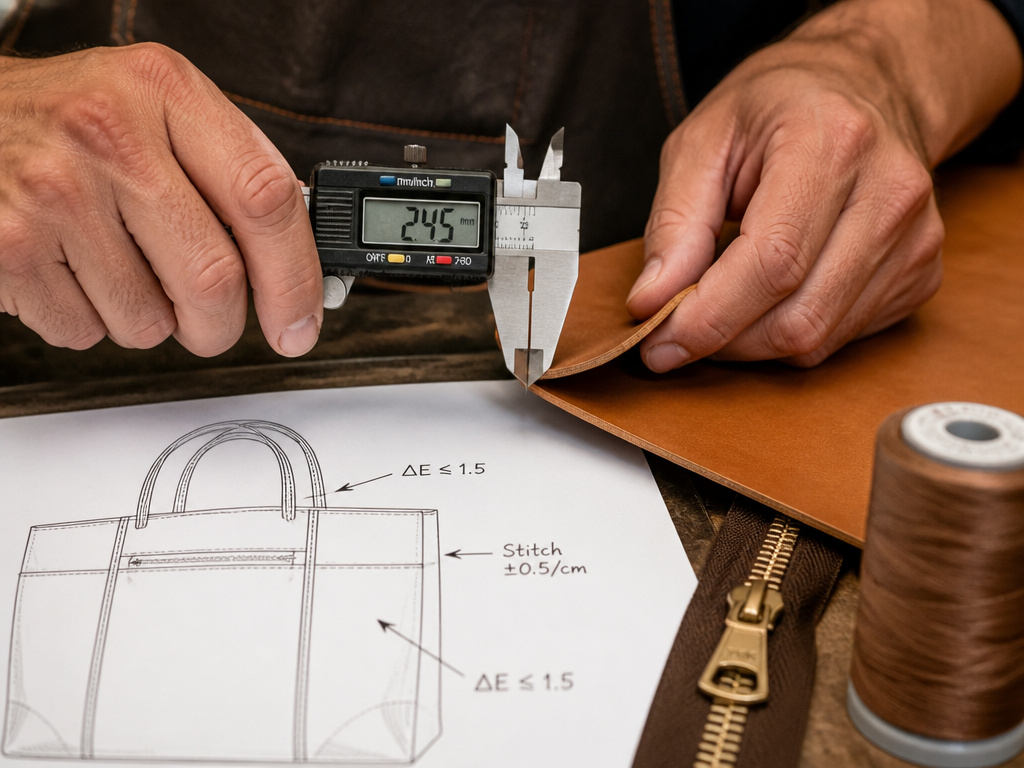 Let’s be clear about this. In manufacturing, “designer” is a set of tolerances, not a logo. It’s the allowable margin of error in every step of making the bag. A mass-market bag might have loose tolerances: the stitching can wander, the leather thickness can vary, the color might shift between panels. A designer-level bag tightens those screws.
The factory-level specs tell the story. For consistent color, the tolerance is ΔE ≤ 1.5, a scientific measure of color difference invisible to the untrained eye but glaring under factory lights. Stitch length must stay within ±0.5 stitches per centimeter. Leather thickness for a given panel has a ±0.2 mm window. These numbers force consistency. They mean the tenth bag off the line should be indistinguishable from the first sample.
This discipline extends to hardware testing. A zipper on a quality bag isn’t just “metal.” It’s tested to withstand a minimum of 5,000 open-close cycles. Clasps are tested for lock strength, D-rings for pull force resistance. This is why hardware on a cheap bag feels light and jangly, and on a good bag, it feels substantial and smooth. The weight and the smoothness are the result of material choice and plating thickness, specified in microns.
I want to help you make confident choices. So look past the brand name. Pick up the bag and check the 10-second list: Are the left and right panels symmetrical? Is the stitch length even, with no loose threads or tension waves? Do the strap anchors look reinforced? Do the zippers run smoothly? Does the bag hold its shape when empty? That’s how you spot the tolerance control, not the marketing.
The Hardware & Lining Reality Check
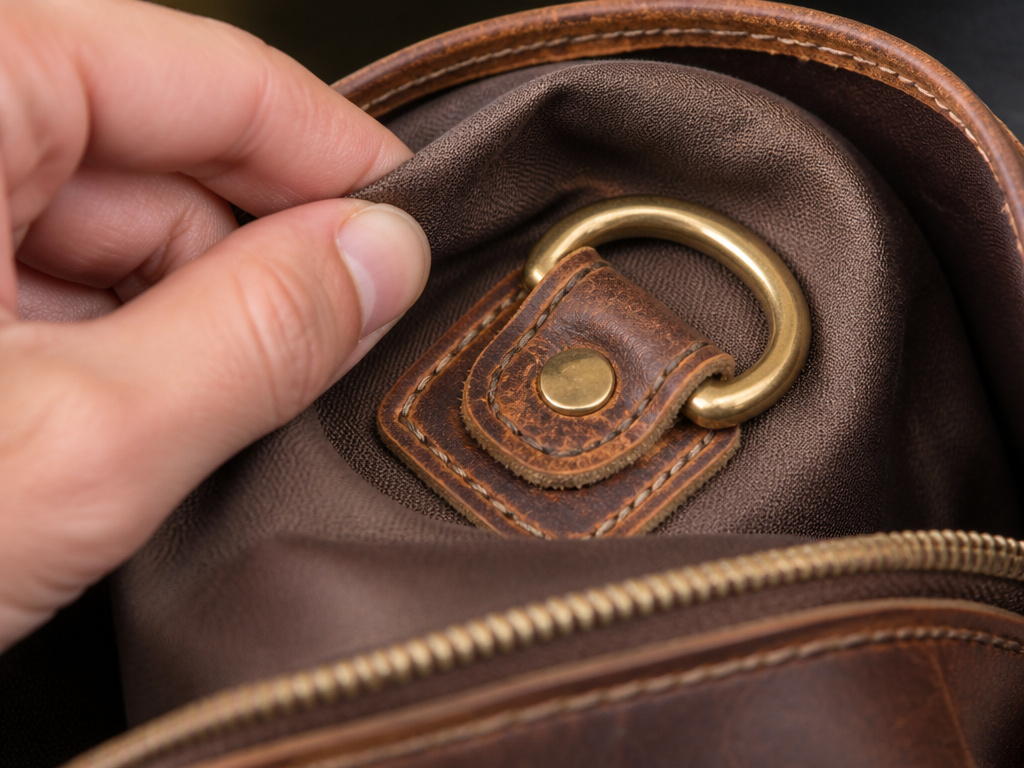 Leather gets the attention, but the bag’s longevity is often decided by the parts you don’t see. Hardware and lining are the support system. They fail first.
Hardware has two failure modes: mechanical and cosmetic. Mechanical failure is a broken zipper tooth, a clasp that won’t stay closed, or a D-ring that bends open. Cosmetic failure is peeling plating, tarnish, or discoloration. Good hardware addresses both. It uses solid base metals like brass or stainless steel, has thick, even plating, and is attached with reinforced stitching or rivets that go through multiple layers of material. The pull of a strap creates immense force on a D-ring; a single layer of leather and a few stitches won’t hold.
Lining is the interior interface. A cheap, thin lining will tear at the seams, especially where you repeatedly reach into pockets. It can also bleed dye onto your belongings or develop a musty smell. A quality lining is a durable, colorfast fabric like microfiber or tight-weave nylon, cleanly attached with no loose threads or puckering. It should feel substantial, not like tissue paper. For a travel or work bag, a lining with some water resistance is a practical upgrade.
Consider these points before you buy: – Zippers: Should glide effortlessly, even around corners. The tape (the fabric part) should be firmly stitched into the seam. – Strap Attachments: Look for wide, riveted fixings or a block of stitches. A single row of stitching is a red flag. – Lining Seams: Should be flat and even. Puckering or loose threads indicate rushed work that will fail.
This is a timeless material, but it needs a good foundation. Great hardware and lining don’t add much to the product’s visual appeal in photos. They add years to its usable life.
How to Match a Leather Grade to the Bag’s Job
“Leather” is not one material. The grade determines how the bag will age, feel, and withstand wear. Picking the right grade for the bag’s function is essential.
Full-grain leather is the top layer of the hide, with all its natural grain and imperfections intact. It’s the strongest and most durable. Over years, it develops a rich patina, a darkening and softening that tells the story of its use. This is the best choice for any bag facing heavy daily use: your primary work tote, travel duffle, or everyday backpack. It might show scuffs initially, but those blend into the character of the patina. It’s the guy who shows up to work with dirt under his nails.
Top-grain leather is the same top layer, lightly sanded and finished to create a more uniform, smoother surface. It’s slightly less rugged than full-grain but more resistant to stains and scratches right out of the gate. It’s an excellent choice for structured handbags, satchels, or shoulder bags where a pristine, polished look is important and the bag won’t be subjected to extreme abrasion.
The other terms are where caution is needed. “Genuine leather” is a technically accurate term for real leather, but in industry parlance, it refers to the lower layers of the hide that have been processed and often coated. It lacks the fibrous strength of the top layers and is prone to cracking and peeling as that coating breaks down. “Bonded leather” is made from leather scraps glued together; it has minimal durability and is not suitable for bags.
Common mistake: Choosing a bag because the tag says “genuine leather,” believing it signifies quality. In manufacturing specs, it’s often the lowest grade used for whole garments. For a bag that carries weight, it’s a compromise.
For most people, the choice is between full-grain and top-grain. – Pick full-grain for bags that will be workhorses: totes, backpacks, messengers, travel duffels. – Pick top-grain for bags where a smooth, refined appearance is the priority: structured handbags, clutches, certain shoulder bags.
Storing Leather Bags: The One Rule You Can’t Skip
All the care in the world is undone by bad storage. Leather is a skin. It needs to breathe.
The worst thing you can do is shove a leather bag, stuffed full, into the back of a humid closet or, worse, a sealed plastic container. Trapped moisture leads to mildew, which shows up as fuzzy spots and a sour smell. The lack of air circulation can also dry out the leather in uneven ways. The goal is to support the bag’s shape in a stable, breathable environment.
Here’s the straightforward advice: 1. Empty it completely. Remove all items, including crumbs from old snacks. 2. Stuff it for shape. Use acid-free tissue paper or a plain cotton pillowcase to fill the main compartment. This prevents creasing and collapse. Avoid newspaper, as the ink can transfer. 3. Use a dust bag. The soft, breathable cotton bag it came with is perfect. It protects from dust and light while allowing air flow. 4. Find the right spot. Store it in a cool, dry place away from direct sunlight, heat sources, and dampness. A shelf in a climate-controlled closet is ideal.
I see the mistake often: someone buys a beautiful bag, uses it for a season, then stuffs it in a plastic bin for summer. By fall, there’s a musty odor and a white mildew bloom in the creases. That damage is frequently permanent. A simple cotton bag and a shelf prevent it entirely. For long-term preservation, this step matters as much as any conditioner. If you want to dive deeper into the specifics, our guide on how to store leather bags covers climate control and materials in detail.
Frequently Asked Questions
What is the most durable type of leather bag for daily use?
For daily abuse, durability is a combination of silhouette and leather grade. A leather backpack or tote bag made from full-grain leather will typically last the longest. The two-strap design of a backpack distributes weight best, reducing stress on any single point, and full-grain leather has the strongest fiber structure. The best leather bags for longevity always prioritize this material and sensible design over fleeting trends.
Are leather crossbody bags practical for travel?
Absolutely. A leather crossbody bag is one of the most practical travel companions. It keeps your essentials secure and hands-free in airports, at markets, or while sightseeing. Look for one with a secure closure (zipper or flap), an adjustable strap, and multiple compartments to organize passports, money, and a phone. The crossbody style deters pickpockets and is far more comfortable for all-day wear than a shoulder bag.
What’s the difference between a satchel and a structured handbag?
The difference is in the rigidity and the closure. A satchel usually has a flap closure that covers the main opening and is often less rigidly structured. It can soften and slouch a bit over time. A structured handbag is built to hold its exact shape when empty, often with internal stiffeners or frames, and may have a zipper or clasp closure rather than a full flap. Satchels lean casual-professional; structured handbags are more formal.
How can I tell if a leather bag is high quality before buying?
Run a quick physical check. First, feel the leather, it should feel substantial, not plasticky. Examine the stitching: it should be even, tight, and consistent, with no loose threads. Check the edges of the leather, they should be finished smoothly, not rough. Test the zippers and clasps; they should operate smoothly and feel solid. Finally, look at the lining; it should be well-attached and made of a durable-looking fabric. These are the characteristics of quality leather bags that you can assess in a store.
Can you repair scratches or stains on a leather bag?
It depends on the leather and the damage. Light surface scratches on full-grain or top-grain leather can often be lessened with gentle rubbing from your finger (the natural oils help) or a dedicated leather conditioner. Stains are trickier. Water-based stains might lift with a damp cloth. Oil-based stains often require professional help. For deep gouges or torn stitching, a professional leather repair service is the best route. I once thought you could buff out any mark, but a deep gouge I encountered needed filling with a leather cement compound, a job for a pro.
The Bottom Line
Choosing between types of leather bags is a logistics problem. Map the bag to your actual movement.If you’re a daily commuter with a laptop, a thick leather tote or backpack is your tool. If you need a polished look for client meetings, a structured handbag in top-grain leather makes sense. If your life involves crowded trains and keeping your hands free, the crossbody is your answer.
Ignore the vague labels. Look for the specs that prove the bag can do its job: leather thickness matched to the silhouette, reinforced stress points, and hardware that feels solid, not hollow. That’s what you’re actually buying. The rest is just marketing draped over a frame. Find the bag built for your reality, and it won’t just be an accessory. It’ll be a piece of gear that works.
