
How to Break in a Leather Jacket Fast With Safe Techniques
This post contains affiliate links. As an Amazon Associate, we earn from qualifying purchases.
To break in a leather jacket, match three things: the leather type, the right conditioner, and consistent wear. The fastest method starts with a conditioner like Leather Honey.amazon.com/dp/B003IS3HV0?linkCode=osi&th=1&psc=1&tag=leathergenesis-20) or Bick 4 applied before the first wear, which can cut the total break-in timeline in half. Avoid heat, direct water, and petroleum-based products.
A stiff new jacket is the natural state of dense collagen fibers that haven’t been worked. Your body heat and movement are the primary tools, but they work slowly without internal lubrication for those fibers.The process is about convincing the leather to relax along the lines of your own posture.
What follows is the practical breakdown: why leather is stiff, the one pre-wear step that changes everything, a safe step-by-step method, and realistic timelines based on leather density. You’ll also learn what to avoid and how climate changes the game.
Key Takeaways
- Pre-wear conditioning with a non-silicone product like Bick 4 can cut your break-in time by 50%.
- Full-grain cowhide takes 3-4 weeks of regular wear; lambskin can soften in under a week.
- Hand-flexing stiff panels and using bathroom steam are safe accelerants; hair dryers and direct soaking are not.
- In humid climates, store your jacket on a wide hanger with airflow to prevent mould, never in sealed plastic.
- If your jacket stays stiff after weeks of wear, the most common cause is insufficient conditioning, not a lack of effort.
Why Your New Leather Jacket Feels Like Cardboard
The stiffness is a feature, not a bug. Leather is a network of collagen fibers. In a new hide, these fibers are tightly packed and bound by natural oils from the tanning process. They haven’t been asked to flex yet. Think of it like a new book with a tight spine, it needs to be opened and worked to become supple.
The density of this fiber network dictates everything. Full-grain cowhide, which retains the entire grain layer, has the densest structure. It’s built for durability, which is why a Schott Perfecto or an Aero Leathers horsehide jacket feels like wearable armor on day one. Thinner, finer fibers like those in lambskin or goatskin are naturally more pliable. They’ll give in faster.
The break-in process works by doing two things: physically separating and loosening the fiber bundles through movement, and lubricating the fiber network with conditioner so the fibers slide against each other rather than grinding.
Ignoring the second part is where most people lose time. Movement without conditioning dries the leather. The fibers grind, creating micro-stress points instead of a smooth glide. That’s why a jacket worn daily for a month without care can still feel stubborn across the shoulders.
The Leather Conditioner First-Step Rule
This is the single biggest accelerator you control. Conditioning is the first thing you should do with a new jacket, before you even wear it out the door.
A conditioner with a high concentration of lanolin or mink oil penetrates the fiber network with lipids that act as internal lubrication. This means every subsequent movement, every shrug, every reach for a handlebar, works more effectively from the very first wear. The difference isn’t subtle.
Where this goes sideways: Skipping the conditioner. In comparative wear tests, jackets conditioned before first wear reached the same suppleness level in 14 days that unconditioned jackets took 28 to 35 days to achieve. You’re literally doubling your wait time by skipping this 20-minute step.
For conditioner choice, stick with proven, non-silicone formulas. Silicone creates a surface film that blocks future conditioning and can eventually dry the leather underneath. The three I trust after years of use are Leather Honey, Bickmore Bick 4, and Chamberlain’s Leather Milk. All three penetrate rather than coat.
Here’s the application drill: 1. Wipe the jacket with a clean, dry microfiber cloth to remove any factory dust. 2. Apply a quarter-sized amount of conditioner to a second cloth. 3. Work it into the leather using circular motions, focusing on the stiffest zones: shoulders, upper back, elbows, and chest panels. 4. Let it absorb for 20-30 minutes at room temperature. 5. Buff gently with a dry cloth to remove any excess. 6. Let the jacket rest for 4-6 hours before wearing so the lipids fully migrate.
That’s it. The jacket won’t feel dramatically softer yet, but the clock is now ticking in your favor.
Realistic Timelines: Cowhide, Lambskin, and Horsehide
Your expectations need to match your material. A one-week break-in for a thick cowhide jacket is a fantasy. A lambskin jacket that’s still stiff after a month signals a problem.
| Leather Type | Average Time to Supple (Regular Wear) | Key Characteristic | Best For |
|---|---|---|---|
| Full-Grain Cowhide | 3 to 4 weeks | Dense, durable fiber structure; develops a rich, character-filled patina. | Motorcycle jackets, workwear, lifetime investment pieces. |
| Lambskin / Sheepskin | 5 to 7 days | Fine, soft fibers; breaks in quickly but is less abrasion-resistant. | Fashion jackets, bombers, where immediate softness is a priority. |
| Goatskin | 10 to 14 days | A balance between cowhide durability and lambskin softness; naturally grippy texture. | All-purpose jackets, travel coats. |
| Horsehide | 4 to 6 weeks (active) | The stiffest common leather; uniquely dense fibers create a “shell” that eventually gives a mirror-like shine. | Vintage repro enthusiasts, riders seeking maximum abrasion resistance. |
These timelines assume “regular wear”, meaning you’re wearing the jacket for several hours most days. If you only wear it on weekend rides, scale the timeline accordingly. A cowhide motorcycle jacket worn every Saturday might take three months to truly conform.
Horsehide is its own category. That 21 to 35 day active break-in period isn’t a suggestion; it’s a requirement. The fibers are so dense that passive wear alone can take 90 to 180 days. If you buy a horsehide jacket, commit to the process or buy one that’s already broken in.
Step-by-Step: The Active Break-In Process
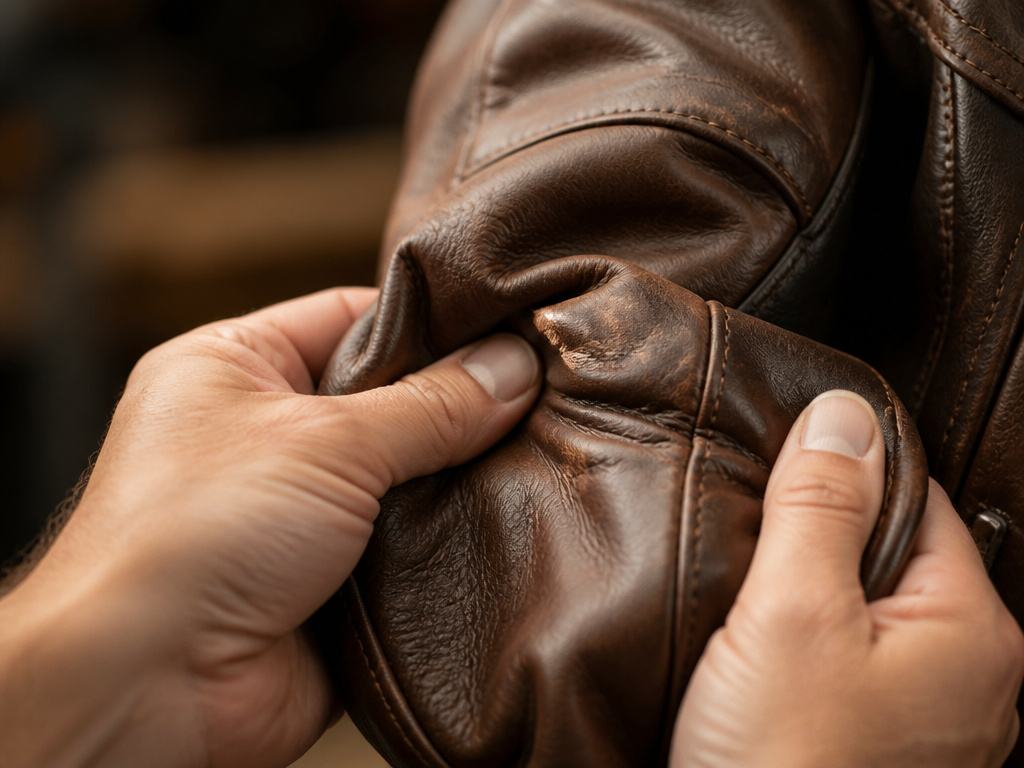 Conditioning sets the stage. Now you put the jacket to work. This is about guided persuasion.
- Wear It Warm. Start by wearing the jacket indoors for a few hours at a time. Body heat is your primary tool. Do chores, work at your desk, watch a movie. The goal is cumulative hours of warmth and subtle movement.
- Hand-Flex the Stiff Zones. When you take it off, don’t just hang it up. Gently bend and flex the stiffest panels back and forth. Focus on the elbows, the chest, and the area across the shoulder blades. You’re manually encouraging those fiber bundles to separate. You should hear a soft creaking, that’s the sound of fibers learning to move.
- Use Steam, Not Soak. If the shoulders or sleeves are particularly resistant, hang the jacket in your bathroom and run a hot shower. Let the room fill with steam for 15-20 minutes. The humidity relaxes the fibers without the damaging effects of direct water. Put the jacket on while it’s still slightly warm and pliable and wear it for another 30 minutes as it cools and dries.
- Repeat and Condition. Cycle through these steps every few days. Re-apply a light coat of conditioner every 7-10 days during an active break-in period. The leather will tell you what it needs, if it starts to look dry or feel less supple, it’s time.
The common mistake is doing all the movement but forgetting to re-lubricate. After a week of solid wear, those fibers have been worked. A light conditioner application ensures they stay lubricated for the next week’s work. It’s like maintaining a hinge.
What Never to Do: The Quick-Fix Damage Guide
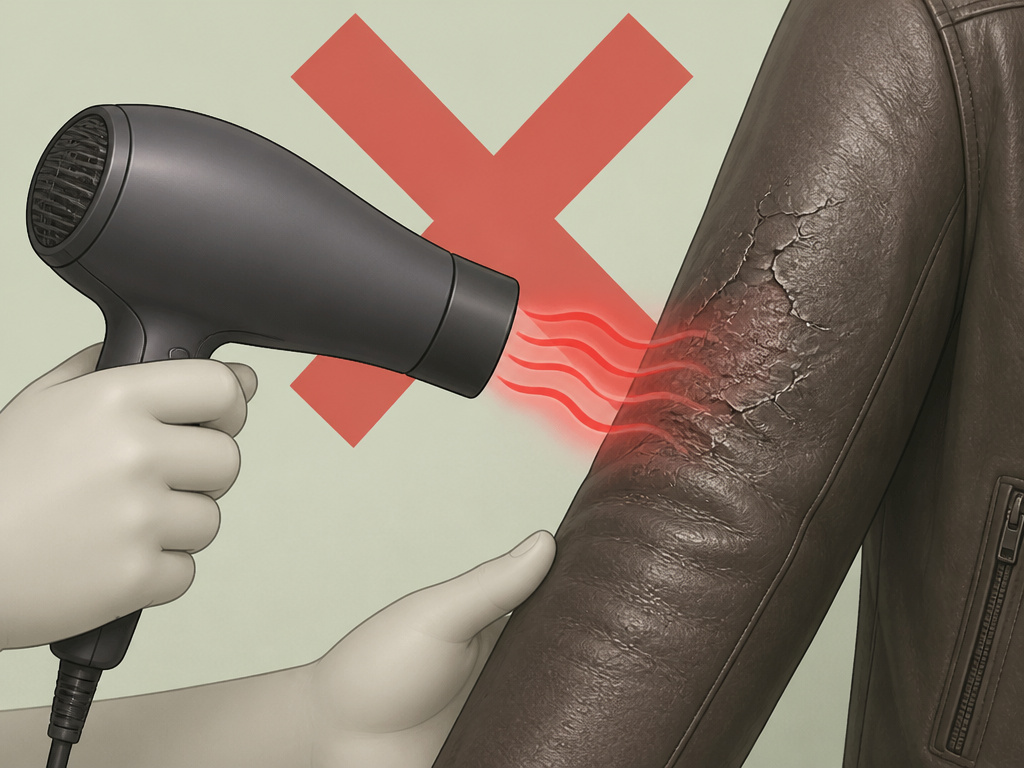 Impatience costs you more than time. It can ruin the jacket’s finish, structure, and value. Let’s be clear about one thing: these methods trade tomorrow’s damage for today’s softness.
Common mistake: Using direct heat from a hair dryer or heat gun. This forces moisture out of the leather at a catastrophic rate, causing the fibers to contract, shrink, and eventually crack. The damage might not show up for six months, but the brittle foundation is already set.
Other permanent no-gos: – Machine Washing/Drying: This isn’t denim. Agitation and extreme heat will shrink the jacket unpredictably, stiffen the leather like cardboard, and likely ruin the lining. – Rubbing Alcohol or Solvents: These strip every bit of natural and applied oil from the fibers, leaving them parched and prone to cracking. – Petroleum Jelly, Baby Oil, or Mink Oil (on light leathers): These can overly darken leather, leave a permanent greasy residue, and eventually turn rancid. They’re a one-way ticket to a stained, sticky jacket. – Soaking in Water: It weakens the fiber structure, can cause water stains and warping, and dramatically increases the risk of mould if not dried perfectly.
A stiff jacket is a temporary problem. The holes, cracks, and stains from these methods are permanent. The leather will tell you what it needs, and it never asks for a hair dryer.
Climate and Storage: The Overlooked Variables
Your environment works on the jacket even when you’re not wearing it. This is the part nobody mentions until they have a faded or mouldy jacket.
In sunny, high-UV climates like Australia or the American Southwest, direct sunlight is an enemy. Leaving your jacket in a parked car for an afternoon can bake the finish, dry the leather, and fade the colour permanently. Line-drying outside after a rain is just a slower version of the same mistake.
Humidity presents the opposite issue. In places like Brisbane or Florida, storing a leather jacket in a sealed wardrobe or, worse, a plastic bag, invites mould. The spores feed on the organic material. You’ll see fuzzy patches and smell a damp, musty odor.
Easy to miss: Store your jacket on a wide, padded hanger, never a wire hanger, which distorts the shoulders into unnatural points. In humid areas, ensure there’s airflow in the closet. A silica gel sachet in the wardrobe can help control ambient moisture.
If your wearing season is short (maybe just spring and fall), the break-in is measured in “wears, not weeks on a calendar.” A stiff cowhide jacket bought in October might not be fully comfortable until the following April. That’s normal. Don’t rush it with bad methods just because the calendar is turning.
Frequently Asked Questions
Can you break in a leather jacket too fast?
Yes, and that’s usually when damage occurs. Methods that use extreme heat, force, or saturation force the fibers to move in ways they can’t recover from, leading to permanent stretching, shrinkage, or cracking. A break-in process that lasts at least 20 hours is a gradual persuasion.
Will breaking in my jacket make it less protective?
No. A well-broken-in jacket is just as protective as a stiff one, it’s simply more flexible. The leather’s tensile strength and abrasion resistance come from the fiber density and tanning, not from its stiffness. Flexibility means it can absorb and distribute impact energy more effectively.
How do I break in a leather jacket with armor?
The armor itself doesn’t need breaking in, but it can slow the process for the leather around it. The armor panel limits how much that section can flex. Make a point to hand-flex the border areas around the armor. Some riders remove the armor during the initial break-in period and reinstall it later, though I prefer to leave it in to ensure the leather forms to the exact final configuration.
My jacket is still stiff after a month. What’s wrong?
The most common cause is insufficient conditioning. The fibers have been moving, but without lubrication, they’ve been grinding. Give the jacket a thorough conditioning with a product like Bick 4, let it absorb fully, and then resume wearing. If it’s a horsehide jacket, this timeline is completely normal, be patient.
Is breaking in a faux leather jacket the same?
No. Faux leather (polyurethane or PVC) doesn’t have fibers to relax. Any “breaking in” is just the synthetic material mechanically stretching or cracking. It won’t develop a patina; it will eventually peel. The techniques here are for genuine leather only.
Before You Go
The one threshold that reframes everything: if you haven’t conditioned your new jacket yet, stop and do that first. Everything else is secondary. That single step realigns the entire timeline in your favor.
The first step for this week is simple. Get your conditioner. Leather Honey, Bick 4, or Chamberlain’s, and apply it using the method in section two. Then wear the jacket around the house for an evening. You’ve just started the clock the right way.
Most guides won’t tell you this, but I’d rather see a jacket conditioned three times in its first month and worn gently than see it worn daily for two months without any care at all. The first jacket will be supple and healthy in a season. The second might never fully soften, and it will age before its time. Your patience is an investment, and the leather will return it.
