
Learn How to Clean a Leather Backpack Without Causing Harm
This post contains affiliate links. As an Amazon Associate, we earn from qualifying purchases.
This post contains affiliate links. As an Amazon Associate, we earn from qualifying purchases.
Clean a leather backpack by first identifying its specific leather type and construction. Use a soft, dry cloth for dust. For deeper cleaning, most leathers tolerate a cloth dampened with distilled water and a drop of mild, pH-neutral soap, worked in circles and dried completely away from heat. Condition only after cleaning if the leather is uncoated and feels dry.
That’s the framework. The details, the water temperature, the soap choice, the conditioner debate, are where people wreck good bags. Manufacturers themselves disagree on fundamentals, which is why a one-size-fits-all guide is worse than useless.
What follows is a breakdown of those contradictions, the physical reasons behind them, and the specific steps for your bag’s leather type. By the end, you’ll know why Dooney & Bourke says no conditioner for their All-Weather Leather, why Fitz & Huxley bans hot water, and how to handle a bag like the Eastpak Wyoming that mixes leather with fabric.
Key Takeaways
- Identify the leather type first. Cleaning a pebble-grain “All-Weather Leather” bag (distilled water, mild soap) is fundamentally different from cleaning suede (blot, dry, brush).
- Heat is the enemy. Never use a hair dryer, heater, or direct sunlight to dry leather. Air dry in a well-ventilated room; forced heat cooks the fibers and makes them brittle.
- Conditioner is not always needed. Factory-finished leathers (like Dooney & Bourke’s All-Weather or Saffiano collections) have protective topcoats; adding conditioner just sits on top and can attract dirt.
- Test everything. Always test your cleaning solution, even plain water, on a small, hidden area (like inside a strap loop) and let it dry fully to check for discoloration.
- Storage matters as much as cleaning. Before long-term storage, clean the bag, stuff it with acid-free paper to hold its shape, and keep it in a cool, dry place away from sunlight.
The Universal First Step (No Matter the Leather)
Empty the bag completely. Turn it inside out if the design allows, and give it a firm shake over a trash can. Use a soft-bristle brush or the fabric attachment on your vacuum to remove crumbs, dust, and grit from every seam and pocket.
The part nobody mentions: Vacuuming isn’t just about crumbs. Grit trapped under a flap or in a stitch line acts like sandpaper. Every time you move the bag, it microscopically scuffs the leather’s surface, dulling the finish long before any stain shows up.
This step removes abrasive particles that would turn your gentle cleaning cloth into fine-grit sandpaper. Do not skip it, even if the bag looks clean. The sound you’re listening for is silence, no faint scratching as you brush. If you hear a gritty whisper, keep brushing.
Decoding the Leather Type
You can’t clean it if you don’t know what “it” is. The care label is your first stop, but it often uses vague terms. Here’s the translation guide.
| Leather Type / Finish | What It Looks/Feels Like | The Critical Cleaning Rule |
|---|---|---|
| Full-Grain / Top-Grain (Unfinished) | Natural, visible grain; develops a patina; feels supple or firm. | Avoid saturating. Use minimal water, condition only after cleaning if leather feels dry. |
| Finished / Coated (e.g., Dooney & Bourke All-Weather Leather) | Uniform pebble or smooth grain; often has a subtle sheen; feels slightly waxy or plasticky. | Clean with damp cloth & mild soap. Requires no conditioner—the factory coat provides protection. |
| Suede / Nubuck | Fuzzy, velvety surface. | Never use water first. Blot liquids, dry thoroughly, then use a suede brush to lift the nap. |
| Napa Leather (e.g., Knack Packs) | Exceptionally soft, smooth, and lightweight. | Often naturally stain-resistant. A damp cloth is usually sufficient; aggressive cleaning can damage the delicate surface. |
| Patent or Saffiano | High-gloss (patent) or cross-hatched texture (Saffiano). | Wipe with distilled water on a cloth. Avoid soap unless necessary, and never use conditioner—it will cloud the finish. |
This table isn’t just a list. It’s the reason you must pause. Using a suede cleaner on a waxed-finished leather will gum it up. Conditioning a coated leather is like applying hand cream over a raincoat, it does nothing for the material underneath and makes the outside sticky.
The Contradiction: Water & Conditioner
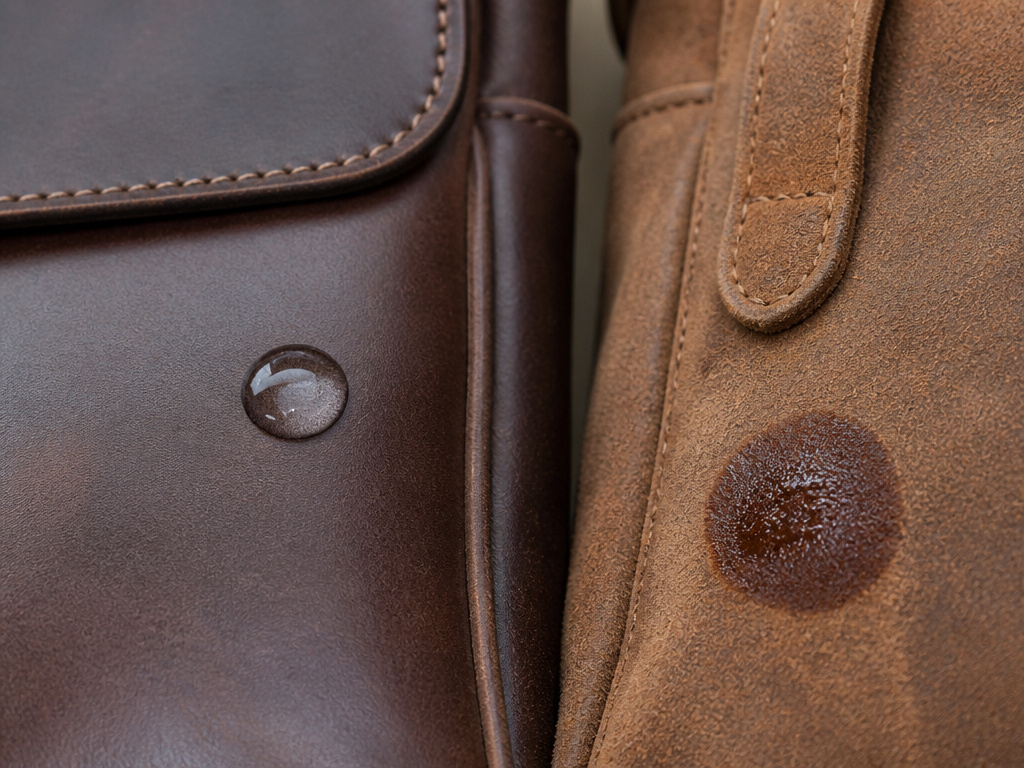
Here’s where standard advice falls apart. If you read care pages from Eastpak, Bellroy, and Fitz & Huxley, they advise keeping leather dry and using conditioners. Then you read Dooney & Bourke’s guide for their All-Weather Leather, which explicitly recommends a damp cloth with mild soap and states no conditioner is ever needed.
Who’s right? Both are, for the specific leathers they’re discussing.
- Eastpak/Bellroy/Fitz & Huxley are generally talking about more porous, vegetable-tanned or oil-tanned leathers. These absorb water, which can swell fibers and leave stains. They also lose natural oils over time, hence the conditioner recommendation.
- Dooney & Bourke’s All-Weather Leather has a factory-applied finish, a micro-coating that makes it water-repellent. Dirt sits on top of this coat. A damp cloth with soap cleans the coat without penetrating it. Adding conditioner can’t penetrate either; it just sits as a greasy film, attracting more dirt.
The rule of thumb? If water beads up on your bag’s surface, you likely have a finished leather. Clean it, don’t condition it. If water soaks in quickly and darkens the spot, you have an unfinished leather. Use water sparingly and follow with a conditioner containing dimethicone or cyclomethicone after it’s fully dry.
A Step-by-Step Guide for Unfinished Leathers
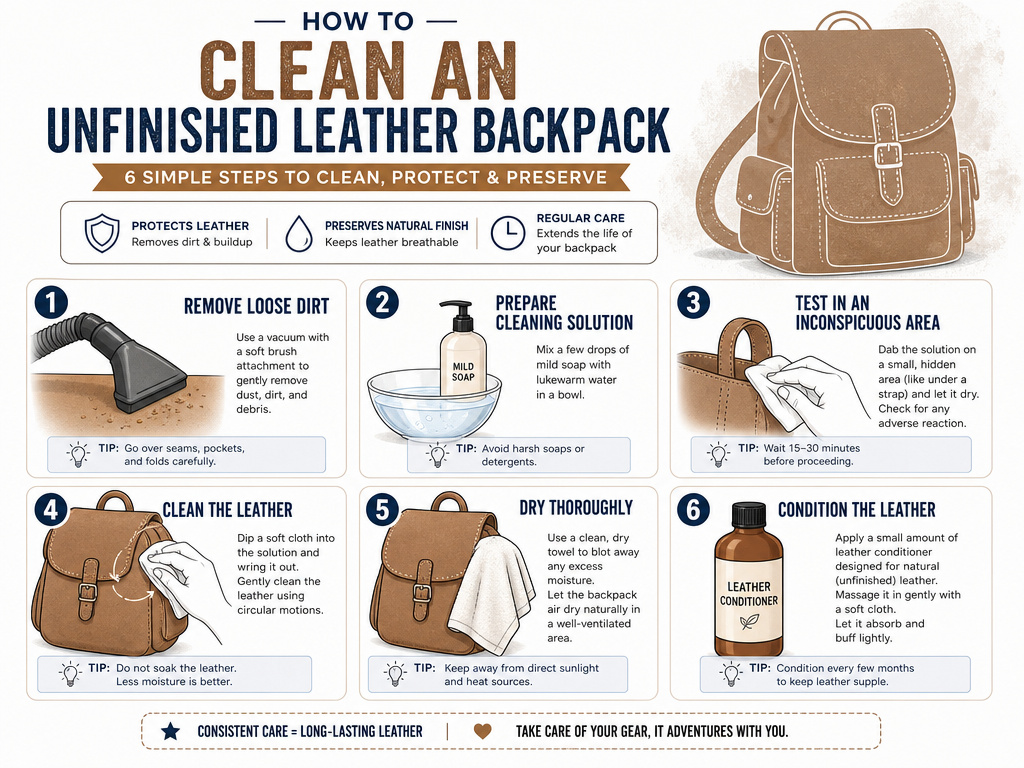
This is for the bags that develop a rich patina, full-grain, top-grain, or any leather that drinks up a drop of water.
- Dust and Vacuum. Complete the universal step above.
- Create Your Solution. Mix a drop of pH-neutral soap (like castile soap) into a bowl of distilled or lukewarm tap water. Distilled is better, it lacks minerals that can leave faint white residues.
- Test. Dampen a clean, white microfiber cloth in your solution, wring it out until it’s just barely damp. Rub an inconspicuous spot (inside a strap loop) and let it dry completely. Check for color transfer or texture change.
- Clean. Using the damp cloth, work in small, overlapping circular motions. Apply no pressure. You’re lifting dirt, not scrubbing it. Rinse your cloth in clean water frequently.
- Rinse & Dry. Go over the cleaned area with a cloth dampened with clean water to remove soap residue. Dry immediately with a soft, dry towel. Let the bag air-dry away from heat sources for 24-48 hours.
- Condition (If Needed). Once bone-dry, assess the leather. Does it feel stiff or look ashy? If so, apply a tiny amount of a quality conditioner (like Bickmore Bick 4) to a clean cloth. Rub it in with circles until the leather won’t absorb more. Buff off any excess with a dry cloth after 30 minutes.
Where this goes sideways: Applying conditioner to leather that’s even slightly damp. The conditioner seals moisture inside, which can lead to mildew or rot from the inside out. Wait the full 48 hours if you’re unsure.
I learned the hard way about mismatched products. Years ago, I used a heavy oil-based conditioner on a thin, modern jacket. It over-softened the leather overnight, turning a tailored piece into a droopy, darkened mess. The leather was too delicate for the treatment. Now I test first, every single time.
Mixed Materials & Edge Cases
Some bags, like the Eastpak Wyoming, combine leather with canvas or nylon. Here, you must care for each material separately.
- For Fabric Sections: Spot clean with a cloth, cold water, and mild detergent. For canvas, Fitz & Huxley notes a 6-12 month waxing interval with a product like Otter Wax to maintain water resistance.
- For Leather Sections: Follow the steps above for the specific leather type.
- The Golden Rule: Clean one material at a time, and protect the other. When cleaning the fabric, avoid getting the leather soaking wet. When conditioning the leather, keep product off the fabric.
Other edge cases have specific protocols: * Mold: If you see fuzzy spots or smell mustiness, wipe the area with a cloth dampened with a 50/50 mix of white vinegar and water. Dry thoroughly in a sunny, airy spot (sun is okay here for its UV properties). Then perform a full clean. * Oil Stains: Sprinkle cornstarch or talc on the stain to absorb the oil. Let it sit overnight, brush it off, then clean with a leather cleaner appropriate for your leather type. * Ink: This is often permanent on porous leathers. On finished leathers, try a dab of rubbing alcohol on a cotton swab, test first, and blot, don’t rub.
Why Drying Method is Non-Negotiable
This is the step that feels passive but is actively protecting your bag. Eastpak and Fitz & Huxley are adamant: no hairdryers, no radiators, no direct sun.
Leather is skin. Apply direct heat, and the fibers contract too quickly, pulling moisture out with violent force. This causes the leather to stiffen, crack, and lose its tensile strength. The bag might look dry in an hour, but you’ve baked in weakness.
The right way: After patting dry with a towel, stuff the bag loosely with crumpled acid-free paper or a clean towel to absorb internal moisture and maintain shape. Place it in a room with good air circulation, like near a fan on low. Turn it occasionally. It will take a day or two. That’s fine.
Frequently Asked Questions
Can I use baby wipes to clean my leather backpack?
No. Most baby wipes contain alcohols, emulsifiers, and fragrances that can strip natural oils from leather or leave a sticky residue. They’re designed for skin, not tanned hide.
How do I clean the inside of a leather backpack?
For fabric linings, vacuum thoroughly. Spot clean stains with a cloth, cold water, and a drop of mild detergent. For unlined leather interiors, use extreme caution, a barely damp cloth with a hint of soap, followed by immediate drying. Never soak an unlined interior.
Is saddle soap safe for cleaning a leather backpack?
Rarely. Traditional saddle soap is designed for thick, untreated saddle leather that gets covered in dirt and sweat. On most modern backpack leathers, especially finished ones, it can be overly aggressive and leave a dulling residue.
Will cleaning my backpack void the warranty?
It shouldn’t, if you follow the manufacturer’s instructions. For example, Eastpak’s 30-year limited warranty covers defects in materials and workmanship. Improper cleaning that causes damage (like using bleach or a washing machine) would not be covered. Always check your warranty terms.
Can I use a washing machine on a leather backpack?
Absolutely not. The agitation, heat, and detergents will destroy the leather’s structure, strip all finishes, and likely ruin any hardware. There is no scenario where machine washing a leather backpack is acceptable.
Before You Go
Cleaning a leather backpack isn’t about restoring it to showroom new. It’s about preserving the material so it ages with character, not decay. The single most important thing you can do is identify your leather type before you touch it with any product. That knowledge is the difference between a bag that lasts a decade and one that cracks in a year.
For ongoing care, integrate these steps into a simple leather backpack care routine. The same principles apply whether you’re maintaining a leather briefcase or a leather purse. Start gentle, always test, and never rush the dry. Your bag will thank you by looking better every year you own it.
