
Bifold vs Trifold Wallet | The Real Choice in Your Pocket
This post contains affiliate links. As an Amazon Associate, we earn from qualifying purchases.
This post contains affiliate links. As an Amazon Associate, we earn from qualifying purchases.
Choosing between a bifold and trifold wallet comes down to three things: how many cards you carry, where you keep your wallet, and your tolerance for bulk. A bifold is generally slimmer and faster to access, while a trifold offers more organized capacity in a slightly thicker package.
The panel count isn’t just a design quirk, it dictates the entire user experience. That third panel in a trifold adds compartmentalization at the cost of added folds and thickness. Your daily habits will tell you which trade-off makes sense.
What follows: a breakdown of real capacities from manufacturer specs, the tactile difference each style develops over time, and the common mistakes people make when choosing based on looks alone. By the end, you’ll know which fold belongs in your pocket.
Key Takeaways
- Trifolds hold more, but feel thicker. A model like the Popov Leather Trifold offers nine card slots and a deep billfold, creating a package about 0.75 inches thick when full. A typical bifold stays under 0.5 inches.
- Break-in periods differ. A bifold’s single fold softens quickly. A trifold’s two folds and extra stitching take longer to become supple, and tight card slots may fight you for a week.
- Access speed favors the bifold. You can flip it open one-handed to see all contents. A trifold requires unfolding two panels to reach interior slots, adding a step.
- Long-term patina varies. A bifold develops wear creases along one central fold. A trifold shows character at three hinge points, often creating a more complex, story-filled look over years.
- Wrong choice consequences are physical. Picking a trifold for a minimalist carry leads to a perpetually bulky pocket. Choosing a bifold for a 15-card load overstretches slots and strains seams.
The Core Difference: A Matter of Panels
A bifold wallet folds once, in half. A trifold folds twice, into thirds. This isn’t a minor detail, it’s the architectural blueprint that determines everything else.
Think of it like a book. A bifold is a pamphlet: open it and you see everything at once. A trifold is a brochure with flaps: more sections for information, but you have to open each flap to get the full picture. That third panel is essentially a built-in organizer, adding a layer of dedicated card slots and often a separate bill compartment. The Shinola Trifold Wallet uses this to offer six lined card pockets and three open pockets, a layout physically impossible in a standard bifold frame.
The panel count directly dictates internal layout and external bulk. A bifold’s single hinge creates a slim profile; a trifold’s two hinges add structure and storage at the cost of added folds in the pocket.
This structural difference is why you can’t simply judge by closed dimensions. A trifold might appear only marginally wider, but that extra fold material stacks up when placed next to your leg. The sensation is less about size and more about rigidity, a new trifold is a structured block, while a bifold is a flexible plate.
Capacity Showdown: What Fits Inside?
Manufacturer specs tell a clear story. Trifolds are built for volume; bifolds are built for edited carry.
| Wallet Model (Style) | Card Capacity (Advertised) | Bill Compartment Notes | Closed Thickness |
|---|---|---|---|
| Popov Leather Trifold | 9+ cards | Deep billfold, holds 20+ bills | 0.75 inches |
| TORRO Leather Trifold | Up to 18 cards | Large notes compartment | Not specified |
| Shinola Trifold | 6 card pockets + 3 open pockets | Leather-lined cash pocket | Not specified |
| Typical Leather Bifold | 4-8 cards | Standard dual pocket | 0.4 – 0.6 inches |
| Allett Leather Trifold | 3-12+ cards | Divided bill pocket, coin pocket | 0.25 inches |
The numbers reveal the trifold’s mission. The TORRO Leather Trifold claims space for up to 18 cards by using slip pockets behind primary slots. This is a capacity game. A bifold physically cannot allocate that much real estate without becoming a clunky square.
But here’s the practical layer: advertised capacity isn’t the same as comfortable capacity. Stuffing 18 cards into any wallet will turn it into a brick. The Popov Leather Trifold markets itself “for people who carry a lot,” but owner reviews note the card pockets are tight initially and require a break-in period. That’s the hidden timeline, a fully loaded trifold might not close neatly for its first week of use.
For a balanced, everyday load of 6-8 cards and some cash, a well-designed bifold is often neater. The choice isn’t about maximum possible space, but the space you actually use. If you routinely carry more than ten cards, a trifold or a dedicated card holder might be a better fit than an overstuffed bifold.
The Feel in Your Pocket: Slim vs. Structured
This is where theory meets your hip. The physical experience diverges sharply.
A bifold aims for forgettability. Its slim, rectangular form slides easily into a front or back pocket. When you sit, it flattens. High-quality leather bifolds, like those in our review of the best leather bifold wallets, often use thin, supple leather to minimize bulk. The goal is to be there when you need it, and unnoticed when you don’t.
A trifold makes its presence known. It’s a cube. That added structure provides organization but resists compression. In a front pocket, it can feel like a rounded block. In a back pocket, it creates a noticeable lump when sitting. Brands like Tough Traveler use heavy-duty 1000D Cordura nylon on their Deluxe Tri-Fold Wallet to withstand this daily pressure, acknowledging the style’s inherently rugged use case.
Where this goes sideways: Choosing a thick, rigid trifold for suit trousers. The structured cube will strain the seam of a tailored pocket and ruin the line of the fabric every time you sit down.
There’s also a sensory break-in period. A bifold’s single crease softens predictably. A trifold has multiple stress points at its folds and stitching junctions. A full-grain leather trifold might feel stiff and stubborn for a month before the fibers relax and it starts to mold to your body. That stiffness is a sign of durability, it’s not breaking, it’s breaking in, but it demands patience.
Durability and Aging: The Patina Path
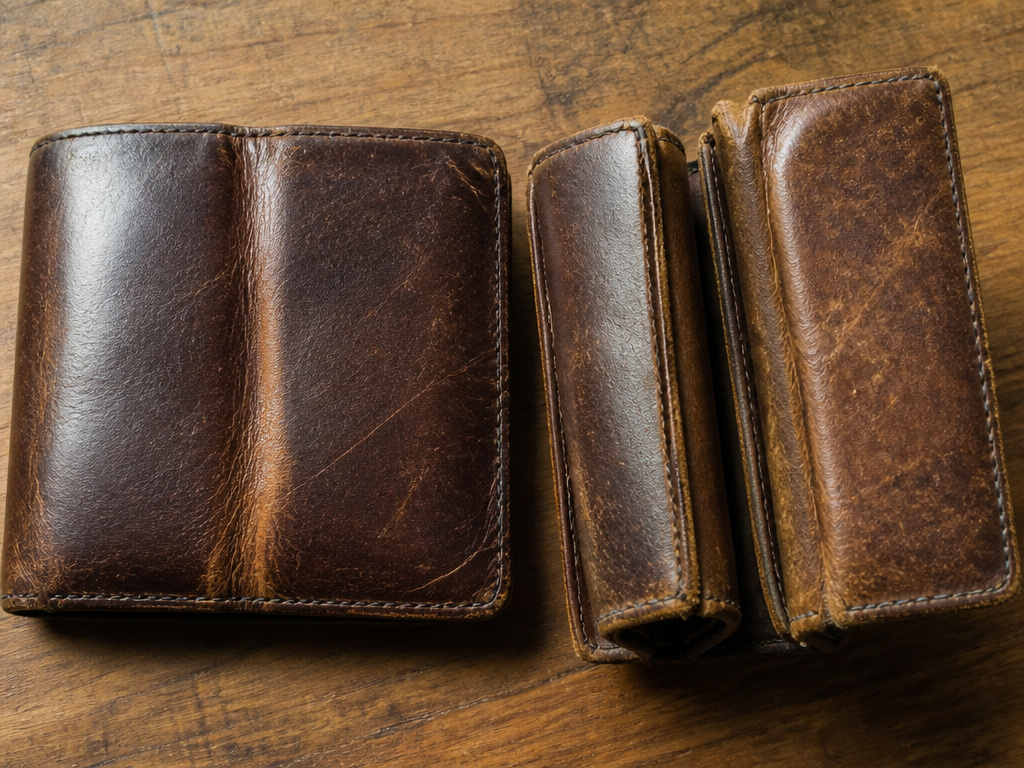 Both styles are durable if well-made, but they age along different fault lines. The fold is the future wrinkle.
A bifold develops a primary crease down its center. All the bending stress concentrates here. With good saddle stitching, this isn’t a weakness. The thread, like the Ritza 25 Tiger thread used by Popov Leather, locks each stitch independently so a single point of wear won’t unravel the seam. The patina, the darkening and softening of the leather, focuses along this central valley, creating a single, deep character line.
A trifold ages at three hinge points. The leather flexes at two internal folds and the outer closure, creating a more complex map of wear. This can look richer over decades, telling a more detailed story of how it was opened and handled. However, it also means more opportunities for surface scuffing at the folded edges. The corners of each panel are high-contact areas.
The construction method becomes critical here. For a trifold’s more complex flex, saddle stitching isn’t just a luxury; it’s a functional necessity. A machine lockstitch has a single continuous thread that can unravel if compromised at any of these multiple stress points. This is why many premium makers emphasize their hand-stitching for leather trifold wallets, it’s the right tool for a more demanding job.
My own early mistake was underestimating stress points. I once skipped properly sealing the edges on a multi-fold item. The raw, porous edges absorbed dirt and moisture at each flex point, fraying much faster than the main panels. The lesson applies directly here: the folded edges of a trifold are its most vulnerable spots. A wallet with burnished or painted edges will seal them against the extra friction they’ll encounter.
Organization and Access: The Speed Trade-Off
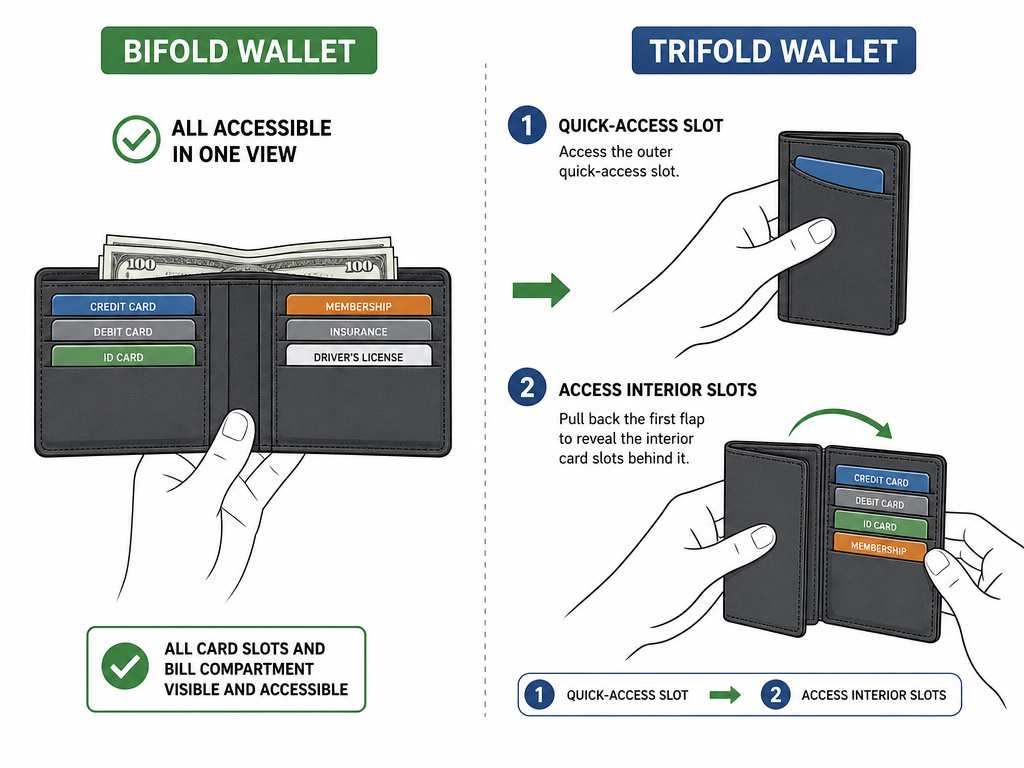 How quickly do you need your third credit card? The answer might decide your fold.
Bifold access is direct. Flip it open. All card slots and the bill compartment are immediately visible and reachable. It’s a one-handed, two-second operation. This layout is ideal if you’re frequently grabbing a specific card at a checkout counter or need to quickly show your ID.
Trifold access is sequential. You open the first flap, then the second to reach the interior slots. Some designs, like the Allett Trifold, place quick-access slots on the outer panels, but the core storage is behind that second fold. This adds a step and often requires two hands. The benefit is compartmentalization, you can separate work cards, personal cards, and receipts into different panels, which is a boon for organization but a barrier to speed.
Common mistake: Over-stuffing the outer quick-access slot on a trifold. This prevents the first flap from lying flat, which then puts lateral stress on the second fold’s stitching every time you force the wallet closed.
For true minimalist speed, neither may be the best answer. A slim cardholder vs wallet comparison often reveals that a simple card holder offers the fastest access of all, sacrificing bill storage for pure velocity. Your choice hinges on whether you prioritize categorized storage or immediate retrieval.
Making the Choice: Which Fold is For You?
Stop looking at pictures online. Your existing carry habits already have the answer.
Choose a bifold if:
- You carry 8 or fewer cards daily.
- You primarily keep your wallet in a front pocket.
- You value a sleek, flat profile in tailored clothing.
- You want to access any card in under three seconds.
- You prefer a simple, unified patina over time.
The bifold is the default for a reason. It does the job cleanly for most people. Explore a curated selection of men’s leather bifold wallets to see the range of slim profiles available.
Choose a trifold if:
- You routinely carry 10 or more cards, IDs, and receipts.
- You need to categorize cards (e.g., business vs. Personal).
- You don’t mind a thicker, more structured feel in your pocket.
- You appreciate having a dedicated coin pocket or hidden compartments.
- You like the idea of a wallet that develops a complex, storied patina.
The trifold is the specialist. It solves a capacity problem. If that’s not your problem, it becomes a burden. For a look at high-capacity options, see our guide to the best men’s trifold wallets.
Still stuck? Downsize. Seriously. Most people carry expired cards, random receipts, and loyalty cards they haven’t used in a year. Clean out your current wallet. If what remains fits comfortably in a bifold, go that route. If you’ve trimmed the fat and still have a substantial stack, the trifold’s organizational logic makes sense. This process of editing your carry is the first step in any good wallet selection guide.
Frequently Asked Questions
Do trifold wallets last longer than bifold wallets?
Not inherently. Longevity depends on leather quality, stitching, and edge finishing, not panel count. A poorly made trifold with thin leather and machine stitching will fail at its stress points faster than a well-made bifold. A well-crafted version of either, using full-grain leather and saddle stitching, will last for decades.
Are trifold wallets always thicker?
Yes, when comparing wallets of similar leather weight and equal card load. The extra fold layer and additional lining material add millimeters. However, some modern “slim trifold” designs use ultra-thin materials to minimize this. The Flowfold Traveler Trifold, made from lightweight EcoPak fabric, achieves a 0.2-inch profile by sacrificing the traditional leather structure.
Which style is better for RFID blocking?
Both can offer it equally. RFID blocking is a function of a special lining material (often a metal mesh) inserted between the leather layers. The bifold or trifold construction has no impact on its effectiveness. Brands like Shinola and TORRO offer RFID-blocking versions in both styles.
I carry about 6 cards. Which should I pick?
For a six-card carry, a bifold is almost certainly the better choice. It will hold that load comfortably in a slimmer format, giving you faster access and a less bulky pocket feel. A trifold’s extra capacity would simply be unused space, adding unnecessary thickness.
How does the break-in differ?
Bifold breaks in along one main fold. It might feel stiff for a week or two before softening. A trifold breaks in at two internal folds and the outer seam. This process takes longer, often three to four weeks of daily use, and the wallet may not close perfectly flat during this period. Patience is key.
The Bottom Line
Pick the wallet that solves your actual problem, not an imagined one. If bulk bothers you, the bifold’s slim logic wins. If running out of slot space is your daily frustration, the trifold’s added panel is your answer.
Ignore the fantasy of a wallet that holds everything and feels like nothing. That doesn’t exist. The trade-off is real: capacity for bulk, organization for speed. Your current pocket contents, right now, are the best consultant you have. Empty them out and count. That number, more than any style preference, points to the right fold.
For most, the classic leather bifold wallet is the balanced choice. It’s the timeless design for a reason. But if your count pushes past ten, step up to the organized space of a trifold without guilt. Just know what you’re signing up for, a little more cube in your pocket, in exchange for never fighting to zip a bill compartment closed again.
