
The Complete Guide on How to Care for Your Leather Saddle
This post contains affiliate links. As an Amazon Associate, we earn from qualifying purchases.
Caring for a leather saddle requires three distinct actions: a daily wipe-down of sweat and salt with a damp cloth, a monthly cleaning with a glycerine-only saddle soap, and a strategic, sparing application of oil or conditioner, only to areas that need it, and never more than 2-3 times a year. The goal is to replace the natural oils sweat and sun leach away without saturating and weakening the hide.
Most guides treat a saddle like any other leather good. They aren’t. The combination of sweat concentration, structural tension, and pressure points creates unique failure modes a handbag will never see.
What follows is a breakdown of the daily, monthly, and yearly rhythms, grounded in manuals from Brooks, Hermès, and saddle-makers you’ve probably never heard of. This guide explains the cleaning trick that stops white salt crust permanently, the exact tension adjustment required to avoid warranty issues, and how your costly synthetic pad often worsens the problem.
Key Takeaways
- Sweat is leather’s primary enemy; wipe the saddle down with a barely-damp cloth after every ride and use a thin wool pad to wick moisture away from the leather itself.
- For a deeper clean, use only a pure glycerine saddle soap (like Oakwood Glycerine Leather Cleaner). Avoid soaps with detergents, which leave residue inside the leather’s pores.
- Apply oil or conditioner (like Effax Leder-Balsam) sparingly and strategically, only 2-3 times per year, and never on stretched leather areas like girth points or billets.
- Brooks saddles require a specific tension check: if the leather sags more than 5-6mm when pressed, a ¼-turn adjustment is needed. Ignoring this can void the warranty.
- Store saddles at room temperature (above 5°C) and 30-40% humidity. Never leave them in direct sunlight, a damp tack room, or a hot car.
The Daily Sweat Wipe-Down (and the Vinegar Trick)
The work happens here, not during the monthly deep clean. A long trail ride leaves a concentrated patch of sweat and salt under the stirrup leathers and billets. Leave that to dry, and you get a white, crusty residue that feels like sandpaper. That crust is crystallized salt drawing moisture out of the hide every time it gets damp.
I started using a specific trick on my own gear. After unsaddling, I take a sponge barely damp with a 10:1 mix of water to white vinegar and wipe those critical areas. The mild acidity neutralizes the salt without harming the leather. You don’t soak it; you just wipe. Then I go over it with a dry cloth. That single step added months between needed conditioning sessions because the leather wasn’t fighting a salt invasion.
Common mistake: Letting sweat dry on the saddle. The salt residue draws moisture from the leather every time the air gets humid, creating a cycle of drying and re-wetting that cracks the surface within a season.
This is also where your saddle pad choice matters more than any conditioner. A cheap, thin wool pad pulls moisture away from the leather and into itself far better than any synthetic “high-tech” pad I’ve tested. The leather stays drier, which means it needs less frequent intervention with oils that can over-soften it. Think of the wool pad as the first line of defense; the conditioner is the backup repair crew.
The Monthly Deep Clean: Glycerine is Non-Negotiable
Once a month, or after a particularly muddy or sweaty ride, you need to actually clean the saddle, not just wipe it down. This is where you reach for saddle soap. Here’s the thing: most commercial saddle soaps are terrible for this job. They contain detergents and waxes that clog the leather’s pores, trapping dirt and preventing later conditioners from penetrating.
You need a pure glycerine soap. Oakwood Glycerine Leather Cleaner is the benchmark. Glycerine is a humectant, it attracts and holds a small amount of moisture, which helps clean without stripping. It also leaves no residue.
The process is simple, but slow: 1. Use a warm, damp sponge to work the soap into a light lather. 2. Apply it to one section of the saddle, focusing on areas of friction like the seat and flaps. Scrub gently in small circles. 3. Wipe the area clean with a separate damp cloth before the soap dries. Dried soap is residue. 4. Move to the next section and repeat. Never soap the entire saddle at once. 5. Let the saddle air dry completely, away from direct heat, before even thinking about conditioning.
Skipping the rinse-and-wipe step is how you get a hazy, sticky film. That film then blocks the conditioner from doing its job.
The Core Principle: Feed, Don’t Saturate
Conditioning replaces the natural oils that sweat, sun, and cleaning remove. The biggest error is over-application.A saturated piece of leather loses its structural integrity, it becomes a damp sponge that can’t support weight.
Manufacturers are brutally specific about this. Brooks states that applying their Proofide dressing more than every six months can over-soften the leather “to the point it will no longer support the rider’s weight.” That’s a total failure from trying too hard.
Your conditioning strategy depends on the saddle’s age and the product you use. The table below breaks it down.
| Saddle Stage | Primary Goal | Recommended Product | Frequency & Warning |
|---|---|---|---|
| New (First 14 Days) | Deep, initial nourishment | Saddle Oil (e.g., Effax Leder-Öl) | Apply 250mL total, focusing on stitches. Never oil girth points or billets. |
| Established (6+ Months) | Maintenance of moisture levels | Conditioning Balm (e.g., Effax Leder-Balsam) | 2-3 times per year max. Only apply to dry, “thirsty” areas—skip the seat if it’s supple. |
| Dry or Stiff | Targeted rehydration | Conditioning Balm | Spot-treat only. If the leather feels stiff but not brittle, it may just need use, not product. |
The “where” matters as much as the “when.” Newtown Saddles explicitly warns against oiling or conditioning girth points, as they are made from stretched leather and treatment can cause further stretching or misshaping. Similarly, Schleese advises against using oil on the seat of an English spring tree saddle, as it can soak into the laminated wood and glue, “possibly resulting in the eventual breakage of the tree.”
So you condition the panels, the flaps (sparingly), and the undersides. You avoid the seat, the tree points, and any stretched leather. This isn’t guesswork; it’s mechanics.
Tension: The Thing Most People Forget
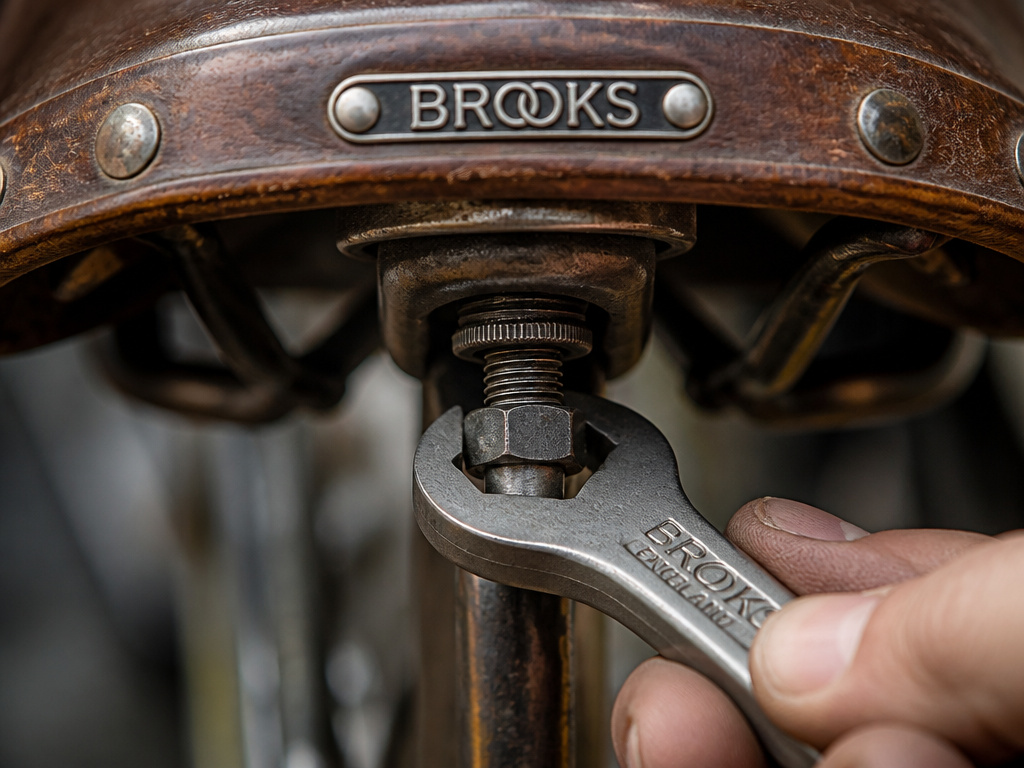 If you own a Brooks bicycle saddle or any leather saddle with a tensioning mechanism, this maintenance is structural integrity. The leather stretches over thousands of miles.If it stretches too much, it sags, loses support, and can overstress the rivets.
Brooks provides a specific metric: press down on the leather at the rear of the saddle. If the flex exceeds 5 or 6 mm, it needs adjustment. The process uses a special tensioning spanner to turn the tension nut under the nose a ¼ or ½ turn clockwise (90° or 180°). You turn the nut, not the bolt.
I learned this the hard way. I rode a Brooks B17 for a year without a second thought. The sag was subtle, but the comfort vanished. A quarter-turn with the spanner brought it back to life in minutes. The difference wasn’t academic; it was the difference between a broken-in saddle and a worn-out one.
Ignoring this has a tangible consequence. Brooks states they will refuse warranty and extended guarantee claims if “tension adjustment has been overlooked and the leather overtightened.” They don’t say “might refuse.” They will. That’s how critical this single step is to the product’s lifespan.
Let me be clear about this: a tensioning spanner is a required maintenance tool, as essential as a conditioner from a brand like Lexol.
Storage: It’s About Climate, Not Convenience
How you store the saddle between rides determines how much work you have to do later. Leather is a hygroscopic material, it absorbs and releases moisture based on its environment. The goal is to keep that exchange slow and stable.
| Condition | Risk to Leather | The Fix |
|---|---|---|
| High Humidity (>60%) | Promotes mold growth, can cause metal components to rust. | Use a dehumidifier in the tack room. Store with moisture-absorbing packs. |
| Low Humidity (<30%) | Leather dries out, becomes brittle, and is prone to cracking. | A room humidifier set to 30-40% is ideal. Avoid storing near heat vents. |
| Direct Sunlight | UV rays break down oils and dyes, causing fading and premature aging. | Always store in a dark place or under a breathable cover. |
| Extreme Cold (<5°C) | Leather can become stiff and more susceptible to cracking when flexed. | Schleese recommends never storing tack cooler than 5 degrees Celsius. |
A damp, dark tack room is a mold incubator. A spot next to a sun-filled window is a drying oven. The sweet spot is a room-temperature, moderately dry space. Hang the saddle on a rack with a wide, curved bar that supports its shape, don’t just lean it against a wall. And if it gets wet from rain, let it air dry naturally at room temperature, never force-dry it with a heater or hair dryer.
Frequently Asked Questions
Can I use mink oil or neatsfoot oil on my saddle?
You can, but you probably shouldn’t for a modern saddle. These are heavy, penetrating oils designed for very dry, thick work leather. They can over-soften saddle leather dramatically and darken it permanently. For English saddles with wooden trees, they pose the same breakage risk as any oil. Stick with a manufacturer-recommended balm like Effax Leder-Balsam for maintenance.
How do I know if my saddle is too dry?
Look and feel. Visually, the leather will lose its luster and look dull or chalky. To the touch, it will feel stiff and brittle, not firm and supple. You might hear a faint creaking when you flex the flap. A properly nourished saddle has a slight sheen and yields slightly under pressure without cracking.
My new saddle is very stiff. Should I condition it more?
No. A new saddle is supposed to be stiff. Its break-in period, where it molds to you and the horse, is what creates suppleness through mechanical flexing, not chemical softening. Over-conditioning a new saddle to make it soft faster is a great way to ruin its longevity. Follow the maker’s initial oiling instructions, then ride it.
What’s the best way to clean off dried mud?
Let it dry completely, then brush it off with a soft bristle brush. Forcing wet mud off just grinds it into the leather. Once the bulk is brushed off, use your glycerine saddle soap process to clean the remaining residue. Never soak a muddy saddle.
Can a cracked saddle be repaired?
Surface cracks can sometimes be improved with careful conditioning, but deep structural cracks are usually permanent. A saddler from a reputable brand like Schleese can patch or reinforce some areas, but the repair will be visible and the leather’s strength is compromised. Prevention through consistent, correct care is infinitely cheaper than a major repair.
Before You Go
The single most impactful change you can make starts your next ride: switch to a thin wool saddle pad. The reduction in sweat saturation will do more to preserve your leather than any magic-in-a-bottle conditioner.
When you do condition, remember the rule of thumb from my own bench: if the leather feels stiff, it might need conditioning. If it feels dry and brittle, it needs conditioning now. But always err on the side of less. A slightly thirsty saddle is always better than a soggy, over-oiled one.
Finally, mark your calendar twice a year, perhaps at the start and end of the riding season, to check tension if you have a Brooks, and to give the whole saddle a close inspection. That’s the rhythm that turns a purchase into an heirloom.
