
How to Choose the Perfect Leather Office Chair: Key Tips
This post contains affiliate links. As an Amazon Associate, we earn from qualifying purchases.
Choosing a leather office chair means matching three things: the leather’s actual grade, the chair’s certified ergonomic adjustments, and your local climate. The wrong grade cracks in two years. The wrong adjustments cause back pain in two weeks. Get the match right, and the chair supports you for twenty years.
That match is where most buying guides stop. They list features but don’t connect the spec sheet to the physical failure you’ll see in your home office. A bonded leather chair doesn’t just “wear out.” It peels at the seat edge after 24 months in an air-conditioned room because the plasticizers evaporate. An uncertified chair doesn’t just “feel cheap.” It lacks the tested structural integrity to handle your weight safely through 2,000 hours of use a year.
What follows is a breakdown of those three factors. We’ll translate leather marketing terms into real-world lifespans, explain which ergonomic certifications actually matter, and outline a simple climate-proofing strategy. By the end, you’ll be able to read any product page and know exactly what you’re buying, and how long it will last.
Key Takeaways
- Ignore the term “genuine leather.” It’s a technical classification for the lowest grade of real leather and tells you nothing about durability. Focus on “top-grain” or “full-grain.”
- Always verify the chair’s weight capacity exceeds your body weight by at least 20 kg (44 lbs). This safety margin accounts for dynamic loading when you lean or recline.
- In dry, air-conditioned, or sunny climates (like Dubai), bonded or PU leather will crack and peel within 2-4 years. Prioritize top-grain leather and commit to bi-annual conditioning.
- Look for independent certification labels like BIFMA or EN 1335. These prove the chair’s adjustability range and structural strength have been tested to a published standard, not just advertised.
- The chair’s internal frame and foam density matter more than a luxury leather cover. A high-density foam core retains its shape for a decade; cheap foam compresses into a hard pancake in eighteen months.
The Leather Grade Decoder
Let’s be clear about this: the label on the box is often designed to confuse you. “Genuine leather” is the prime offender. In industry terms, it simply means the upholstery contains some layer of the animal hide. It’s the bottom tier, often sanded and heavily coated to hide imperfections. It tells you nothing about longevity.
You need to decode the real grades. Their names signal the hide’s quality and the manufacturing process, which directly dictates how the chair will age on your floor.
Top-grain leather is sanded to remove surface imperfections and then finished with a protective coating. This makes it highly resistant to stains and scuffs, and it typically lasts 10-15 years with basic care. It’s the workhorse of quality office furniture.
Full-grain leather is the entire, un-sanded outer layer of the hide. It develops a rich patina over time but is more susceptible to stains and requires more attentive care. In a professional office setting with proper maintenance, it can last 20-30 years. Then we have the alternatives.
Bonded leather is a pulp of leather fibers mixed with bonding agents and pressed onto a fabric backing. It feels like leather when new but lacks a consistent fibrous structure. Here’s the predictable timeline: in a climate-controlled office, the surface typically begins to crack and peel at high-stress points (seat front, armrest edges) within 2-4 years. The failure often involves a sudden, catastrophic tear along a seam because the material has no natural ‘give.'”
PU (Polyurethane) Leather is a plastic coating on a fabric base. High-performance versions have improved, but mass-market PU has a hard ceiling. The plasticizers that keep it flexible evaporate over time. You’ll notice the surface first gets a tacky feel, then starts to crack and delaminate. Expect 3-5 years before this becomes visually apparent.
| Material | What It Actually Is | Realistic Office Lifespan | Failure Mode & Timeline |
|---|---|---|---|
| Full-Grain Leather | The full, un-sanded hide. Develops a patina. | 20-30 years | Can stain if unfinished; requires conditioning. |
| Top-Grain Leather | Hide sanded & given a protective topcoat. | 10-15 years | Topcoat may eventually wear at extreme contact points after a decade+. |
| Bonded Leather | Leather fibers bonded with latex/PU to a backing. | 2-4 years | Cracks and peels at stress points; can tear suddenly at seams. |
| PU Leather | Polyurethane coating on a fabric base. | 3-5 years | Plasticizers evaporate, leading to cracking, delamination, and a tacky feel. |
The bottom line: For a chair that is both durable and low-maintenance, top-grain leather is the default choice. It offers the best balance of longevity, stain resistance, and professional appearance. Save full-grain for a statement piece where you welcome a evolving character, and avoid bonded leather entirely for a daily-use office chair.
Ergonomics: The Specs Under the Skin
A beautiful hide wrapped over a poorly designed chair is a waste of money. The internal engineering, the frame, the foam, the mechanism, is what determines if the chair supports your body or slowly injures it. This is where independent certifications move from marketing fluff to essential buying criteria.
Look for labels like BIFMA (Business and Institutional Furniture Manufacturers Association) or EN 1335. These items are evidence that the chair has passed a battery of independent tests for structural safety, durability, and adjustability range. A BIFMA-certified chair, for example, has been tested to a weight standard of 250 lbs through thousands of tilt cycles.It’s a verification of performance.
The adjustability checklist is essential. A proper ergonomic leather office chair must have: 1. Seat Height Adjustment: Your feet must rest flat on the floor with thighs parallel to it. 2. Seat Depth Adjustment: You should have about 2-3 fingers of space between the seat edge and the back of your knees. 3. Lumbar Support Adjustment: It needs to hit the natural curve of your lower spine, not just the middle of your back. 4. Armrest Adjustment: They should allow your shoulders to relax and your elbows to rest at a 90-degree angle.
Skip any one of these, and you’ll be forcing your body to adapt to the chair instead of the other way around. The result is pressure points, slouching, and the kind of low-grade fatigue that kills productivity by 3 PM.
Common mistake: Buying a chair where the seat pan is too deep. If the front edge presses into the back of your calves, it cuts off circulation. Within an hour, you’ll be fidgeting constantly to find a comfortable position.
Let’s talk about weight capacity. Most standard chairs are rated for 100-120 kg. If you weigh 90 kg, that seems fine. It’s not. You need a safety margin for dynamic loading, the extra force when you lean back, shift, or recline. The guidance from experts is to ensure the rated capacity exceeds your body weight by at least 20 kg. This isn’t about bulk; it’s about engineering headroom. A chair operating near its limit will wear out its tilt mechanism and casters far faster.
Climate-Proofing Your Investment
Leather is a natural material that reacts to its environment. If you live somewhere with intense sun, dry air conditioning, or high humidity, you can’t ignore this. The same chair will age three times faster in Dubai than in Dublin. I want to help you make confident choices for your local conditions.
Dubai’s environment, for example, is a perfect storm for leather degradation. The 3,500 annual hours of sunshine mean powerful UV radiation, even through windows, which fades and oxidizes the surface. The air conditioning pulls humidity down to 35-50%, while leather’s happy zone is 45-65%. This chronic under-humidification sucks the natural oils right out of the hide, leaving it stiff and prone to cracking.
The thermal cycling from a 45°C outdoor to a 22°C indoor office stresses the material and stitching over time. In this climate, a bonded leather chair is a disposable item. Even a good top-grain chair will fail prematurely without a defensive routine.
The maintenance protocol isn’t complicated, but it’s non-optional: * Condition Every 3 Months: Use a quality leather conditioner (look for lanolin or neat’s-foot oil) to replenish lost oils. Apply a thin coat, let it absorb fully, and buff off any residue. * UV Protect Every 6 Months: For chairs near windows, a dedicated UV-protectant leather spray is critical. Data from retailers in the Gulf shows this can extend lifespan by 40-60%. * Control Humidity: If your office feels very dry, a small humidifier to keep levels above 45% makes a dramatic difference.
This is straightforward advice. Think of it like applying a hand-rubbed oil finish to a wood table. You don’t slather it on once a year; you work in thin, even coats and let each one be fully absorbed. The goal is preservation, not a quick fix.
The Certification & Warranty Safety Net
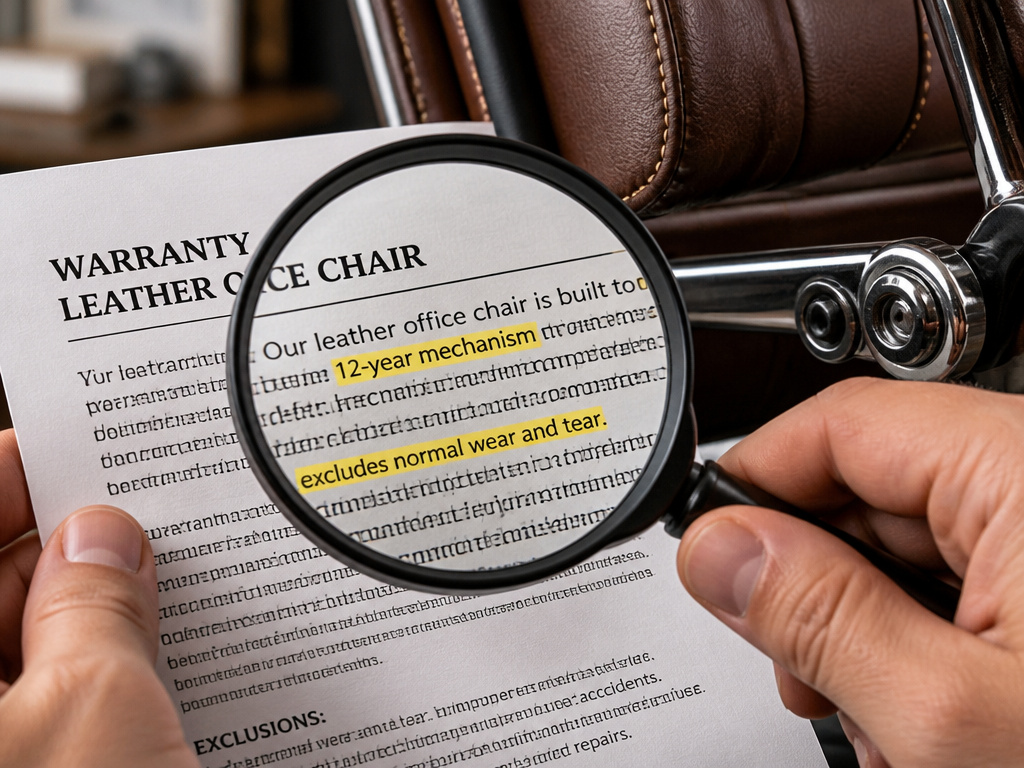 When you’re spending significant money, the warranty and certifications are your legal safety net. They separate reputable manufacturers from marketing companies. Let me share what I’ve learned about reading the fine print.
A premium chair should come with a minimum 2-year parts warranty, but quality brands offer 5, 10, or even 12 years. This action is a signal. A company offering a 12-year warranty on the mechanism is betting their own money that the steel and polymers inside will last.They’ve engineered it to do so.
Pay close attention to what the warranty covers. Does it cover the leather upholstery, or just the frame and mechanism? Many warranties exclude “normal wear and tear” on the leather, which is exactly what you’re trying to prevent. Some retailers, like OfficeMaster.ae, offer a 14-day trial period. This is invaluable. A chair can feel great in a showroom and completely wrong after eight hours at your desk.
Where this goes sideways: Assuming a “lifetime warranty” means your lifetime. It almost always means the “expected lifetime of the product,” which the manufacturer gets to define. Always get the specific terms in writing.
Finally, look beyond the leather for other responsible certifications. The Leather Working Group (LWG) standard assesses the environmental performance of tanneries. It’s a strong indicator of a brand that cares about its supply chain. These details might seem small, but they collectively paint a picture of a product built to last, not just to sell.
Frequently Asked Questions
Is a leather office chair too hot for long hours?
It can be. Leather is less breathable than mesh. If you tend to run warm, look for chairs with perforated leather sections in the seat and back, which greatly improve airflow. Alternatively, a high-quality mesh chair might be a more comfortable choice for hot climates or if you personally overheat easily.
How do I clean and maintain a leather office chair?
Regular dusting with a soft, dry cloth is the first step. For deeper cleaning, use a damp cloth with a drop of mild, pH-neutral soap. The key to longevity is conditioning every 3-4 months with a product designed for finished leathers to prevent drying and cracking. Avoid silicone-based “conditioners” or furniture polish, which can clog the leather’s pores and create a slippery surface.
Can I fix peeling bonded leather?
Practically speaking, no. Once bonded leather starts to peel, the damage is to the material’s core structure. Repair kits are temporary, messy fixes. The only permanent solution is to re-upholster the chair, which often costs more than a new mid-range chair. This is why avoiding bonded leather from the start is the best strategy.
What’s the difference between an executive chair and an ergonomic chair?
The terms overlap, but the emphasis differs. An “executive” chair prioritizes aesthetics, generous sizing, and plush cushioning to convey prestige. An “ergonomic” chair prioritizes adjustable support (lumbar, armrests, seat depth) to promote a healthy posture. The best chairs, like many in our reviewed leather office chairs list, are both, they look authoritative and are built to support you biomechanically.
Are expensive leather office chairs worth it?
High-quality top-grain leather chair from a reputable brand is worth the investment if you use it for work daily. The cost amortizes over a 10-15 year lifespan, the support prevents pain and medical costs, and the durability means less waste. A cheap chair needs replacing every few years, offers poor support, and ends up costing more in the long run, both in money and comfort.
Before You Go
The choice ultimately comes down to a simple filter. First, eliminate any chair that uses bonded leather for the main upholstery, that’s your first and easiest veto. Second, verify the ergonomic adjustments you actually need and look for a BIFMA or EN 1335 certification to back them up. Third, be honest about your local climate and your willingness to perform basic, bi-annual maintenance.
If your climate is harsh and your commitment to conditioning is low, a high-quality fabric or mesh chair might be a smarter long-term investment than a leather one you’ll neglect. The goal isn’t to own a leather chair for the sake of it. The goal is to own a chair that supports your work and your wellbeing for the next decade. Everything else is just aesthetics.
