
How to Choose a Leather Recliner: A Complete Buyer’s Guide
This post contains affiliate links. As an Amazon Associate, we earn from qualifying purchases.
To choose a leather recliner, match three things: your body size to the chair’s dimensions, your room’s layout to the required wall clearance, and your budget to the real leather type, top-grain or full-grain for durability, bonded or faux for a short-term budget fix that peels in 3-5 years. The motor mechanism and warranty fine print decide long-term cost.
That 3-5 year peeling timeline is the documented end-of-life for bonded leather, the material in countless “affordable” recliners. Getting the leather right is the single biggest factor that separates a 15-year investment from a 5-year disappointment.
What follows is a breakdown of the specs that matter: leather types decoded, the motor configurations that change how you sit, the measurements most people get wrong, and the warranty clauses that leave you holding the bill for a $300 motor.
Key Takeaways
- Bonded leather and faux leather (PU/PVC) begin peeling and cracking predictably within 3-5 years. Top-grain leather is the practical, durable choice for most households.
- Standard power recliners need 12-18 inches of wall clearance; wall-hugger models need only 4-6 inches. You must measure this space before you buy.
- A “limited lifetime warranty” often excludes the motor, the most expensive part to replace at $150-$300, and may not cover labor, doubling your repair cost.
- Your height determines the ideal seat depth: under 20″ for petite users (under 5’4″), 20-21″ for standard (5’4″ to 6′), and 22″+ for tall users (6’+).
- Power recliners with dual or triple motors allow independent adjustment of the backrest and footrest, a feature worth the upgrade for tailored comfort.
The Leather Type Dictates Everything
Let’s be clear about this: the term “leather recliner” covers four different materials with wildly different lifespans. Your choice here decides whether you’re buying furniture or a temporary fixture.
Top-grain leather is real leather with a protective, stain-resistant finish. It’s the most practical choice for a recliner because it stands up to the friction, oils, and flex of daily use without demanding constant care.
Full-grain leather is the top tier. It’s the full hide, minimally processed, and it develops a rich patina over time. It’s also more susceptible to showing scratches and stains. For a family-room workhorse, top-grain’s added protection is usually the smarter play. Bonded leather is where the trouble starts. It’s made from shredded leather fibers bonded with polyurethane. The peel is inevitable. Faux leather (PU or PVC) is pure plastic. It’s cold to the touch, doesn’t breathe, and cracks with age.
I see people treat bonded leather like a bargain. It’s not. It’s a lease. The clock starts ticking the day it arrives. That peeling isn’t a defect; it’s the material failing as designed. For a piece you use every day, the math favors real leather.
| Leather Type | What It Is | Feel & Breathability | Real-World Lifespan | Best For |
|---|---|---|---|---|
| Full-Grain | Full hide, natural surface | Supple, breathes well, shows character | 15+ years with care | Purists, low-traffic spaces |
| Top-Grain | Real leather, sanded & finished | Consistent, protected, still breathes | 10-15 years | Families, daily use |
| Bonded | Leather fibers + PU binder | Stiff, plasticky | 3-5 years (peels) | Short-term budget option |
| Faux (PU/PVC) | Synthetic plastic | Cold, no breathability | 2-5 years (cracks) | Lowest upfront cost |
Motor Mechanism: Single, Dual, or Triple?
A power recliner isn’t just a chair with a plug. The number and configuration of its motors dictate how it moves and how comfortably it can support you. This is where a spec sheet tells you more than a showroom sit.
A single-motor recliner is the most common. One motor drives both the backrest and footrest in a fixed sequence. You get a classic recline. It’s reliable and affordable, but you can’t adjust the back angle independently of the footrest. A dual-motor system changes the game. One motor controls the back, another controls the footrest. This lets you find positions a single-motor can’t, like raising your feet without leaning back, perfect for reading or watching TV. Triple-motor setups add a third motor, often for an adjustable power headrest or lumbar support.
The choice comes down to how you relax. If you just want to put your feet up, a single motor is fine. If you have specific comfort needs or want to tailor the position for different activities, the dual-motor is worth the step up. The triple-motor is a luxury, and honestly, the headrest motor is the one most likely to need service first. Focus on the core two.
Measure Twice, Buy Once
A recliner that doesn’t fit your body or your room is a daily annoyance. This isn’t about liking the size; it’s about measurable dimensions that affect comfort and function.
First, fit the chair to you. Seat depth is critical. If you’re under 5’4″, look for a seat depth under 20 inches so your knees bend properly at the edge. Between 5’4″ and 6 feet? Target 20 to 21 inches. Over six feet tall? You’ll need 22 inches or more. Your back should rest fully against the cushion with about two fingers of space between the seat edge and the back of your knees.
Now, fit it to the room. This is the step everyone rushes.
Common mistake: Assuming any recliner will fit where your old armchair did. A standard recliner needs 12 to 18 inches of clearance behind it to fully recline without hitting the wall.
Wall-hugger models use a clever sliding mechanism and need only 4 to 6 inches. That difference is everything in a small living room. Don’t forget the front clearance either. The footrest can extend 18 to 24 inches forward. Grab a tape measure. Map it on the floor with painter’s tape if you have to. A recliner that blocks a walking path is a recliner you’ll eventually resent.
Warranty Fine Print: What’s Actually Covered?
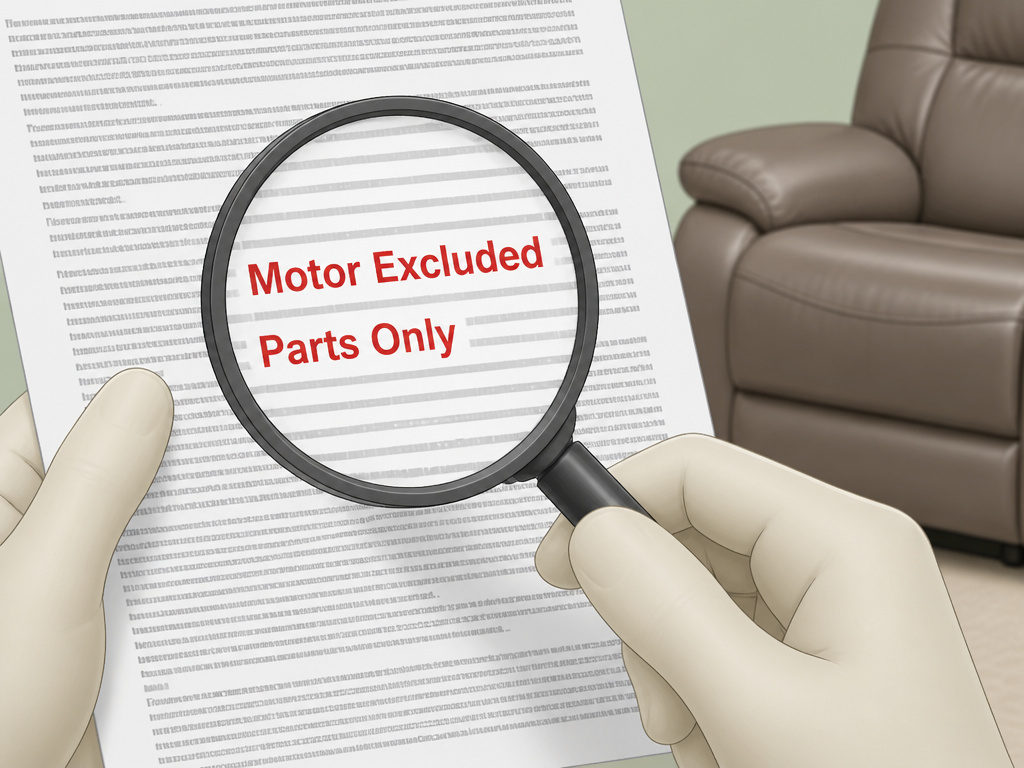 Here’s some straightforward advice: a warranty is a promise about the future. The language defines how easily that promise can be broken. “Limited lifetime warranty” sounds great until you read the limitations.
The two biggest red flags are motor exclusions and labor costs. The motor is the heart of the chair and costs $150 to $300 to replace. If the warranty doesn’t explicitly cover the motor for at least three years, reconsider. Labor is the other killer. A warranty that covers “parts only” means you’re paying a technician $100-$200 to install that “free” motor. A $200 repair becomes a $400 bill.
Look for these terms: “full warranty,” “includes labor,” and “motor covered for X years.” Ignore the marketing term “limited.” It’s a weasel word. Your defense is to read the actual warranty document, usually available online, before you commit. A brand that hides its warranty details isn’t one betting on its product’s longevity.
Power vs. Manual vs. Hybrid
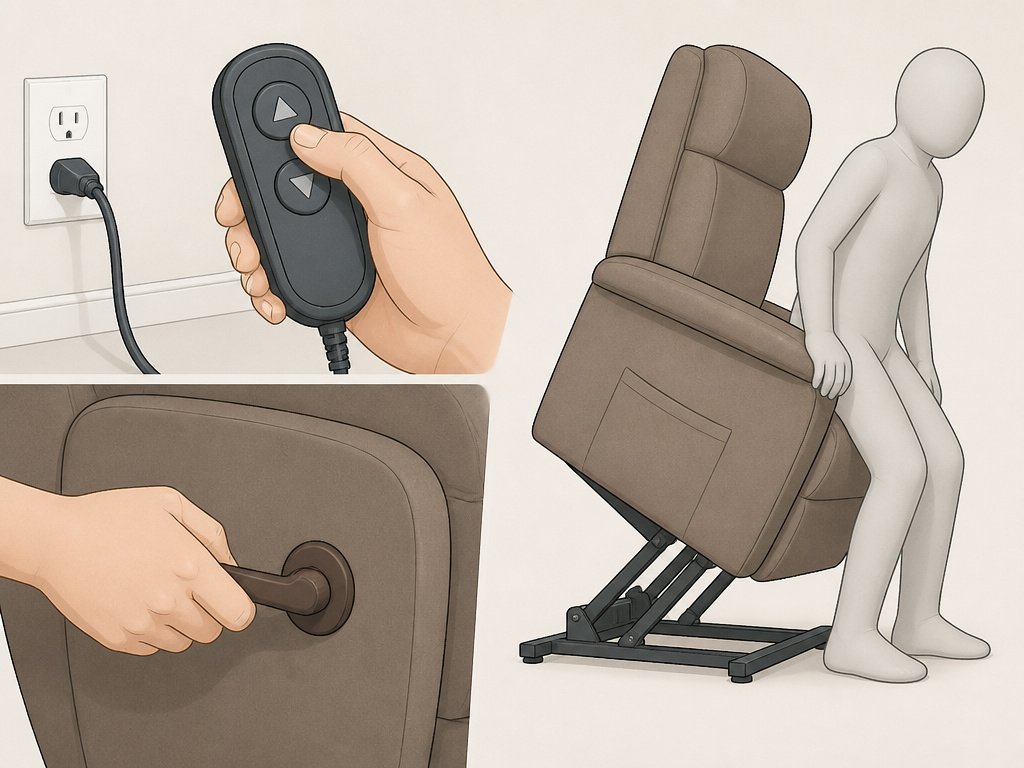 The choice between power and manual operation is about daily ease, not just technology. Each has a different feel and a different failure mode.
Power recliners offer push-button control, often with memory positions and smooth, independent adjustment. The downside is obvious: they need power. Some have battery backups for a few cycles during an outage, but they’re fundamentally dependent on electricity. Manual recliners use a lever or a push-back mechanism. They’re simpler, often cheaper, and never need an outlet. The lever style lets you lock in specific angles. The push-back style requires you to lean into it and push up to return, it can be a physical challenge for some.
There’s also a hybrid: the power-lift recliner. It uses a motor to gently tilt the entire seat forward, assisting you to stand. This is a functional tool, not just a comfort feature. If ease of standing is a priority, this is the category to explore. For most people, the convenience of a standard power recliner is the default pick. Just make sure you have an outlet nearby.
Features That Matter (And Ones That Don’t)
Recliner feature lists can get long. Let’s separate the useful from the decorative.
Worth It:
- Lumbar Support: Even basic adjustable lumbar can prevent lower-back ache during a long movie. It’s a small addition with a big comfort payoff.
- USB Charging Ports: If the chair will live where you use your phone or tablet, built-in USB ports are incredibly convenient and keep cords off the floor.
- Removable, Washable Cushion Covers: For fabric recliners, this is a lifesaver. For leather, it’s less common but a bonus for protecting the headrest area.
Skip It:
- Built-in Cup Holders & Storage: These often feel flimsy, are hard to clean, and compromise the chair’s structural lines. A simple side table is better.
- Excessive Massage/Vibration Functions: The motors for these are low-power and often the first thing to break. They’re a gimmick on all but the highest-end medical-grade chairs.
- “Thermo-Cool” or “Gel-Infused” Leather: These are usually marketing terms for a standard top-grain leather with a different backing. Don’t pay a premium for them.
Your money is best spent on the core components: quality leather, a robust motor mechanism, and solid frame construction. Everything else is secondary.
The Long-Term Care Non-Negotiables
A leather recliner’s lifespan is determined as much by its environment as its construction. You can buy top-grain leather and still ruin it in five years with simple neglect.
Sunlight is the enemy. UV radiation fades and dries leather faster than anything else. If the chair must be near a window, use blinds or a UV-filtering film. Heat is just as bad. Keep the chair at least three feet from radiators, fireplaces, or heating vents. That dry, direct heat will bake the moisture out of the leather, leading to premature cracking.
The care routine is simple but non-negotiable. Weekly, give it a quick dust and wipe with a dry, soft cloth. Monthly, do a deeper clean with a pH-balanced leather cleaner. Condition it only when it feels dry, maybe every 6 to 12 months, using a quality product like Leather Master or Colourlock. Here’s the thing: over-conditioning is as bad as not conditioning at all. It creates a greasy film that attracts dirt. Think of it like a hand-rubbed oil finish on wood: thin, even coats, fully absorbed.
Frequently Asked Questions
What is the most durable type of leather for a recliner?
Top-grain leather is the most durable practical choice. It has a protective finish that resists stains and scuffs from daily use, while still being real, breathable leather. Full-grain is more natural and develops a patina, but it’s also more susceptible to showing marks.
How much space do I need behind a leather recliner?
It depends entirely on the mechanism. A standard power recliner needs 12 to 18 inches. A wall-hugger recliner needs only 4 to 6 inches. Always check the specific model’s manual for its required clearance.
Can a power recliner work during a power outage?
Most cannot operate without electricity. Some models include a battery backup system that will allow for a few recline cycles (usually one or two) to return the chair to an upright position, but this is for emergency use only, not regular operation.
Is bonded leather a complete scam?
It is a misrepresentation, marketed as “real leather,” which it technically contains, but its performance is defined by the polyurethane binder.It has a short, predictable lifespan of 3-5 years before peeling. It’s a short-term budget material, not a long-term investment.
What should I look for in a strong warranty?
Coverage for the motor for at least 3 years, inclusion of labor costs (not just “parts only”), and a clear, accessible warranty document. Be deeply suspicious of warranties that exclude the motor or electrical components, those are the parts that will fail.
Before You Go
The most common regret isn’t spending too much; it’s spending on the wrong thing. Choosing a bonded leather recliner for its lower price is a classic example. You save several hundred dollars today but commit to replacing the entire chair in a handful of years. The cost-per-year of a quality top-grain leather recliner is almost always lower.
So, take your tape measure. Read the warranty PDF. And understand that the leather type defines the chair’s expiration date. Everything else follows from getting that one decision right.
