
How to Soften a Leather Jacket: The Most Overlooked Step
This post contains affiliate links. As an Amazon Associate, we earn from qualifying purchases.
This post contains affiliate links. As an Amazon Associate, we earn from qualifying purchases.
To soften a leather jacket, you must first diagnose the cause: is it new and unbroken, or old and dried out? For a new jacket, consistent wear and gentle hand-flexing are your primary tools. For a dry jacket, a thin application of a pH-balanced leather conditioner like Lexol or Bick 4 is essential to replace lost oils called fatliquors. Never use heat, household oils, or force, as these methods crack the leather and cause permanent damage.
That distinction between “new-stiff” and “dry-stiff” is where most guides fail. They give you a universal method, but the leather’s needs are not universal. A jacket straight from the box has tight, compact fibers. A jacket pulled from a dry closet has fibers that have lost their internal lubrication. Using conditioner on the first is overkill; skipping it on the second guarantees the stiffness will return, worse than before.
What follows is a breakdown of both scenarios. This section details the safe, gradual methods that work with the leather’s biology, the products that actually penetrate without clogging, and the storage mistake that causes most long-term stiffness. By the end, you’ll know exactly which path your jacket needs.
Key Takeaways
- Diagnose first: New stiffness requires breaking in; old stiffness requires conditioning. Using conditioner on a new jacket can oversaturate it.
- Condition thin, not thick: A dime-sized amount of conditioner for an entire panel is enough. Excess sits on the surface, attracts dirt, and can turn rancid.
- Heat is the enemy: Never use a hairdryer, radiator, or clothes dryer. Heat rapidly drives moisture from the leather, causing irreversible cracking and shrinkage.
- Storage humidity is non-negotiable: Leather needs 40-50% relative humidity. Storing it in a very dry environment (below 40%) will suck the moisture from the fibers, making it hard and brittle.
- Patience beats force: A thick cowhide motorcycle jacket needs 15-20 wear sessions over 3-5 weeks to break in. Rushing the process with aggressive bending risks cracking the topcoat.
Why Leather Gets Stiff in the First Place
You can’t fix a problem you don’t understand. Leather stiffens for two core reasons, and they demand completely different solutions.
First, new leather stiffness is a feature, not a defect. Think of the collagen fibers in a hide like a tightly packed bundle of straws. During tanning and finishing, those fibers are set in a relatively rigid state. A new jacket hasn’t had those fibers stretched and flexed by your body’s movements. This is especially true for protective gear like a Schott motorcycle jacket, where the thick, full-grain cowhide is chosen for durability, not initial suppleness.
Second, dry leather stiffness is a failure of maintenance. Leather isn’t a static material; it’s a skin. It contains natural oils and, more importantly, added oils called fatliquors from the tanning process. These fatliquors lubricate the fibers, allowing them to slide past each other when you move. Over years, and accelerated by dry air, heat, and sunlight, these oils slowly evaporate. The fibers lose their lubrication, compress, and bind together. The jacket feels board-like, and may develop a whitish, chalky look along the creases. This is the leather crying out for help.
Leather conditioners are designed to help soften and protect against drying out, which is exactly what you need for stiff leather. First of all, make sure the leather is clean of any dirt or dust. After that, simply apply the conditioner by gently rubbing it into the surface until it is no longer visible. The conditioner will seep down into the pores of the leather, moisturizing and softening it from the inside out.
Ignoring this difference is the root of most failed softening attempts. Conditioning a new jacket is like oiling a new hinge that just needs to be worked. Not conditioning a dry jacket is like expecting that same hinge to swing smoothly after a decade in the desert.
The Golden Rule of Conditioning (and Why You’re Probably Doing It Wrong)
If your jacket is dry, conditioner is the necessary solution. But here’s where even well-intentioned people wreck good leather.The rule is simple: thin, even, and patient.
Most people apply conditioner like lotion on dry skin, using a generous, thick coat. For leather, that’s a disaster. Leather can only absorb so much at a molecular level. What it can’t absorb sits on the surface, clogging the pores. This creates a greasy feel, attracts every speck of dust, and, over months, can turn rancid. You’ll smell it before you see it, a faint, unpleasant sourness.
The right way is almost comically minimal. For the back panel of a jacket, use an amount of conditioner the size of a dime. Warm it between your fingers, then work it into the leather in slow, circular motions. You should feel the leather warming slightly from the friction. Let it absorb for at least 20 minutes, 30 for thick horsehide. Then, buff the surface vigorously with a clean, dry cloth. If it still feels tacky, you used too much. The finished surface should feel smooth and supple, not slick or waxy.
| Conditioner | Best For | Key Trait / Risk |
|---|---|---|
| Lexol | All-purpose, safe for most finishes | pH-balanced, light, minimal darkening |
| Bick 4 | Aniline & delicate leathers | Famous for not darkening leather |
| Leather Honey | Very dry, thick leather (e.g., work boots) | Deep penetration; will darken leather noticeably |
| Saddle Soap | Heavy-duty work gear only | Cleans aggressively; strips oils and dries out fashion leather |
This table serves as a warning against using the wrong tool. Using a heavy oil like Leather Honey on a delicate lambskin blazer is like using a firehose to water a seedling.I learned this the hard way on a vintage aniline-dyed jacket. The mink oil darkened the leather permanently and left a greasy residue that never fully absorbed, attracting lint for the rest of the jacket’s life. The leather will tell you what it needs, start gentle.
The Wear-In Routine: Letting Your Body Do the Work
For a new jacket, the best softening tool is you. This method has virtually zero risk and costs nothing but time. The goal is to use your body heat and natural movement to gently coax the fibers to relax and conform to your shape.
Put the jacket on over a t-shirt or light sweater. Wear it around the house for 30-45 minutes at a time. Don’t just sit still. Make a coffee, fold laundry, reach for books on a high shelf. Focus on the high-stress areas: bend your elbows, roll your shoulders, reach across your body as if grabbing a motorcycle handlebar. The warmth from your body slightly plasticizes the leather’s fibers, and the repeated, low-stress movement encourages them to stretch and settle.
How long does it actually take? It depends entirely on the hide’s thickness and temper. * Thick Cowhide (Motorcycle Jacket): 15-20 wear sessions over 3-5 weeks. * Medium Cowhide (Bomber Jacket): 10-15 sessions over 2-4 weeks. * Lambskin (Fashion Jacket): 5-10 sessions over 1-2 weeks.
The creak you hear in the shoulders on day one will be gone by week three. Impatience here is your enemy. Never try to accelerate this by sitting on the jacket, folding it sharply, or worse, getting it wet and wearing it for hours. That’s a shortcut to water stains and distorted seams.
Gentle Hand-Flexing and Rolling
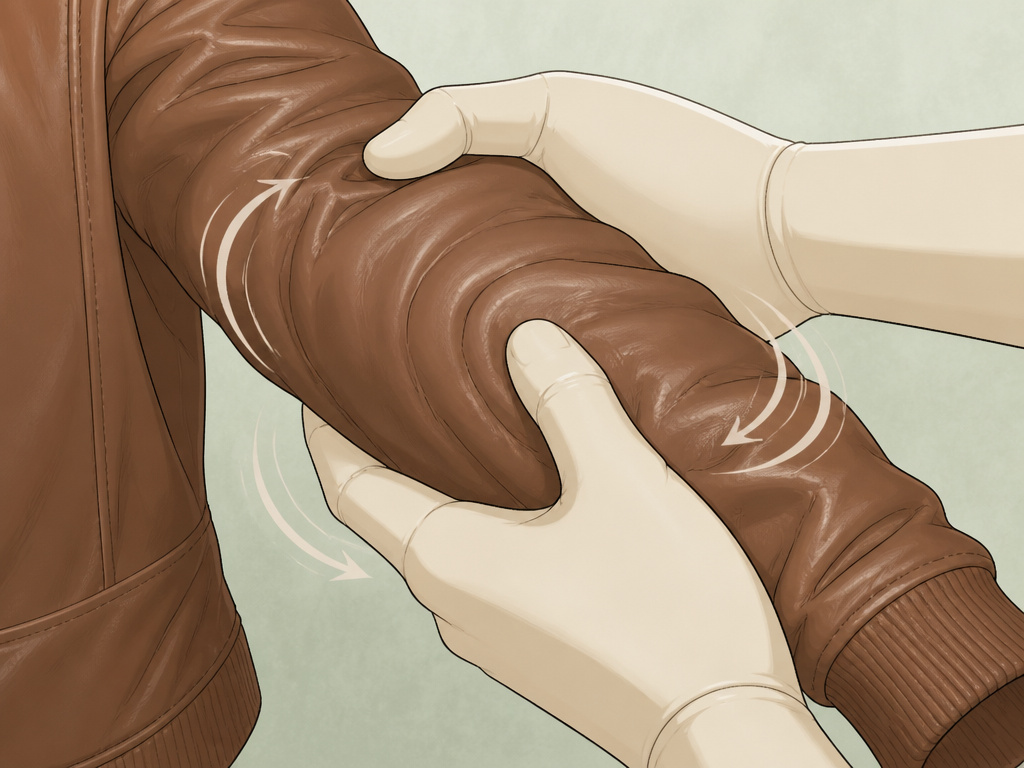 This is a companion to the wear-in routine, perfect for when you can’t wear the jacket or for targeting a particularly stubborn panel. It reduces surface tension without creating harsh, permanent creases.
Lay the jacket flat on a bed, front-side up. Start with the sleeves. Take one sleeve and gently knead the leather around the elbow area between your palms, like you’re warming up a stiff piece of clay. Use a slow, rolling pressure, not a sharp bending motion. Then, fold the jacket loosely front-to-front, and gently roll it from the collar down to the hem into a soft cylinder. Hold for ten seconds, then unroll. Repeat this a few times.
The difference between this and force is subtle but critical. You’re encouraging the leather to drape, not demanding it to fold. Aggressive twisting or sharp 90-degree bends stress the topcoat. On a new jacket, this can cause micro-fractures in the finish that turn into full cracks after a few months of wear. Gentle persuasion always wins.
When to Use (Extreme Caution) and Avoid Moisture
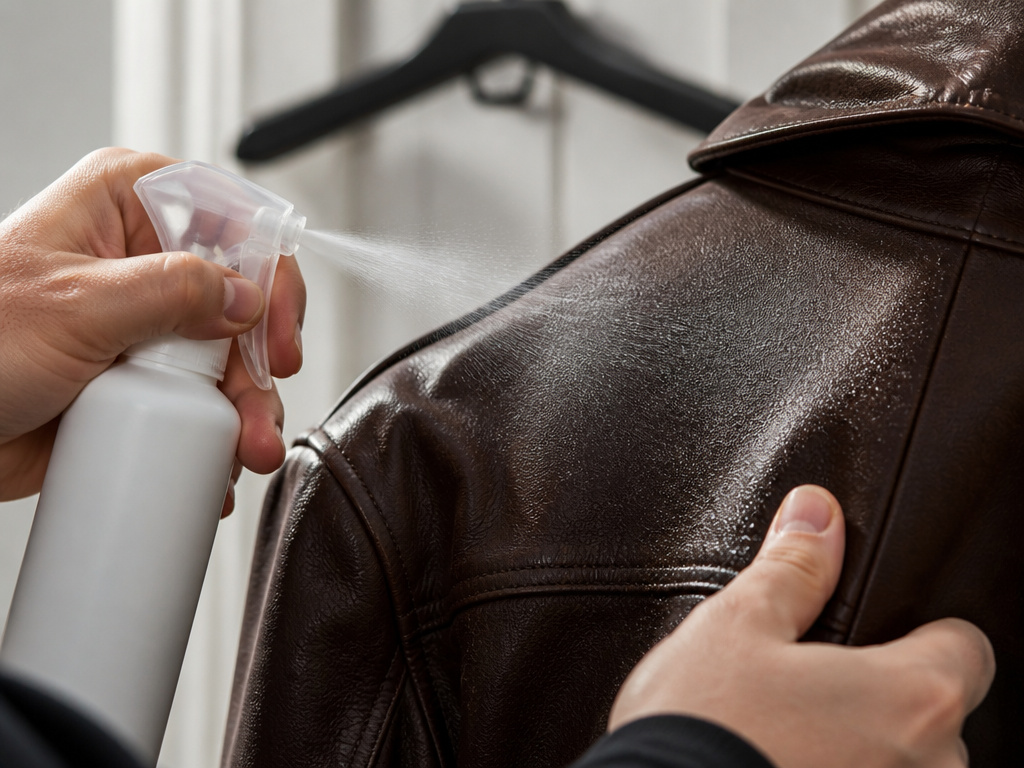 The internet is full of dangerous advice about water. Let’s be clear: soaking a leather jacket is a fantastic way to ruin it. However, controlled moisture, used with precision, can help relax fibers on a jacket that’s already clean and dry.
The only safe technique is the light mist. Use a clean spray bottle with plain water. From about 12 inches away, give the jacket’s exterior a single, fine mist, you want a faint glisten, not dampness. Immediately put the jacket on and wear it for an hour as it dries at room temperature. The slight dampness softens the fibers, and as the jacket dries on your body, it molds to your shape.
Where this goes sideways: Using a steam iron or garment steamer directly on the jacket. The concentrated heat and moisture can cook the finish, leaving permanent shiny patches and causing the leather to shrink and harden as it cools.
After any moisture exposure, hang the jacket on a wide, padded hanger in a well-ventilated room. Never, ever place it near a radiator, in sunlight, or use a hairdryer to speed drying. Heat causes the leather to contract violently as it loses moisture, leading to irreversible stiffness and cracks. If you use this method, always follow it with a very light application of conditioner once the jacket is bone-dry to replenish any oils that may have been displaced.
Storage: The Silent Stiffness Culprit
You can do everything right and still end up with a stiff jacket if you store it wrong. The biggest offender is humidity.
Leather is hygroscopic; it constantly exchanges moisture with the air. Store it in a closet with very low humidity (common in homes with forced-air heating in winter), and the leather will surrender its moisture to the air. The fibers become desiccated and brittle. This is why a jacket can feel fine when you put it away in April and feel like cardboard when you take it out in October.
The fix is straightforward. Aim to store your jacket in an environment with 40-50% relative humidity. A simple digital hygrometer can tell you your closet’s status. If it’s consistently below 40%, consider a small room humidifier or even placing a damp sponge in a bowl in the closet (keep it well away from the jacket itself). This one adjustment does more to prevent long-term dryness than any conditioning routine.
Combine this with proper hanging. Always use a wide, padded or contoured wooden hanger that supports the jacket’s shoulder seams. A wire hanger concentrates pressure on two small points, distorting the shoulder shape into unnatural peaks over a single season. For long-term storage, a breathable cotton garment bag is ideal; avoid plastic bags that trap moisture and can promote mildew.
Frequently Asked Questions
Can I use olive oil or coconut oil to soften my jacket?
No. These are food-grade oils with the wrong molecular structure to penetrate leather properly. They sit on the surface, go rancid within months, attract dust, and permanently darken the leather in ugly, uneven patches. Stick to purpose-made leather conditioners like Lexol or Bick 4.
How often should I condition my leather jacket?
For a jacket you wear regularly, once or twice a year is sufficient. Over-conditioning is a real problem that clogs the leather’s pores. If the jacket is in seasonal storage, condition it once before you put it away. The best indicator is the leather itself, if it looks chalky or feels stiff, it’s time.
Will wearing my jacket in the rain soften it?
Light rain won’t hurt a finished leather jacket, but it’s not a reliable softening method. The real danger comes after. If you dry it quickly with heat (radiator, hairdryer), you’ll cause severe stiffening and cracking. If caught in rain, blot off excess water, stuff the sleeves with paper to hold shape, and let it air-dry naturally away from heat. Condition it once fully dry.
My jacket is still stiff after conditioning. What now?
First, ensure you buffed off all excess conditioner, a tacky surface can feel stiff. If it’s truly still stiff, the leather may be severely desiccated and need a second, thin application after a week. If there’s no improvement, or you see cracking, the leather’s structure may be compromised. At this point, DIY methods risk more damage. It’s time to consult a professional leather restorer.
Is a stiff new jacket a sign of bad quality?
Often, the opposite is true. High-quality, full-grain leather from a maker like Aero Leathers is dense and durable, which means it starts off stiffer. Thin, low-grade leather feels soft immediately but won’t last or develop a patina with the depth and character of full-grain leather. Some stiffness at the outset is a sign of substance, not poor craftsmanship.
Before You Go
The single most important step is the one you take before you touch a product: identify whether your jacket is new or dried-out. That diagnosis dictates everything that follows. For the vast majority of people, a combination of patient wearing and a single, thin conditioning treatment per year will keep a jacket supple for decades. Remember that leather is a long-game material. It rewards consistency and gentle care, and it punishes shortcuts and force. Ignore the “life hack” videos promising instant softness. Listen to the leather instead, it will tell you exactly what it needs.
