
A Complete Guide on How to Stretch Leather Shoes at Home
This post contains affiliate links. As an Amazon Associate, we earn from qualifying purchases.
This post contains affiliate links. As an Amazon Associate, we earn from qualifying purchases.
To stretch leather shoes, you need three things: the right tool (a mechanical shoe stretcher), a leather-specific stretching spray, and patience. Leather can give about a quarter to a half size, primarily in width. Forget water, heat, or the freezer, those methods warp the boot’s structure and cause damage that shows up months later.
That width-versus-length distinction is the whole game. You can coax the sides of a shoe to accommodate a wider foot or a bunion. Trying to gain meaningful length is a fight against the insole and the last, and you will lose. The process isn’t magic; it’s mechanical. You’re persuading a network of collagen fibers to relax and hold a new shape.
What follows is a walk through the tools that work, the methods that backfire, and the one type of shoe, steel-toe boots, where the rules change completely. By the end, you’ll know whether your tight spot is fixable or if you need to start shopping for a different size.
Key Takeaways
- Leather stretches in width, not length. Aim for a quarter to a half size of relief at most.
- A two-way mechanical shoe stretcher paired with a leather stretching spray is the only reliable DIY method.
- Steel-toe and composite-toe caps are dimensionally fixed by the ASTM F2413 safety standard and cannot be stretched.
- Common DIY methods like the freezer bag trick, soaking, or using a hair dryer cause permanent structural damage that often manifests 6+ months later.
- Always condition the leather with a product like Bickmore Bick 4 or Lexol after stretching to prevent drying and cracking.
The Right Way to Stretch Leather Shoes at Home
Let’s be clear about this: most at-home stretching is just temporary flexing. Without the right setup, the leather springs back. The goal is permanent reshaping, and that requires a specific mechanical advantage.
A two-way mechanical shoe stretcher, used with a leather softening spray, can permanently expand width by up to half a size. The spray relaxes the leather’s collagen fibers, allowing them to reposition and set in the new shape as they dry around the stretcher.
The first step is always diagnosis. Put the shoe on and press around. Is the pinch across the ball of your foot? On the little toe’s side? Directly over a bunion? You need to know the exact spot, because stretching the wrong area just creates new problems. Once you’ve mapped the pressure, clean the leather. A quick wipe with a damp cloth removes surface grit. Stretching over dirt grinds it into the grain.
Next, apply a leather stretching spray like Angelus Professional Shoe Stretch or Tarrago Shoe Stretch to the inside and outside of the tight zone. Don’t drench it, a light, even coating is enough. This isn’t a conditioner; it’s a temporary relaxant. Wait five minutes for it to absorb.
Now insert the stretcher. If you’re targeting a specific spot like a bunion, thread on the plastic plug attachment and position it precisely. Turn the handle until you feel firm, steady pressure. This is the critical moment. Cranking to maximum pressure stresses the stitching and can warp the shoe’s last. Firm is the goal.
Leave the stretcher in place for 24 to 48 hours. Leather needs time to adjust. Less than a day and it likely snaps back. After two days, remove the tool and try the shoe on. If it’s still tight, reapply spray and repeat the cycle. Most shoes need two or three sessions.
The final, essential step is conditioning. The stretching process dries out the leather. Apply a light coat of a conditioner with lanolin or beeswax to the stretched area, let it soak in for 20 minutes, and buff it off. This replaces lost oils and prevents the leather from cracking along the new stress lines.
The One Tool That Makes All the Difference
You can try to stretch shoes with socks, potatoes, or hope. It might even feel looser for a day. For a permanent change, you need a mechanical shoe stretcher.
I keep a KevenAnna 2-way Wooden Shoe Tree stretcher in my workshop. It’s a simple screw mechanism that expands in length and width independently. The “two-way” part is key, it lets you target the forefoot without distorting the heel pocket. It also comes with those bunion plugs for precision work on a single pressure point.
Here’s the thing about tools: the right one does the job without a fight. A stretcher applies even, controlled pressure exactly where you direct it. Stuffing a shoe with wet newspaper applies chaotic, uneven force. One method reshapes. The other distorts.
| Tool Type | Best For | Realistic Outcome |
|---|---|---|
| Two-Way Mechanical Stretcher (e.g., FootFitter, KevenAnna) | Overall width relief, targeted spot stretching | Permanent gain of 1/4 to 1/2 size in width. |
| Stretching Spray (e.g., Angelus, Tarrago) | Used WITH a stretcher to relax fibers | Makes the mechanical stretching permanent. Useless alone. |
| Professional Cobbler’s Service | Steel-toe boots, expensive footwear, complex fits | Uses commercial-grade equipment; can tackle jobs home tools can’t. |
| “DIY Tools” (Thick Socks, Hair Dryer, Freezer) | Creating new problems | Temporary relief at best, warping and long-term damage at worst. |
A cobbler’s service is the other professional tool, and for certain shoes, it’s the only smart choice. Their industrial stretchers can handle forces and shapes that consumer models can’t. If you’re dealing with a $300 pair of boots, the $25 cobbler fee is insurance.
Common Stretching Methods (And the Ones to Skip)
The internet is full of bright ideas for stretching shoes. Most of them are terrible. They trade short-term comfort for long-term damage, and the damage often doesn’t show up until it’s too late.
Where this goes sideways: The freezer-bag-of-water trick. Water expands as it freezes, yes. But it thaws unevenly. This warps the boot’s internal structure and can separate the insole from the midsole. On work boot forums, this is a top cause of “my boots fell apart” stories.
Let’s untangle the worst offenders:
- The Freezer Method: As mentioned, it’s a gamble with your boot’s integrity. The expansion is crude and uncontrollable.
- Soaking in Water: This strips natural oils from the leather, weakens the adhesives holding the sole on, and causes the leather to shrink as it dries, not stretch. The damage from saturation might not be visible until the welt starts to fail six months down the road.
- Using a Hair Dryer or Heat Gun: Direct heat rapidly dries out leather. It might feel softer for an hour, but as the moisture evacuates, the fibers become brittle. The leather will stiffen permanently and is far more prone to cracking. Red Wing’s own care guides explicitly warn against this.
- Rubbing Alcohol or “Special” Potions: Alcohol is a drying agent. Applying it to leather is the opposite of what you want. It dehydrates and can strip finishes.
So what does work besides the stretcher? Honestly, very little. Wearing the shoes indoors with thick socks for short periods can help ease the break-in of stiff, new leather. But that’s not stretching, that’s natural flexing. It might gain you a millimeter. For any meaningful change, you need mechanical assistance.
When Stretching Has Hard Limits: Steel-Toe and Safety Boots
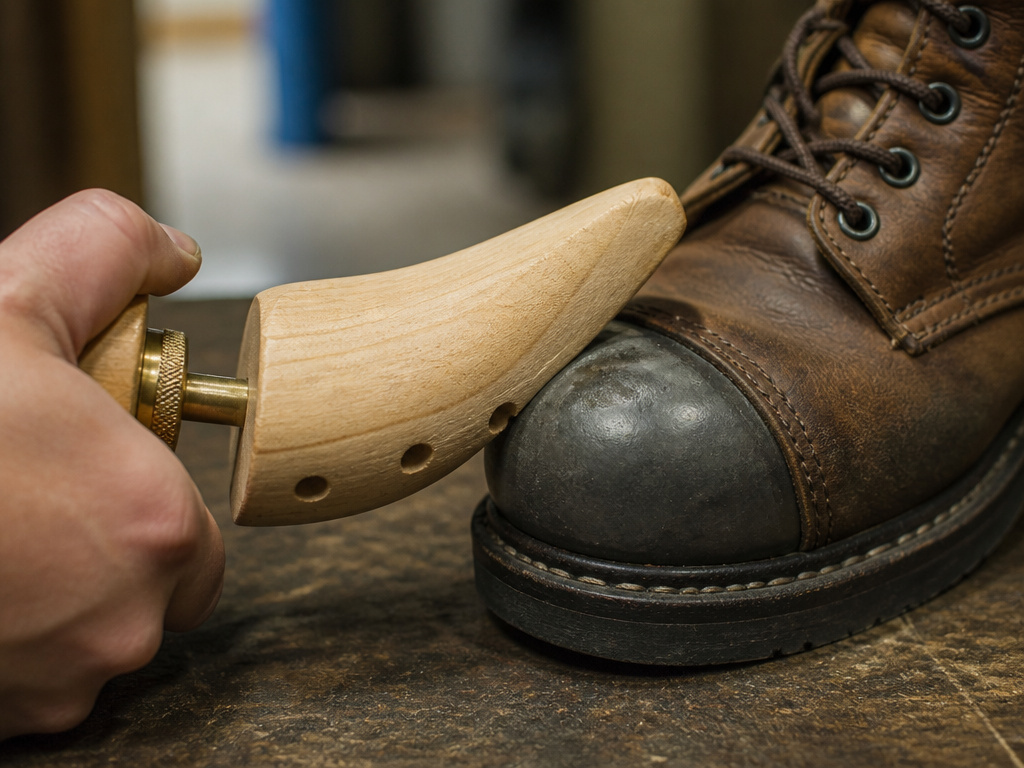
This changes everything. If your work boots have a steel-toe or composite-toe cap, you are playing by different rules.
The protective cap inside the toe box is not leather. It’s a rigid shell manufactured to the dimensional specifications of the ASTM F2413 safety standard. That shell does not bend. It does not flex. It cannot be stretched.
The part nobody mentions: Major consumer stretcher brands like FootFitter explicitly state their tools are “not recommended for use with steel-toed safety boots.” The rigid cap prevents the stretcher’s toe block from functioning correctly, leading to uneven pressure that can damage the welt seam.
This doesn’t mean all hope is lost if your steel-toe boots are tight. It means you need to diagnose the source of the pinch with precision.
- Is the cap itself pressing on your toes? If you feel pressure directly on top of your toes or the sides of your big/little toes against a hard, unyielding surface, that’s the cap. The fix is not stretching. The fix is a different boot with a cap shape that matches your foot. You need to return them.
- Is the leather around the cap pinching? If the pressure is on the softer leather panels just behind or above the cap line, that material can be stretched. However, this is a job for a cobbler with commercial equipment designed to work around the rigid block. It’s the safer, more effective route.
Trying to force a consumer-grade stretcher into a steel-toe boot is an exercise in frustration and risk. The tool isn’t designed for it, and you’re likely to stress the boot’s construction without solving the problem. Know the limit.
The Essential Post-Stretch Ritual: Conditioning
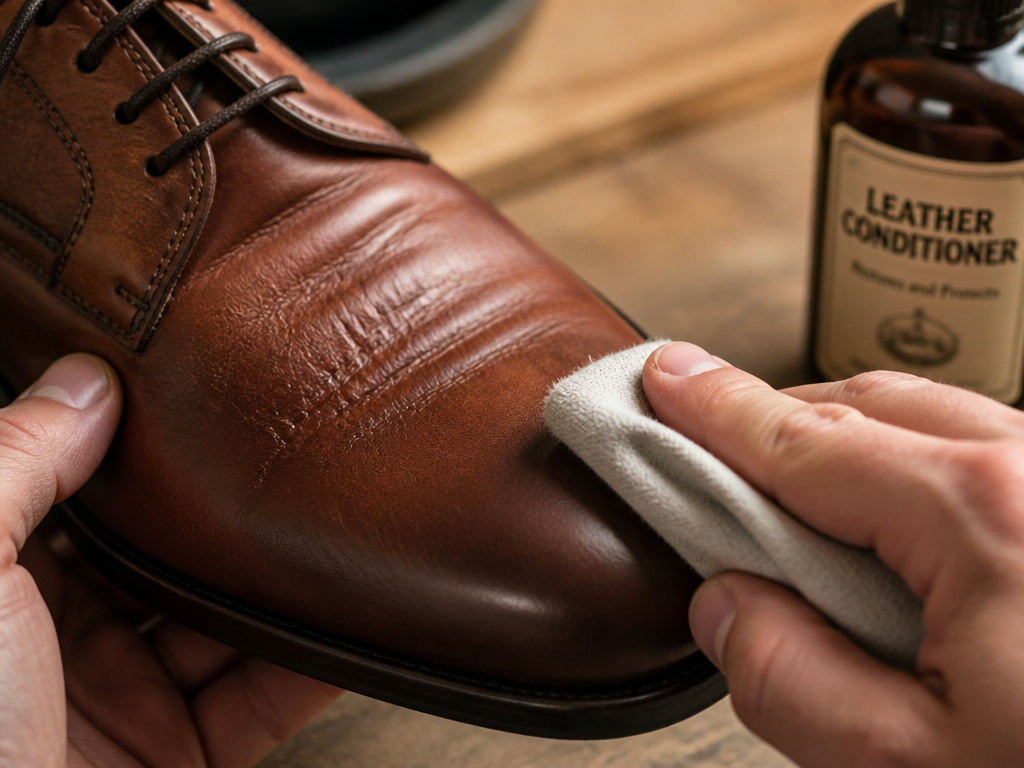
Stretching leather is a controlled stress test. You’ve asked the fibers to move and hold a new position. In doing so, you’ve inevitably displaced some of the natural oils that keep the leather supple.
Skipping the conditioner step is how you end up with a pair of shoes that are finally the right width, but now have a dry, cracked patch right over the ball of the foot. The conditioning is not optional; it’s part of the repair.
After you’ve removed the stretcher and confirmed the fit, apply a quality leather conditioner. Bickmore Bick 4 is a favorite because it hydrates without darkening the leather significantly. Lexol Leather Conditioner is another reliable choice. Use a clean cloth and apply a thin coat only to the stretched area. Let it soak in for at least 20 minutes, then buff off any excess.
This single step restores the leather’s flexibility and seal, ensuring the stretch lasts and the material stays healthy. It’s the difference between a successful adjustment and a compromised one.
Frequently Asked Questions
Can you stretch leather shoes a full size?
No. Realistically, leather can be stretched about a quarter to a half size, primarily in width. Attempting to gain a full size will overstress the leather, distort the shoe’s shape, and likely damage the construction. If you need a full size up, you need a different shoe.
Does wearing thick socks to stretch shoes work?
It works for the initial break-in of very stiff new leather by flexing it, but it’s not a true stretching method. The pressure is diffuse and temporary. For a permanent change in width or to target a specific spot, thick socks alone lack the sustained, focused force required.
What’s the best leather stretching spray?
These are formulated to temporarily relax leather fibers without damaging them. Do not use household chemicals, alcohol, or generic leather conditioners for this purpose.
Can a cobbler stretch shoes lengthwise?
Skilled cobbler with professional equipment can gain a very small amount of length, up to a quarter size at the absolute maximum. However, length is constrained by the insole and the rigid last of the shoe. It is far more difficult and less successful than stretching for width. If your toes are jammed against the front, the shoe is too short.
How long does it take to stretch leather shoes?
With a mechanical stretcher and spray, the process takes 24 to 48 hours per stretching cycle. Most shoes require 2 to 3 cycles to achieve the desired fit. “Quick” methods that promise results in minutes or hours typically cause damage.
Before You Go
Stretching leather is a repair, not a resurrection. It can fix a minor fit issue, a narrow forefoot, a pressing bunion spot. It cannot turn the wrong size into the right size.
The rule of thumb is straightforward: if you need more than a half size of adjustment, return the shoes. The most elegant, professional stretching job in the world won’t overcome a fundamental sizing mismatch. Your time and money are better spent finding a last that matches your foot shape from the outset.
For that quarter-size pinch, though, the path is clear. Grab a two-way stretcher, a bottle of proper spray, and your conditioner. Apply steady pressure, not force. Give it time. And always finish by feeding the leather. That’s how you widen a shoe’s world without shortening its life.
