
How to Style Leather Pants: Essential Tips for a Cool Look
This post contains affiliate links. As an Amazon Associate, we earn from qualifying purchases.
To style leather pants, match three things: a fit that allows movement, a top half that lowers the temperature, and accessories that add polish, not performance. A straight-leg, high-waisted cut in black is the most versatile starting point. Pair it with simple, soft fabrics like a cashmere knit or a plain tee, and finish with clean footwear and minimal jewelry.
The fit part is essential. Leather holds its shape and shows every wrinkle, so a cut that strains across the seat or bags at the knee turns a sharp piece into a costume. The goal is a trouser that happens to be leather, not a leather piece forced into trouser shape.
What follows is a breakdown of the three style rules that work every time, how to tell the difference between leather trousers, jeans, and leggings, and the specific fabric pairings that keep the look cool rather than trying too hard.
Key Takeaways
- Fit for sitting, not just standing. Leather should follow your shape without pulling or sagging. If you can’t sit comfortably, the fit is wrong.
- Pair with “quiet” fabrics. Balance leather’s inherent edge with soft knits, crisp cotton, or flowing silk. Avoid pairing it with other loud, shiny textures.
- Accessories are a polish, not a performance. Minimal gold jewelry, a classic handbag, and clean footwear (think loafers, sleek boots, or plain trainers) complete the look without competing with it.
- Know your leather type. Trousers (tailored, zip fly) are for smart looks; jeans (five-pocket, casual) are for everyday edge; leggings (stretchy, pull-on) are for comfort.
- Head-to-toe leather is a stunt. Wearing a leather jacket with leather pants feels heavy and dated unless executed with extreme, deliberate precision.
The Three Rules That Never Fail
Ever wondered why some leather pants look effortlessly cool and others look like a Halloween costume? It usually comes down to ignoring one of three basic principles. These aren’t vague tips; they’re mechanical rules about how leather interacts with your body and other fabrics.
First, fit dictates everything. Look for a leather pant with a compression rating of 70-80 grams. When you sit, the leather at the front of the thigh should relax into soft horizontal folds, not pull taut into a shiny, strained sheet. If it pulls, it’s too tight. Conversely, if it bags loosely behind the knee when you stand, it’s too big. That bagging creates permanent, awkward creases because leather has memory.
Common mistake: Buying for the stand-up mirror pose. Leather pants need to pass the sit test. If they’re restrictive seated, you’ll never wear them out of the house, regardless of how good they look standing.
Second, balance the texture. Leather makes a statement on its own. Your job is to calm that statement down, not amplify it. This is where most people overstyle. The easiest path is to pair leather with its opposite: a soft, matte, or flowing fabric.
- A chunky cashmere sweater.
- A simple cotton tee.
- A silk camisole.
- A fine-gauge merino wool turtleneck.
These “quiet” tops lower the visual temperature. They make the leather pants feel like a choice, not a cry for help. What you avoid is pairing leather with other “loud” elements: sequins, bold animal prints, or more shiny patent.
Third, accessories are a finish, not a feature. A leather pant is the feature. Piling on bold jewelry, logo-heavy bags, or strappy stilettos pushes the outfit into “trying too hard” territory. Think of accessories as the polish on a piece of furniture, not another piece of furniture in the room.
A simple gold chain, small hoop earrings, a structured but plain handbag in a contrasting color (navy, tan, oxblood), and clean footwear. That’s the formula. “Think polish, not performance,” as one stylist put it. This approach is what separates a Kate Moss look from a try-hard one.
Leather Trousers vs. Jeans vs. Leggings: Pick Your Weapon
Not all leather pants are the same. Calling them all “leather pants” is like calling a suit, jeans, and sweatpants all “cotton bottoms.” The style you choose sets the entire tone. Here’s the breakdown most guides skip.
They are the smartest option. You wear these with a crisp button-down shirt, a blazer, or a fine knit to a dinner, an office (if your office allows it), or any event where you want to look polished but interesting. Brands like Falcon Garments specialize in this category.
Leather Jeans are cut like denim: five pockets, belt loops, and a slim or skinny leg. They read as casual and edgy. This is your go-to for weekend wear, pair them with a band tee, a hoodie, or a plaid shirt. Brands like Diesel and AllSaints have built empires on perfecting this style. They’re less forgiving than trousers because the denim patterning can create tight spots across the hips if the leather has no stretch.
Leather Leggings are close-fitting, stretchy, and pull-on. They are the most casual and, ironically, often the most comfortable. Their job is to be worn under long tunics, oversized sweaters, or blazers where they act more like a sleek base layer than a standalone statement pant.
| Style | Best For | Pair With | Feels Wrong With |
|---|---|---|---|
| Trousers | Smart-casual, evenings, creative offices | Blazers, button-downs, sleek knits | Graphic tees, chunky sneakers |
| Jeans | Everyday wear, weekends, casual outings | Tees, sweatshirts, boots, trainers | Blazers, structured handbags |
| Leggings | Comfort, layering, running errands | Long tops, oversized sweaters, cardigans | Cropped tops, blazers |
Choosing the right type is the first step to styling them correctly. Want smart? Go trousers. Want everyday edge? Go jeans. Want comfort? Go leggings. Mixing these categories, like trying to dress up leather leggings with a blazer, usually fails.
How a Good Pair Should Actually Fit
Let’s be clear about this: the fit advice for leather is different from denim or wool. Leather doesn’t drape; it holds. A misfit isn’t just unflattering, it’s uncomfortable and destructive to the garment. Getting four things right solves 90% of fit problems.
The seat and waist. This is the most critical zone. The leather should follow the curve of your seat without straining. When you sit, you should feel the leather relax, not fight you. If you see horizontal tension lines radiating from the hips or crotch when standing, the pants are too small. The waist should sit comfortably without gapping or digging in. A high-waisted cut is the most universally flattering and easiest to style.
The thigh and knee. There should be enough room to pinch about an inch of fabric at the front of your thigh. Behind the knee, there should be no excess fabric bagging when you stand straight. Bagging there creates a permanent, awkward bend in the leather.
The leg opening and break. For most modern looks, a straight or slim leg is king. The hem should just kiss the top of your shoe, creating a slight break, or be cropped to hit above the ankle. Avoid a length that pools on the floor, it looks sloppy and will scuff the hem.
The overall feel. Good leather pants feel like a second skin, but with agency. You should be aware of them, but not constrained by them. If they squeak when you walk or feel like they’re resisting every move, they’re too tight. Practically speaking, if you can’t comfortably get into a car or sit through a meal, they’re not right.
I learned this the hard way early on, not with pants but with a leather card holder. I used a thick, rigid harness leather, seduced by its durability. The result was a bulky, impractical item that wouldn’t fit in any pocket. The same principle applies: the material must suit the application. For pants that move with you, you need a leather that is either soft and supple from the start (like lambskin) or has some mechanical stretch.
What to Wear With Leather Pants: The Pairing Guide

Now for the practical part. You have a well-fitting pair. What do you put on with them? The goal is to build an outfit where the leather pants are the star, but the supporting cast is so strong nobody notices they’re trying.
For a casual, cool look: A plain white tee, a leather jacket in a slightly different finish (matte if your pants are shiny, or vice versa), and clean white trainers. This is the uniform. It works because the tee softens the edge, the jacket adds a layer without going full “Matrix,” and the trainers keep it grounded. It’s the difference between looking like you’re in a band and looking like you’re in a band’s marketing photo.
For smart-casual or work (creative settings): A crisp white button-down shirt, slightly oversized, tucked in. Or a fine-gauge cashmere turtleneck. Add a pair of loafers or ankle boots with a low block heel. The Guardian leather trousers fashion guide nails this: “The coolest partner is a top half that lowers the temperature a little.” The contrast in texture, crisp cotton or soft wool against the leather, is what makes it feel grown-up.
For evening: A silk slip top or a simple, elegant bodysuit. Keep jewelry minimal, small gold hoops, a delicate chain. Heels can be simple straps or sleek pumps. The leather pants provide the structure and edge; the delicate top provides the contrast. This avoids the head-to-toe leather trap, which, unless you are a rock star on stage, feels heavy and costumey.
Here are three specific outfit formulas to copy: 1. Weekend Formula: Black leather jeans + Grey marl sweatshirt + Black leather jacket + White sneakers. 2. Office Formula: Black leather trousers + White poplin shirt + Black blazer (cotton or wool) + Black loafers. 3. Evening Formula: Black leather trousers + Black silk camisole + Structured black blazer (carry it) + Black strappy sandals.
The thread through all of these? You’re styling the pants as you would a great pair of wool trousers or dark denim. You’re not highlighting the leather; you’re incorporating it. That’s the mental shift.
What Not to Wear With Leather Pants
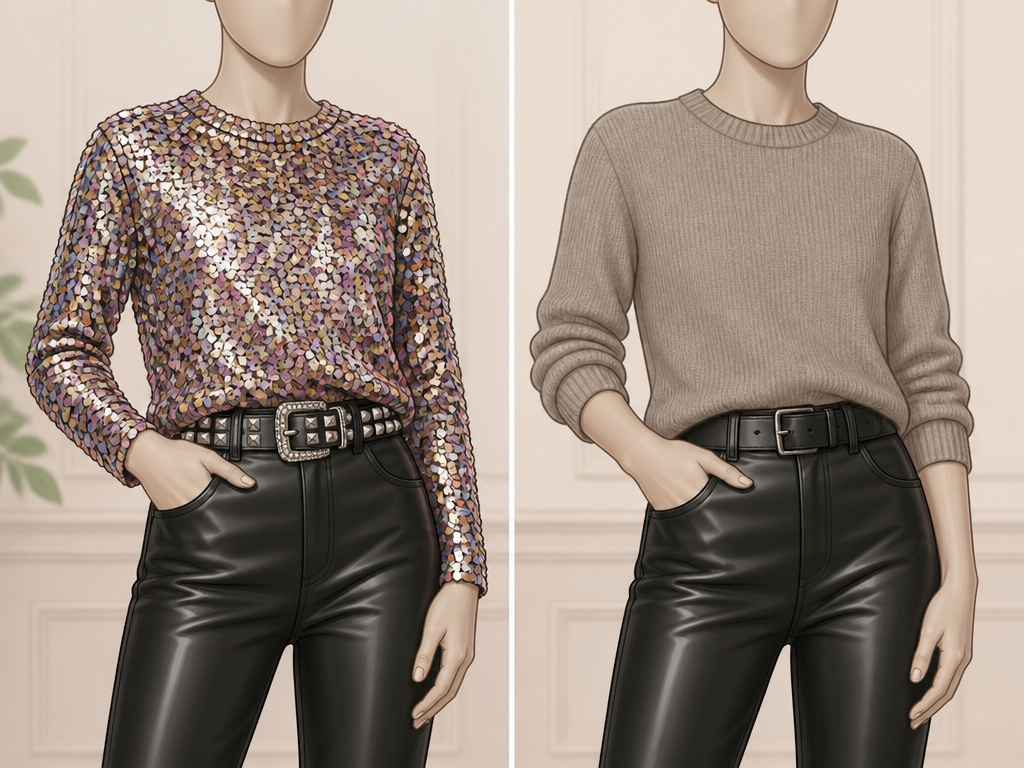
Just as important as what to wear is what to avoid. Some pairings almost guarantee the look will tip over into tacky or costumey territory.
Avoid head-to-toe matching leather. A leather jacket with leather pants is a stunt. It requires perfect fit, perfect color matching, and a specific attitude to pull off. For 99% of people, it reads as trying too hard, a relic of an 80s music video. If you must, ensure the leathers are different in texture (a suede jacket with smooth pants) or color (brown jacket, black pants).
Avoid overly “rock and roll” clichés. Studded belts, bandannas, graphic band tees with your leather pants. This is dressing as a concept, not dressing for your life. It looks engineered, not effortless.
Avoid competing textures. Don’t pair shiny leather pants with a sequined top, a loud animal print, or velvet. It becomes a visual shouting match where no one wins. The leather is your statement piece; everything else should be a supporting player.
Avoid the wrong footwear. Ultra-chunky platform sneakers, gladiator sandals, or anything overly ornate competes with the pants. Clean, simple silhouettes work best: Chelsea boots, ankle boots, loafers, plain pumps, or minimalist sneakers.
Where this goes sideways: Pairing leather pants with a top that is equally loud. The outfit loses all focus and becomes a costume. The fix is always to simplify the other elements.
Remember, the goal is for the leather to look like a natural choice, not a costume piece. If you feel like you’re in disguise, you probably are. Scale it back.
Frequently Asked Questions
Can you wear leather pants in summer?
You can, but choose wisely. Opt for faux leather or very lightweight, perforated real leather. Pair them with sleeveless silk tops, linen shirts, or simple tanks. Avoid dark, heavy colors; a tan or light brown leather pant works better in heat. Keep footwear airy, sandals or open-toe mules.
Are leather pants business casual?
It depends entirely on your workplace. In creative, fashion, or tech-forward offices, a pair of well-tailored black leather trousers with a button-down shirt and a blazer can absolutely be business casual. In conservative fields like law or finance, they are likely still too bold. The key is the cut: straight-leg, tailored trousers only. No jeans or leggings.
How do you make leather pants look less edgy?
The edge comes from the shine and association. To soften it, pair them with traditionally “soft” or classic items: a beige cashmere sweater, a striped breton shirt, a trench coat, or a cardigan. Finish with ballet flats or loafers instead of boots. The contrast tames the edge.
What colors go best with black leather pants?
Black leather pants are a neutral. Everything goes, but some combinations are stronger. Crisp white, camel, navy, and grey are foolproof. For a pop, try emerald green, burgundy, or a soft pink. The key is to let the color of the top be solid, not patterned, so the pants remain the focal point.
How do you care for leather pants?
Never machine wash or dry clean using standard chemicals. For routine care, wipe them down with a damp cloth to remove dust. Hang them to air out after wearing, but not in direct sunlight. Use a leather conditioner specifically for garment leathers once or twice a year to prevent drying and cracking. Store them on a wide hanger, not folded, in a breathable cotton garment bag, never plastic.
Before You Go
One rule most guides skip: if your leather pants are so tight you dread sitting down, they’re not worth keeping. Comfort isn’t a bonus with leather; it’s the foundation. A pair that fights you will hang in your closet, a monument to a bad purchase.
The best leather pants are the ones you forget are leather. They’re just a great pair of trousers that happen to be leather. They look sharp late at night when lesser trousers have wilted. They make you look like you’re not trying, even when you’ve actually thought quite a lot about what you’re wearing.
That’s the trick it pulls off. And it starts with getting the three things right: fit, balance, and polish. Everything else is just noise.
