
How to Use Neatsfoot Oil on Leather for Perfect Conditioning
This post contains affiliate links. As an Amazon Associate, we earn from qualifying purchases.
To use neatsfoot oil on leather, clean the leather with a damp cloth, then apply the oil sparingly with a cloth in circular motions. Let it soak in for several hours or overnight, then buff off any excess. It will always darken the leather.
The darkening is a guarantee. You put oil into a porous material, the fibers soak it up, and the color deepens. That’s not a side effect; it’s the mechanism. Expect it, test for it, and lean into it if you want the piece to look richer.
What follows is the straight talk on doing this right: when neatsfoot oil is the only choice, how to apply it so the leather doesn’t turn greasy, and the one blend I keep for baseball gloves. We’ll also cover what you should never put it on and why museum conservators would rather you didn’t use it at all.
Key Takeaways
- Neatsfoot oil always darkens leather, test first on an inconspicuous area.
- Apply it sparingly in thin coats; over-saturation makes leather limp and greasy.
- Wait at least 24 hours between coats for full absorption.
- It’s excellent for reviving stiff, vegetable-tanned leather but a poor choice for suede, light-colored, or heirloom pieces.
- For break-in, blend pure neatsfoot oil 50/50 with a conditioner like Lexol to keep leather firm yet supple.
What Is Neatsfoot Oil, Actually?
Forget the marketing. Let’s look at the chemistry. Neatsfoot oil is a yellow liquid rendered from the shin bones and feet of cattle, ‘neat’ is Old English for cattle. Its power comes from its fatty acid profile, which is about 67% oleic acid. Oleic acid is a monounsaturated fat that penetrates leather fibers well, replacing natural oils that have evaporated.
Pure neatsfoot oil has a pH around 6. Leather sits between pH 4.5 and 5. That slight alkaline difference doesn’t matter for a work boot, but it starts a slow acid-base reaction that degrades fibers over decades. For an heirloom piece you want to outlive you, that’s a problem.
That pH gap is why museum conservators in the NPS leather conservation guide avoid it. They’re thinking in century-long timelines. You and I are usually thinking about the next ten years. For a dry belt, a stiff saddle, or a baseball glove that needs to close, that long-term risk is a trade worth making for the immediate suppleness.
What You’ll Need to Start
You can’t do this job with just the oil. Missing one item on this list is how you end up with a sticky, over-saturated mess.
| Item | Purpose | What Happens Without It |
|---|---|---|
| Pure Neatsfoot Oil | The conditioner itself. Fiebing’s is the standard. | Using a “prime” or compound oil adds petroleum that makes leather brittle. |
| Clean, Lint-Free Cloths | One damp for cleaning, one dry for applying oil, one for buffing. | Dust gets driven into the grain; excess oil isn’t removed. |
| A Small Bowl or Lid | To pour a tiny pool of oil for dipping your cloth. | You pour directly from the bottle, lose control, and over-apply. |
| Patience (24 hrs) | The non-negotiable drying time. | The oil stays on the surface, attracts dirt, and never fully nourishes. |
The cloth matters. An old cotton t-shirt works. Paper towels shed lint and can leave bits stuck in the grain. Pour about a teaspoon of oil into your bowl, you can always add more, but you can’t take it back out.
Why Every Application Darkens Leather
Do you want the leather darker? That’s the first question. The answer isn’t maybe. It’s yes, and here’s by how much.
It’s not a surface stain. The oil soaks into the leather’s microscopic structure, filling spaces between the collagen fibers. Light passes through this now-saturated material differently, bouncing back as a deeper, richer tone. A dry, thirsty piece will darken dramatically. A slightly dry piece will shift a shade or two.
This is also why multiple thin coats work better than one heavy flood. A heavy coat sits on top, takes days to dry, and can turn the surface tacky. A thin coat sinks in, darkens the leather incrementally, and actually conditions it.
The Professional’s Step-by-Step Plan

Follow this sequence. The timing between steps is as important as the steps themselves.
- Clean the leather with a damp cloth. Use water, not saddle soap. The controversy around saddle soap is real, the museum leather care appendix notes it can drive dirt and old oils deeper into the leather. A damp cloth lifts surface dust without adding chemicals.
- Let the leather dry completely. This takes about an hour at room temperature. Applying oil to damp leather can trap moisture underneath, leading to mold or a stiff, uneven finish. Patience here saves a headache later.
- Dip a corner of your dry cloth into the oil. Wipe it around the inside of your bowl to distribute it evenly across the cloth. You want the cloth damp with oil, not dripping.
- Apply in small, circular motions. Work on a section about the size of your hand. Focus on dry, stiff areas first. You’ll feel the leather start to absorb the oil almost immediately, the surface will look less matte.
- Let it soak in for 4-6 hours, or overnight. Walk away. This is when the oleic acid does its work, migrating into the fibers.
- Buff with a clean, dry cloth. Remove any oil still sitting on the surface. If the cloth comes away clean, you applied the right amount. If it’s greasy, you used too much; buff vigorously.
- Wait 24 hours, then assess. Has the leather softened? Is it still stiff? If it needs more, repeat from step 3. Most items need two coats, spaced a day apart.
Common mistake: Applying the second coat too soon. The leather needs a full day to redistribute the first dose of oil internally. Adding more oil on top of undigested oil creates a greasy buildup that never fully cures.
The One Blend I Keep for Baseball Gloves
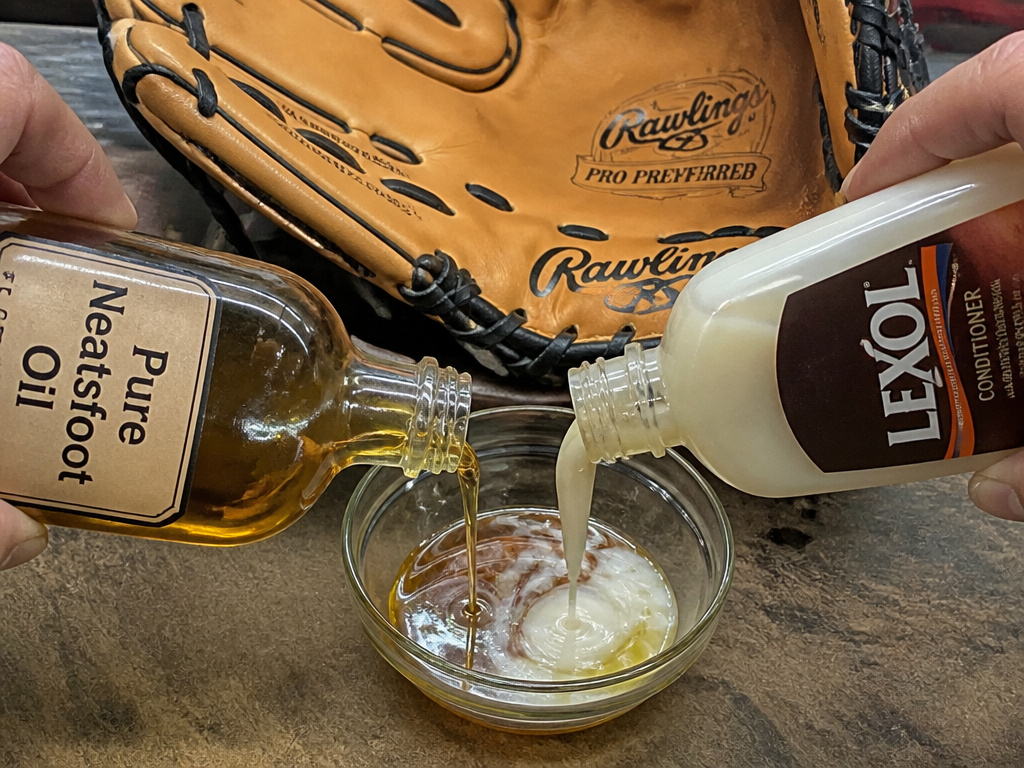
Pure neatsfoot oil is strong. On a new baseball glove, it can soften the palm so much it loses its pocket shape. Here’s the fix I learned from breaking in a Rawlings Heart of the Hide glove.
Mix pure neatsfoot oil 50/50 with a light conditioner like Lexol Conditioner. The neatsfoot aggressively softens the stiff palm and hinges, while the Lexol keeps the leather from getting overly greasy and limp. It’s the difference between a glove that’s broken in and one that’s broken.
Apply any blend to the laces first. Dry laces snap. Oiled laces stay flexible and help pull the whole glove into shape as you work it.
When Not to Use Neatsfoot Oil
This oil isn’t universal. Using it in the wrong context doesn’t just fail, it damages.
- Suede or Nubuck. The oil will darken it unevenly and mat down the nap permanently.
- Light-Colored Leathers. It will turn cream leather tan and tan leather brown.
- Heirloom or Archival Pieces. The pH mismatch accelerates degradation over a 50-year timeline.
- Leather You Plan to Highly Polish. The oil creates a barrier that prevents wax-based polishes from adhering properly.
- Garment Leathers (Jackets, Pants). It’s too heavy and will make the leather uncomfortably stiff and greasy.
For these, reach for a pH-neutral cream like Bickmore Bick 4. It conditions without the dramatic color change or long-term chemical risk.
Neatsfoot Oil vs. Everything Else
How does it stack up against the other options on your shelf? The difference isn’t about quality, but job suitability.
| Conditioner | Best For | Downside | Finish |
|---|---|---|---|
| Pure Neatsfoot Oil | Very dry, stiff vegetable-tanned leather (belts, saddles, work boots). | Always darkens; not for heirlooms; slow drying. | Rich, matte, supple. |
| Mink Oil Paste | Water resistance for outdoor footwear. | Can feel waxy; builds up over time. | Water-repellent, waxy. |
| Lexol Conditioner | Regular maintenance of all leather types. | Less effective on severely dried-out leather. | Light, natural. |
| Bick 4 | Light-colored, garment, or expensive leathers. | Lacks the penetrating power for bone-dry items. | Virtually no color change. |
If you’re weighing a mink oil vs neatsfoot oil decision, remember mink oil is for weatherproofing, neatsfoot is for resurrection. They solve different problems.
Frequently Asked Questions
Does neatsfoot oil waterproof leather?
It helps, but it’s not a sealant. Neatsfoot oil fills the leather’s pores, which slows water absorption. For real waterproofing, you need a wax-based product like Obenauf’s Leather Oil applied over a neatsfoot-oiled base.
How long does neatsfoot oil take to dry?
Plan for at least 24 hours per thin coat before you use the item. In humid conditions, it can take 48 hours. The leather should feel dry to the touch and not transfer oil to a clean cloth.
Can you use too much neatsfoot oil?
Absolutely. Over-saturated leather turns dark, greasy, and limp. It can also seep out onto clothing or other surfaces for weeks. The fix is time and aggressive buffing with a dry cloth to pull excess oil back out.
Will neatsfoot oil rot leather stitching?
No, pure neatsfoot oil won’t rot modern polyester or nylon thread. It can degrade natural sinew or cotton threads over many years, but that’s a concern for historical restoration, not everyday care.
Is neatsfoot oil safe for colored leather?
It’s safe for the leather’s integrity, but it will darken and intensify the color. On a cherry-red bag, it will deepen the red. On a pastel, it will ruin the hue. Always test.
The Bottom Line
Neatsfoot oil is a specialist, not a daily conditioner. Keep it for the projects where nothing else works: the vegetable-tanned belt that’s gone stiff as a board, the work boot that cracks when you bend it, the baseball glove that won’t close.
Apply it thin. Wait a full day between coats. And accept the darker color as the cost of doing business.
For everything else, your jacket, your bag, your good shoes, a pH-neutral conditioner like Bick 4 is the quieter, smarter choice. It keeps leather looking like itself, just better cared for. That’s the real goal.
