
What is a Chelsea Boot | The 3 Defining Parts Explained
This post contains affiliate links. As an Amazon Associate, we earn from qualifying purchases.
This post contains affiliate links. As an Amazon Associate, we earn from qualifying purchases.
A Chelsea boot is an ankle-high boot defined by three specific parts: elastic side panels (gussets) for slip-on wear, a low heel, and a snug fit around the ankle secured by a continuous leather upper. The design dates to 1837, enabled by Charles Goodyear’s vulcanized rubber, and eliminates the need for laces or buckles.
That third part, the snug, continuous upper, is where most discussions stop. They mention the elastic, but they don’t explain how the leather’s shape and the panel’s placement work together to create that signature fit. A poorly made gusset stretches out in six months; a well-made one holds its shape for a decade. The difference is in the construction details most guides gloss over.
What follows is a breakdown of the boot’s anatomy, from the Victorian patent to modern manufacturing tricks like Crockett & Jones’s “blocking” process. By the end, you’ll be able to look at a pair and know whether you’re seeing full-grain leather and Goodyear welt construction or a cheap imitation.
Key Takeaways
The elastic side gusset is the essential feature, joining the vamp and quarters just above the ankle; its quality and placement dictate longevity. – True quality comes from lasting and construction, look for terms like Goodyear welt or storm welt for resoleability, not just “genuine leather.” – The RM Williams boot uses a unique single-piece upper construction, a major variance that eliminates the side seam for increased strength. – Toe shape and sole material are the main variables: round toes are classic, chisel or almond toes are modern, and rubber soles beat leather for daily wear. – Avoid boots where the elastic runs all the way to the sole; it should stop just above the welt, or it becomes a structural weak point.
The Three Parts That Make a Chelsea Boot
Forget fashion labels for a minute. Mechanically, a Chelsea boot is a system for getting a snug, laceless boot on and off your foot. Three pieces make it work, and if one is wrong, the whole thing fails.
The first is the continuous upper. This is the main body of the boot, typically formed from the vamp (the part over the front of your foot) and the quarters (the sides and back). On most boots, these are two separate pieces of leather stitched together below the ankle. That seam is a potential stress point. On the highest-end versions, like those from RM Williams, the upper is crafted from a single piece of leather joined only at the heel, a construction that trades stitching complexity for superior durability.
The elastic side panel, or gusset, is a strip of vulcanised rubber or elastic that joins the vamp and quarters near the ankle. It extends to just below the ankle but not to the sole, maintaining the boot’s structure while allowing flex for entry and removal.
The second part is the elastic side gusset. This isn’t just a strip of elastic sewn in as an afterthought. In proper construction, it’s a structural bridge. The vamp and quarters are stitched together below where the gusset is set. The gusset is then set into a U-shaped opening, creating a flexible panel. If the elastic runs all the way down to the welt, the boot loses lateral stability. You’ll feel it wobble on uneven ground within a season.
Finally, the heel pull tab isn’t just decoration. It’s the lever. Trying to force your foot in by grabbing the top of the boot collar strains the elastic and distorts the leather. The tab gives you a dedicated, reinforced point of purchase. No tab? You’ll see people using a shoehorn, which defeats the purpose of the easy-on design.
A Quick History: From Queen Victoria to The Beatles
The story starts with a problem. In the early 1800s, boots were the standard footwear, but they fastened with buttons or laces, a tedious process. London shoemaker Joseph Sparkes Hall solved it. Around 1837, he patented an “elastic ankle boot” for Queen Victoria, using the newly invented vulcanized rubber from Charles Goodyear to create the side gussets. The Queen, reportedly, walked in them daily.
The boot was practical, but it wasn’t yet cool. That changed in the 1950s and 60s in London’s Chelsea district. The “Chelsea Set” of artists, musicians, and actors adopted it. Then, in 1961, The Beatles walked into theatrical shoemaker Anello & Davide. They saw a standard Chelsea boot in the window and commissioned a version with a higher, Cuban heel and a pointed toe. The Beatle boot was born, and the style became inseparable from the mod and rocker scenes. Its cultural significance and design evolution are well-documented, cementing its place from practical Victorian innovation to a 20th-century icon.
Construction & Quality: What to Actually Look For
You can find Chelsea boots for fifty dollars or five hundred. The price often hinges on construction methods invisible at a glance. Here’s what separates a throwaway pair from a lifelong companion.
The most important hidden detail is how the sole is attached. Goodyear welting is the gold standard. A strip of leather (the welt) is stitched to the upper and a separate insole. The outsole is then stitched to the welt. This creates a cavity that can be filled with cork, molding to your foot, and, crucially, allows the outsole to be replaced multiple times. A storm welt is a variant that angles outward, helping shed water. Blake stitch construction is sleeker and lighter but is harder to resole and less water-resistant. Then there’s cemented construction, glue. It’s cheap, it’s common, and when the bond fails, the boot is trash.
Leather quality is a minefield. “Genuine leather” is a useless term, it legally refers to the bottom layer of the hide. Look for full-grain or top-grain leather. Full-grain is the strongest, most durable outer layer, and it will develop a patina. Top-grain is sanded and refinished, often for a more uniform look. For the gusset, the elastic should be wide, tightly woven, and firmly anchored with double-stitching. Narrow, flimsy elastic is the first point of failure.
Where this goes sideways: Buying based on “hand-stitched” claims alone. A lock-stitch done by a quality machine is stronger and more consistent than uneven hand-stitching. The thread type matters more, bonded nylon or polyester for strength, linen for tradition.
Chelsea Boot Variations and Styles
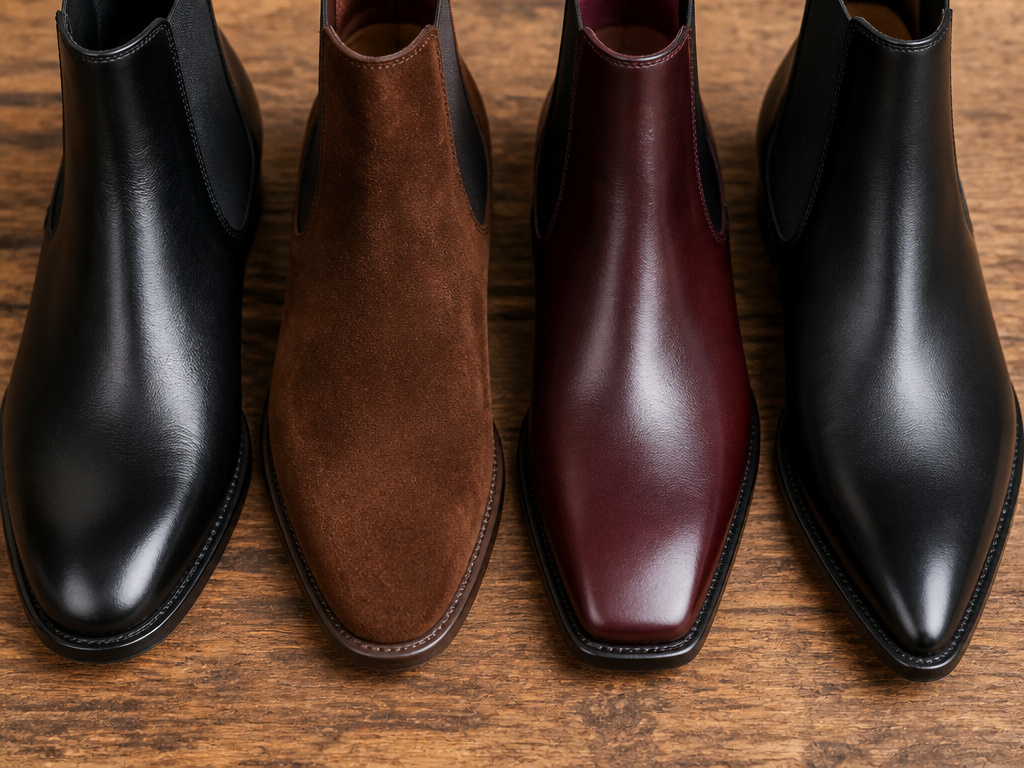 The basic template has spawned countless interpretations. The variations let you choose a boot for a boardroom, a barn, or a rainy city street.
Toe Shape: This is the biggest style differentiator. * Round Toe: The original, classic shape. Most versatile and traditional. * Chisel or Almond Toe: A tapered, elegant look. Modern and dressier. * Square Toe: A bold, contemporary statement. Can be harder to style. * Pointed Toe: The Beatle boot heritage. Dramatic and retro.
Sole Material: This is a practicality choice. * Leather Soles: Traditional, sleek, and dressy. They wear down quickly on pavement and are slippery when wet. * Rubber Soles: The practical choice for most people. They offer grip, durability, and weather resistance. Dainite or similar studded soles are a premium hybrid, durable rubber with a dressier profile.
Material & Finish:
- Suede: Softer, more casual, and develops a beautiful nap. It’s more vulnerable to stains and water.
- Polished Leather: From calfskin to cordovan, this is for formal or smart-casual settings.
- Weather-Ready: Brands now offer versions with Gore-Tex linings, storm welts, and water-resistant leathers. These are genuine tools, not just fair-weather fashion.
| Variation | Best For | Compromise / Consideration |
|---|---|---|
| Round Toe + Leather Sole | Formal wear, office settings, classic style | Less grip, less durable on concrete |
| Chisel Toe + Rubber Sole | Smart-casual, daily urban wear, versatility | Some find the tapered toe less comfortable |
| Suede Upper | Casual outfits, texture-focused style | Requires protective spray, avoid wet weather |
| Storm Welt + Waterproof Leather | Commuting, travel, inclement weather | Often heavier, less sleek in profile |
How a Premium Chelsea Boot is Made: The “Blocking” Process
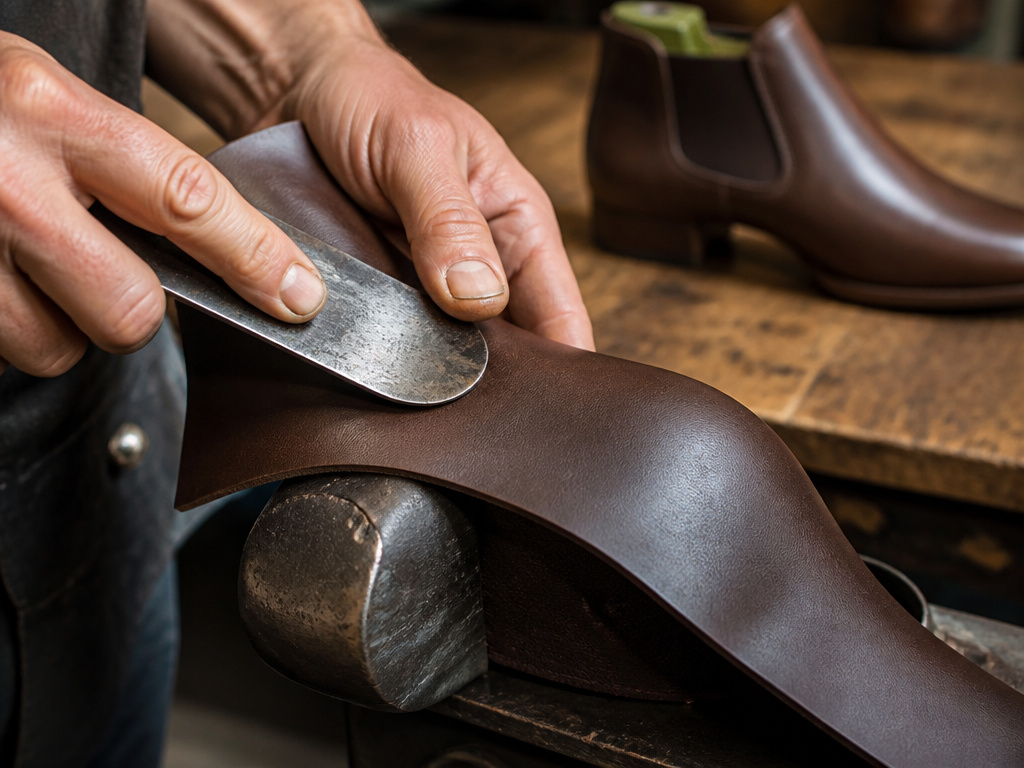 High-volume brands cut patterns and assemble. Heritage makers like Crockett & Jones use a slower, more precise method called blocking. This is a specific answer to a specific problem: how do you get the high, curved vamp of a Chelsea boot to sit perfectly on the last (the foot-shaped form)?
Blocking involves placing the leather for the vamp over a specially engineered metal blade. Pressure is applied, sculpting the leather into the exact three-dimensional shape needed before any cutting happens. The pre-shaped “castors” are then sent to be cut to the precise half-size. This lengthy prep ensures the leather wraps the last without puckers or undue tension, resulting in a cleaner line and a more comfortable fit that holds its shape. It’s the kind of step that doesn’t appear on a spec sheet but is felt on your foot.
This attention carries through to the finishing. The edge of the sole will be neatly trimmed and stained, not raw. The heel stack will be layered leather, sanded smooth. The elastic will be set in with tight, even stitches. These are the signs you’re holding a quality boot, where the craftsmanship is in the details that don’t scream for attention.
Chelsea Boots vs. Other Ankle Boots
It’s easy to confuse styles. Here’s how the Chelsea boot stands apart from its closest cousins.
Chukka Boots: A chukka boot is defined by its two or three pairs of eyelets for laces and its open lacing system. It’s an ankle boot, but it lacks the defining elastic side panel. Chukkas are almost universally casual, often with a suede upper and a crepe or rubber sole. The Chelsea is more versatile, sliding from casual to formal thanks to its clean, laceless face.
Desert Boots: This is essentially a specific type of chukka boot (suede, crepe sole), so the same distinction applies: laces vs. Elastic.
Ankle-High Work Boots: Boots like the classic 6-inch work boot share the height. But they are defined by their lace-up closure, often a steel toe, and a heavy-duty purpose-built look. The Chelsea is defined by its sleek, laceless silhouette.
Jodhpur Boots: This is the closest relative and the most common source of confusion. A Jodhpur boot is also ankle-high and often has a strap and buckle closure around the ankle, not at the instep. Some minimalist Jodhpurs can look very Chelsea-like, but the buckle is the tell. The Chelsea is pure, closure-less simplicity.
Frequently Asked Questions
Are Chelsea boots formal?
They can be. A Chelsea boot in sleek, black calfskin with a leather sole and a chisel toe is absolutely formal enough for a suit. A suede Chelsea with a commando sole is strictly casual. The key is the specific combination of materials and details. Their versatility is their strength, but you have to check the intended use and weight rating on the product tag.
How should Chelsea boots fit?
Snug, but not tight. Your heel should be held firmly with no slip. The elastic panels should hug your ankle without pinching. There should be enough room in the toe box to wiggle your toes slightly. The most common mistake is buying them too large, thinking they’ll stretch. Quality leather will mold, but it won’t shrink; a boot that’s loose from day one will never fit right.
Can you resole Chelsea boots?
Yes, if they are constructed with a resoleable method like a Goodyear welt or Blake stitch. This is a critical factor in longevity and a hallmark of quality. Cemented boots cannot be properly resoled, once the sole wears thin, the boot is finished. Always check the construction type before investing in a premium pair.
What’s the difference between men’s and women’s Chelsea boots?
The core design is identical. Differences are typically in last shape (women’s versions often have a narrower heel and more tapered toe box), available sizes, and sometimes the height of the heel. A low “Cuban” heel is common on women’s styles for a slight lift. The best unisex styles are built on a more neutral last.
How do I care for leather Chelsea boots?
Use a regimen based on the leather. For polished calfskin, use a damp cloth to wipe clean and a cream polish occasionally. For suede, use a suede brush and a dedicated protector spray. Amazon.com/dp/B001CS2Q4M?linkCode=osi&th=1&psc=1&tag=test-20)) once or twice a year is sufficient. The elastic panels generally require no special care; just avoid getting them soaked in oils or conditioners, which can degrade the elastic over time.
Before You Go
So, what is a Chelsea boot? It’s a system, elastic, upper, tab, perfected in 1837 and never fundamentally improved upon because it didn’t need to be. The round toe is classic, the chisel toe is modern, but the functional heart remains.
If you’re buying your first pair, let practicality lead. Choose a rubber sole, a round or chisel toe in a versatile color like brown or black, and prioritize construction (look for “Goodyear welt”) over exotic leather. That combination will handle 95% of what you throw at it. The best leather boots aren’t the flashiest; they’re the ones you forget you’re wearing because they just work, day after day, exactly as a tool should.
