Skiving Knife Explained: The Key Tool for Thinning Leather
This post contains affiliate links. As an Amazon Associate, we earn from qualifying purchases.
This post contains affiliate links. As an Amazon Associate, we earn from qualifying purchases.
A skiving knife is a specialized, wide-bladed hand tool used in leathercraft to shave off thin layers of leather, primarily to taper edges for seamless joining or to reduce bulk for folding. Its rectangular blade, sharpened on three sides, is pushed almost flat across the leather’s surface, scraping away material with controlled, shallow cuts. This process, called skiving, is fundamental for creating professional-looking seams on items like wallets, bags, and belts where multiple layers would otherwise create an uncomfortable, bulky ridge.
That description covers the what, but the why separates a usable tool from an essential one. A skive with a consistent bevel angle and a feathered edge transition marries pieces perfectly, without a step or a lump. The edge you’re thinning will be glued and stitched, hidden inside a fold, or blended into a curve. Get it wrong, and the flaw is buried in the construction, whispering “amateur” every time the item is handled. Get it right, and the piece feels born whole.
What follows is a breakdown of the tool itself, blade shapes, steel types, handle ergonomics, and the technique that brings it to life. We’ll cover when to reach for a skiving knife over a machine, a few tricks the old manuals don’t mention, and how to keep the one tool in your kit that absolutely must be sharp.
Key Takeaways
- A skiving knife’s primary job is to taper leather edges for invisible seams and comfortable folds, not for general cutting.
- Blade shape dictates use: diagonal blades are for long, straight edges; curved blades excel at recesses and controlled depth work.
- Sharpness is non-negotiable. A dull blade will tear leather instead of shaving it, ruining your work and requiring more force.
- For soft or slick leather, dusting the surface with a pinch of flour gives the blade immediate bite and prevents dangerous slips.
- While electric skiving machines are fast, a hand skiving knife offers unmatched control for detail work, tight spaces, and steep, short tapers.
What a Skiving Knife Actually Does
Let’s be clear about one thing. This isn’t a knife for cutting out patterns. You use a round knife or a utility blade for that. A skiving knife is a planer. Its wide, flat blade is designed to be held at a low angle and pushed forward, taking off gossamer-thin shavings to reduce thickness with precision.
A skiving knife is a hand tool with a wide rectangular blade (typically 6–10 cm) with a very sharp, straight cutting edge and a firm handle. The leatherworker places the blade almost horizontally on the leather and pushes it forward, scraping away material to create an even, tapered surface.
The core mechanical action is a controlled scrape, not a slice. You’re not trying to wedge the blade deep into the material. You’re using its razor edge to pare away the top layers, guided by the angle of your hand and the pressure of your thumb on the blade’s spine. The goal is a smooth, gradual transition from the full thickness of the leather down to a feathered edge sometimes as thin as paper.
Key Uses of a Skiving Knife in Leatherwork
The applications are everywhere a neat join or a refined edge is needed. Here are the most common:
- Reducing Bulk at Seams: This is the number one job. Before gluing and stitching two pieces together, like the gusset to the body of a bag, you skive the edges that will meet. This ensures the combined thickness at the seam is no greater than the surrounding leather, preventing a hard, raised line.
- Preparing Leather for Folds: Think of a belt end folding over a buckle, or a wallet’s card slot flap. Skiving the leather where it will fold makes the bend supple, clean, and comfortable instead of stiff and bulky.
- Creating Tapered Profiles: For aesthetic edges that aren’t joined, like on a knife sheath or the tip of a belt, skiving creates a elegant, sloping finish.
- Thinning Specific Areas: Sometimes you only need to reduce thickness in a small spot, like where a strap attaches to a buckle or where a decorative overlay sits. The skiving knife’s precision is perfect for these localized tasks.
Anatomy and Types: Choosing Your Blade
Not all skiving knives are the same. The differences in blade shape, steel, and handle drastically change how the tool feels and what it’s best for.
Blade Shape: The Geometry of the Cut
The shape of the blade’s cutting edge is your first major choice. It dictates the contact patch with the leather.
| Blade Shape | Best For | Why It Works |
|---|---|---|
| Diagonal | Long, straight edges (belt edges, long bag seams) | The straight, angled edge maintains consistent contact for the length of a pull, giving an even taper. |
| Curved | Controlled-depth work, curved recesses, detail skiving | The curve means only the center of the blade cuts deepest. You use the edges for lighter shaving, allowing fine control over the taper’s profile. |
| Diagonal Curved | A blend of the above; versatile for both straight and slightly curved work | Combines the long cutting edge of a diagonal shape with the control of a curve. A popular choice for generalists. |
Where this goes sideways: Picking a blade shape because it looks right, not because it matches your most common task. A diagonal blade will fight you on a tight inside curve, and a curved blade can leave a wavy finish on a long, straight edge if your technique isn’t perfect.
Steel, Hardness, and Handle Materials
The blade’s material determines how long it stays sharp and how it responds to honing. SKD11 steel (similar to D2 tool steel) is a common premium choice, often hardened to around 60 Rockwell. This makes it exceptionally wear-resistant, holding an edge through a lot of leather, but it can be more brittle and requires careful sharpening on stones.
Traditional high-carbon steel blades, like those on the Japanese-made knife from Lee Valley, take and keep a terrifyingly sharp edge but demand more frequent stropping to prevent rust and maintain that keenness.
Handles are about control and comfort during prolonged pressure. Dense, hardwoods like ebony, rosewood, or cocobolo provide a firm, non-slip grip that absorbs vibration. The shape matters too, many professional knives, like those from Vergez Blanchard, have a flat-sided handle designed to sit low in your palm, giving you direct feedback and leverage.
How to Use a Skiving Knife: The Forward Push
The motion feels unnatural at first. You’re not pulling the knife toward you like a paring knife. You’re pushing it away, using your body weight and arm, not just your wrist.
Here’s a straightforward guide. I’ll break down the details for you.
- Secure Your Leather. Anchor the piece firmly to your workbench with clamps or a stitching pony. Any movement during the skive will cause an uneven cut or, worse, a slip.
- Set Your Angle. Hold the knife with your dominant hand, gripping the handle firmly. Place the blade flat on the leather, bevel-side down, then raise the back of the blade just a millimeter or two. You want an angle of maybe 5–10 degrees. Almost horizontal.
- Apply Forward Pressure. With your index finger or thumb braced on the blade’s spine for control, push the knife forward in a smooth, steady motion. Don’t saw back and forth. One confident push.
- Let the Shavings Curl. A properly sharpened blade will produce a thin, continuous curl of leather. If you’re getting dust or tearing, your blade is dull or your angle is too steep.
- Repeat with Overlap. For a wider skive, make another pass slightly overlapping the first. Multiple light passes are always better than one heavy, gouging pass.
Skip the initial light pass, and you’ll dig a trench. The first pass establishes the plane. If you try to take too much off at once, the blade will catch and dive into the leather, creating a valley you then have to try and flatten out, often by removing more material than you intended.
The Flour Trick for Slippery Leather
Soft leathers, especially chrome-tanned or oily ones, can be frustrating. The blade wants to skate across the surface instead of biting in. An old bench trick solves this: dust the area you plan to skive with a tiny amount of ordinary flour. The fine powder gives the blade immediate micro-traction, preventing slips and giving you perfect control. Wipe it away when you’re done. It’s one of those simple, non-commodity insights that changes the game.
Hand Skiving Knife vs. Machine Skiver
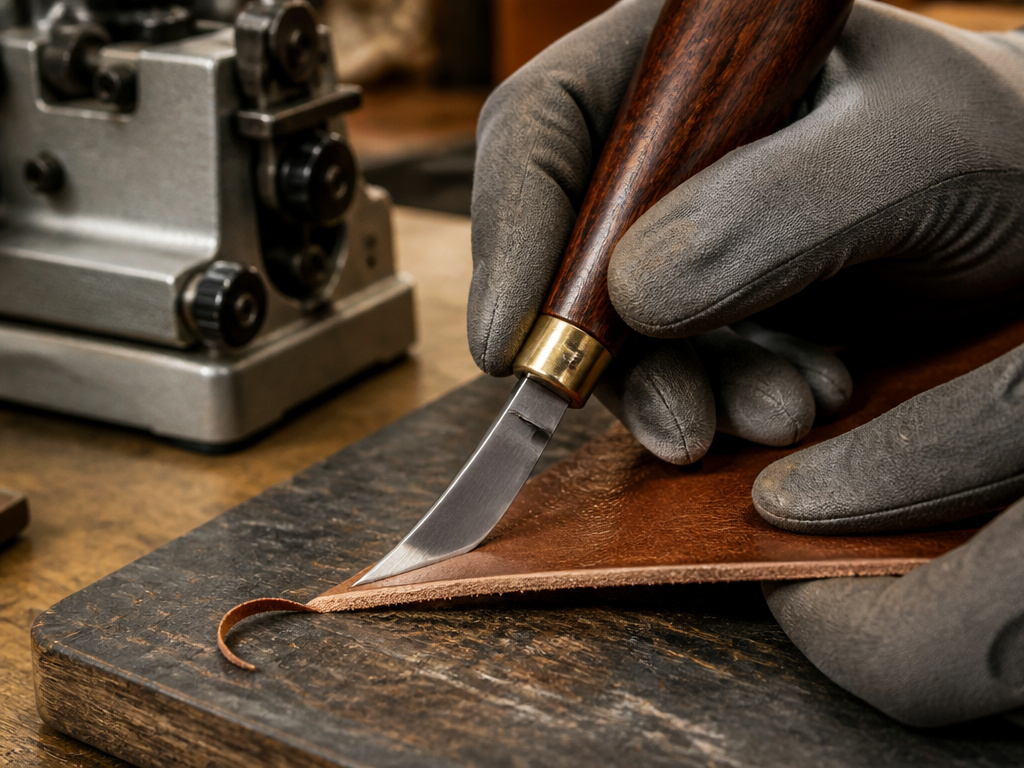
This is a classic trade-off: the absolute control and versatility of hand tools versus the speed and perfect consistency of machinery.
A hand skiving knife is agile. It can work on a partially assembled bag, skive a steep taper on a tight curve, or thin just a half-inch of a strap. It requires developed skill, your hand is the motor and the guide, but once mastered, it’s the most adaptable tool in your kit. Brands like C.S. Osborne and Vergez Blanchard make the models most professionals reach for.
Tabletop skivers (like the C.S. Osborne tabletop model) and powered bell knife skivers are for volume. You set a skiving height, clamp the leather, and pull it through. The result is a perfectly consistent ribbon of leather removed, edge to edge. They are fantastic for production work on long straps or prepping many identical pieces. But they can’t handle short pieces, complex curves, or work inside an assembly.
The practical takeaway? Start with a knife from a brand like Veritas or Flexcut. It teaches you the feel of the leather and the mechanics of the cut. If you find yourself skiving miles of strap leather for a product line, then consider the machine. The machine doesn’t replace the skill; it automates the result of that skill.
Maintaining Your Edge: Sharpening is the Whole Game
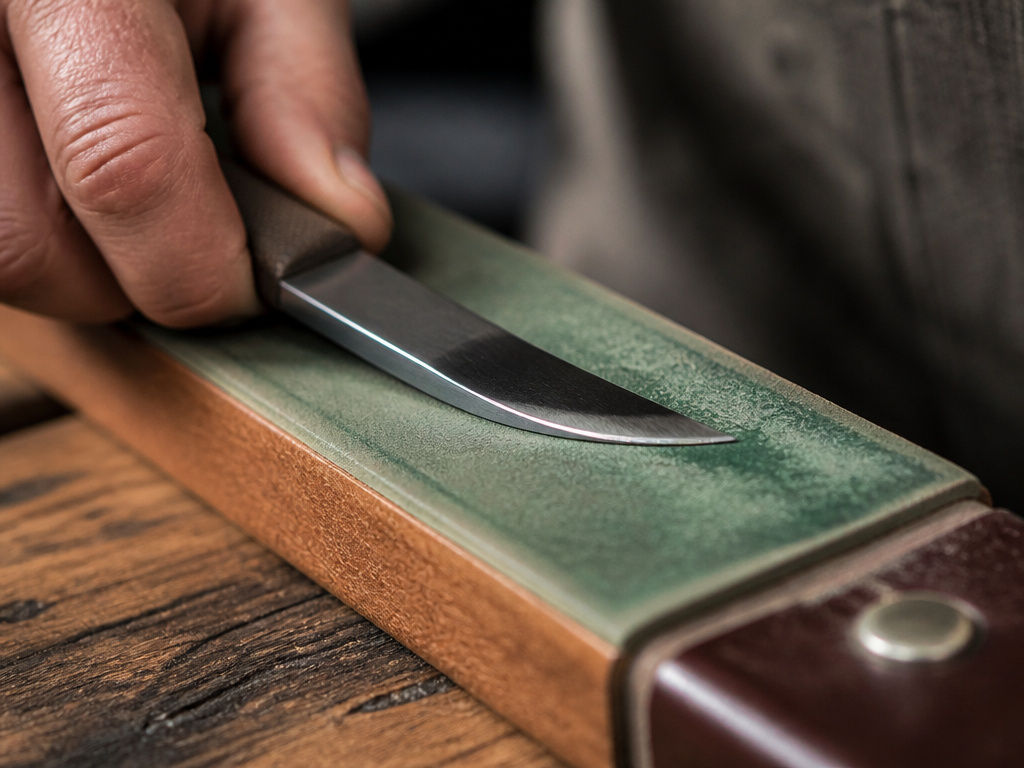
A skiving knife is only as good as its edge. A dull blade doesn’t skive; it tears, crushes, and requires so much force that control vanishes and safety plummets.
You don’t need a complex sharpening regimen. You need a consistent one. After every project, or even during a long skiving session, strop the blade. A leather strop charged with a fine abrasive compound (green chromium oxide or diamond paste) realigns the microscopic edge without removing significant metal.
When the stropping no longer restores a push-cutting edge, it’s time for stones. Start with a medium grit (around 1000) to re-establish the bevel, then progress to a fine stone (3000-6000), finishing on a super-fine (8000+) or the strop. The goal is a polished, razor edge that reflects light in a clean line.
Common mistake: Only sharpening when the knife is completely dull. This requires removing a lot of metal to fix. Frequent, light stropping maintains the edge indefinitely, preserving your blade’s life and your sanity.
Frequently Asked Questions
Can I use a utility knife or X-Acto blade for skiving?
You can try, but you shouldn’t. Those blades are too narrow and flexible. They will follow the grain and imperfections in the leather, resulting in a wavy, uneven skive. The wide, rigid blade of a skiving knife with a flat-ground back bridges over small inconsistencies, giving you a flat, true plane. It’s the difference between planing a board with a hand plane versus a chisel.
Is a skiving knife only for leather edges?
Primarily, yes. Its design is optimized for creating tapers. However, a sharp skiving knife can also be used as a superb light-duty scraper to clean glue residue or to slice through leather along a cut line when used against a metal straightedge. Don’t force it into roles it wasn’t designed for, like cutting out thick patterns.
I’m left-handed. Are there skiving knives for me?
This is a genuine hurdle. Many high-quality knives, like the specific Japanese model from Lee Valley, are ground with a single bevel for right-handed users. Using one left-handed forces the blade at an incorrect angle. Some manufacturers, like Doldokki, offer left-handed versions of their diagonal-curved blades. Your best bet is to seek out a symmetric double-beveled knife or confirm a maker offers a true left-handed model.
How do I prevent gouging the leather?
Gouging happens from too much downward pressure or too steep an angle. Focus on forward motion, not pushing down. Let the sharpness of the blade do the cutting. If you feel like you’re having to lean on it, stop and strop the blade. The leather should almost feel like it’s melting away under the tool.
What’s a good beginner skiving knife?
Look for a diagonal or diagonal-curved blade in a mid-range steel. It’s the most forgiving shape for learning the basic push stroke on straight edges. Avoid the cheapest options; a blade that won’t hold an edge will make learning impossible and frustrating. A serviceable starter knife from a known leathercraft supplier is a better investment than a no-name tool that arrives dull.
The Bottom Line
A skiving knife isn’t a optional accessory for advanced leatherworkers. It’s a fundamental tool for achieving professional-grade construction. The ability to seamlessly join two pieces of leather is what elevates a homemade item to a handcrafted one.
Start with one good blade, a diagonal shape is most versatile, and commit to keeping it sharp. Practice on scrap leather, focusing on that low-angle forward push until the motion feels natural. Ignore the impulse to buy a machine until your hand tells you the limitation is speed, not skill. The control you develop with the hand tool will inform every other cut you make.
