
How to Choose Leather Gloves: Material, Fit & Stitch Guide
This post contains affiliate links. As an Amazon Associate, we earn from qualifying purchases.
To choose leather gloves, start with the leather: cowhide for general durability, goatskin for fine work, or deerskin for soft warmth. Then get the fit right, measure around your knuckles, not the length of your fingers. Finally, pick the construction: a Gunn cut for dexterity and a keystone thumb for comfort. A glove that pinches at the knuckle or feels bulky in the palm is the wrong glove.
That’s the three-part checklist. Leather isn’t a single material; it’s a category. A thick cowhide work glove and a thin lambskin dress glove share a name and nothing else. The right choice balances the job’s abrasion risk against your hand’s need to feel and move.
What follows is a breakdown of those three parts, material, fit, and construction, with the specs that actually matter. You’ll know how to read a product description, spot a quality stitch, and avoid the pair that stiffens up after one wash.
Key Takeaways
- Measure for fit around your knuckles, not your palm. A glove that’s tight across the back of your hand will fail first.
- Grain leather (the top layer) is more durable and weather-resistant. Split leather (the underside) is more abrasion-resistant but absorbs oil and water.
- A Gunn-cut pattern with a keystone thumb offers the best dexterity and comfort for prolonged wear, but costs more than a basic Clute cut.
- Never clean leather gloves with soap unless the maker explicitly says to. Soap strips natural oils, leading to stiffness and cracks.
- For a balance of softness and durability in daily gloves, look at capeskin or deerskin. Save ultra-soft lambskin for occasions.
The Leather Comes First: Hide, Grain, and Thickness
The animal and the part of its hide determine everything. Common wisdom says “leather is leather.” Common wisdom is often wrong.
Cowhide is the default for a reason. It’s heavy, moderately priced, and resists abrasion and dirt well. It starts stiff but breaks in. Pigskin is softer out of the box and handles moisture without stiffening, its porous structure breathes. Goatskin carries natural lanolin, making it supple, water-resistant, and excellent for tasks needing fine dexterity. Deerskin is the warmest and softest, molding to your hand like a second skin, but it sacrifices some durability.
Then there’s the cut. The hide is split into layers. The top, outer layer is grain leather. It has a tight, dense fiber structure and often a smooth finish. This is what you see on a quality jacket or a durable work glove. It’s more weather-resistant.
Grain leather forms the hide’s natural, dense outer surface. It’s tougher and better for outdoor conditions where water and dirt are factors.
The underside layer is split leather. It’s sueded, fibrous, and incredibly abrasion-resistant because those interwoven fibers grip and hold. It’s also less expensive. The trade-off? It absorbs oils and moisture more readily. In a metal shop, that’s an advantage. On a fireline, that’s a disqualification.
Thickness matters, but it’s measured in ounces (oz), not millimeters. A 3-ounce cowhide is a robust work glove. A 1.5-ounce deerskin is a delicate dress glove. Thicker means more protection and less feel. Your job picks the weight.
| Leather Type | Best For | Trade-Off |
|---|---|---|
| Cowhide (Grain) | General work, abrasion, outdoor wear | Starts stiff; breaks in over time |
| Pigskin | Moist environments, tasks needing flexibility | Less durable than cowhide |
| Goatskin | Fine dexterity, water-resistant tasks | Softer, can be punctured more easily |
| Deerskin | Warmth, supreme comfort, dress wear | Lowest abrasion/puncture resistance |
| Split Leather | High abrasion tasks, oil absorption (e.g., metal handling) | Absorbs moisture, less weatherproof |
How Fit Actually Works: Measuring the Right Way
A size label is just a suggestion. Your hand’s circumference is the rule.
Forget measuring your palm. Wrap a soft tape measure around your dominant hand at its widest point, across your knuckles, excluding your thumb. That number, in inches, is your starting point. A hand measuring 8 inches around typically fits a men’s size 8. Brands vary, so a detailed glove sizing guide is your next stop.
Here’s the thing. Gloves for active use need room. If the leather pulls taut across your knuckles when you make a fist, size up. A tight fit stresses the seams every time you move. Dress gloves can be snugger, but they still shouldn’t compress your fingers.
Length is the second check. The glove tip should reach the base of your fingernail. Too long, and the fingertips bunch and hamper feeling. Too short, and you’re stretching the leather with every grab.
Common mistake: Buying gloves that fit your palm but are tight across the knuckles. The seam at the thumb crotch will blow out within a month of regular use.
Try gloves on in the afternoon. Hands swell during the day. That slight morning snugness becomes a painful squeeze by 3 p.m. If you’re buying unlined gloves, remember they’ll stretch about half a size with wear. Lined gloves won’t give much.
Pattern and Thumb: The Shape of Work
The way a glove is cut and sewn dictates comfort and longevity. This is where cheap gloves reveal themselves.
The two main patterns are Gunn cut and Clute cut. A Gunn-cut glove has a single, seamless piece of leather across the back of the hand. The seams are set away from the palm’s working area, and the two middle fingers are sewn in separately to reduce bulk. It’s the pattern for jobs requiring hand dexterity and a secure grip. It costs more to make.
A Clute cut uses a one-piece palm with seams running up the inside of each finger. It’s roomier, simpler to manufacture, and more economical. It’s fine for general, non-precision tasks where cost is a bigger factor than perfect feel.
The thumb design is a small detail with a huge impact. A straight thumb is cheap and sewn straight on. It doesn’t allow for natural motion. A winged thumb is set at an angle, offering better flexibility for pushing and pulling. The keystone thumb is cut and angled to mirror your thumb’s natural position in the palm. It’s the most comfortable for all-day wear and complex handwork, and it reinforces the high-stress webbing area.
I’ve used the same simple four-stitch saddle stitch for every high-stress seam because its locking mechanism is incredibly strong and durable. Look for that kind of reinforced stitching at the thumb crotch and between the fingers on any glove you plan to use hard. A single row of machine stitching will fray and fail.
Cuffs and Linings: The Finishing Touches
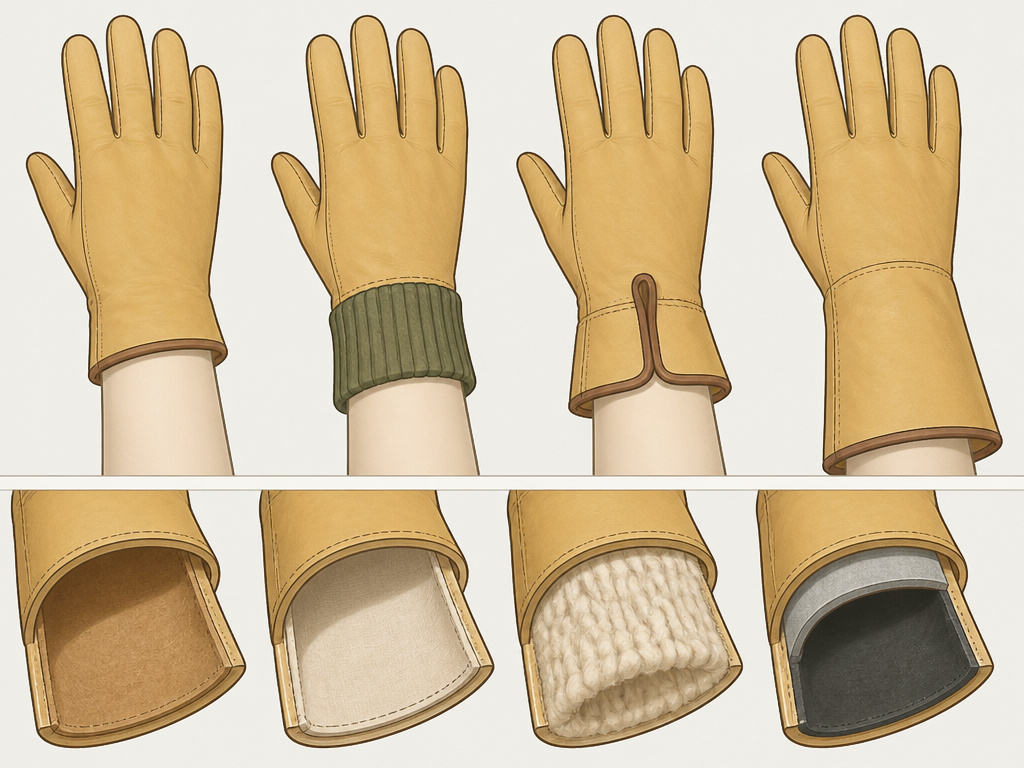 The cuff is about protection and removal. A basic slip-on cuff ends at the wrist. It’s easy on and off. A knit wrist cuff, usually two to three inches of stretchy fabric, keeps debris out and adds a little warmth. A safety cuff includes a slit or strap so you can yank the glove off quickly if it gets caught, an essential feature for machinery work. A gauntlet cuff extends four inches or more up the forearm, protecting against sparks, brush, or weather.
Linings add warmth, not durability. An unlined leather glove is the most breathable and will mold to your hand over time. A cotton or jersey lining prevents chafing during long wear. Wool or pile linings are warmer. Thermal linings are for sub-freezing work. Remember, a lining adds bulk. That cashmere-lined pair might feel luxurious, but if your hands sweat or you get caught in the rain, the lining will hold moisture and ruin the leather from the inside.
The Dexterity Trade-Off: What Safety Gloves Cost You
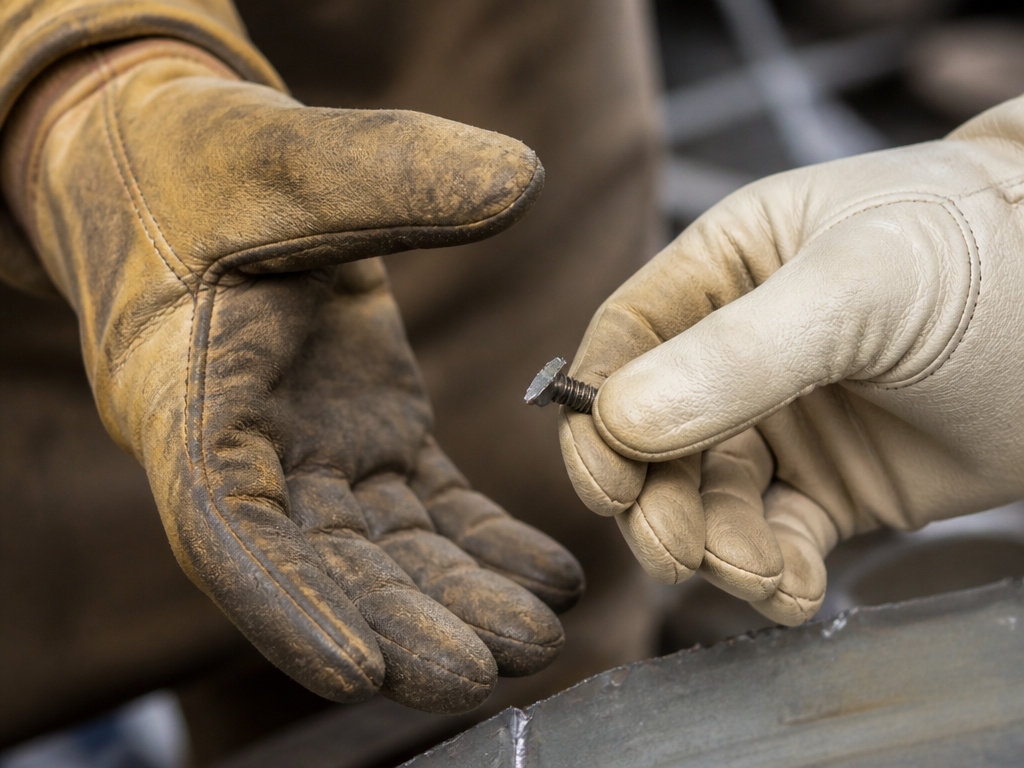 All gloves reduce your hand’s natural ability. A 2023 study on cut-resistant gloves in the PMC journal laid it out clearly. Every tested glove significantly lowered finger dexterity scores. Grip and pinch forces changed, and the range of motion in the wrist and fingers dropped. The study, a peer-reviewed glove usability testing analysis, found that thicker, protective materials inherently limit skill.
The lesson isn’t to skip gloves. It’s to choose the lightest, most flexible protection that meets the hazard. For handling sharp sheet metal, a cut-resistant liner under a thin goatskin glove might beat a bulky, padded model. You keep more feel and control, which itself is a safety feature. Fatigue from fighting a stiff glove leads to mistakes.
Cleaning and Care: The Industry Argument
Here’s where advice splits. One camp, including some official material guides like the NBS leather gloves circular, recommends mild soap and lukewarm water. The other camp, filled with leather workers, says never use soap.
I side with the workers. Soap is a degreaser. Leather needs its natural oils to stay supple. Soap strips those oils, leaving the fibers brittle. The glove stiffens, and then it cracks. Dry cleaning or using a dedicated leather cleaner is safer. For daily maintenance, just brush off dirt and let the gloves air dry away from direct heat. Condition sparingly, once or twice a season at most. Over-conditioning is like drowning wood in varnish; you clog the pores.
Even after years of experience, I once rushed through conditioning a vintage bag and applied too much product, leaving it tacky for weeks until it fully absorbed. The same mistake on gloves would attract dirt and grime, making them unpleasant to wear. For a full routine, our guide on essential leather glove care techniques walks through the safe steps.
Matching the Glove to the Job: A Quick Guide
This table sorts the common choices. Your priority decides the column.
| Your Priority | Leather Choice | Construction Pick | Brands to Look At |
|---|---|---|---|
| Maximum Dexterity & Feel | Goatskin or thin Deerskin | Gunn cut, keystone thumb, unlined | Chester Jefferies, Hestra (liners) |
| Heavy-Duty Work & Abrasion | Cowhide (grain or heavy split) | Clute or Gunn cut, safety cuff | Kinco, Wells Lamont |
| Cold Weather & Warmth | Deerskin or lined Cowhide | Gauntlet cuff, wool/pile lining | Hestra, Dents |
| Wet/Damp Conditions | Pigskin or oil-treated leather | Slip-on or knit cuff, unlined or quick-dry lining | Many work brands offer oil-tanned options |
| Driving & Grip | Perforated capeskin or thin leather | Gunn cut, short cuff, palm grip | Dents, Hebeos |
Frequently Asked Questions
Can leather gloves be waterproofed?
You can treat them with a wax-based conditioner (like beeswax) or a dedicated leather waterproofing spray. This will shed light rain. No treatment makes them submersible or truly waterproof for long periods, the seams will always leak. Pigskin and oil-tanned leather handle moisture best naturally.
How long should a good pair of leather gloves last?
It depends entirely on use. A quality deerskin driving glove with careful glove care can last for years of occasional wear. A heavy cowhide work glove used daily in a lumberyard might last a single season. The first sign of failure is usually seam splitting at the thumb or fingertip wear.
What’s the difference between ‘grain’ and ‘top-grain’ leather?
In gloves, they’re often used interchangeably to mean the top, outer layer of the hide. “Full-grain” means that top layer hasn’t been sanded or buffed to remove imperfections. For gloves, you’re usually getting grain leather (the good stuff) or split leather (the sueded underside). The label “genuine leather” is meaningless for quality, it just means it contains some leather, often the split layer.
Are leather gloves good for winter?
They can be, with the right lining. An unlined leather glove is a poor insulator. Look for a wool, pile, or thermal-lined leather glove with a gauntlet cuff to block wind. Deerskin is naturally the warmest leather. Our curated list of the best leather gloves for cold weather focuses on these insulated designs.
How do I stop my gloves from stretching out?
Buy the right size from the start. Leather will stretch slightly with wear, especially in width. Avoid pulling them off by the fingertips, which stretches the finger tubes irreparably. Instead, pinch the leather at the cuff and pull from there. Store them flat, not crumpled in a pocket.
Before You Go
Skip the softest leather if you need the glove to work. Lambskin feels luxurious but marks and tears if you look at it sideways. For a daily glove that balances comfort and toughness, capeskin or a mid-weight deerskin is the sweet spot.
Measure your knuckles, not your palm. That number is your guide, not the size on the tag. If a glove doesn’t feel right in the store, it will feel worse in an hour.
Finally, don’t wash them with soap. Use a damp cloth, a dedicated cleaner, or take them to a professional. A stiff, cracked glove is a discarded glove, and that’s a waste of good leather. Start with a pair built for your task, and they’ll last long enough to develop a real patina.
