
How to Shrink Leather Using Heat, Moisture, and the Risks
This post contains affiliate links. As an Amazon Associate, we earn from qualifying purchases.
To shrink leather, you apply controlled moisture and heat to tighten its collagen fibers. The method depends entirely on the leather’s tanning: vegetable-tanned leather shrinks around 85°C, while chrome-tanned can resist up to 120°C. Most home attempts risk permanent damage like cracking, discoloration, or a puckered texture.
That temperature range isn’t a guess. It’s the shrinkage temperature, a specific, measurable property defined by international standards like ISO 3380 and SATRA TM17. Tanners use this test to grade leather for products that must survive hot, wet manufacturing processes.
What follows is the science behind why leather shrinks, the exact industry test that defines it, and a safer path for attempting it at home on a pair of pants or a jacket that’s just a bit too roomy. We’ll also cover what you should never do, methods that turn a salvageable fit issue into a ruined garment.
Key Takeaways
- Leather shrinks because its core protein, collagen, denatures and contracts under moist heat at a specific shrinkage temperature.
- The shrinkage temperature is determined by the tanning method: chrome tanning (up to 120°C) resists heat far better than vegetable tanning (~85°C).
- Industry tests like SATRA TM17 use pressurized apparatuses to measure this property precisely for footwear manufacturing.
- At-home shrinking is high-risk; it often leads to uneven results, discoloration, and irreversible stiffness or cracking.
- The safest approach for a leather garment that’s too large is to have it tailored by a professional who works with leather.
What is the Leather Shrinkage Temperature?
Let’s be clear about this. When you read “shrink leather,” you’re talking about forcing a permanent, physical change in the material by overcoming its hydrothermal stability. This isn’t a gentle tweak. It’s a controlled failure of the leather’s structure.
The official test, SATRA TM17, defines it perfectly. A strip of leather is suspended in water inside a pressurized chamber like the SATRA STD 114 apparatus. The water is heated at a steady rate. Everyone watches. At a specific point, the strip suddenly contracts by several millimeters. That’s the shrinkage temperature.
The principle of SATRA TM17 is that a strip of leather is immersed in water and slowly heated until a sudden shrinkage occurs. The temperature at which this happens is characteristic of the tannage of the leather.
Why does this happen? Leather is mostly collagen, a protein that behaves like a bundle of coiled springs. Water and heat work together to break the bonds holding those coils tight. When enough bonds break at once, the springs snap into a shorter, tangled mess. That’s the irreversible shrinkage you see.
Raw, untanned hide will do this around 65°C. Tanning stabilizes the collagen, raising the temperature needed to trigger that collapse.
| Tanning Method | Typical Shrinkage Temperature | Best For |
|---|---|---|
| Chrome Tanning | Up to 120°C | Footwear, car interiors, garments needing high heat resistance |
| Vegetable Tanning | Up to ~85°C | Belts, bags, tooling leather where heat resistance is less critical |
| Alum/Vegetable Combination | Can exceed 100°C | Specialized leathers needing a balance of properties |
This table isn’t academic. If you try to shrink a chrome-tanned leather jacket with a hairdryer, you might never reach the 100°C+ needed, especially since the heat dissipates quickly in air. But a vegetable-tanned belt? It’s in the danger zone much sooner.
Why Tanning Type is Everything
You can’t talk about shrinking leather without knowing how it was tanned. The process isn’t just about color or feel; it fundamentally rewires the collagen’s resistance to heat.
Chrome tanning uses chromium salts that form strong, stable cross-links between collagen fibers. Think of it as adding extra welds to a steel frame. This creates the highest shrinkage temperature, which is why it’s used for shoes that go through hot cementing and molding. The downside is that if you do manage to hit that high threshold, the damage is catastrophic, think severe, brittle tightening.
Vegetable tanning uses natural tannins from bark and wood. These create a different, more heat-sensitive network of bonds. The result is that beautiful, patina-ready leather that craftsmen love, but with a much lower tolerance for moist heat. This is the leather that can shrink unintentionally if left in a hot car.
Then there’s alum tanning, often used for white or delicate leathers like some gloves or bookbinding leather. Alone, it’s not very heat-stable. Combined with vegetable tanning, it can create a “semi-alum” leather that performs better. But as a category, alum-tanned leathers are some of the most vulnerable to shrinkage.
Here’s the thing. Most quality leather garments, jackets, pants, skirts, from brands like AllSaints or Falcon Garments use chrome-tanned or chrome-retanned hides for this very reason. They need to withstand body heat, environmental warmth, and the occasional spot clean without deforming. The “second skin” fit in 100% non-stretch leather only works if the leather itself is thermally stable.
The Right Way to Shrink Leather at Home
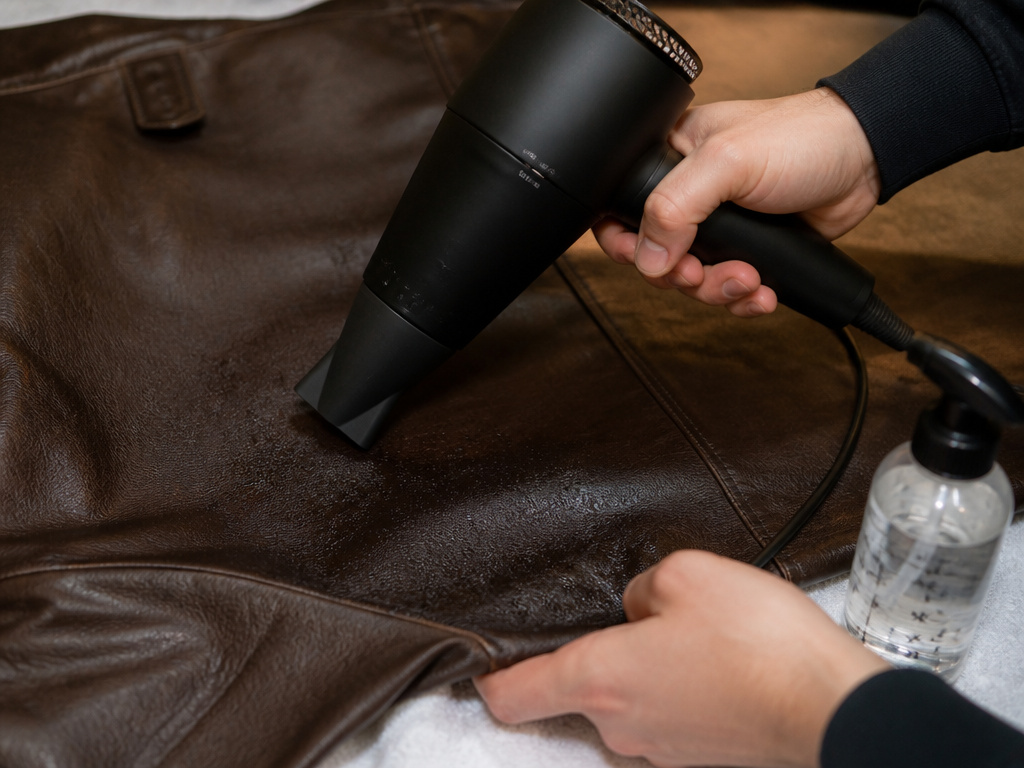 I need to start with a warning. I don’t recommend this. At all. The difference between a successful slight adjustment and a ruined piece is a matter of degrees, literally. But if you have an older, less valuable item and you’re determined, this is the most controlled path.
You’ll need a spray bottle with warm water, a clean towel, and a hairdryer. A clothes steamer can also work, but it’s harder to control.
Step 1: Dampen, Don’t Soak.
Lightly mist the inside of the garment where you want it to shrink, the back of a jacket, the thighs of pants. You want the leather damp to the touch, not wet through. Soaking it stretches the leather under the water’s weight, which is the opposite of your goal.
Step 2: Apply Gentle, Even Heat.
Put the garment on a hanger or lay it flat. Use the hairdryer on its medium setting, keeping it moving constantly 6-8 inches from the surface. The goal is to evaporate the moisture slowly and evenly. You’ll feel the leather get warm and start to tighten.
Step 3: Let It Cool On Form.
This is the part everyone skips. As the leather cools, the collagen fibers set in their new, slightly shrunken state. If you move or bend the garment before it’s fully cool, you’ll stretch it right back out. For pants, let them cool laid flat. For a jacket, leave it on the hanger.
Step 4: Condition (The Next Day).
Heat and water dry leather out. After the piece is fully dry (wait 24 hours), apply a thin coat of Bickmore leather conditioner.amazon.com/dp/B001CS2Q4M?linkCode=osi&th=1&psc=1&tag=leathergenesis-20) or Lexol**. This replaces lost oils and prevents the leather from becoming stiff and crackly.
Where this goes sideways: Using a high-heat setting or holding the dryer too close. The surface dries and hardens instantly, trapping moisture underneath. This causes the leather to shrink unevenly, creating hard, wrinkled ridges that never relax.
Could you use a clothes dryer? Some care labels might say you can, but I’ve seen the results. It creates a puckered, distressed look that’s impossible to reverse. For suede or nubuck, a dryer on any heat is a death sentence, it mattes the nap and can leave permanent, shiny heat spots.
What Not to Do: Common Shrinking Mistakes
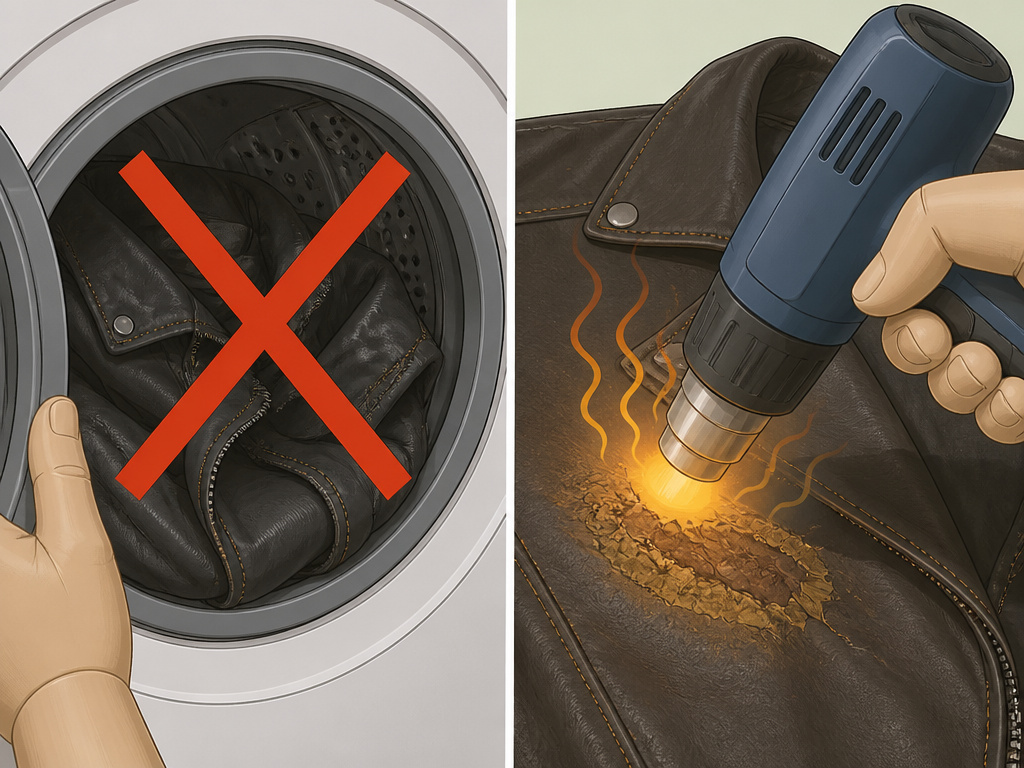 The internet is full of bad advice on this topic. Let’s untangle that.
Never machine-wash or machine-dry leather. Even on a gentle cycle, the agitation, detergent, and intense heat will destroy the material’s finish, structure, and color. You might get shrinkage, but you’ll also get a stiff, faded, misshapen mess. Dry-cleaning with standard chemicals is equally harmful, as they can strip oils and cause shrinkage all on their own.
Avoid direct, high-intensity heat sources. Placing leather near a radiator, using a heat gun, or ironing it (even with a cloth barrier) applies heat too fast and too locally. The leather doesn’t have time to contract evenly. Instead, it overheats, burns the oils, and becomes brittle. You’ll see discoloration first, then cracks.
Don’t store leather wet or damp. If you get caught in the rain, dry your jacket at room temperature away from direct heat. Storing it wet in a closet, or worse, a plastic bag, doesn’t just risk mildew. As the water slowly evaporates, it can cause slow, uneven shrinkage you won’t notice until you put it on again.
What about that story of using the sun? I once revived a bone-dry, stiff saddle by very carefully using brief, indirect morning sun alongside heavy conditioning. The key was the conditioning and the indirect light. Direct, hot afternoon sun will bake and shrink leather every time. It’s a last-resort tool for experts, not a standard method.
When to Call a Professional Tailor
Practically speaking, if your leather jacket is a size too big or your pants are baggy in the seat, the smartest money is on a tailor who specializes in leather. They have the right machines, the knowledge of grain direction, and the ability to take apart and reseam garments properly.
A tailor can: * Take in the sides of a jacket. * Shorten sleeves from the shoulder (preserving the cuff detail). * Taper the legs of leather pants. * Replace a lining.
The cost is often less than the replacement value of the garment you’re trying to save. They can also assess whether the leather has enough seam allowance to be altered at all, something you can’t know without taking it apart.
For items with sentimental value or high cost, this is the only path that makes sense. Shrinking is a destructive, irreversible process. Alteration is a constructive, reversible one.
Frequently Asked Questions
Can you shrink leather without damaging it?
It’s very difficult. Any process that causes shrinkage is, by definition, damaging the leather’s natural structure at a microscopic level. You might not see immediate damage like cracks, but you will likely lose softness, promote future stiffness, and alter the finish. The goal should be minimal, controlled change.
Does leather shrink in the wash?
Yes, and it’s a terrible way to do it. The wash cycle agitates and stretches the leather while wet, then the dryer bakes it under high, uneven heat. The result is often a shrunk, stiff, and discolored garment with a rough texture. This method is only cited in commodity guides because it’s dramatic, not because it’s sound.
How much can you shrink leather?
There’s no reliable percentage. It depends on the leather’s thickness, tannage, and how evenly you apply heat and moisture. Even in the controlled SATRA TM17 test, shrinkage is a sudden event, not a gradual reduction. At home, you might get a quarter-inch across a jacket back, or you might get one sleeve shorter than the other. It’s wildly inconsistent.
Can stretched leather be shrunk back?
Sometimes, but not to its original shape. If leather has stretched from wear (like the knees of pants), applying moisture and heat can help it contract somewhat. However, the fibers have been permanently elongated. You’ll never get it back to a “new” state, and repeated attempts will only weaken the material further.
Will a steamer shrink leather?
Yes, and it’s risky. A steamer delivers a concentrated blast of very hot vapor. It can cause rapid, localized shrinkage and set wrinkles permanently. If you must use one, hold it at least a foot away, keep it moving, and never steam the same spot for more than a second.
Before You Go
Let me share what I’ve learned. The desire to shrink leather usually comes from a love for a particular piece, it’s almost right, if only it fit. That emotional attachment is why the risky, DIY methods are so tempting.
The reality is, leather is a durable, timeless material because its structure is stable. Forcing it to change that structure is a fight against its very nature. The industry measures shrinkage temperature not so we can hack it at home, but so manufacturers can avoid reaching it during production.
So, here’s my straightforward advice. If you have a premium leather jacket or pants that don’t fit, seek a professional alteration. The cost is an investment in the garment’s future. If you have an old beater jacket you’re willing to sacrifice in the name of experiment, then the damp-and-low-heat method is your least-bad option. Just know that you’re walking right up to the line that the tanners worked so hard to draw.
