
Types of Leather Sofas | Key Durability Facts for Buyers
This post contains affiliate links. As an Amazon Associate, we earn from qualifying purchases.
This post contains affiliate links. As an Amazon Associate, we earn from qualifying purchases.
The main types of leather sofas are full-grain, top-grain, aniline, semi-aniline, pigmented, bonded, and faux leather. Your choice hinges on balancing natural character with practical durability. For a family room, a protected leather like semi-aniline or pigmented top-grain is the pragmatic pick; it resists stains and wear while lasting 15+ years. For a formal space where patina is the goal, full-aniline offers unmatched beauty but demands meticulous care.
That split between character and practicality is where most buying guides stop. They list the types but leave you guessing which one survives Tuesday night with a bowl of spaghetti. The real answer isn’t in the marketing copy. It’s in the durability surveys and the specific failure modes each leather hides.
What follows is a breakdown of seven sofa leathers, grounded in 2026 consumer data and material specs. This guide explains what each type actually feels like, how long it lasts with kids or pets, and the one field test that reveals a plastic coating in thirty seconds. By the end, you’ll match a leather to your life, not just your decor.
Key Takeaways
- Faux leather is the least durable option, a 2026 survey of 1,333 owners found over half reported damage, a statistically significant failure rate.
- The “heat test” identifies plastic top coats, if the material stays cool after 30 seconds of your hand, it has a synthetic coating that affects breathability and aging.
- Conditioning frequency is climate-driven, dry, heated homes need conditioning every 6 months; humid environments can stretch to 6-12 months.
- “Genuine leather” is a bottom-tier classification, it’s made from leftover hide scraps, not a mark of quality.
- Aim for a Martindale rub count over 30,000 for fabric alternatives if you have a high-traffic household; leather doesn’t use this rating, but its equivalent is hide thickness and finish.
The 2026 Survey Says: Durability Rankings You Won’t Expect
Let’s start with the numbers, because they flip the script. In October 2025, Which? Surveyed 1,333 sofa owners. The question was simple: does your sofa show damage or wear?
Real leather came in at a 40% damage rate. That’s worse than synthetic fabric (32%) and far worse than wool (16%). Faux leather was the clear loser at 57%. This wasn’t a fluke, a 2023 survey of over 4,000 members showed the same pattern.
Where this goes sideways: Choosing a leather sofa for perceived indestructibility. In owner-reported data, both real and faux leather underperform compared to many woven fabrics. Leather’s value is in its aesthetic and easy cleaning, not in being bombproof.
The reason is in the construction. Faux leather is a thin plastic film over a fabric backing. It cracks and peels because that film has no give. Real leather fails differently, usually through scratches, staining on unprotected types, or coating delamination.
So why buy leather at all? Because that 40% figure lumps all leathers together. A bonded leather sofa failing in three years is counted the same as a twenty-year-old full-grain piece developing a patina. The type of leather changes everything.
Decoding the Label: The Leather Spectrum from Full-Grain to Faux
Walk into a showroom and you’ll hear a cascade of terms. Here’s what they actually mean, moving from most to least natural.
Full-Grain Leather uses the entire outer hide, scars and all. No sanding, no corrective finish. This is the most durable leather for a sofa because the tight, intact fiber structure resists stretching. It ages by developing a patina, a rich, dark glow from oils and light. It’s also the most expensive and shows every mark of its life.
Top-Grain Leather is the outer hide lightly sanded to remove imperfections, then finished. It’s more uniform and slightly softer than full-grain. This is the workhorse of quality leather furniture. It balances durability, cleanability, and cost. Most high-end residential sofas use a top-grain leather with a protective coating.
Aniline Leather is dyed with soluble dyes without a opaque pigment topcoat. It’s incredibly soft and shows the hide’s natural character beautifully. It’s also the most vulnerable to stains and fading. IKEA’s material guide notes the protective surface on aniline leather is less than 0.01 mm thick, which is why they rarely use it on seating.
Semi-Aniline Leather gets a light pigment coating over the aniline dye. This adds stain resistance while letting some natural grain show through. For most households, this is the sweet spot. It offers the look of luxury with a layer of practicality.
Pigmented (Corrected Grain) Leather has a heavier coating of pigment and polyurethane, often with an embossed grain pattern stamped on. It’s the most stain-resistant and uniform option. The trade-off is a less natural feel and a finish that can crack if low-quality.
Bonded Leather is a composite. It’s made from shredded leather fibers bonded with polyurethane onto a fabric backing. It might contain 10-20% leather. It peels and cracks within a few years. As the upholstery resource StitchDesk bluntly states, “Corrected grain isn’t appropriate for residential furniture clients expect to last a decade.”
Faux Leather (PU/PVC) is 100% plastic. It’s easy to clean and consistent, but it doesn’t breathe and can feel cold or sticky. That 57% damage rate speaks for itself.
| Leather Type | Best For | Feels Like | Real-World Lifespan |
|---|---|---|---|
| Full-Grain | Formal spaces, patina enthusiasts | Stiff at first, softens over decades | 20-25+ years |
| Top-Grain | Most families, high-use rooms | Supple, slightly waxy | 15-20 years |
| Semi-Aniline | Those wanting luxury with less worry | Buttery soft, warm | 15-20 years |
| Pigmented | Busy households with kids/pets | Smooth, can feel plastic-like | 10-15 years |
| Bonded | Temporary furniture, tight budgets | Stiff, plasticky | 3-5 years |
| Faux | Vegan households, low-maintence needs | Cold, synthetic | 5-7 years |
Two Field Tests to Run Before You Buy
Store lighting is a sales tool. These two simple tests cut through the gloss and tell you what you’re actually getting. Do them on a showroom sample or, if buying online, on a swatch.
The Heat Test: Place your palm flat against the leather for 30 seconds. If the material stays noticeably cool, it has a thick plastic top coat. Genuine leather will warm to your touch because it’s breathable. A cool feel isn’t a deal-breaker, it means you’re looking at a heavily protected pigmented leather, but it tells you the sofa won’t develop a natural patina.
The Finger-Press Test: Press a finger firmly into a discreet spot, like the back of a cushion sample. Hold for ten seconds, then release. Full-grain and aniline leather will wrinkle slowly around the indent and may not fully spring back immediately. Top-grain and pigmented leather will bounce back quickly, leaving minimal creasing. Bonded or faux leather may show a whitish stress mark in the indentation, a sign the coating is separating from the base layer.
These tests take a minute. They reveal more about durability and aging than any sales brochure. A sofa that passes the heat test with flying colors is built for spills, not for character.
The Care That Actually Matters (And the Myths to Ignore)
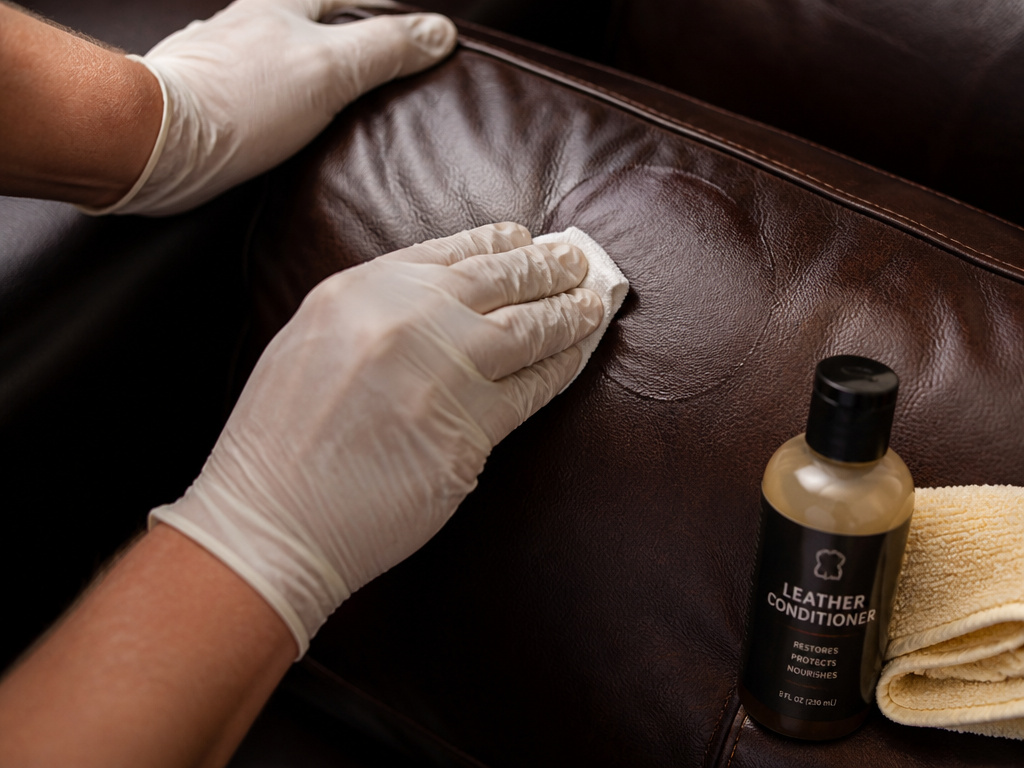
Leather care is drowning in bad advice. People treat it like a fussy museum piece; it’s actually the guy who shows up to work. You just need the right protocol.
Forget conditioning every season. Leather conditioning requirements vary by climate and usage. In a dry, heated home, condition every six months. In a stable, humid environment, every 6-12 months is fine. Over-conditioning is a real problem, it can oversoften the leather and attract dust.
The first step is always cleaning. Use a dedicated leather cleaner like Leather Master’s Soft Cleaner. Apply it to a microfiber cloth, never directly on the sofa. Wipe in gentle circles to lift dirt and oils. Let it dry completely.
Conditioning comes next. Think of it like applying a hand-rubbed oil finish to wood. You don’t slather it on. Use a product like the Colourlock Furniture Kit for protected leathers. Work in thin, even coats, letting each absorb fully before even thinking about the next. Buff off any excess with a dry cloth.
Here’s the thing most people miss: the undersides of the cushions and the inside arms. That’s where skin oils transfer directly and build up. Wipe these areas with a damp cloth every month. It prevents those dark, permanent stains.
Common mistake: Using furniture polish or silicone-based “conditioners.” The polish creates a dangerous, slippery film. Silicone sprays clog the leather’s pores and can cause the finish to cloud or crack. The only thing a silicone-based leather ‘conditioner’ conditions is the profit margin of the company selling it.
Which brings me to a story. People often ask about using household oils like olive oil as a quick conditioner. I recommend against it every time. It might look good for a week, but eventually, it can go rancid. It also attracts dust and creates a sticky residue that’s a nightmare to fix. Stick to products formulated for furniture.
Matching a Leather Type to Your Life (Not Just Your Room)
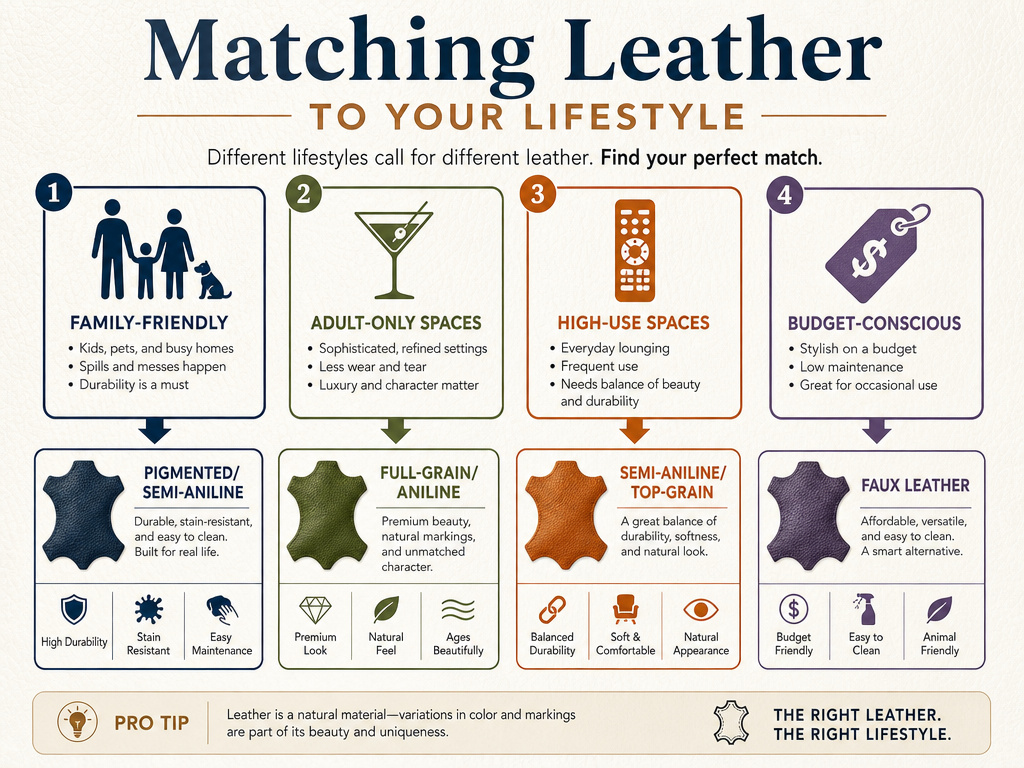
This is where theory meets the floor. Your lifestyle picks the leather, not the other way around.
For Families with Kids & Pets: Your default is a pigmented top-grain leather or a high-quality semi-aniline. The protective coating resists juice, crayon, and paw prints. Choose a medium or dark color. A distressed or pull-up finish hides scratches beautifully. Avoid aniline or full-grain here, they’re stain magnets. A durable leather sectional sofa in this category can handle the chaos.
For Adult-Only or Formal Living Rooms: You can choose for character. Full-grain or aniline leather will develop a glorious patina. Light colors are an option. Remember, these require commitment, keep them out of direct sunlight to prevent fading, and be ready to professionally treat any stains immediately. This is the domain of a classic leather Chesterfield sofa.
For High-Use Spaces (TV Room, Home Office): Durability and easy cleaning are king. A semi-aniline or durable top-grain leather is ideal. Look for a rub count equivalent, for fabrics, this is over 30,000 Martindale, but for leather, focus on thickness (over 1.2mm) and a quality finish. A leather reclining sofa for this space should prioritize a robust, coated leather over a ultra-natural one.
For Budget-Conscious or Temporary Situations: If you need the look for a few years, a faux leather is acceptable. Just go in with eyes open. Know it will likely crack or peel. A bonded leather is rarely worth even the low cost due to its short lifespan. For a bit more, a fabric sofa often offers better longevity.
Sometimes, the best choice isn’t a single type. Many quality leather sofas use a “leather match” construction: top-grain on the seating surfaces and arms, with a matching vinyl on the sides and back. This is a smart cost-saving move that doesn’t sacrifice durability where it counts.
Frequently Asked Questions
What is the most durable type of leather for a sofa?
Full-grain leather is the most durable due to its intact fiber structure, but it requires acceptance of natural markings. For balanced durability and practicality in a family home, a protected top-grain or semi-aniline leather is the most durable choice.
Is genuine leather good quality for a sofa?
No. “Genuine leather” is a specific classification referring to leather made from the fibrous layers left after the top-grain is split off. It is the lowest grade of real leather, often reinforced with coatings. It is not a synonym for high quality. For a long-lasting sofa, look for terms like top-grain, full-grain, or semi-aniline.
How long should a good leather sofa last?
Sofa made from full-grain leather** or quality top-grain leather should last 15 to 25 years with proper care. Bonded leather may last 3-5 years, and faux leather 5-7 years. Lifespan depends entirely on the leather type, construction, and maintenance.
Can you repair scratches on a leather sofa?
Yes, but the method depends on the finish. Light scratches on pigmented or protected leather can often be buffed out with a microfiber cloth. Deeper scratches on aniline or full-grain leather may need a colored leather filler or professional touch-up. Always test any repair product in a hidden area first.
What’s the difference between Italian leather and other leathers?
Italian leather refers to hides tanned and finished in Italy, following strict environmental and quality regulations. It is not a type of leather (like full-grain) but a mark of origin and craftsmanship. Italian tanneries are renowned for their dyes and finishing techniques, often resulting in exceptionally soft, luxurious-feeling aniline and semi-aniline leathers.
The Bottom Line
Your leather sofa is a decade-long companion. Pick the one built for the life you actually live, not the showroom fantasy.
If your household includes Friday night pizza and a dog, let go of the purist ideal. A protected semi-aniline or pigmented top-grain leather is your honest, resilient workhorse. It will clean up and keep going. If your living room is a calm sanctuary, then invest in the natural beauty of full-grain or aniline. Commit to its care and enjoy the story it tells as it ages.
Before you buy, do the heat test. Check for “leather match” construction. And remember the data: real leather isn’t inherently the toughest material, but the right type of real leather, chosen for your reality, is the one that becomes part of your home for good.
