
Leather vs Cloth Car Seats: The Flammability Recall Owners Miss
This post contains affiliate links. As an Amazon Associate, we earn from qualifying purchases.
This post contains affiliate links. As an Amazon Associate, we earn from qualifying purchases.
Leather vs cloth car seats comes down to three main trade-offs: long-term durability against stains, ease of cleaning against material feel, and the hidden safety specs most buyers never see. Leather wins on cleanability and patina, cloth wins on initial comfort and cost, but a 2020 federal recall on a specific laminate cloth material proves the safety conversation isn’t theoretical.
Let’s be clear about this. The choice is about matching the material to your life, your climate, your passengers, and how long you plan to keep the car. The consensus online misses the documented failure modes that manufacturers quietly address in technical bulletins.
What follows is a breakdown of the real-world performance, drawn from service bulletins, recall documents, and the physical reality of both materials. This review addresses cleaning truth, durability under stress, and the one safety recall that should change how you view “premium” cloth.
Key Takeaways
- A 2020 NHTSA recall of Land Rover Dinamica cloth seats for failing federal flammability standards (FMVSS 302) highlights a real, if rare, safety variable most comparisons ignore.
- Leather’s top advantage is cleanability: spills bead up and wipe off a coated surface. Cloth’s top advantage is temperature consistency, staying cooler in summer and warmer in winter against skin.
- Long-term, leather develops a patina with careful maintenance, while cloth faces abrasion wear and permanent staining; Subaru and Audi have issued technical service bulletins for premature cloth bolster wear.
- The FTC’s Part 24 guides strictly regulate leather labeling; terms like “leather seats” often mean vinyl or polyurethane bolsters, while “vegan leather” is unregulated and usually means plastic.
- Your climate dictates the hassle: leather requires UV protection to prevent cracking in sun, cloth requires vigilance against moisture and mold in humidity.
The Safety & Flammability Reality Check
Most comparisons talk about feel and cost. They skip the safety sheet. Here’s the thing: all interior materials must pass Federal Motor Vehicle Safety Standard (FMVSS) 302 for flammability. It’s a baseline. But in 2020, Land Rover issued a recall for 66 Range Rover Evoque vehicles because the front seats trimmed with “Dinamica” cloth, a laminate bonded material, did not meet this burn rate requirement.
The supplier’s own testing found variability once the material was laminated. The fix wasn’t a cleaner; it was a full replacement of the seat covers with a sewn-bonded version. This specific vehicle seat material safety recall is a documented case where a premium, marketed alternative material failed a fundamental safety test.
Where this goes sideways: Assuming all OEM materials meet the same safety floor. Laminate constructions, whether synthetic or “vegan,” can introduce variability that pure, thick leather hides or simple woven cloths do not.
Leather, as a dense, collagen-based material, has inherent fire-resistant properties. High-quality automotive leather is also treated with flame-retardant coatings. The risk is that the safety of any non-standard material should be a verified spec, not a marketing assumption.
The Cleaning & Maintenance Showdown
Spill coffee on a leather seat? You have about 30 seconds before it soaks into cloth. That’s the entire debate in a microcosm.
Leather cleaning is surface work. A pH-balanced cleaner like Colourlock Mild Leather Cleaner and a microfiber cloth lift grime from the coating. You’re not cleaning the hide itself; you’re cleaning the protective topcoat. Conditioning is separate, and for modern automotive leathers, it’s often overkill, these are heavily pigmented and sealed.
Cloth cleaning is absorption work. You’re fighting the capillary action of the fibers. Even with a treatment like Scotch Guard, a spill needs immediate blotting, not wiping, to avoid driving the stain deeper. Over time, ground-in dirt changes the fabric’s color permanently.
| Task | Leater Seats | Cloth Seats |
|---|---|---|
| Spill Response | Wipe up. Most liquids bead on the coating. | Blot immediately. Wiping spreads the stain. |
| Deep Clean | Leather-specific cleaner; conditioner rarely needed. | Upholstery extractor or foam cleaner; air dry completely. |
| Routine Upkeep | Dust with microfiber; use a UV protectant like 303 Automotive. | Vacuum with brush weekly to pull up grit; treat stains ASAP. |
| Common Mistake | Using saddle soap or vinyl cleaners, which strip/damage the coating. | Using too much water, leading to mold in the cushion foam. |
The feel factor matters here, too. A clean leather seat has a consistent, slightly cool feel. A clean cloth seat feels like fabric. But cloth hides spills in a way leather cannot, a faded stain is less visually obvious than a glossy spot from a silicone-based “protector” misapplied to leather.
The Long-Term Wear & Patina Story
This is where my perspective as a leather guy comes in. People treat full-grain leather like a fussy museum piece; it’s actually the guy who shows up to work with dirt under his nails. Automotive leather is different, it’s a heavily finished product. Its long-term story is about resisting cracks and cuts.
The enemy is UV radiation and friction. The side bolster where you slide in and out takes the most abuse. On leather, this shows as glossing, the topcoat polishes smooth, and eventually, micro-cracks. On cloth, this shows as pilling, fuzzing, and abrasion wear.
Manufacturers know this. Subaru issued a technical service bulletin for 2012-2013 Impreza models for premature pilling of front seat fabric bolsters. Their remedy was a revised upholstery with a resin-coated backing for better abrasion resistance. Audi has a bulletin distinguishing between “fur-like fluffing” (considered customer misuse) and “knotting” (a warrantable defect). These are acknowledgments of cloth’s inherent vulnerability in high-wear zones.
Leather, if taken care of, gets BETTER with age and are infinitely easier to keep tidy.
That quote from an enthusiast forum in our research nails a common sentiment, but it’s nuanced. Coated leather doesn’t “age” like a whiskey barrel; it simply degrades more slowly than cloth under identical abrasive conditions. The advantage is that leather wear is often uniform and can be partially refreshed with dyes and conditioners. Cloth wear is a breakdown of the fibers themselves, once the threads are gone, only reupholstery fixes it.
Cost, Comfort & Climate Considerations
The upfront cost difference is the least interesting part of this debate. Yes, leather is typically a package upgrade costing a few thousand dollars. The real cost is in long-term ownership and climate-driven hassle.
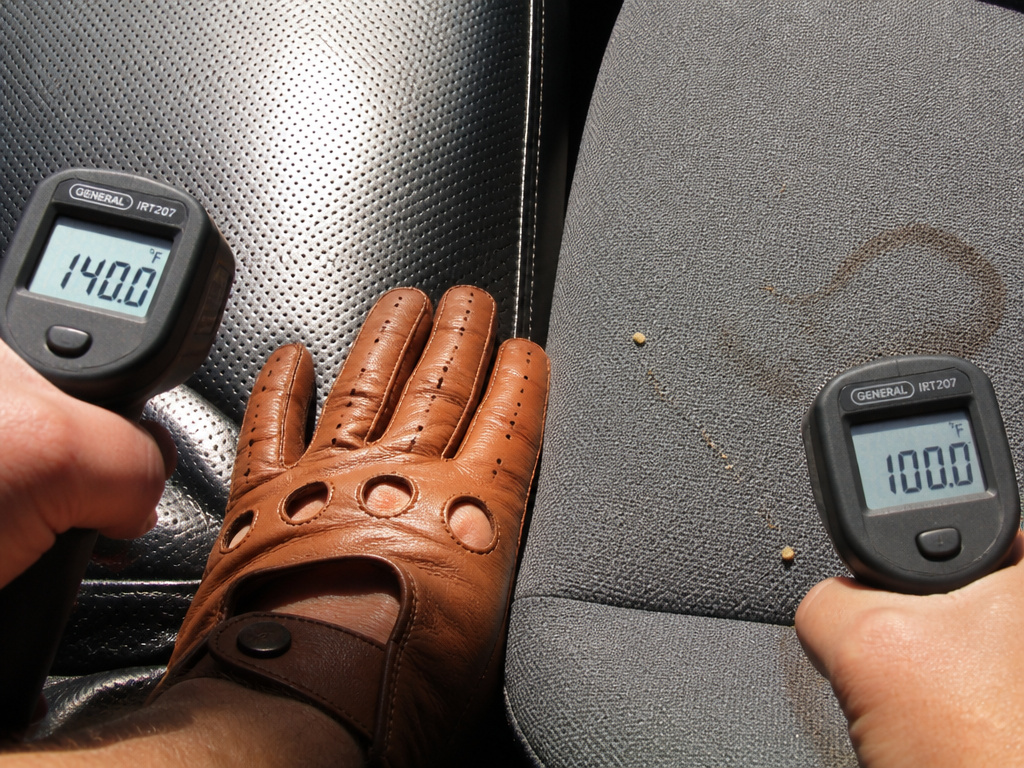
Let’s talk comfort. In a 100°F parking lot, leather seats can hit 140°F, a genuine burn risk. Cloth stays closer to ambient air temperature. In a 20°F winter, leather is cold-soaked for the first ten minutes of your drive; cloth feels less harsh. Modern solutions like ventilated and heated seats bridge this gap, but they add complexity and cost.
Climate dictates your maintenance burden: * Hot, Sunny Climates: Leather is under assault. UV radiation is the primary cause of cracking and fading. A protectant like 303 Automotive is essential. Without it, leather loses. * Humid, Wet Climates: Cloth is the risk. Moisture gets trapped in the foam backing, leading to mildew and a musty smell. Leather’s non-porous surface wins here, provided you don’t have perforated seats that can funnel water underneath.
Here’s some straightforward advice: if you have kids, pets, or a lifestyle that involves spills, leather’s cleanability is a sanity preserver. If you live in extreme heat, prefer a more casual feel, and are diligent about vacuuming, cloth’s comfort and lower upfront cost are compelling.
Understanding the Labels: “Leather,” “Vegan,” & “Synthetic”
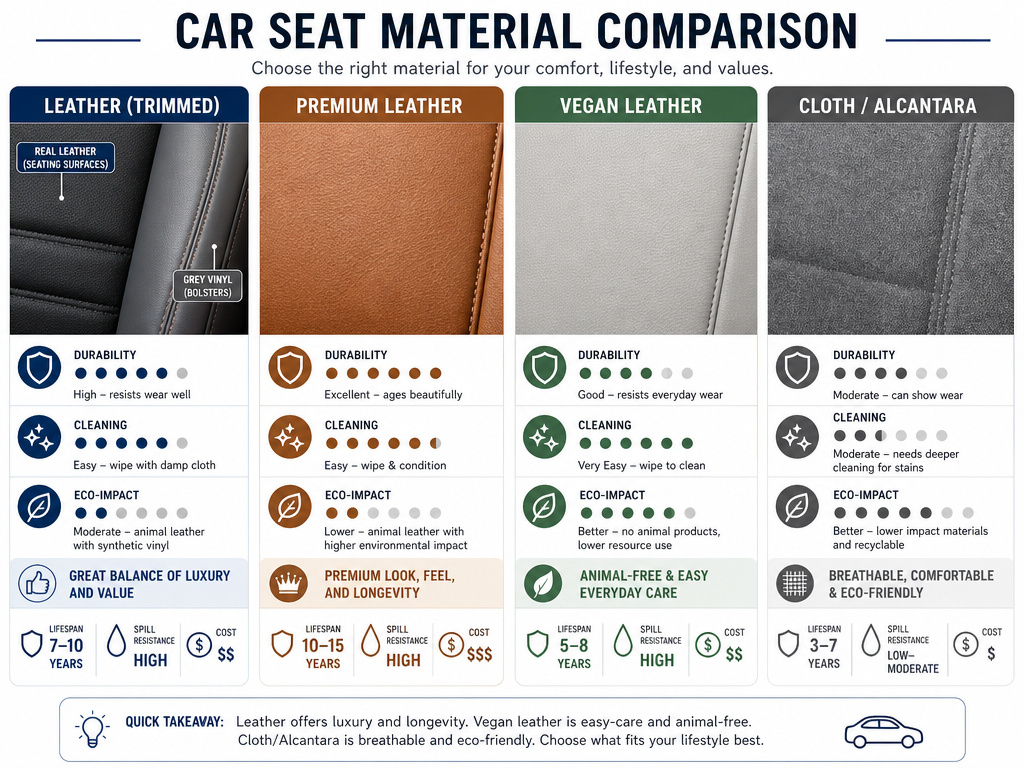
This is where consumers get misled daily. The U.S. Federal Trade Commission has clear FTC leather product guides (Part 24). A seat can only be called “leather” if the entire exposed surface is leather. Many “leather-trimmed” seats use leather only on the seating panels, with vinyl or polyurethane (PU) on the sides and back.
“Vegan leather” is an unregulated marketing term. It almost always means a plastic-based material like polyurethane or PVC. As a scientific review of conventional materials notes, these synthetic leathers present challenges related to fossil fuel dependence and non-biodegradability. Their performance varies wildly.
“Cloth” is usually a blend of polyester and nylon for durability. Premium brands might use materials like Alcantara (a microfiber suede) or wool blends, which have different care requirements entirely.
| Common Label | What It Usually Means | Performance Tip |
|---|---|---|
| Leather Seats | Often a mix of leather (seating panels) and vinyl/PU (bolsters, backs). | Clean with products for finished leather; avoid oils. |
| Premium / Nappa Leather | Full-grain or top-grain leather with a lighter, more natural coating. | More prone to scratches; use gentle cleaners and condition 1-2 times a year. |
| Vegan Leather | Polyurethane (PU) or Polyvinyl Chloride (PVC) coating over a fabric mesh. | Clean like vinyl; avoid abrasives. Can peel or crack over time. |
| Suede / Alcantara | Synthetic microfiber with a nap, feels like sued. | Requires specific “suede” cleaners and regular brushing to maintain the nap. |
When evaluating your car’s seats or selecting car seat leather for a project, ignore the marketing poetry. Look at the material code in your owner’s manual or ask the dealer for the spec sheet.
Making Your Choice: A Practical Framework
So, which one should you pick? Forget “which is better.” Answer these three questions:
- What’s your primary hassle? Is it spilled drinks and muddy paws, or is it sweating on summer road trips? Your biggest annoyance points to the solution.
- How long will you own the car? If it’s a 3-year lease, the long-term durability debate is irrelevant. Pick for comfort and cost. Choose a full-grain leather or a high-performance synthetic fabric like Sunbrella.
- What’s your maintenance tolerance? Are you the type to vacuum and treat stains quarterly, or do you want to wipe seats down once a season and call it done?
For most families with young children or outdoor lifestyles, the cleaning leather seats advantage of leather is a daily benefit. For the single commuter in a hot climate who values initial comfort, a high-quality cloth is a perfectly rational, comfortable choice.
Your first purchase should be a bottle of a UV protectant from a brand like Lexol. Use a cleaner specifically formulated for your cloth type at the first sign of a stain.
Frequently Asked Questions
Do leather car seats crack easily?
Modern automotive leather seats crack from neglect, not age. The two main causes are UV damage from sun exposure, which dries and degrades the coating, and abrasion from friction (like sliding across a rough seam). Using a UV protectant and preventative maintenance for leather seats can prevent cracks for a decade or more.
Can you get cloth seats in a luxury car?
Yes, but it’s rare in the North American market. Brands like Lexus and BMW have offered high-grade cloth or wool-blend seats in other markets. In the U.S., cloth is typically relegated to base trims. The perception that leather equals luxury is deeply entrenched here, despite many high-end home furnishings using premium fabrics.
Are cloth seats safer than leather?
There is no blanket safety advantage. Both must meet the same federal flammability standard (FMVSS 302). The safety difference is in the details: leather may offer slightly better grip in cornering, while some advanced cloths may stay cooler in a fire. The 2020 Land Rover recall proves the specific material construction is what matters, not the general category.
How do you clean cloth car seats effectively?
Start by vacuuming thoroughly. For stains, use a dedicated upholstery cleaner, not all-purpose spray. Apply the foam, agitate gently with a soft brush, then blot with a damp microfiber cloth. Never soak the fabric, as moisture can reach the foam cushion and cause mildew. For overall cleaning, a portable extractor is the most effective tool.
Is “vegan leather” good for car seats?
Vegan leather (usually polyurethane) is a cost-effective synthetic. Its performance is inconsistent. Some PU blends are durable and easy to clean; others peel and crack within a few years under sun exposure. It lacks the long-term durability and repairability of genuine leather. Treat it as a mid-life material: expect to replace it or cover it with protective seat covers long before the car’s life is over.
Can you repair torn cloth seats?
Repairing torn cloth is very difficult and rarely invisible. Re-weaving is a specialist skill. The practical solution is either a seat cover or a full reupholstery of the panel. This is one area where leather has an advantage: small cuts and scratches can be filled, dyed, and blended by a professional.
The Bottom Line
Leather versus cloth is a practical decision with real consequences for cleaning, comfort, and cash over a decade of ownership. Leather’s win is the wipe; cloth’s win is the feel against your skin on a temperature extreme day.
Before you decide, check your car’s manual for the exact material code. And remember the Land Rover lesson: a premium price tag doesn’t guarantee a material meets the basic safety standard it legally should. Whether you choose leather or cloth, your first act of care, applying a UV shield or a fabric protector, sets the timeline for everything that comes after. Choose the material that fits the life you actually live, not the one you see in the brochure.
