
The Ultimate Guide to Alligator vs Crocodile Leather Quality
This post contains affiliate links. As an Amazon Associate, we earn from qualifying purchases.
The difference between alligator and crocodile leather comes down to two anatomical signatures: sensory pores (tiny dots in each crocodile scale) and an umbilical scar (a star-shaped mark on the alligator’s belly). Crocodile tends to be slightly tougher with a more irregular pattern; alligator is generally softer with a uniform, tile-like grid. Both are top-tier exotic leathers, with American alligator often carrying a slight price premium.
Let me share what I’ve learned from years of fielding questions from readers: this confusion isn’t academic. It protects your wallet from buying a mislabeled calfskin wallet for exotic prices, and it guides you to the material that will actually age with your style.
Understand leather better to make confident choices. This is a straightforward guide, based on practical experience, that breaks down the details for you. We’ll look at the science behind the pores, decode the market’s pricing signals, and give you a simple test you can use the next time you’re evaluating a belt or a bag.
Key Takeaways
- Crocodile leather has sensory pores (ISOs) as tiny dots in each scale; alligator leather has a unique umbilical scar on its belly and lacks these pores.
- Alligator leather typically absorbs dye more evenly, resulting in a uniform color, while crocodile’s varied texture creates subtle tonal depth.
- In the U.S. Market, farmed American alligator often commands a 10-20% premium over comparable Nile crocodile leather, though brand markup often dwarfs this difference.
- Caiman leather, a lower-quality crocodilian leather frequently mislabeled as “crocodile,” is prone to cracking due to bony deposits and carries a much lower price point.
- The care routine for both leathers is identical: condition sparingly with an exotic-specific product, avoid prolonged moisture, and store properly to ensure a decades-long lifespan.
The Pore-and-Scar Test Every Buyer Needs
Forget vague pattern descriptions. The fastest, most reliable way to identify genuine skin is with a visual fingerprint check. Let’s be clear about one thing: a perfectly repeating, uniform pattern is a sign of embossed leather, not the real thing. Real crocodilian skin has natural, organic variation.
Crocodile scales have visible sensory pores (tiny dots); alligator scales are smooth with no pores but feature a distinctive umbilical scar on the belly. These are remnants of the animals’ biology, not manufacturing artifacts.
This test works because it’s based on biology. Crocodiles have Integumentary Sensory Organs (ISOs) distributed across their entire body—tiny pressure receptors that detect vibrations in water. Alligators only have ISOs around their jaws. When the skin is tanned, these leave the characteristic pore markings. Conversely, alligators retain a web-like scar from where the yolk sac attached, a mark crocodiles don’t have.
Here’s the practical takeaway: if you see pores, it’s crocodile leather. If you see a star-shaped belly scar (and no pores), it’s alligator leather. If you see neither, you’re likely looking at an imitation.
Pattern, Feel, and Dye: The Sensory Reality
The biological differences create a distinct sensory profile for each leather. You can feel the difference long before you check the price tag.
The Look: Uniform Grid vs. Organic Flow
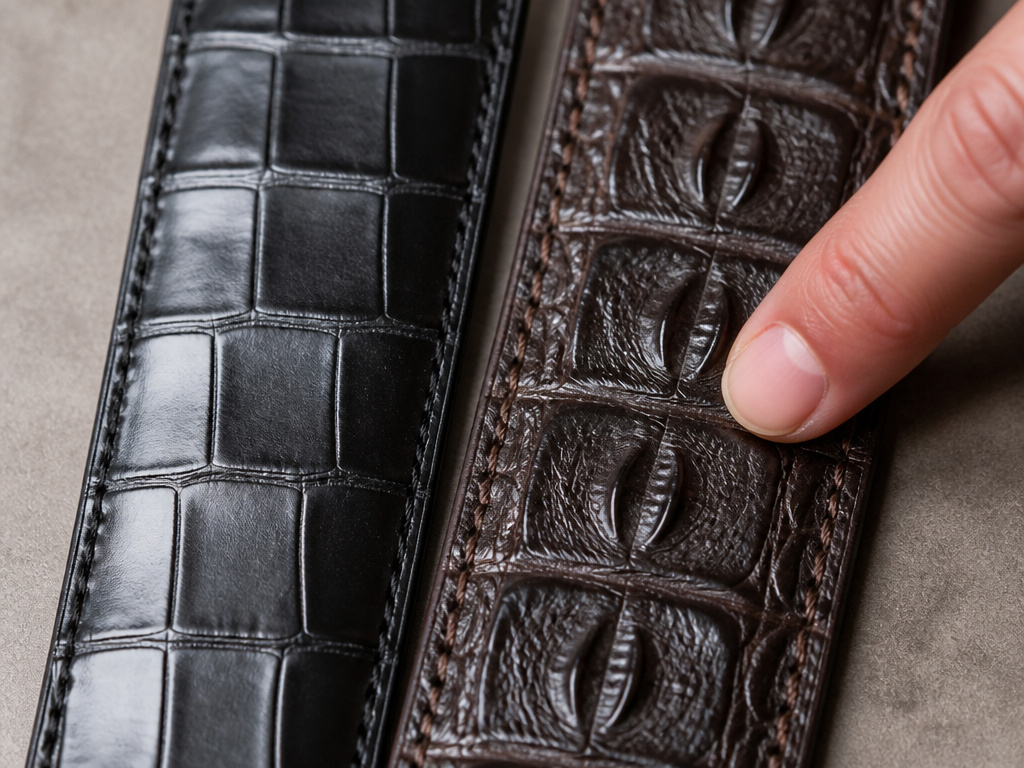
An alligator’s belly scales form a remarkably consistent, tile-like grid. The transition from the large, square belly scales to the smaller flank scales is more abrupt. This uniformity is why many luxury brands favor alligator leather for sleek, formal accessories where a clean aesthetic is key. The pattern reads as refined and orderly.
Crocodile scales, particularly on species like the Nile, vary more in size and shape across the same area. The pattern has a more gradual, organic flow. This creates a bolder, more textured look that many associate with statement pieces. For high-impact items where the leather itself is the star, this more rugged texture often wins.
The Feel Under Your Fingers
Run your thumb across a piece. Alligator feels smoother and flatter. The scales are less pronounced, and the surface has a more uniform plane. This flatness is part of why it conforms to the body so well in items like leather belts.
Crocodile has a more raised, textured surface. You’ll feel the distinct ridges between scales, and the individual scutes have more three-dimensional presence. This tactile quality contributes to its perceived ruggedness, but it doesn’t mean it’s stiff. A well-tanned crocodile hide will still have excellent suppleness.
How Each Leather Takes Color
This is where the two leathers diverge in a way that affects the final product’s appearance. Alligator’s smoother, more uniform surface absorbs dye evenly. This results in a consistent, solid color across the entire piece. It’s predictable, which is a virtue in mass luxury production.
Crocodile’s varied topography means dye settles differently. The recessed areas between scales hold more pigment, while the raised ridges might be slightly lighter. This creates a subtle, multi-dimensional tonal depth—a effect that many leather enthusiasts prize. It’s not better or worse; it’s a different aesthetic choice. Do you want solid confidence or nuanced character? The leather will tell you what it needs.
Durability, Pricing, and the Caiman Trap
People often ask which leather is “better.” It’s not that one is universally better. They are tools for different jobs, priced by different markets. A 2023 comparative analysis in the Journal of Materials Science found genuine crocodile leather exhibited a tear strength more than five times that of some bio-based alternatives and its mechanical performance was notably sensitive to humidity.
| Factor | Alligator Leather | Crocodile Leather |
|---|---|---|
| Perceived Durability | Extremely high, slightly softer surface | Extremely high, slightly tougher surface |
| U.S. Market Price | ~10-20% premium over comparable Nile croc | Slightly lower baseline, but varies by species |
| Common Pitfall | Paying luxury-brand markup for modest quality gain | Mistaking lower-quality caiman for true crocodile |
| Best For | Formalwear, uniform aesthetics, faster break-in | Textured casualwear, tonal depth, statement pieces |
In the U.S., farmed American alligator from Louisiana and Florida typically commands a premium. However, this 10-20% difference at the tannery level is often swallowed whole by the “Brand Tax” on the final product. A direct-to-consumer belt from a maker like Crockett & Jones using high-grade Nile crocodile can be every bit as luxurious and durable as an alligator one for less.
The real pricing trap is caiman. This lower-quality crocodilian leather, often from South America, is riddled with bony deposits called osteoderms that make it prone to cracking. It’s frequently mislabeled as “crocodile” at discount prices. If you see a “genuine crocodile belt” for under $100, be skeptical. A legitimate piece from a source like Beltley starts around $150. Ignore the marketing copy and look for the pores or the scar.
Sourcing, Ethics, and What You’re Actually Buying
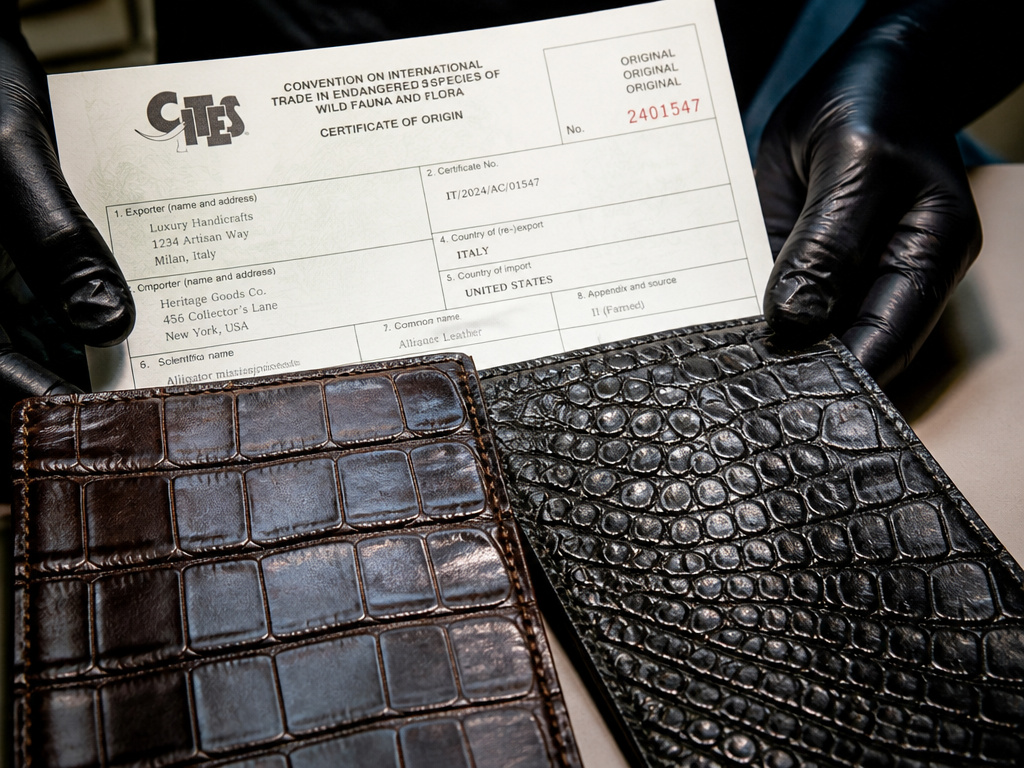
Both alligator and crocodile leather in the legal global market come from CITES-certified farms. This isn’t just feel-good paperwork; it’s a traceability system that ensures sustainability and prevents wild poaching. Reputable sellers can and should provide documentation. When you choose farmed exotic leather, you’re opting for a regulated, traceable material over unverified wild skins.
The tanning process also dictates quality. Many top tanneries, including Horween Leather Company and Wickett & Craig, specialize in vegetable tanning for exotics. This older, slower method uses natural tannins from trees, resulting in a leather that develops a rich patina over decades. Chrome tanning is faster and produces a more water-resistant leather with consistent color, but it lacks the same aging character.
I recommend against any shortcut that uses petroleum distillates on leather. They can degrade the fibers over time and attract grime, which is the opposite of care.
This lesson came from years of reader questions. People would want to use all sorts of household products to condition or quiet a squeaky strap. A petroleum-based lubricant might seem to work today, but it compromises the leather’s structure for tomorrow. Stick to conditioners made for exotic skins.
How to Care for Your Exotic Leather Investment
The care routine for both leathers is identical, and it’s simpler than most think. The leather will tell you what it needs, usually less often than you’d expect.
- Dust & Clean: Wipe gently with a soft, dry cloth in the direction of the scales. For spills, dab carefully with a barely damp cloth and let it air dry completely away from heat.
- Condition Sparingly: Only when the leather looks or feels dry. Use a conditioner specifically formulated for exotic leathers (avoid silicone-heavy products). Apply a tiny amount with a clean cloth, let it absorb for an hour, then buff off any residue.
- Store with Intent: Store items flat or loosely coiled in a breathable cotton dust bag. Never in plastic, which traps moisture and can cause mildew.
- Avoid Extremes: Keep away from prolonged direct sunlight, intense heat (like radiators), and excessive moisture. A humid environment is better than an extremely dry one.
Conditioning is like building a roux—you need patience and the right ingredients. Too much oil applied too often leads to a gummy buildup. A light, infrequent touch preserves the leather’s natural integrity for the long haul.
Frequently Asked Questions
Is crocodile leather more durable than alligator leather?
Technically, crocodile leather has a slight edge in scratch resistance due to its thicker, more raised scale structure. However, in practical, daily-wear terms, both are exceptionally durable and will last decades with proper care. The difference in lifespan is negligible; the choice should be based on aesthetics and feel.
Why is alligator leather more expensive?
American alligator leather often carries a price premium due to stricter U.S. Farming regulations, limited geographic sourcing (primarily Louisiana and Florida), and its high demand in the formal luxury market. The perceived uniformity of its pattern also adds to its status.
Can you use the same conditioner on both?
Yes. The care products and routines for alligator and crocodile leather are identical. Always use a conditioner made for exotic leathers, apply it sparingly, and avoid products containing petroleum distillates or silicone.
How can I be sure I’m not buying caiman?
First, check the price. Authentic alligator or high-quality crocodile belts start around $150 from direct makers. Second, examine the pattern. Caiman has small, irregular scales with visible bony deposits that feel rigid. Third, buy from reputable sources that provide CITES documentation and are transparent about the species origin.
Which is better for a belt?
Both are excellent. Alligator is often preferred for formal or business wear due to its uniform pattern and smoother drape. Crocodile offers a more textured, casual look with visual depth. For a first high-end belt, focus on the tannery’s reputation and the craftsmanship of the leather belts maker more than the species alone.
Before You Go
Here’s a straightforward guide to your final decision. If your priority is a sleek, uniform appearance that pairs with suits and formalwear, lean towards alligator leather. Its predictable dye absorption and classic grid pattern are hard to beat for traditional elegance.
If you want texture, character, and a piece that shows subtle tonal shifts in the light, crocodile leather is your match. Its organic pattern and rugged yet supple hand-feel make it ideal for casual belts, statement watch straps, and bags that are meant to be noticed.
Ignore the marketing noise about one being definitively “better.” It’s not that one is bad, it’s that each is better suited for different visual goals. Do that, and either one will become an heirloom.
