What Is Alligator Leather? Your Guide to Skin Width & Cuts
This post contains affiliate links. As an Amazon Associate, we earn from qualifying purchases.
Alligator leather is the tanned skin of the American alligator (Alligator mississippiensis), characterized by its distinctive raised belly tiles or scales. It is a luxury exotic leather sold by the centimeter width of the hide’s belly, not by the square foot, and its value is heavily determined by the size, regularity, and absence of natural blemishes in its tile pattern.
That centimeter measurement is the single number that decides what you can actually make from a skin. A hide that’s 30 centimeters wide at its widest point can’t accommodate a wide pattern piece for a jacket front, no matter how long the skin is.This fact separates farmed skins, which average around 30–34 cm for footwear, from wild skins, which average 48–52 cm and are the only real option for larger apparel panels.
Let’s be clear about one thing. Alligator leather is expensive because the process of turning a living, semi-aquatic reptile into a uniform, workable leather is a long, careful, and frankly wasteful one. We’ll break down the specifics: where the leather comes from, how it’s graded and priced, what the tanning process does to it, and the very real challenges of turning its long, narrow, irregular shape into a garment or bag.
Key Takeaways
- Alligator hides are sold by the centimeter across the widest part of the belly, not by square footage, with wild skins typically 50% wider than farmed ones.
- Grade 1 skins have the fewest natural flaws and command the highest price; less than 5% of wild-caught hides qualify as top quality due to scarring.
- Converting from fabric to leather requires a 5–10% extra allowance for natural imperfections, one yard of 54-inch fabric equals about 13 square feet of leather.
- The skin’s long, narrow, irregular shape makes pattern placement a puzzle, favoring designs with many small pieces or intentional seaming.
- Most alligator leather is chrome-tanned for softness and color range, but vegetable-retanned versions exist for a firmer feel in belts and shoes.
What Actually Defines Alligator Leather?
When you hear “alligator,” you’re almost certainly hearing about the American alligator. The Chinese alligator is critically endangered and not legally harvested for leather. This isn’t just taxonomic pedantry. The American alligator skin has a specific tile pattern, thickness profile, and growth size that tanneries have built their entire grading systems around.
The belly tiles are the star. They’re larger and more uniform than the tiles on the sides or back, creating that classic look. On larger, older animals, these tiles are bigger. A farm-raised alligator, typically harvested at 4–5 feet in length, will have smaller belly tiles than a wild alligator that’s lived twice as long. This is why, when comparing alligator vs crocodile leather, the tile shape is your first visual clue. Alligator tiles are more rounded and uniform; crocodile tiles are more irregular and often feature a distinctive central pore.
The belly of an American alligator is where the value concentrates. It’s the widest part of the skin, has the largest and most symmetrical tiles, and is the section measured for pricing. The head, legs, and tail are often trimmed away or used for very small components.
Beyond the visual, the leather has physical properties driven by its origin. It’s a dense, fibrous skin built for life in water, which translates to a leather that’s naturally strong and resistant to abrasion. However, that same density is what makes it stiff in its raw state. A skin that hasn’t been thoroughly broken and softened by a tannery will sit on a boot shaft “like a dinner plate,” as one artisan put it, firm, rigid, and uncomfortable.
How Alligator Leather Is Measured (and Why Centimeters Matter)
Forget square feet. In the world of bovine leather, you buy by the side or by the square foot. In the world of alligator, you buy by the centimeter. Specifically, the skin is measured across the widest part of the belly, and that number becomes its size class and primary price determinant.
This system exists because the hide is a long, tapering shape. The width gives you a reliable, repeatable metric for how much usable belly area you’re getting.The length of the skin is almost an afterthought in pricing, though it matters immensely for patterning.
Here’s where the farmed versus wild divide becomes practical.
| Skin Source | Typical Belly Width (cm) | Primary Use Case | Tile Size Relative to Wild |
|---|---|---|---|
| Farmed Alligator | 30–34 cm | Footwear, small accessories, watch straps | Smaller |
| Wild Alligator | 48/52 cm average (up to 90+ cm) | Larger apparel panels, handbags, luggage | Larger |
The data in the PanAm Alligator Skin Guide breaks this down further, correlating width to total length and average thickness. A 20/24 cm skin (meaning it fits into that size class) has an average total length of 88 cm and an average thickness of 0.8 mm. Jump to a 60/64 cm skin, and you’re looking at a length of nearly 2 meters (197 cm) and a thickness of 1.8 mm. That thickness difference alone changes which tannery finishes you can apply.
If you’re trying to convert from a fabric pattern, the rule of thumb is this: one yard of 54-inch wide fabric translates to roughly 13 square feet of leather. One yard of 36-inch fabric equals about 9 square feet. And you must add 5–10% more to that for waste due to natural imperfections. This conversion is why an alligator jacket requires so many skins, you’re working with narrow strips of prime material, not a broad sheet.
The Grading System: From Flawless to Utility
Not all centimeters are created equal. Two skins can measure the same 40 cm across the belly, but if one is covered in scars from territorial fights and the other is pristine, their prices will be worlds apart. This is where grading comes in.
Tanneries sort incoming skins into grades, typically five categories, with Grade 1 representing the fewest defects. A defect is any natural blemish: a scar, a tick bite mark, a discoloration, or a stretch mark. In the wild, where alligators spar and navigate abrasive environments, unmarked skins are rare. As one source notes, less than 5% of wild-caught skins qualify as “top quality.”
Where this goes sideways: Assuming a wider wild skin is automatically better. A wide skin riddled with scars might be graded so low it’s only useful for cutting into very small pieces, negating the width advantage. The grade often matters more than the centimeter measurement.
Farmed skins, raised in controlled environments with padding to prevent bruising, have a much higher yield of Grade 1 hides. This is a major reason farmed alligator is almost always more expensive than wild, it’s about consistency and usable yield, not just rarity.
Grading isn’t just about beauty. A scar or bite mark weakens the fiber structure at that point. For a belt or a bag strap that undergoes constant stress, a Grade 3 skin with a scar across a critical stress point is a liability. For a wallet interior or a decorative panel, it might be perfectly fine. Understanding leather grading is how you decode why two seemingly similar skins have such different price tags.
From Skin to Garment: Tanning and Finishing
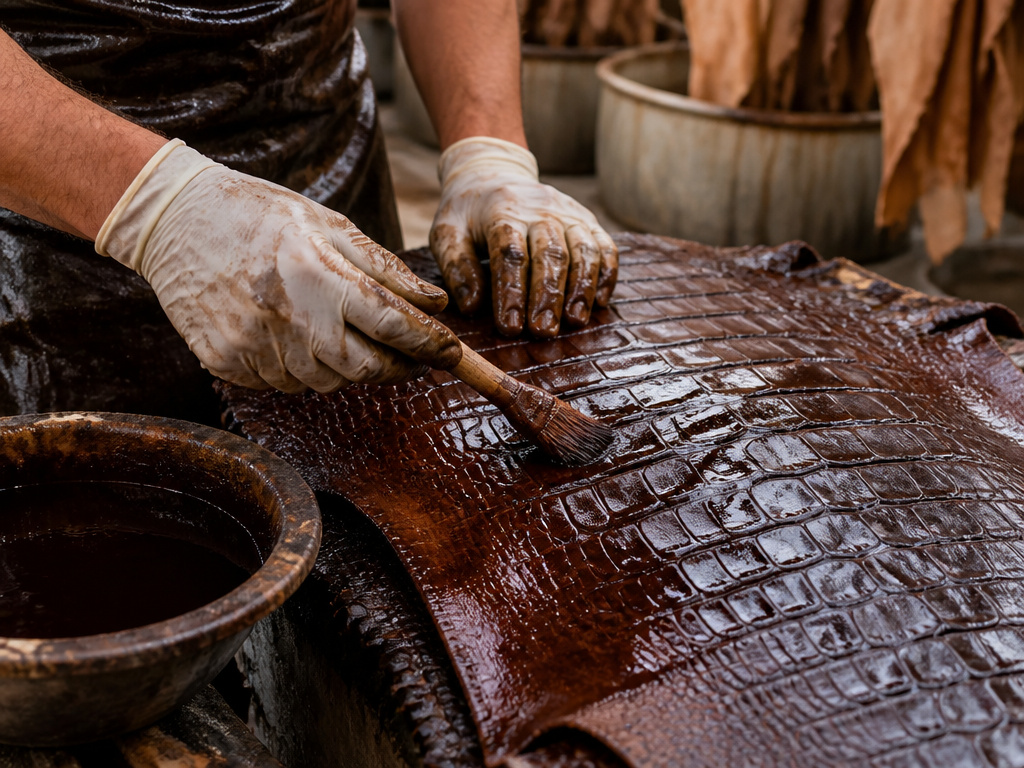
Once a hide is graded, it goes to the tannery. Most alligator leather you encounter will be chrome-tanned. Chrome tanning uses chromium salts, which penetrate the fibers quickly and produce a leather that is soft, pliable, and thermally stable. It also accepts dyes and finishes very well, resulting in the vibrant, uniform colors you see on designer bags.
Some tanneries offer a vegetable-retanned alligator. This process usually starts with a chrome tan for stability, then uses vegetable tannins (from tree bark, leaves, etc.) for the final layers. This yields a firmer, drier hand-feel and is typically used for items that need to hold their shape, like belts and certain shoe styles. It’s also the finish most likely to develop a rich leather patina over time, darkening and glowing with use.
The finish applied on top of the tanning matters just as much. For apparel, a garment finish is mandatory. This involves a combination of oils, waxes, and mechanical breaking to make the leather supremely supple. It needs to drape, bend, and wrinkle like a textile. You can identify a garment-finished skin by its soft hand-feel and excellent bending properties; it should have very little shearing rigidity.
A gloss or crust finish, in contrast, leaves the leather firmer and is used for handbags, luggage, and footwear where structure is desired. This finish performs worst in standardized tear tests because it doesn’t flex as easily, but that stiffness is precisely what gives a bag its shape.
The Practical Challenge of Working With Alligator Leather
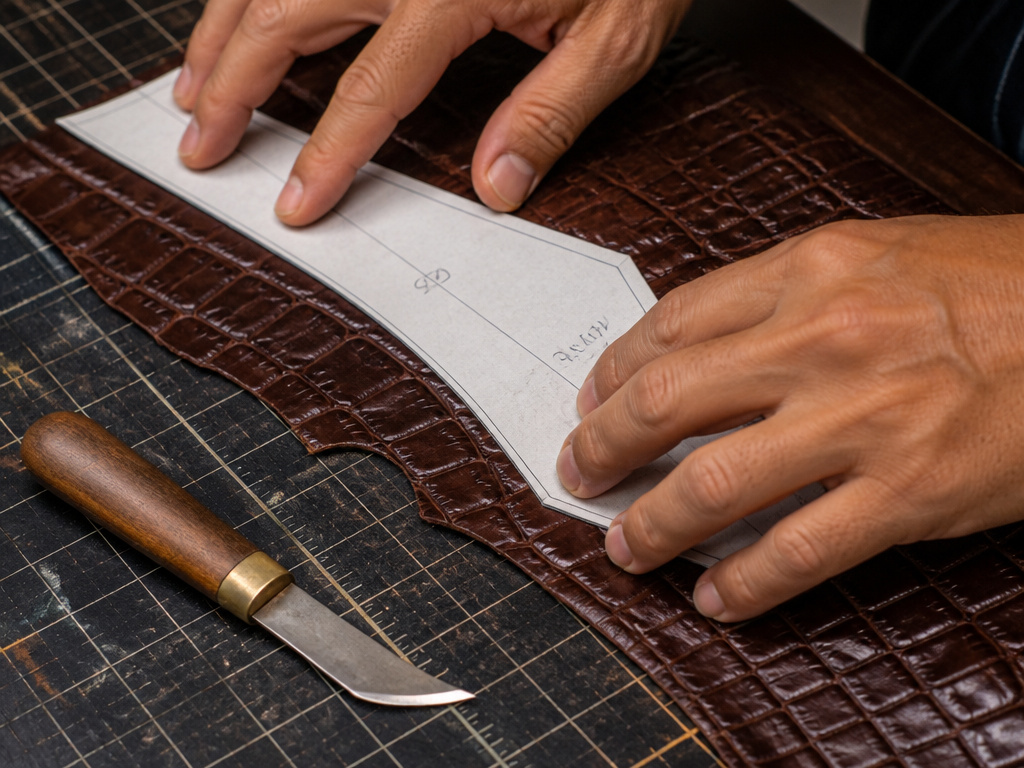
Here’s the part most glossy magazine features skip. Actually making something from alligator leather is an exercise in problem-solving. The skin’s natural shape is your first and biggest constraint.
The hide is long and narrow. It is not a rectangle or a square. This makes fitting wide pattern pieces, like a jacket front or a tote bag side, genuinely difficult. Designers have to adapt. A two-piece set-in sleeve pattern fits on a skin more easily than a one-piece sleeve. Seams must become part of the design, not hidden.
Common mistake: Trying to cut a garment like you would from wool. You must cut on a single ply (one layer at a time) to match the tile pattern across seams. Every major seam, like a center front, requires you to match the size and alignment of the tiles as closely as possible. This is a slow, meticulous process.
Sewing brings its own rules. You need a needle designed for leather, it pierces cleanly rather than tearing. Stitches should be slightly longer than normal for woven fabric because too many needle holes close together create a perforation line that can tear. On thick seams, a household machine will skip stitches; a light industrial machine is the practical minimum.
And once it’s sewn, forget alterations. It is notoriously difficult to alter seam lines in an alligator leather garment. The needle holes are permanent, and the leather doesn’t have the same give as fabric. The fit has to be right the first time. This level of commitment is why thorough methods to test leather and precise patterning are essential before the knife ever touches the skin.
Alligator vs. Other Reptile and Exotic Leathers
Alligator sits in a family of exotic leathers, each with its own profile. It’s useful to know how it stacks up against its peers, not for status, but to understand which material is actually suited to a job.
Compared to crocodile leather, alligator is generally considered to have a more symmetrical, cleaner tile pattern. Crocodile skin, especially from species like the Nile crocodile, often has more irregular scales and that distinctive central pore. The choice between them is often aesthetic.
Against other reptile skins like lizard leather or snakeskin leather, alligator is thicker, heavier, and far more durable. Lizard and snake skins are delicate, often backed with fabric for stability. They’re for accent pieces, not for something that needs to bear weight or resist abrasion.
For pure, almost absurd durability, stingray leather is in a league of its own due to its calcium bead surface. It’s also much stiffer. For a unique texture, ostrich leather with its quill follicles is softer and more pliable than alligator, but lacks the same visual formality.
The point is that exotic leathers are specialist materials. Alligator’s niche is that combination of a recognizable, prestigious pattern with enough substance to be used for primary structural components in goods meant to last.
Is Alligator Leather Worth It? A Realistic Take.
Let me share what I’ve learned. Alligator leather is a specialist material for specialist applications. It is not a general-purpose leather. Its value is in its specific aesthetic and the skilled labor required to work with it, not in any supernatural performance metrics.
For a belt or a pair of dress shoes that will see daily wear for decades, a top-quality bovine leather from a tannery like Horween will outlast and outperform alligator for less money. Alligator belts can crack along tile lines under constant flexion; alligator shoes are notoriously finicky to resole and maintain.
Where alligator makes sense is in items where its appearance is the entire point, and where the design accommodates its physical constraints. A watch strap. A cardholder. A handbag panel where the pattern is carefully engineered to respect the skin’s shape. In these applications, maintained properly, it can last a very long time.
The leather will tell you what it needs. And what alligator leather needs is careful storage, protection from extreme dryness, and cleaning with products meant for exotic skins, never saddle soap or heavy conditioners. It’s a commitment.
If you want the look but are wary of the care and cost, high-quality embossed calfskin can replicate the pattern at a fraction of the price and with far fewer care headaches. No one but you will know the difference. That’s the practical takeaway.
Frequently Asked Questions
Is alligator leather durable?
Yes, but with a caveat. Its dense fiber structure gives it good abrasion and tear resistance. However, the raised tiles can be prone to cracking along the edges if the leather is kept too dry or subjected to sharp, repeated bending. Durability is highest on the flat belly areas and lower on seams that stress the tile boundaries.
How can you tell real alligator leather from fake?
Look at the back. Genuine alligator leather will have a fibrous, natural backing, often with a suede-like finish. Fake or embossed leather will have a uniform fabric or polyurethane backing. On the front, genuine tiles are individual, raised pieces of leather; on fakes, the pattern is stamped on and feels flat. The pores on genuine skin are also three-dimensional, not printed.
How do you care for alligator leather goods?
Use a clean, soft cloth for regular dusting. For deeper cleaning, use a damp cloth with a drop of mild soap, then wipe with a clean, damp cloth to remove soap residue. Let it air dry away from heat. Condition sparingly with a product formulated for exotic leathers, these are typically lighter and won’t clog the scales. Store in a breathable dust bag, never in plastic.
Why is alligator leather so expensive?
The cost is a sum of regulated scarcity, lengthy farming cycles (2-4 years), high feed costs (they’re carnivores), significant waste during tanning and grading, and the intensely skilled labor required for cutting and sewing. A single Grade 1 skin represents years of investment and risk for a farmer, with no guarantee the animal won’t scar itself before harvest.
Can alligator leather get wet?
It can tolerate brief exposure to moisture, but it is not waterproof. Prolonged wetting can cause stains, watermarks, and eventually stiffen or damage the leather. If it gets wet, blot gently with a dry cloth and let it air dry at room temperature. Never use a hairdryer or direct heat.
Before You Go
One rule most guides gloss over: if you’re buying an alligator skin for a project, your first question shouldn’t be about the price per centimeter. It should be about the grade and the exact measurements of the belly panel you need. A cheaper, lower-grade skin might force you to buy two skins to get enough clean material, wiping out the savings.
For most people curious about exotic leathers, I’d suggest starting with a small item, a key fob, a wallet, from a brand like Tanner Goods or Saddleback Leather. Feel the material, see how it ages with your use. That hands-on experience with a premium leather type like Shell Cordovan or a sturdy exotic is more valuable than any spec sheet. It teaches you what the numbers actually mean in your hand.
And if you’re a maker diving in, remember the research. That study on [experimental patternmaking for alligator leather](https://doi.org/10.1080/17543266.2024.2329177 is a map of the frustrations you’re about to face, documented by people who’ve already fought those battles. Use it.Your leather, your time, and your sanity will thank you.
