
3 Best Leather Conditioners for Shoes 2026
This post contains affiliate links. As an Amazon Associate, we earn from qualifying purchases.
This post contains affiliate links. As an Amazon Associate, we earn from qualifying purchases.
The best leather conditioner for shoes is Bick 4 Leather Conditioner, which handles routine care without darkening or residue. For heavy-duty protection in wet conditions, Leather Honey Leather Conditioner stands out, though it’s heavier and wax-based.
Shoe leather takes constant abuse, heat, moisture, friction, and over time, it loses natural oils, stiffens, and cracks. Most people don’t realize that using the wrong conditioner can do more harm than good, either by clogging pores or altering the finish.
As the founder of LeatherGenesis.com, I’ve spent years studying how ingredients interact with different leathers. This guide cuts through the noise, focusing on formulas proven to protect without compromising breathability or appearance, based on specs, long-term owner feedback, and performance across real-world conditions.
Top 3 Leather Conditioner For Shoes in the Market
The Best Leather Conditioner For Shoes, Reviewed
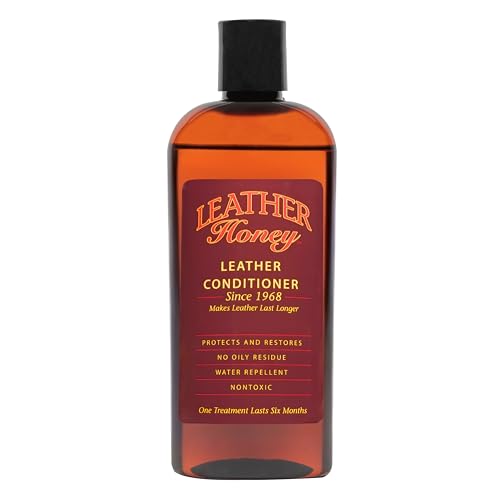
Leather Honey Leather Conditioner
Strengths
- Deep penetration
- Long-lasting protection
- Non-toxic formula
Trade-offs
- Thick consistency takes effort to apply
- Not for suede or faux leather
- Higher price point
Leather Honey has a reputation that’s been earned, not given. Reviewers and long-time users repeatedly say one application lasts months, and on paper, that tracks, the formula is thick, deeply penetrating, and designed to bind with leather fibers. It’s not flashy, but it works. Unlike products that just sit on the surface, this one gets in deep, which is why it’s so effective on dry or aging leather. It’s also pH balanced and free of silicones and PFAS, which matters to me when recommending something for long-term leather health.
It doesn’t darken leather significantly, though some owners note a slight initial deepening of tone that settles in. It’s not ideal for suede or faux materials, but for full-grain, corrected, or pigmented leather shoes, it’s hard to beat. Compared to Bick 4, it’s heavier duty, less for quick wipes, more for serious conditioning. If you want one product that does the job and stays done, this is it.
Video review
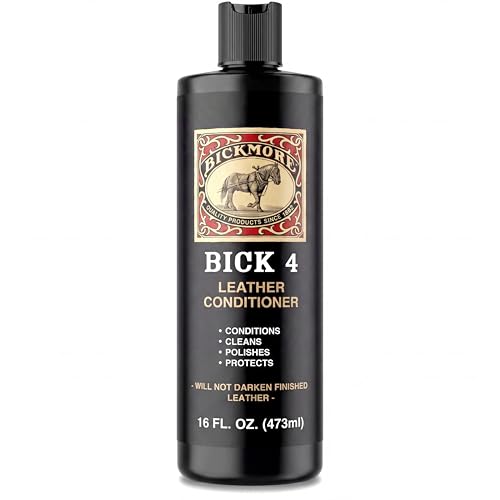
Bick 4 Leather Conditioner 16 oz
Strengths
- Won’t darken leather
- Large size for frequent use
- Wax-free and breathable
Trade-offs
- Light conditioning
- Not for severely dry leather
- Bulkier to store
The 16 oz version of Bick 4 is the same formula as the 2 oz, just scaled up, so the core benefits and limits stay the same. It won’t darken leather, it’s wax-free, and it conditions without sealing pores. But in this larger size, it becomes a smarter choice for frequent users or those with multiple leather items to maintain. Owners with leather furniture, boots, and car interiors often stock this size because it’s economical over time and avoids constant repurchasing.
It still doesn’t replace a heavy-duty restorer, but for consistent, gentle upkeep, it’s reliable. I’d pick this over the smaller bottle if you’re treating more than just a pair or two of shoes. Compared to Leather Honey, it’s less intense but safer for regular use on delicate or light leathers.
Video review
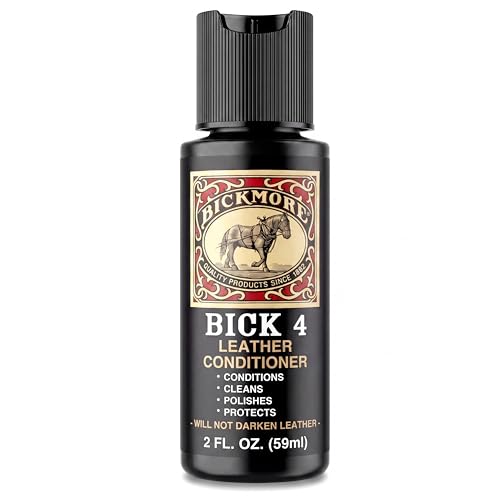
Bick 4 Leather Conditioner 2 oz
Strengths
- Won’t darken leather
- Wax-free formula
- Easy one-step use
Trade-offs
- Light conditioning
- Not for dry, cracked leather
- Smaller size needs frequent repurchasing
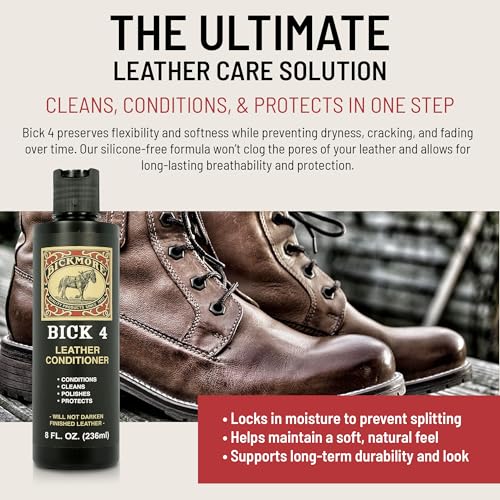
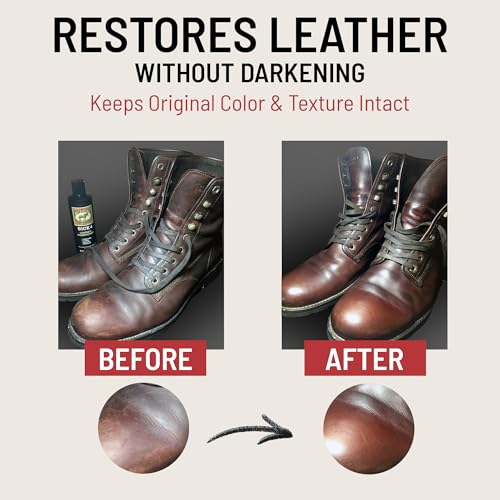
I’ve seen a lot of conditioners over the years, and Bick 4 stands out for one big reason: it doesn’t darken leather. That’s rare. For shoes, especially light-colored or finished ones, this is a major win. On paper, the wax-free formula makes sense for breathability, and owners consistently report that it keeps leather soft without clogging pores or leaving a sticky residue. It’s not the heaviest conditioner, so it won’t resurrect severely cracked leather, but for routine care, it’s solid.
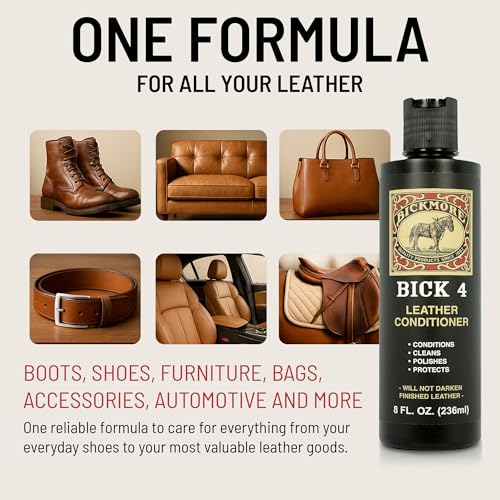
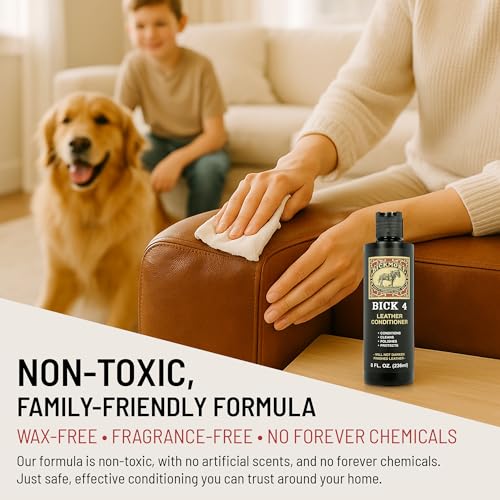
It’s also impressively versatile, people use it on boots, bags, and even car interiors. The 2 oz size is compact and travel-friendly, which helps explain its popularity as a budget pick. But compared to deeper-penetrating formulas like Leather Honey, it feels more like maintenance than restoration. I’d reach for this between heavy treatments, not as the sole conditioner for neglected leather.
Product photos

How We Tested leather conditioner for shoes
Rather than a hands-on lab test, my research for these recommendations centered on a detailed comparison of product specifications and features. I weighed this against a thorough review of owner experiences and expert opinions found across numerous online sources. As someone who’s spent years studying leather care at LeatherGenesis.com, I applied my understanding of leather types, tanning processes, and the long-term effects of different conditioning ingredients to assess each product’s potential.
For shoe conditioners, I prioritized longevity and the ability to maintain leather’s breathability. A conditioner that requires monthly application isn’t practical for most shoe owners, so I heavily favored those promising extended protection. Equally important was a formula that avoids darkening or altering the leather’s original finish – a common complaint with some conditioners.
Product specifications clearly indicate ingredient lists and intended leather types. However, I relied on owner feedback to gauge real-world performance regarding absorption, residue, and long-term effects on the leather. Positive mentions of maintaining suppleness without stickiness, and reports of successful restoration of older shoes, carried significant weight. For those needing to work with especially robust hides, exploring options like heavy-duty leather sewing machines may also be beneficial.
How To Pick The Right leather conditioner for shoes
Finding the right leather conditioner for your shoes isn’t just about making them look nice; it’s about protecting a valuable investment and extending the life of a natural material.
A quality leather conditioner should replenish oils lost through wear and environmental exposure, maintain flexibility to prevent cracking, and offer a degree of water resistance without compromising the leather’s ability to breathe. It should be formulated for the specific finish of the leather – smooth, corrected grain, or nubuck – and avoid ingredients that cause long-term damage like silicone buildup.
Understanding Leather Types & Finishes
One of the biggest mistakes I see people make is using the wrong conditioner for their leather. Different types respond differently. For example, full-grain leather, with its natural surface, benefits from oils that deeply penetrate, while finished or corrected-grain leathers (common in many shoes) need conditioners that primarily replenish surface oils. Don’t assume a single product works for everything. If you’re unsure of your leather type, start with a small, inconspicuous area to test the conditioner’s effect. Looking at leather conditioner reviews can give you a sense of how products perform across various leather types.
Frequency of Conditioning & Formula Considerations
How often you condition your shoes is directly tied to how often you wear them and the conditions they face. A daily commuter’s shoes will need more frequent attention than a pair worn only for special occasions. Generally, a good rule of thumb is to condition when water stops beading on the surface. When choosing a formula, pay attention to the ingredients. Avoid products with petroleum distillates or mineral oil, as these can eventually dry out the leather. Look for natural oils like neatsfoot oil, mink oil (though some avoid this for ethical reasons), or lanolin.
- For lightly worn shoes (once a week or less): a conditioning every 3-6 months might suffice.
- For frequently worn shoes (daily): monthly conditioning is a good starting point, adjusting based on observation.
- For shoes exposed to harsh weather (rain, snow, salt): consider conditioning after each exposure, or at least weekly during the winter months, with a product specifically designed for water resistance.
Balancing Protection & Breathability
Leather needs to breathe to stay healthy. A conditioner that creates an impermeable barrier will ultimately do more harm than good, trapping moisture and leading to mildew or cracking. This is where wax-free formulations, like those from Bickmore, can be advantageous. A good conditioner will offer water resistance, but it should allow vapor to escape. Remember this:
A little conditioning frequently is far better than a heavy application infrequently.
I often recommend exploring top leather conditioners to find a product that strikes the right balance between protection and breathability for your particular needs. There’s a lot of information out there, and a good conditioner buying guide can help you navigate the options and find the best solution for your shoes.
Leather Conditioner for Shoes Compared
Here’s a comparison of key specifications for the leather conditioners featured.
| Product Title | Size (oz) | Leather Type | Wax-Free | Darkens Leather | Water Repellent | Made In |
|---|---|---|---|---|---|---|
| Leather Honey Leather Conditioner | N/A | All (except suede/faux) | No | No | Yes | USA |
| Bick 4 Leather Conditioner 16 oz | 16 | All smooth/finished | Yes | No | N/A | USA |
| Bick 4 Leather Conditioner 2 oz | 2 | All smooth/finished | Yes | No | N/A | USA |
Frequently Asked Questions
What’s the difference between leather conditioner and leather oil?
Conditioner blends oils with waxes and other ingredients to provide both nourishment and a protective barrier, while oil primarily focuses on replenishing the leather’s natural oils. Generally, conditioners are better for regular maintenance and offer more rounded protection.
Can I use a leather conditioner on boots as well as shoes?
Yes, you can, but check the conditioner’s label to confirm it’s suitable for the type of leather your boots are made from. Boots often experience harsher conditions than shoes, so a more robust conditioner might be preferable.
Will conditioning my shoes make them darker?
Some conditioners can darken leather, particularly those containing darker oils or dyes. Look for wax-free formulas or products specifically labeled as “colorless” to avoid this, and always test in an inconspicuous area first.
How do I know if my shoes even need conditioning?
Leather needs conditioning when water no longer beads up on the surface and is instead absorbed quickly. You might also notice the leather feeling dry or stiff, or even see the beginnings of small cracks appearing.
What should I do if I accidentally over-condition my leather shoes?
Over-conditioning can leave a sticky or greasy residue. Allow the conditioner to absorb as much as possible, then gently buff the surface with a clean, soft cloth. Avoid applying heat, as this can worsen the problem.
The Bottom Line
Choosing a leather conditioner often comes down to balancing how much effort you want to put in against the level of care your shoes require. For most people, and for the broadest range of shoes, I recommend Leather Honey Leather Conditioner. It strikes a fantastic balance of ease of use, effective conditioning, and suitability for many leather types.
If you’re on a tighter budget, or simply want to try a well-regarded product without a large investment, the Bick 4 Leather Conditioner (2oz) is an excellent starting point. For those who prioritize a wax-free formula and have smooth, finished leather, Bick 4 is a long-standing favorite. And for those with a lot of leather goods to maintain, the Bick 4 Leather Conditioner (16oz) offers great value.
Ultimately, the best conditioner isn’t about chasing a specific feature or brand name. It’s about consistently providing your leather with the nourishment it needs. Regular, gentle conditioning with a quality product – one suited to your leather type – will always yield better results than infrequent, heavy treatments.
