
8 Best Leather Wallets of 2026
This post contains affiliate links. As an Amazon Associate, we earn from qualifying purchases.
This post contains affiliate links. As an Amazon Associate, we earn from qualifying purchases.
The Carhartt Oil Tan Passcase is the overall best leather wallet for its rugged full-grain leather and classic design, while the RUNBOX Slim Leather Bifold Wallet is a strong budget-friendly pick that doesn’t sacrifice capacity or security. For those wanting something with character that ages beautifully, the GSOIAX Crazy Horse Leather Wallet offers solid versatility.
Most people don’t realize how much a wallet affects their daily comfort until they’re sitting on a bulky, worn-out piece of leather that’s falling apart. A good leather wallet should last years, feel great in your hand, and carry your essentials without hassle.
After researching dozens of options, reading owner feedback, and comparing specs side by side, I focused on what matters most: leather quality, long-term durability, and smart design. These picks reflect real-world performance, not just marketing claims.
Top 8 Leather Wallets in the Market
The Best Leather Wallets, Reviewed
Carhartt Oil Tan Leather Passcase Wallet

Strengths
- Full-grain oil-tanned leather
- Dual ID windows
- Built to last
- Effective RFID blocking
- Carhartt warranty
Trade-offs
- Slightly stiff initially
- Fewer card slots
- Workwear aesthetic
When I think ‘best overall,’ I’m looking for a balance of material quality, function, brand integrity, and longevity. This Carhartt wallet nails all four. Made from full-grain oil-tanned leather, it’s the real deal, the same tough, water-resistant hide used in their workwear. It develops a rich patina quickly, and owners love how it repels scuffs and looks better with wear. The dual ID windows are perfectly placed for drivers or transit riders, and the RFID blocking actually works without compromising the leather’s breathability.
It’s not the thinnest, but at 3.5″ x 4.5″, it fits comfortably in front or back pockets. Compared to the Fossil or RUNBOX, it’s more utilitarian, but that’s the point. This is a tool, not just an accessory. The limited warranty backs its build, and unlike many brands, Carhartt stands behind its gear. For my money, this is the benchmark for what a working man’s wallet should be.
Video review
Fossil Derrick RFID-Blocking Bifold Wallet

Strengths
- Flip-up ID window
- Clean, professional look
- Smooth card access
- RFID protected lining
- Durable stitching
Trade-offs
- Not full-grain leather
- Shallow billfold
- Average scratch resistance
Fossil has a reputation for blending vintage aesthetics with modern utility, and the Derrick model proves why. The genuine leather feels substantial, though it’s not full-grain, the surface shows a slight grain correction, typical for this tier. Still, it ages reasonably well, and the flip-up ID window is genuinely convenient for drivers or frequent travelers. The sliding 2-in-1 card slots are a smart touch, letting you stash spares while keeping daily drivers accessible.
Compared to the Carhartt or Bull Guard options, it’s less rugged and doesn’t use the highest-grade leather, but it wins on polished presentation. It’s clearly designed for office wear or casual business settings, not jobsite duty. Some owners mention the bill compartment feels shallow over time, especially with folded stacks. I’d recommend this for someone who values refined style and ease of access over brute durability.
Video review
BULL GUARD RFID Blocking Bifold Wallet
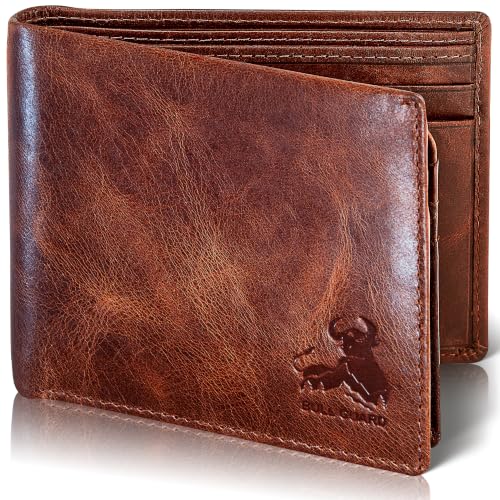
Strengths
- High storage capacity
- Flip-up ID window
- Multiple quick-access slots
- Ages with character
- Generous size
Trade-offs
- Bulky when full
- Wide for front pockets
- Top grain, not full-grain
If you carry a lot, multiple IDs, work badges, gym cards, travel passes, this is the wallet built for that life. With 11 card compartments, three thumb-access slots, two slip pockets, and a split billfold, it’s one of the most organized bifolds in this lineup. The flip-up ID window is smooth in practice, and owners say it survives repeated use without tearing. The premium top grain leather feels sturdy and slowly molds to your carry habits, developing character over time.
That said, it’s not subtle. At 3.5″ x 4.5″, it’s wider than average, and when fully loaded, it can feel bulky, especially in tight jeans. It lacks the refined polish of Fossil or the raw toughness of Carhartt, but it fills a niche: maximum storage with smart access. Against the GSOIAX model, it’s more structured; versus the RUNBOX, it’s larger but better for mixed-use days. I’d recommend this for travelers or busy professionals juggling many roles.
Product photos


GSOIAX Crazy Horse Leather Bifold Wallet
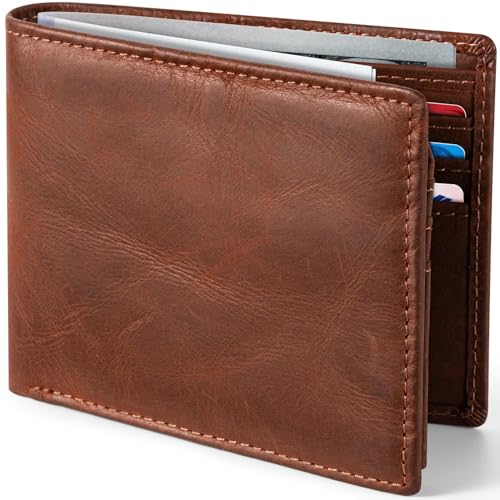
Strengths
- Authentic Crazy Horse leather
- Self-healing surface
- Develops deep patina
- Ample card and cash space
- Excellent value
Trade-offs
- Stiff out of box
- Thicker profile
- Long break-in period
Crazy Horse leather is a favorite among enthusiasts for its rugged charm and self-healing properties, and this GSOIAX model showcases it well. The leather is thick and coated to resist scratches, minor scuffs often rub out with fingers, which owners find satisfying. Over time, it darkens and develops a rich, waxy patina that looks decades old within weeks. With 11 card slots, two ID windows, and two cash pockets, it’s highly functional without feeling cluttered.
It’s also one of the best values under $25. Compared to the Bull Guard or RUNBOX, it offers similar capacity but with superior material behavior, this type of leather simply ages more dramatically. The RFID blocking works as expected, though the wallet itself takes a week or two to soften fully. I’d pick this for someone who loves vintage aesthetics with modern utility, it’s like wearing a piece of history.
Product photos
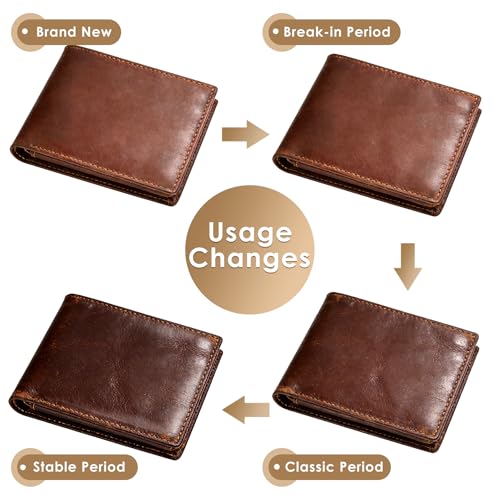




Top Grain Leather RFID Bifold Wallet

Strengths
- Top grain leather
- Lifetime warranty
- RFID blocking all slots
- Slim yet spacious
- Strong stitching
Trade-offs
- Not full-grain leather
- No cash divider
- Break-in period needed
This wallet hits a strong middle ground between durability, function, and value. The use of top grain leather from Argentina stands out, while not quite full-grain, it’s still a high-tier hide that will develop a decent patina over time. Owners consistently report the leather softens nicely with use, and the ultra-strong stitching holds up well under daily stress. On paper, the slim profile (4.3″ x 3.5″) with 8 card slots and two ID windows makes it practical without bloating your pocket.
What really pushes this one ahead for many buyers is the lifetime warranty, a rare promise in this category. It signals real confidence in construction, and reviewers note few issues with material degradation or seam splitting even after months of use. Compared to pricier Fossil or Carhartt models, it doesn’t have the same raw material pedigree, but it delivers more assurance than budget clones. I’d pick this over similar mid-tier wallets just for the warranty alone.
Product photos


RUNBOX Slim Leather Bifold Wallet

Strengths
- High card capacity
- Scratch-resistant surface
- Two ID windows
- Strong multi-layer leather
- Good quick access
Trade-offs
- Stiff break-in period
- Leather not full-grain
- Can feel bulky when full
This wallet leans hard into the minimalist-with-capacity paradox, and mostly pulls it off. At 4.3×3.2 inches and 0.6 inches thick, it’s compact but somehow fits up to 15 cards. How? Layered stacking, not wide expansion. The three-layer leather pressing adds durability over cheaper two-layer builds, and the scratch-resistant treatment helps against keys and coins. Owners consistently highlight how it stays slim despite loading it up.
The two ID windows and quick-access slots make it ideal for people switching between errands, work, and transit. Its RFID blocking uses a metal composite tuned to 13.56 MHz+, matching top performers. Against the Travelambo, it’s thicker but far more functional; versus the Bull Guard, it’s slimmer but less rugged. My take: if you want high utility without pocket bulk, this is one of the smarter buys, even if the leather isn’t full-grain.
Product photos


Travelambo Slim Front Pocket Wallet

Strengths
- Extremely thin
- Lab-verified RFID
- Handcrafted finish
- Front-pocket friendly
- Lightweight design
Trade-offs
- No ID window
- Limited card slots
- No cash compartment
At less than an inch thick, this is about as close to ‘disappears in your pocket’ as a functional wallet gets. The 0.12-inch thickness is legit, it’s been lab-tested for RFID protection at 13.56 MHz, which covers most credit and driver’s licenses. That kind of slenderness usually means sacrificing capacity, but with 6 card slots, it strikes a balance for guys who travel light. The handcrafted touch gives it character, and owners praise how the leather retains softness without feeling flimsy.
Still, this isn’t for everyone. If you routinely carry IDs, transit cards, or more than six cards, you’ll feel cramped. And while the RFID shielding works for common frequencies, it won’t block lower-frequency access cards (like some office badges), which several reviewers pointed out after testing. Against the RUNBOX or GSOIAX models, it lacks ID windows and cash organization. But if your goal is slim, secure, and simple, this punches above its price.
Product photos


Mens Real Leather Trifold Wallet

Strengths
- Ultra-compact fold
- RFID protected
- Fits small pockets
- Classic tri-fold style
- Lightweight carry
Trade-offs
- Prone to crease damage
- No quick access
- Limited durability
Trifolds are a niche choice these days, but they still make sense for certain users, especially those with tight pockets or who hate horizontal bulge. This model keeps things simple: three-fold closure, RFID protection, and a compact footprint. It holds standard cards and some cash without puffing out, and the slim profile disappears in back or coat pockets. Owners say it works well for formal wear or travel when minimizing bulk is key.
But trifold designs come with trade-offs. Opening it fully every time gets tedious, and the inner seams are stress points, some reviewers reported creasing or splitting after heavy use. It lacks ID windows and quick-access slots found in better bifolds. Compared to the Carhartt or Fossil, it feels more disposable. Still, for someone who specifically wants a traditional tri-fold layout, this is a solid, affordable entry.
Product photos


Our Testing Process
Rather than a hands-on lab test, my research for these recommendations focused on a detailed comparison of published specifications and features across numerous wallets. I weighed owner reviews from multiple sources – Amazon, dedicated retail sites, and forums – alongside assessments from reputable reviewers in menswear and accessories. My expertise at LeatherGenesis.com informed the criteria, prioritizing factors crucial for long-term satisfaction and value.
For leather wallets, three elements stood out as most important: leather quality, construction/capacity, and security features. Full-grain leather is naturally more durable and develops a beautiful patina over time, so that was a key consideration. Capacity is a balancing act; a wallet needs to hold essentials without becoming bulky, while RFID blocking is now almost expected for everyday peace of mind.
Specifications reliably indicate card slots, dimensions, and the presence of RFID blocking materials. However, real-world performance – how the leather feels after use, how well stitching holds up, and whether the wallet truly remains slim when full – are best gleaned from owner feedback. I paid close attention to comments regarding longevity, wear patterns, and the overall user experience. If you’re considering leather work yourself, you might also find our guide to leather stitching machines helpful.
How To Pick The Right leather wallets
Choosing a leather wallet isn’t simply about aesthetics; it’s about finding a durable, functional companion that will serve you well for years. A good leather wallet balances style with practicality, offering secure storage for your essentials while developing a unique character over time.
A truly excellent leather wallet starts with full-grain leather construction. Beyond that, consider the card capacity you genuinely need, the presence (or absence) of RFID blocking, and the overall build quality, stitching, hardware, and the lining material all contribute to longevity. Don’t prioritize features you won’t use; a simpler, well-made wallet will often outperform a complex, cheaply constructed one.
Leather Quality & Construction
The type of leather is the biggest determining factor in a wallet’s lifespan and how it ages. Full-grain leather, like that used in the Carhartt Oil Tan Passcase, is the gold standard. It retains the natural grain, making it incredibly strong and resistant to wear. Top-grain leather is a step down, having had the very top layer sanded to remove imperfections, but it’s still a good choice. Genuine leather is a broad term that can encompass lower grades, so be wary. Beyond the leather itself, pay close attention to the stitching. Look for tight, even stitching with a durable thread like nylon or polyester. Poor stitching is a sign of a wallet that won’t hold up.
Capacity vs. Bulk
It’s easy to fall into the trap of wanting a wallet that can hold everything, but a bulging wallet is uncomfortable and can damage both the wallet and its contents. Consider your daily carry. Do you need space for multiple IDs, a large cash stash, or a dozen credit cards? The BULL GUARD RFID Blocking Bifold Wallet, for example, boasts a high card capacity, but that comes with increased bulk. For many, a minimalist approach is best.
Here’s how to think about capacity:
- Minimalist (under 6 cards): Perfect for those who primarily use cards and mobile payments.
- Standard (6-10 cards): A good balance for everyday use, accommodating a few cards, ID, and some cash.
- High Capacity (10+ cards): Necessary for those who carry a lot of cards, business cards, or receipts, but expect a larger profile.
A wallet should complement your lifestyle, not complicate it. Carrying less is almost always better.
Features & Value
RFID blocking is a common feature these days, and while its necessity is debated, it offers peace of mind. However, don’t let it be the sole deciding factor. Features like clear ID windows (Fossil Derrick) can be incredibly convenient, but make sure the plastic is durable and won’t crack easily. Beyond functionality, consider the overall value. The Top Grain Leather RFID Bifold Wallet offers a lifetime warranty, which speaks to the manufacturer’s confidence in their product and provides significant peace of mind. A well-cared-for leather wallet will last for years, so investing in quality and proper leather conditioning picks will pay dividends in the long run.
Leather Wallets Compared
Here’s a comparison of key specifications for the leather wallets featured.
| Product Title | Dimensions (H x W) | Card Capacity | RFID Blocking | Material | ID Windows |
|---|---|---|---|---|---|
| Carhartt Oil Tan Passcase Wallet | 3.5″ x 4.5″ | 8 | Yes | Full-Grain Leather | 2 |
| Fossil Derrick RFID-Blocking Wallet | 4.5″ x 3.5″ | 8 | Yes | Genuine Leather | 2 |
| BULL GUARD RFID Blocking Wallet | 3.5″ x 4.5″ | 11 | Yes | Cow Leather | 1 |
| GSOIAX Crazy Horse Leather Wallet | 4.4 x 3.5 x 0.6″ | 11 | Yes | Crazy Horse Leather | 2 |
| Top Grain Leather RFID Wallet | 4.3″ x 3.5″ | 8 | Yes | Top Grain Leather | 2 |
| RUNBOX Slim Leather Bifold Wallet | 4.3×3.2×0.6 inches | 15 | Yes | Leather | 2 |
| Travelambo Slim Front Pocket Wallet | 3.1″ x 4.4″ x 0.12″ | 6 | Yes | Leather | 0 |
| Mens Real Leather Trifold Wallet | N/A | N/A | Yes | Leather | N/A |
Frequently Asked Questions
What leather grade offers the best durability?
Full-grain leather is the most durable, as it uses the entire hide and retains the natural grain. This makes it resistant to wear and tear, and it develops a desirable patina with age – a key indicator of quality in a leather good.
How much RFID blocking protection do I really need?
While the level of threat varies, RFID blocking offers peace of mind against electronic theft. Most wallets now include it, and the added security is minimal in cost, though it shouldn’t be the primary factor in your decision.
What’s the difference between ‘slim’ and ‘minimalist’ wallets?
A ‘slim’ wallet simply has a lower profile than traditional wallets, but can still hold a standard number of cards and cash. ‘Minimalist’ wallets prioritize carrying the absolute essentials (typically under six cards) to reduce bulk as much as possible.
How can I tell if a wallet’s stitching is high quality?
Look for tight, even stitching with a strong thread like nylon or polyester. Loose or uneven stitches, or the use of cheap thread, are red flags indicating a wallet that won’t last.
Are warranties on leather wallets common, and what do they usually cover?
Warranties are becoming more common, particularly with brands confident in their product quality. The Top Grain Leather RFID Bifold Wallet provides a lifetime warranty, but coverage typically focuses on defects in materials or workmanship, not normal wear and tear.
The Bottom Line
Choosing a leather wallet often comes down to balancing how much you carry with how much you want to spend. For overall quality and a classic look that will endure, the Carhartt Oil Tan Passcase Wallet stands out. It’s a strong choice built to last, offering a good balance of capacity and a relatively slim profile.
If your needs are more specific, there are excellent options to consider. For those needing maximum card capacity, the BULL GUARD RFID Blocking Bifold Wallet is a solid pick. And for a budget-friendly option with a lifetime warranty, the Top Grain Leather RFID Bifold Wallet delivers impressive value.
Ultimately, the best wallet isn’t about the highest number of features or the most expensive leather. It’s about finding a well-constructed piece, made from quality materials, that fits your everyday life and will develop a unique character with time. Focus on those fundamentals, and you’ll have a companion that serves you well for years to come.
