
How Should a Leather Jacket Fit? A Complete Sizing Guide
This post contains affiliate links. As an Amazon Associate, we earn from qualifying purchases.
A leather jacket should fit with the shoulder seam sitting directly on the edge of your shoulder bone, the chest closed but allowing you to comfortably cross your arms, and the sleeves ending at your wrist bone. The waist should taper slightly without pinching, and the hem should fall at your belt line. This fit anticipates that quality leather will soften and mold to your body over several weeks of wear.
That last clause changes everything. The “leather will break in” promise is true, but the amount it gives is finite, about 1-2 cm of ease across the chest over months, not a full size of stretch. Sizing a jacket based on the break-in myth is how you end up with a garment that feels like a straitjacket on day 30, long after the return window closes.
What follows is a map for navigating that gap. We’ll cover the four physical tests that reveal a true fit, the one measurement that’s practically unalterable, the manufacturer-specific numbers you need to compare, and what to actually do when your chest measurement lands between two sizes.
Key Takeaways
- The shoulder seam must sit exactly on the tip of your shoulder bone; a seam that falls toward your arm cannot be moved by any tailor at a reasonable cost.
- Add 2 to 4 inches of ease to your body chest measurement for a standard leather jacket fit; padded linings reduce internal circumference by 1-2 inches.
- Leather gains only 1-2 cm of ease across the chest during its break-in period over several months, it will not stretch to fix a size that’s too small.
- When between sizes, size up unless the larger size shifts the shoulder seam noticeably past your shoulder tip; in that case, size down and accept a closer chest fit.
- Use a tape measure on a jacket you already own that fits well, measuring from armpit to armpit flat, to get a “like for like” comparison for online shopping.
The 4 Leather Jacket Fit Tests That Don’t Lie
A jacket can look perfect in the mirror and still be wrong. Static posture hides the restrictions that show up the moment you move. These four physical checks separate a correct fit from one that will frustrate you every time you wear it.
Cross your arms at your chest. If the back panel pulls tight horizontally or you feel significant resistance in the shoulders, the jacket lacks the cross-back width for your frame. This restriction will not improve with break-in.
The cross-arms test is the most reliable. It simulates reaching for a steering wheel or simply hugging someone, and it directly stresses the shoulder and upper back panels. A jacket that passes this test has the fundamental mobility you need.
Zip the jacket over the thickest layer you plan to wear underneath. Look at the zipper tape. If it’s pulled into a tense, horizontal line or the zipper pull hangs sideways instead of straight down, the chest is too tight. You should be able to slide a flat hand between your sternum and the leather when zipped, a fist’s worth of space means it’s too loose.
Stand naturally with the jacket on and ask someone to look at your back, or use two mirrors. Look for horizontal creases or stress lines running from shoulder to shoulder across your upper back. Those lines are the leather telling you the back panel is under tension. A proper fit shows only vertical folds at the center back, where the material drapes naturally.
Sit down in a chair, then reach forward as if to grab handlebars. The jacket shouldn’t ride up your torso or bunch uncomfortably under your arms. If the entire back lifts and the armholes cut into you, the jacket is either too short in the torso or the armholes are cut too low. This is a common failure point on cheaper jackets where pattern drafting is an afterthought.
The Shoulder Seam Rule: The One Alteration No Tailor Will Touch
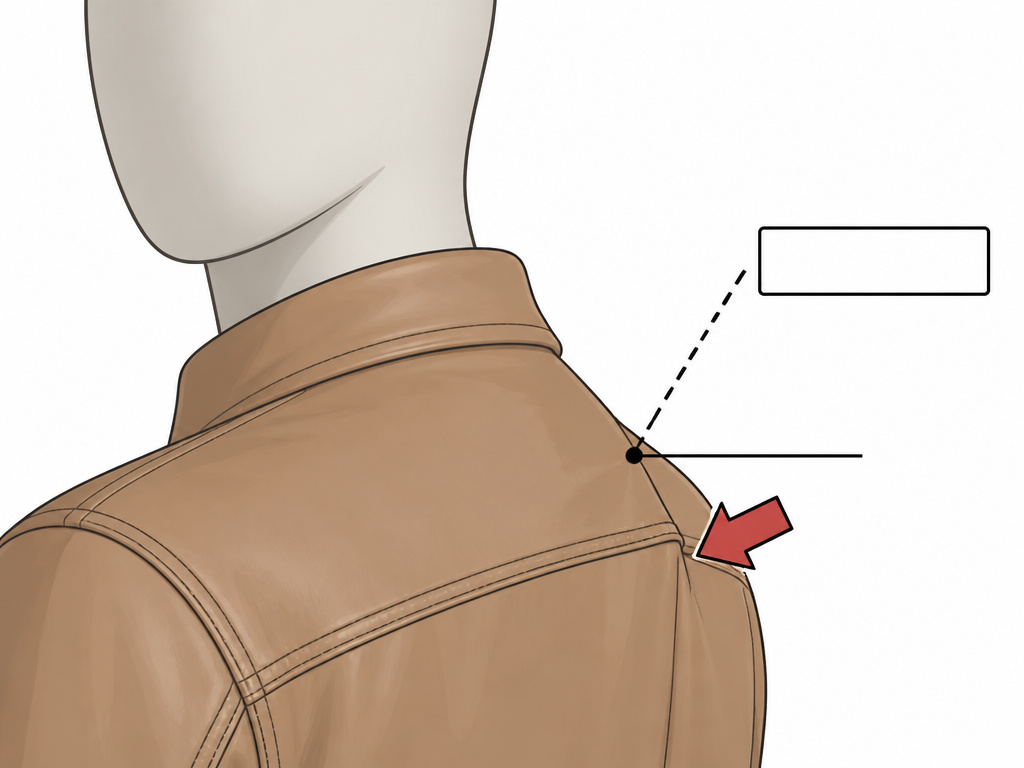
Everything else in a leather jacket can be adjusted, at a price. Sleeves can be shortened. The waist can be taken in. The chest can be tailored. The shoulder seam, however, is the anchor point for the entire garment. Moving it requires completely disassembling the jacket and rebuilding it, a job so expensive it typically costs more than the jacket itself.
That seam must land exactly on the bony tip of your shoulder, the acromion. If it hangs down your arm toward the bicep, the jacket is too large in the shoulders. If it pulls up toward your neck, it’s too small. This is your unalterable measurement. It’s why any guide on how to choose a leather jacket should tell you to prioritize this spot first.
Here’s the practical takeaway. When you’re trying on a jacket, ignore how the chest feels for a moment. Stand straight, look in a mirror from the side, and find that seam. That’s essential. Once that’s locked in, you can address the chest and sleeves.
Let me share what I’ve learned from watching people wrestle with this. A jacket with perfect shoulder placement but a slightly tight chest is a better candidate than one with a roomy chest and drifted shoulders. The chest can gain a tiny bit of ease as the leather breaks in and molds. The shoulder point will never move toward you.
Chest, Sleeves, and Hem: The Numbers That Actually Matter
Shoulders are the foundation, but the rest of the jacket needs to follow a specific set of proportions to look and feel right. Manufacturers like Simons Leather and Helium Leather publish specific external dimensions for a reason, they let you compare a jacket you own to the one you’re buying.
For the chest, you need ease, extra room beyond your body measurement to allow for movement and layering. The amount varies by brand and intended fit. Blackstone Jackets uses a USA standard of adding 4 inches of ease to your body chest measurement for a leather jacket. For a shearling jacket with a thick lining, that jumps to 6 inches. Helium Leather notes that each size increase typically adds about 2 inches across the chest.
| Measurement | Ideal Fit | Consequence If Wrong |
|---|---|---|
| Chest | Body measurement + 2–4″ of ease. Allows a flat hand between chest and jacket when zipped. | Too tight: restricts breathing, creates horizontal zip stress. Too loose: loses silhouette, looks boxy. |
| Sleeve Length | Ends at the wrist bone or base of the thumb. | Too short: exposes wrist, rides up when driving. Too long: cuff covers hand, looks sloppy. |
| Hem / Length | Hits at the belt line for a classic cropped jacket. | Too short: exposes lower back, rides up when sitting. Too long: covers seat, loses iconic silhouette. |
| Waist | Tapers slightly from chest without pinching. | Too tight: creates an “X” shape at the front zipper. Too loose: no shape, hangs straight down like a sack. |
Sleeve length should land at your wrist bone. To measure properly for a leather jacket, bend your elbow 90 degrees and place your hand on your hip. Measure from the center back of your neck, across the shoulder, to the elbow, and down to the wrist. This accounts for the bend.
The jacket’s hem, for a classic biker or racer style, should sit right at your belt line. That’s the cropped look that defines the style. Bomber jackets and longer coats have their own rules, but the principle is the same: the length should complement your torso without restricting movement when you sit.
Between Sizes? Your Decision Tree
 Your chest tape reads 42 inches. The size chart says Medium fits 40–42 and Large fits 42–44. Do you size up or down? Most generic advice says “size up,” but that’s incomplete and can lead you straight into the shoulder-fit trap.
Decrum provides a specific, better rule. If you are between sizes: 1. First, size up. A slightly roomy chest can be filled with a light layer and will soften comfortably. 2. Now, check the shoulder seam on the larger size. If moving up a size shifts the shoulder seam noticeably past the tip of your shoulder bone, then size down instead. In that case, accept the closer chest fit of the smaller size. The shoulder seam is the unalterable measurement, so you sacrifice chest ease to preserve it.
This scenario is common for people with broader shoulders relative to their chest. The “size up” advice assumes your proportions scale evenly with the size chart, but they often don’t. This decision tree is the edge case that most buying guides miss.
Another edge case: padded or quilted linings. Helium Leather states a lightly padded lining reduces the internal circumference by 1 inch; a thickly padded lining reduces it by 2 inches. If you’re between sizes and the jacket has padding, you might need to size up twice to get the internal room you need, but again, watch the shoulders.
Fitted, Slim, Regular, Loose: Decoding Fit Types
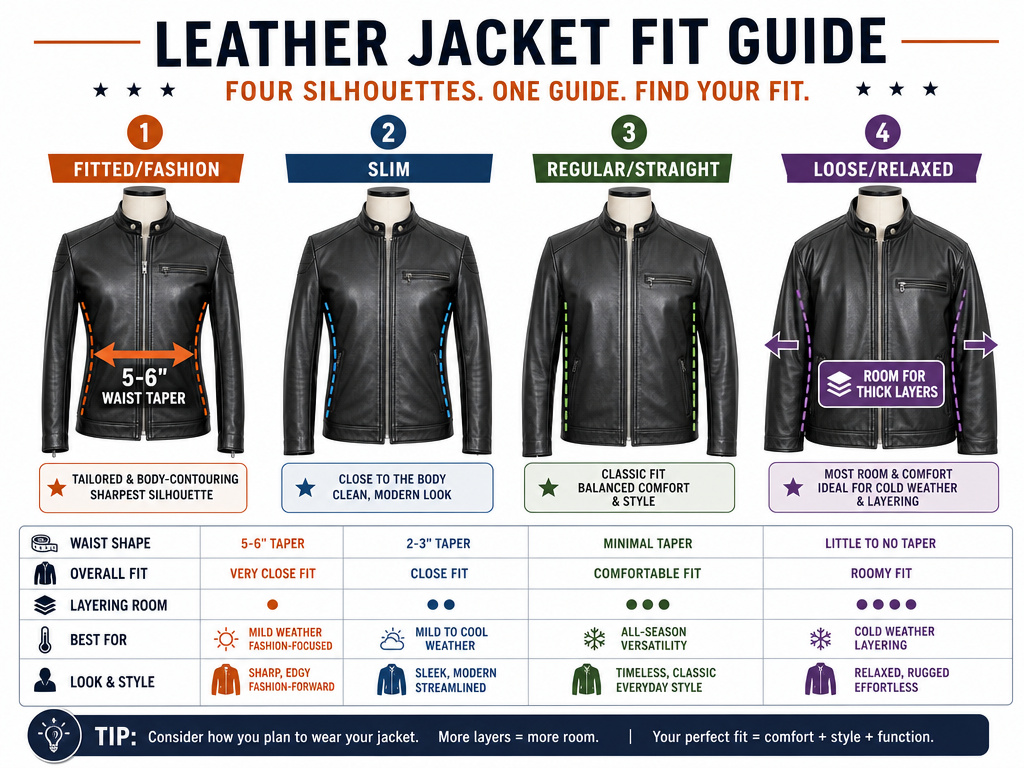 Not all leather jackets are meant to fit the same way. The cut, often listed on product pages, dictates the silhouette. Buying a slim fit jacket when you need a regular cut is a fast route to disappointment.
Here’s how brands typically define these terms: * Fitted / Fashion Fitted: Very close to the body, often narrowing at the waist by 5–6 inches. Meant to be worn with thin layers or open. If you’re not used to tight clothing, size up. * Slim: Close to the body with a defined taper at the waist. The most popular “fashionable” cut. Order your usual size. * Regular / Straight: A classic, straight cut from chest to waist. Adapts to most body shapes. Order your usual size. * Loose / Relaxed: Straight and roomy, allowing for thick sweaters or even a suit jacket underneath. You may need to size down if you only plan to wear light layers.
This is not marketing fluff. The difference between a Slim and a Regular cut in the same brand and size can be over an inch in the chest and waist measurements. Always refer to the specific brand’s size chart for the jacket you want, not a generic “leather jacket” chart.
Where this goes sideways: Buying a slim-fit jacket because it’s trendy, when your lifestyle requires the room of a regular fit for layering. You’ll wear it twice and then it hangs in the closet, feeling restrictive every time.
The Break-In Reality: What “The Leather Will Mould” Actually Means
A new leather jacket is stiff. Over time, it softens and conforms to your body’s unique shape. This break-in period is real, but its effects are consistently overstated.
Quality full-grain leather, like that from a brand like Schott, will gain about 1-2 cm (roughly half an inch to an inch) of ease across the chest and back over several months of regular wear. The leather doesn’t “stretch” in the elastic sense; the collagen fibers relax and the jacket molds to your posture and movement patterns.
This means two things. First, a jacket that is genuinely too small, that fails the cross-arms or zip-stress tests, will not magically become comfortable. Second, the break-in is why a jacket should start snug, not tight. You want it to be close-fitting, with that slight resistance, knowing it will relax into a perfect, personal fit. A jacket that’s already loose from day one will just get baggier.
To break a leather jacket in properly, wear it often for short periods indoors. Move in it, bend, reach, sit. Don’t try to force it with water, heat, or commercial “break-in” sprays. Those can dry out the leather or set stains. Patience is the only tool that works without risk.
Frequently Asked Questions
How much room should be in a leather jacket?
You should be able to comfortably fit a flat hand between your chest and the jacket when it’s fully zipped. This provides enough room for a t-shirt or light sweater. For a more precise number, most manufacturers build in 2 to 4 inches of “ease” beyond your body chest measurement for a standard fit.
Do leather jackets stretch or get bigger?
They mold rather than stretch. Over the first few months of regular wear, a quality leather jacket will soften and conform to your body, gaining about 1-2 cm (less than an inch) of ease across the chest and back. It will not stretch a full size. Buy the correct size from the start.
Should you size up or down in leather jackets?
Generally, size up if you are between sizes and the larger size still places the shoulder seam correctly. However, if sizing up moves the shoulder seam off your shoulder bone, size down and accept a closer chest fit. Always prioritize shoulder placement over chest ease.
How do I know if my leather jacket is too small?
Perform the four physical tests: crossing your arms should feel natural, the zipper shouldn’t show horizontal stress lines, your upper back shouldn’t have horizontal creases, and you should be able to sit and reach forward without the jacket lifting or binding. If it fails any of these, it’s too small.
The Bottom Line
A perfect leather jacket fit is a balance of precise measurement and realistic expectations. Lock the shoulder seam on the bone, ensure the chest passes the hand-test, and trust that the sleeves hit your wrist. Remember that the celebrated “break-in” provides only a centimeter or two of give, it’s a refinement, not a rescue.
When the numbers leave you torn between two sizes, let the shoulder be your guide. A jacket that fits correctly across the shoulders but is snug in the chest is a better long-term bet than one with a roomy chest and drifting seams. That’s the difference between a jacket you’ll wear for a decade and one you’ll list online after a season.
Finally, understand that a motorcycle jacket has a different fit intent than a fashion bomber. One is cut for a forward-leaning riding posture, the other for standing ease. Choose the tool for the job, measure against that brand’s specific chart, and you’ll bypass the guesswork that leaves most people with a jacket that never quite feels right.
