
How to Care for a Leather Basketball | The Glycerin Trick
This post contains affiliate links. As an Amazon Associate, we earn from qualifying purchases.
This post contains affiliate links. As an Amazon Associate, we earn from qualifying purchases.
To care for a leather basketball, clean it with a damp cloth and a drop of glycerin-based saddle soap, dry it away from heat and sun, store it at room temperature, and maintain its pressure at 0.55 bar (8 PSI). The goal isn’t to make it look new, but to preserve the grip and feel that develop through play.
That last point is where most care guides get it backwards. They treat the leather like it’s fragile, prescribing gentle wipes that do nothing for embedded grime. A game-ready ball isn’t pristine. Its pebble grain flattens where your palms rest, the color darkens from sweat and oil, and that’s what gives you control. Your job is to maintain that state without letting salt or dirt corrode it.
What follows is the practical difference between cleaning and preserving. This guide explains the one soap that works without residue, the exact pressure that keeps the bounce true, and the storage mistake that warps a ball in a single summer afternoon.
Key Takeaways
- Use a drop of glycerin saddle soap on a damp microfiber cloth for cleaning; it lifts dirt from the channels without leaving a slick film that kills grip.
- Never dry a wet ball with heat or in direct sunlight. The leather can warp, and the bladder inside can be damaged.
- Inflate to 0.55 bar (8 PSI). Under-inflation deadens the bounce; over-inflation stresses the seams and risks the bladder.
- Store at stable room temperature. A car trunk in summer can permanently deform the leather and ruin the ball’s roundness.
- Break-in happens through play, not products. Skin oils and friction soften the leather naturally; conditioners or sprays will make the surface slippery.
What You’re Actually Trying to Preserve
When you buy a premium leather basketball like a Wilson NBA Game Ball or a Spalding TF-1000, you’re not just buying a round object. You’re buying a playing surface that’s designed to evolve. Brand new, the pebble grain is sharp and uniform. After a few dozen games, the spots where your fingers press and dribble will polish smooth.
This isn’t damage. It’s the break-in process. That smoothness in the primary grip areas is what gives you consistent control, especially when your hands are sweaty. The leather darkens and becomes more supple, molding to the game. The goal of care is to protect this earned character from the things that actually destroy it: ground-in dirt that abrades the fibers, salt from sweat that dries and cracks the leather, and moisture that invites mold or warps the shape.
Think of it like a wooden workbench. You don’t sand away the dents and stains; you oil it to keep the wood from drying out and splitting. Your basketball is the same. You’re maintaining the tool, not restoring it to showroom condition.
The Right Way to Clean (and What to Skip)
Here’s the thing. The standard advice is a damp cloth with mild soap. That’s fine for dust. For the mud, sweat, and court grime that gets packed into the ball’s deep channels, it’s useless. You need a cleaner that breaks down oils without leaving behind a residue that makes the ball slick.
Through trial and error, I found that a tiny drop of glycerin-based saddle soap on a damp microfiber cloth works perfectly. Glycerin is a humectant, it attracts moisture, which helps lift dirt without stripping the leather’s natural oils. The key is the “tiny drop.” You’re not lathering the ball; you’re dampening the cloth.
Common mistake: Using a leather conditioner or spray meant for jackets or shoes. These products are designed to create a water-resistant barrier, which will seal the leather’s pores and make it impossible for the ball to absorb the sweat from your hands, destroying your grip.
The process is straightforward, but the order matters.
- Wipe away loose dirt. Use a dry, soft-bristled brush or a dry cloth. This prevents you from grinding grit into the leather during the next step.
- Apply the cleaner. Dampen a microfiber cloth with warm water, add a single drop of glycerin saddle soap, and wring it out so it’s just damp. Wipe the ball in a circular motion, focusing on the dirty channels. Never submerge the ball or run it under water.
- Rinse the cloth. Wring out your microfiber cloth thoroughly in clean water. Wipe the entire ball again to remove any soap residue. Any leftover soap will feel tacky.
- Dry immediately. Pat the ball dry with a clean, absorbent towel. Then, let it air-dry indoors, away from heaters, hair dryers, or sunlight. A fan in the room speeds this up.
| Do This | Not That | Why It Matters |
|---|---|---|
| Damp cloth, drop of glycerin soap | Soaking in a sink or bucket | Water seeps into the valve, damaging the internal bladder. The leather can also oversaturate and weaken. |
| Air-dry at room temperature | Drying in direct sun or with a hair dryer | Heat warps the leather and can cause the seams to separate. The ball loses its roundness. |
| Clean after use on a dirty court | Cleaning before every single use | Over-cleaning, especially with soap, dries out the leather over time. |
The whole process should take 10 minutes, most of which is drying time. If you’re playing several times a week, a full clean like this is only needed monthly, or after a particularly muddy outing. For daily maintenance, a simple wipe with a dry towel is enough.
Why “Breaking In” Means Playing, Not Polishing
Manufacturers are clear on this. Spalding’s official FAQ states: “You break in a leather basketball by playing with it. There are no product or machinery needed. Skin, sweat, and simply playing with the basketball will break in the leather over time.This is an essential fact of leather sports equipment.
The Wilson NBA Game Ball team advises that even the pros practice with new balls for a couple of weeks before they’re game-ready. The process relies on friction, pressure, and the natural oils from your skin. Any external product, oils, conditioners, “break-in sprays”, short-circuits this. They can oversoften the leather, making it mushy and less responsive, or coat the surface and ruin its ability to absorb sweat.
Think about a leather weightlifting belt. It gets stiffer when it’s sweated in and dried, forming to your body. A basketball works on a similar principle, but through handling. Your job is to enable that process, not replace it with a chemical shortcut.
The Pressure Spec That Most People Miss
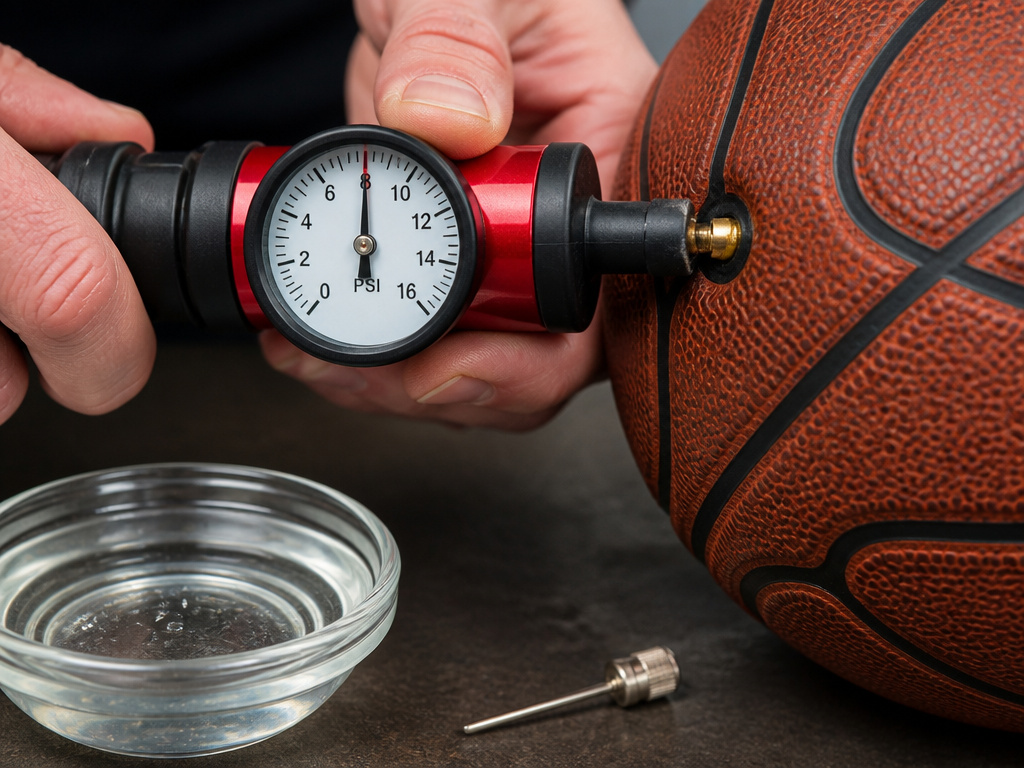
A ball’s feel is dictated by its internal air pressure as much as its cover. The standard for a size 7 basketball is 0.55 bar, which is equivalent to 8 PSI. This isn’t a suggestion; it’s the engineering spec for optimal bounce and seam integrity.
A basketball dropped from 1.8 meters onto a hardwood floor should rebound to a height between 1.2 and 1.4 meters. That’s the test for 0.55 bar of pressure.
Under-inflating makes the ball dead and slow. It also causes the leather to flex in unnatural ways, accelerating wear. Over-inflating is worse. It puts massive stress on the glued seams and the bladder. Spalding warns that extreme over-inflation can cause the ball to explode. Even mild over-inflation makes the ball feel like a rock and can permanently stretch the leather.
Use a pump with a pressure gauge. Before you insert the needle, dip it in a tiny bit of glycerin (even water works in a pinch). This lubricates the valve, preventing damage that leads to slow air leaks. Check the pressure every two to three weeks, as all balls naturally lose a small amount of air over time.
Storage: The Silent Ball-Killer
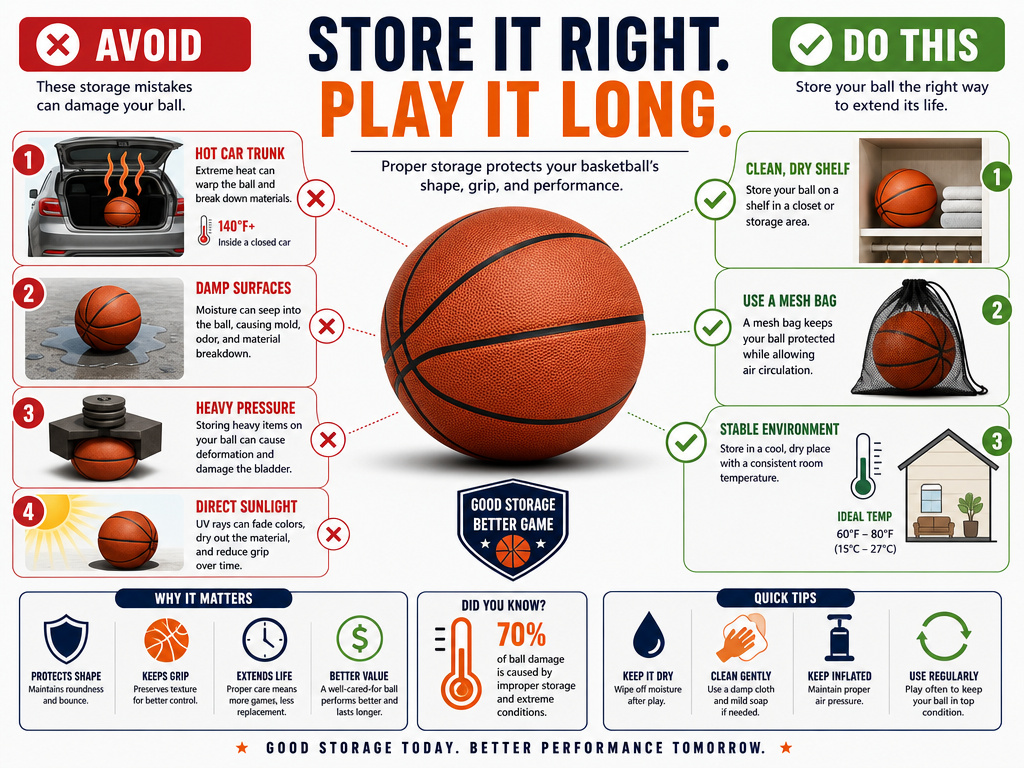
How you store the ball between games has a bigger long-term impact than how you clean it. The enemies are heat, moisture, and constant pressure.
- Never leave it in a car trunk. This is the fastest way to ruin a ball. Summer heat can warp the leather and damage the internal materials. The ball can become permanently lopsided.
- Keep it away from damp floors. Don’t leave it on a concrete garage floor or in a damp basement. Moisture promotes mold and can degrade the leather and glue.
- Store at room temperature. A closet shelf or a room-temperature garage is ideal. The goal is a stable, cool, dry environment.
- Avoid constant compression. Don’t leave it wedged in a tight space or under other gear. Store it in a mesh bag or on a shelf where it can keep its shape.
This is the same principle behind caring for other fitted leather gear. Just as you’d store a [leather saddle](https://leathergenesis.
When to Deflate (And When to Never, Ever Deflate)
For 99% of basketballs, you should never fully deflate it for storage. Deflating and reinflating puts repetitive stress on the valve and can cause the leather panels to crease along the seams.
There is one major exception: the Molten GL Series. These are high-end, full-grain leather balls that come from the factory pre-inflated to a perfect shape. Molten explicitly advises against deflating them, as the premium leather is prone to permanent creasing. If you own one of these, you maintain pressure without ever letting it go fully flat.
For all other balls, if you must transport it long-term in a tight bag, releasing a small amount of air (just enough to make it slightly soft) is acceptable. Inflate it back to 8 PSI as soon as you take it out.
Troubleshooting Common Issues
Even with good care, problems pop up. Here’s how to handle them.
The ball feels slippery after cleaning.
You used too much soap or a product with silicones or waxes. Wipe it down again with a cloth dampened only with water to remove residue. It may take a few playing sessions for the natural grip to return.
It’s losing air faster than usual.
The valve is likely dry. Dip your inflation needle in glycerin and insert/remove it from the valve 5-6 times. This reconditions the rubber. If air loss continues, the valve or bladder may be damaged.
White, crusty residue in the channels.
This is dried salt from sweat. Dampen a cloth with a 50/50 mix of white vinegar and water, wring it out thoroughly, and wipe the affected areas. Follow immediately with a water-dampened cloth to rinse, then dry completely. The vinegar breaks down the salt without harming the leather.
A musty smell.
Mold or mildew has started inside, often from being stored wet. Wipe the exterior with a dilute vinegar solution (as above) and dry thoroughly. Place it in a dry, well-ventilated area. The smell may linger if the interior is affected; prevention is the only real cure.
The logic here mirrors caring for leather gloves or leather boxing gloves, moisture and salt are the common enemies, and the remedy is always gentle, targeted cleaning followed by perfect drying.
Frequently Asked Questions
Can I use mink oil or leather conditioner on my basketball?
No. Never. These products are designed for waterproofing and softening in ways that destroy a basketball’s functionality. They will make the surface slick and prevent it from absorbing the moisture from your hands, which is essential for grip. Stick to the glycerin saddle soap method for cleaning only.
How often should I clean my leather basketball?
For regular indoor use, a detailed clean every 4-6 weeks is sufficient. Always give it a quick wipe with a dry towel after playing to remove sweat and dust. Clean it immediately after using it on a dirty or outdoor court. Over-cleaning is more harmful than under-cleaning.
Is a leather basketball okay for outdoor use?
Officially, no. Leather is for indoor courts. Outdoor asphalt is abrasive and will shred the pebble grain very quickly. For outdoors, use a rubber or durable composite ball. Using a leather ball outside voids any warranty and dramatically shortens its life.
My ball got soaked in the rain. Is it ruined?
Not necessarily, but act fast. Dry it off with towels immediately, then let it air-dry at room temperature for 24-48 hours. Do not use heat. The main risk is water seeping into the valve and damaging the bladder, which can cause a slow leak or mold. After it’s fully dry, check the bounce and listen for any sloshing sounds.
What’s the difference between leather and composite?
Genuine leather (like in the Wilson NBA ball) is a natural material that requires a break-in period and develops a unique feel. Composite leather is a synthetic material designed to mimic leather but is more durable and often usable indoors and out. It needs little to no break-in. Your general leather care principles apply to the former; the latter is more forgiving.
The Bottom Line
Caring for a leather basketball is simpler than most guides make it. Forget the specialty products. Your kit is a microfiber cloth, a drop of glycerin soap, a pump with a gauge, and a dry place on a shelf. The work happens on the court, your sweat and hands do the breaking in. Your job is to remove the dirt and salt that grind the leather down, keep the ball at 8 PSI, and never, ever let it bake in a hot car.
That’s it. A well-maintained leather ball isn’t just a piece of sports equipment; it’s a record of your games. The darkened spots and smoothed grain are the patina of use. Preserve that, and the ball will give you a better feel season after season than any out-of-the-box model ever could. For everything else, the fundamentals of best leather care, gentle cleaning, controlled drying, and stable storage, always apply.
