
How to Care for Your Leather Holster and Preserve Its Fit
This post contains affiliate links. As an Amazon Associate, we earn from qualifying purchases.
This post contains affiliate links. As an Amazon Associate, we earn from qualifying purchases.
To care for a leather holster, focus on two daily habits and one monthly ritual. Wipe it down with a dry cloth after every use to remove sweat and grit. Store it in a cool, dry place, never in a car or direct sun. Once a month, inspect for looseness, apply a drop of oil to snap buttons if needed, and treat the interior with a light spray silicone to protect against moisture and maintain draw speed. Avoid heavy oils and never use solvents.
That routine prevents 90% of problems. The other 10% are specific failures, saltwater immersion, over-softening from conditioners, and the slow collapse of the molded shape that turns a secure holster into a dangerous one.
What follows is the breakdown: why those two habits matter, the exact products that work (and the ones that ruin leather), and how to spot the signs that your holster is becoming unsafe before it’s too late.
Key Takeaways
- The interior needs spray silicone, not conditioner, to fight moisture and keep the draw smooth.
- Over-softening the leather with oils like Neatsfoot or mink oil destroys the molded retention, turning the holster into a loose bucket.
- A loose holster isn’t just an inconvenience; the leather can flex inward and contact the trigger, a documented cause for concern.
- Salt exposure demands an immediate warm water rinse, delaying it sets the corrosion.
- Hardware like snap buttons needs a drop of lubricating oil bi-weekly, but never use threadlocker on holster screws.
The Daily Wipe-Down and Monthly Deep Check
Your holster lives against your body. It collects sweat, skin oils, dust, and lint every single day. Left alone, that mix acts like a slow-acting sandpaper and attracts moisture.
The fix is stupidly simple. After you take it off, give it a ten-second wipe with a clean, dry cotton cloth. Focus on the interior where the gun sits and the belt loop areas. You’re not cleaning yet; you’re removing the day’s abrasive grime. This one habit adds years to the holster’s life.
Once a month, do the real inspection. This is where you catch problems before they become failures.
The part nobody mentions: A leather holster losing its stiffness is a critical failure. As Safariland notes, when it becomes “more like a bucket than a holster,” the retention is gone. Worse, the floppy leather can flex inward under pressure. In a worst-case scenario, that flexing material can interact with the trigger.
Here’s your monthly checklist: * Check the shape. Hold the empty holster up to the light. Does the mouth stay open? Does the trigger guard area still hold its crisp mold? If it’s collapsing, the leather is either over-softened or just worn out. * Test the snaps. Do they release cleanly? A stiff snap button on a magazine pouch is a problem when you need a reload. LD West’s guide is specific: use a Q-tip with one drop of oil on the inside of the snap bi-weekly if you’re using it daily. * Inspect the hardware. Are all screws tight? Galco explicitly states that tension adjustments are the user’s responsibility, as they are not pre-set at the factory. Do not use Loctite. The outgassing from threadlocker adhesives can damage other materials on the holster. * Feel the interior. Is it still smooth, or is it getting sticky or gritty? This is when you apply a light spray silicone to the interior only. One short burst, wiped with a cloth, protects against moisture and maintains a fast draw.
What to Clean With (And What to Avoid Entirely)
For general soil, you need two things: glycerin soap and a soft-bristled toothbrush. Brands like Bianchi and MTR Custom Leather call this out directly. Dampen the brush, work in a tiny amount of soap, and gently scrub the soiled area.
Rinse with a cloth dampened with warm water, do not run the holster under a tap. Pat it dry with a towel until it’s just slightly damp, then let it air-dry at room temperature. This takes a few hours. Never, ever use a hair dryer, oven, or place it in direct sun to speed this up. Artificial heat shrinks and cracks leather permanently.
| Do Use | Do NOT Use | Why It Matters |
|---|---|---|
| Glycerin soap | Saddle soap | Saddle soap is for filthy saddles; it overdries and strips modern holster finishes. |
| Spray silicone (interior) | Neatsfoot/Mink oil | Oils over-soften, destroying retention. Silicone protects without breaking down fibers. |
| Dry cloth | Acetone or solvents | Solvents dissolve the leather’s natural oils and any protective topcoat. |
| Light gun oil (snaps) | Loctite/Threadlock | Threadlocker outgasses and damages plastics and rubbers often found on holsters. |
The conditioner question is where most guides get it wrong. You almost never need to condition the exterior of a quality holster. Brands like Bianchi finish their leather with a specific dressing at the factory. If the exterior becomes dry or scratched, they advise a commercial leather dressing without lacquer. The keyword is sparingly. Conditioning is not a monthly task. It’s a rescue operation for dried-out leather.
My rule of thumb, learned the hard way, is to always test any new cleaner or conditioner on a hidden seam or inside flap before applying it to the main surface. A product that works for a belt might darken or stain a holster’s molded surface.
The Right Way to Break In a New Holster
A new holster should be tight. That’s by design. Galco states plainly that their full-grain holsters are precision-molded to fit tightly, expecting the leather fibers to relax with use. Fighting a stiff draw for the first week is normal.
The correct break-in method doesn’t involve brute force or harmful chemicals. It uses time and gentle pressure.
- Bag the gun. Place your unloaded firearm inside a plastic bag (the bag the holster came in is perfect).
- Insert and wait. Seat the bagged gun fully into the holster. Let it sit overnight, or up to 24 hours.
- Test the fit. Remove the bag and try the gun. Still too tight? Repeat the process. This slowly stretches the fibers without stressing stitches or distorting the mold.
Do not soak the holster in water or oil to speed this up. You’ll break it in, alright, right into a misshapen, over-softened mess. The break-in period is also the best time to start your spray silicone routine on the interior, establishing that protective layer from day one.
Storage: It’s Not a Garage Item
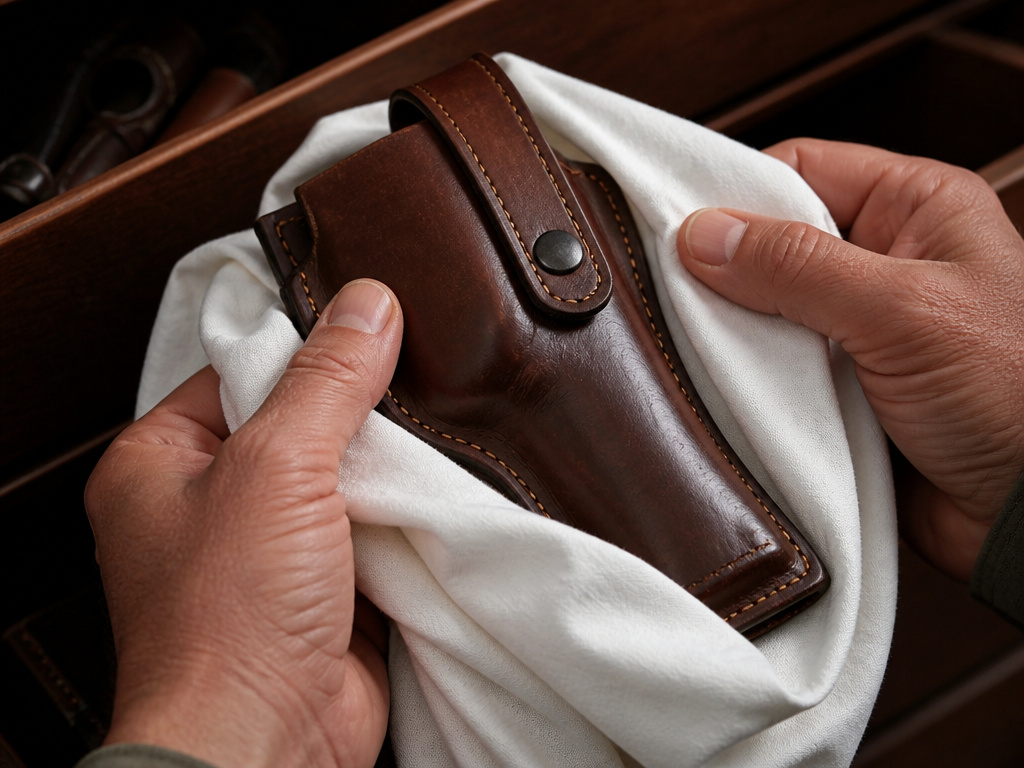 Think of your holster like a good pair of leather boots. You wouldn’t leave them in a hot garage. The same rules apply.
Heat is the enemy. A car dashboard, trunk, or attic will bake the leather, making it brittle and prone to cracking. The adhesives and threads can also fail.
Moisture is the other enemy. A damp basement or a gym bag still wet from sweat invites mildew. The ideal spot is cool, dry, and dark, a closet shelf or a dresser drawer.
If you’re storing it long-term, wrap it in a soft cotton cloth and place it in its box or a hard case. MTR Custom Leather suggests storing it where you’d keep important documents or clothing. And here’s a critical warning from multiple manufacturers: if you store your gun in the holster, you must check it daily for moisture or condensation. The leather can trap humidity against the metal, causing rust in a matter of days.
When Things Go Wrong: Saltwater, Soaking, and Verdigris
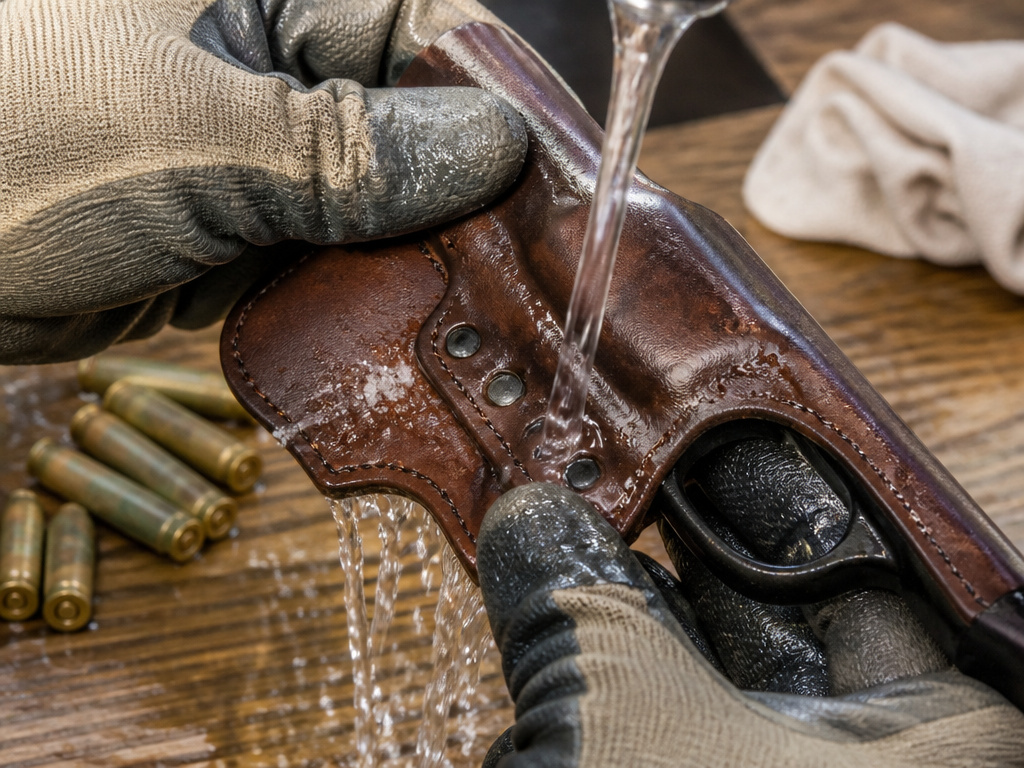 Sometimes, care is about damage control. The procedures here are specific and time-sensitive.
Saltwater exposure isn’t a maybe. Bianchi’s guide is absolute: if exposed to salt spray or immersion, rinse the leather thoroughly in warm water as soon as possible. Salt crystals are abrasive and corrosive. Flush them out immediately, then air-dry.
A soaked holster needs patience. Reshape it by hand as best you can, then air-dry at room temperature. Stuffing it with paper towels can help hold the shape. Again, no heat. It will shrink, and you may need to re-break it in using the bag method once it’s fully dry.
That green gunk on brass? That’s verdigris. It’s a natural chemical reaction between brass hardware (like cartridges in a belt loop) and vegetable-tanned leather. It wipes off with a cloth and isn’t harmful to the leather, just unsightly. If you want to avoid it, use nickel-plated cartridges in your leather carriers.
Frequently Asked Questions
Can I use mink oil on my leather holster?
No. Mink oil, Neatsfoot oil, and other heavy conditioners will over-soften the leather. A holster’s job is to hold its shape rigidly for safe retention. Softened leather loses that rigidity, becoming a safety hazard. Use spray silicone on the interior only, and only a lacquer-free leather dressing on the exterior if it’s genuinely dried out.
How often should I condition my holster?
Rarely, if ever. A quality holster arrives with the finish it needs. Exterior conditioning is for addressing visible dryness or scratches, not for routine maintenance. Over-conditioning is a far more common problem than under-conditioning. Your focus should be on cleaning and protecting the interior from moisture.
My holster is getting loose. Can I fix it?
You can sometimes restore a slightly relaxed fit by re-wetting the leather (with a damp cloth, not a soak) and re-breaking it in with the plastic-bag method. However, if the holster has lost all stiffness and is collapsing in on itself, the leather fibers are over-stretched or degraded. At that point, it’s a retention and safety issue. It’s time for a new holster.
Is it safe to leave my gun in the holster?
For storage, it’s not recommended. Leather can trap moisture against the metal, promoting rust. It also keeps tension on the springs of a semi-automatic. For daily carry, it’s fine, but you must be vigilant about the daily wipe-down to remove sweat and body salts from both the gun and the holster’s interior.
What’s the best leather for a holster?
For durability and mold retention, full-grain cowhide is the benchmark. It molds well, wears in (not out), and maintains its shape. Exotics like shark or elephant hide are incredibly tough but often overkill for most users and complicate the care for leather process. The leather’s temper, its stiffness, is more important than its exotic name.
Before You Go
Leather holster care isn’t about babying the material. It’s about respecting its function. The goal isn’t a shiny showpiece; it’s a piece of safety equipment that remains reliable for years.
So, ignore the complex routines. Stick to the dry cloth after use, the cool drawer for storage, and the monthly check for firmness. Watch for that slow collapse, the shift from a molded shell to a soft bucket. That’s your signal that the leather’s integrity is going, long before a stitch fails.
And when you do need to treat it, remember the rule of the hidden seam. Test first. That one habit has saved more of my gear than any branded miracle product ever has.
