
How to Choose a Leather Phone Case: The Complete Checklist
This post contains affiliate links. As an Amazon Associate, we earn from qualifying purchases.
To choose a leather phone case, match three things: the leather grade (full-grain for patina, avoid “genuine leather”), the construction (a hybrid shell with a screen lip over 0.8mm), and verified MagSafe compatibility. Cases thicker than roughly 3mm will slow or block wireless charging, and a “military-grade” claim without disclosed test procedures is marketing, not a certification.
That 3mm limit isn’t arbitrary. It comes from the internal design documents of wireless charging component makers, who assume a cover thickness of 2 to 2.5 mm for reliable operation. Add a millimeter for the phone’s own glass back, and you’re at the ceiling. Go over it, and the magnetic field weakens, heat builds up, and your overnight charge fails around 2 a.m.
This guide walks through the leather, the build, and the compatibility checks that separate a case that lasts four years from one that warps in eighteen months. You’ll know how to read a product page, what questions to ask, and which specs are essential.
Key Takeaways
- Ignore “military-grade” and “genuine leather” labels; they are marketing terms, not quality guarantees.
- A screen lip must exceed 0.8 mm to prevent the glass from touching flat surfaces.
- Wireless charging reliably works through cases up to ~3mm thick; thicker cases or internal metal plates cause failure.
- Full-grain leather develops a patina over 2–4 years; bonded leather often delaminates within months.
- MagSafe requires precise magnet alignment; uncertified cases can misalign by over 1.5mm, causing accessory detachment.
Leather Grades Decoded
Let’s untangle the single most confusing part of the label. The word “leather” tells you almost nothing. You’re looking for the specific grade, which dictates how the case will feel, age, and eventually fail.
Full-grain leather is the outer layer of the hide, natural grain intact. It has the tightest fiber structure, which is why it resists wear and develops a patina, a darkening sheen from oils and handling, over years. This is what you want if you like the idea of your case looking better with age. Top-grain leather is sanded to remove imperfections and then coated with polyurethane. It looks uniform out of the box but won’t develop a rich patina and is more prone to showing scratches in the coating.
Then there’s “genuine leather.” Here’s the thing. In industry terminology, this is a specific grade that refers to the split layers of the hide after the top is removed. It’s often embossed with a fake grain and heavily coated. It feels acceptable at first but tends to crack or peel within months. I used to dismiss anything labeled “genuine leather” until I handled pieces that defied the rule, but that’s the exception. As a default filter, treat that term as a warning, not a recommendation.
A full-grain leather case on a hybrid shell can last the entire 2–4 year life of your phone. The leather itself will outlive the device, while bonded leather alternatives often delaminate within a single season.
The tanning method matters too, especially if you care about patina. Vegetable tanning uses natural tannins from trees. It produces a firm leather that ages and darkens beautifully over time. Chrome tanning is faster and more common, resulting in softer, more water-resistant leather that ages with less color change. Most quality case makers use a combination tanning process to balance durability and character.
Case Construction: Where Your Phone Actually Gets Protected
Leather wrapped around a flimsy frame is just a pretty cover. Protection comes from the internal chassis. You’re almost always better off with a hybrid design: a leather back fused to a shock-absorbing TPU or polycarbonate bumper frame.
That inner shell does the real work during a drop. Rather than transferring shock directly to the phone’s frame, it distributes force across a wider surface area. The leather back provides grip and takes the daily abrasion from tables and pockets. Look for cases that mention a “precision-molded TPU cradle” or “polycarbonate frame.” Avoid the floppy, all-leather sleeves that offer no edge protection.
The screen lip is non-negotiable. When your phone is face-down on a table, the case’s raised edge should keep the glass from making contact. The magic number is 0.8 mm. Anything less risks a direct hit. The same goes for the camera lip on the back. A slight trade-off: very tall front lips can sometimes interfere with edge-swipe gestures. Look for a case with a lip height of 1.5mm or less.
Button feel is a dead giveaway of manufacturing quality. Cheap cases have mushy, imprecise cutouts that make pressing the volume or power button a vague chore. A well-made case has individual, clicky buttons or precise, open channels that leave the phone’s original buttons exposed and tactile.
The Three Numbers That Actually Matter
Forget marketing poetry. Your decision hinges on a few measurable specs. Get these right, and the rest is aesthetics.
First, screen lip height: >0.8mm. This isn’t a suggestion. It’s the difference between your screen grazing a grain of sand and staying safely above it. You can often find this spec buried in a FAQ or support page; Nomad lists it explicitly for its cases.
Second, overall case thickness: <~3mm. Wireless charging coils have a limited range. Multiple charger manufacturers specify reliable operation through cases of about 3 mm or less. This total includes your phone’s own glass back. A thick case, or one with an internal metal plate for a car mount, will cause slow charging, excessive heat, or outright failure. The phone buzzes as if charging, but the battery percentage doesn’t budge.
Third, leather thickness: 1.2–1.6mm. This is the sweet spot for the leather layer itself. Below 1.0 mm, it risks tearing at stress points like corners. Above 1.8 mm, and the case becomes overly bulky, can impede MagSafe magnets, and snags on your pocket. This optimal range offers durability without sacrificing the slim profile you likely want.
| Critical Spec | Target Measurement | Why It Matters |
|---|---|---|
| Screen Lip Height | > 0.8 mm | Prevents screen and camera glass from contacting flat surfaces. |
| Overall Thickness | < ~3 mm | Maximum reliable thickness for unhindered wireless charging. |
| Leather Thickness | 1.2 – 1.6 mm | Balances durability, pocketability, and MagSafe compatibility. |
MagSafe and Wireless Charging: The Compatibility Minefield
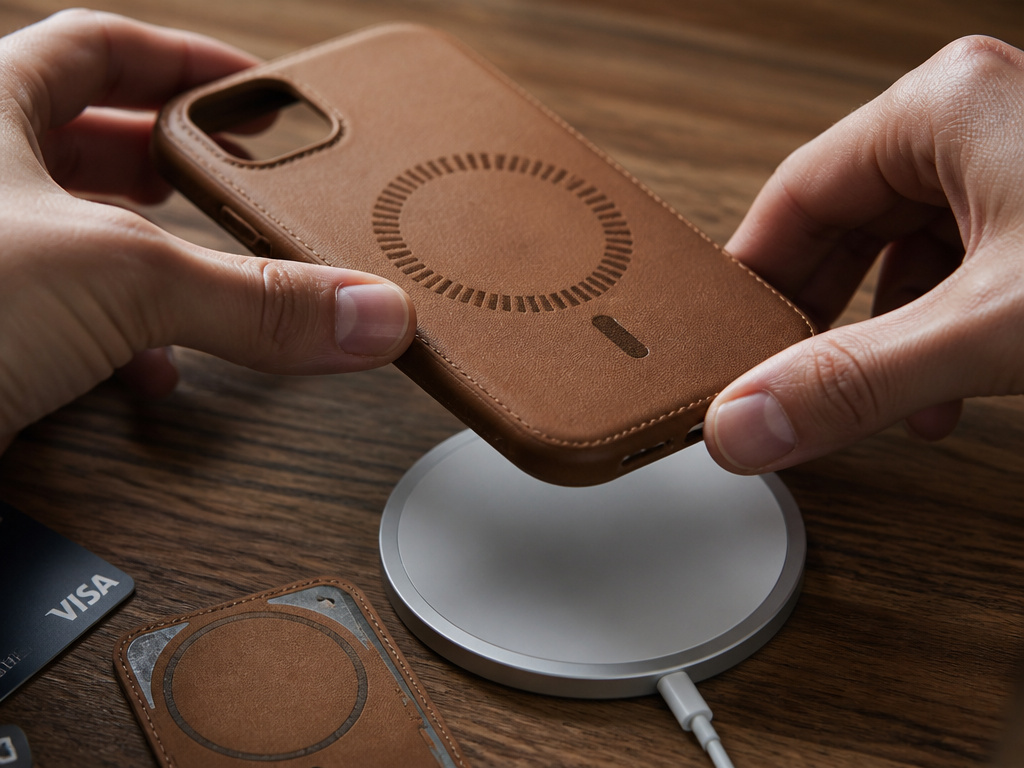
Assume nothing works until proven otherwise. MagSafe isn’t just about magnets sticking; it’s about perfect alignment for efficient charging and secure accessory attachment.
Apple’s own support documentation warns that the magnetic field can damage the magnetic stripes and RFID chips in credit cards, hotel keys, or transit cards. Never leave a card between your phone and a MagSafe charger. The damage is often permanent and silent.
The real issue is alignment. The MagSafe ring in your phone has a specific position. For a case to work properly, its magnet array must be placed within a tolerance of about 1.5 mm. Uncertified, cheap cases frequently miss this mark. The result? Your MagSafe charger snaps on but charges at half speed, or your MagSafe wallet detaches with a gentle bump. Look for cases that explicitly state “MagSafe compatible” and preferably mention testing or certification. Brands like Nomad and Mujjo build this in properly.
Where this goes sideways: Assuming any case works with wireless charging. Stack a thick leather case, a metal plate for a car mount, and a card in a wallet slot, and you’ve almost guaranteed charging will fail. The coil can’t penetrate that much material.
Standard Qi wireless charging has the same thickness limitation. If you rely on a charging pad at your desk or in your car, test your case immediately. A charge is complete when the phone’s battery indicator shows 100%.
What to Ignore on the Product Page
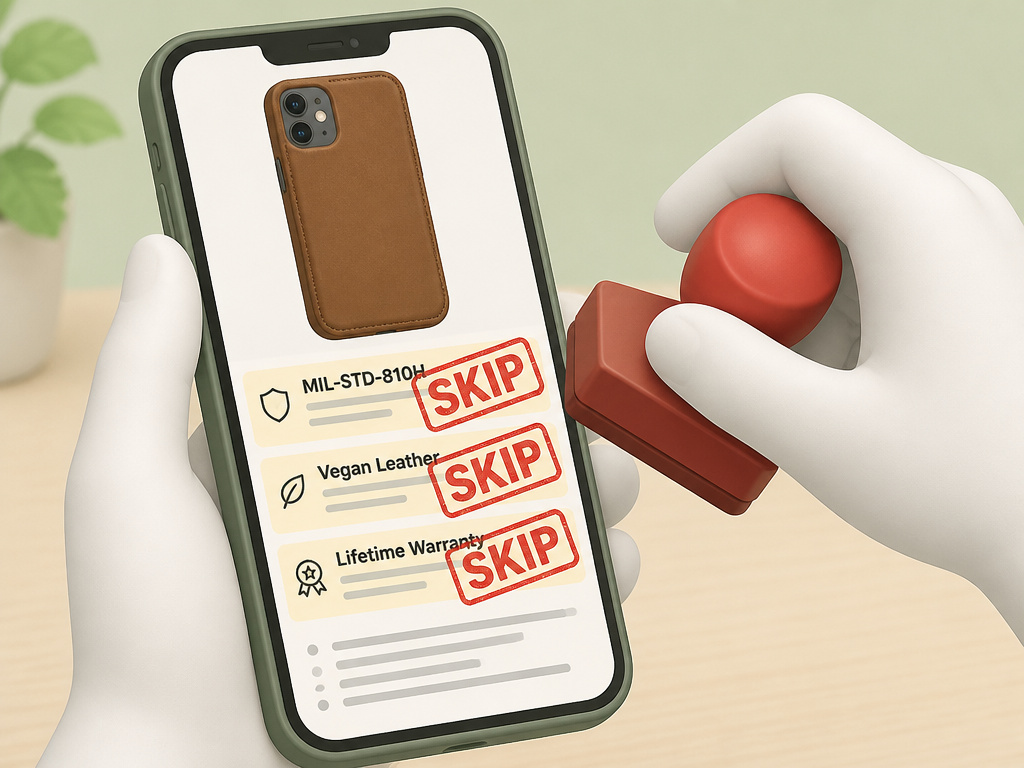
A lot of text on a product listing is designed to convince, not inform. You can safely skim past these sections.
“MIL-STD-810H” or “Military-Grade” is the biggest one. This is a U.S. Department of Defense test methodology, not a certification. Manufacturers can selectively apply specific environmental tests (like drop or temperature) and then claim the product is “tested to MIL-STD-810.” There’s no governing body that certifies a phone case “passed.” Without the manufacturer disclosing which tests (e.g., “26 drops from 1.2m onto concrete”), the term is marketing copy. It’s not a guarantee of superior protection.
“Vegan Leather” is typically polyurethane (PU) or PVC, a synthetic film laminated to a fabric backing. It’s cruelty-free but lacks breathability, cracks faster under UV exposure, and won’t develop a patina. Newer bio-based materials exist but are rare in phone cases and lack long-term durability data.
“Lifetime Warranty” often has fine print that excludes natural wear, patina, discoloration, and damage from drops. It’s usually a warranty against defects in materials or workmanship for the original owner. Read the actual warranty terms before letting this sway you.
How Your Case Will Age (And When It Will Quit)
Leather is a living material. A full-grain case changes. For the first two weeks, it might feel stiff. Over the first six months, the oils from your hands will darken it and create a unique sheen, that’s the patina. Embrace it. It’s the record of your use.
Dye transfer is real. New, dark denim bleeds indigo. If you carry a light-colored case in your jeans pocket, it will pick up blue tones. You can clean it with a slightly damp cloth, or choose a mid or dark leather color to start.
The structural failure points have a timeline. A hybrid case’s weakest link is the adhesive bonding the leather to the rigid frame. This often breaks down after 18–24 months, leading to delamination at the corners. A full-leather wrap case might last longer but offers less drop protection. Stitching can loosen, and corners can stretch over 2–4 years of daily insertion and removal from your pocket.
This is a timeless material, but it’s not immortal. Plan on a case lasting the life of your phone, not a decade.
Frequently Asked Questions
Will a leather case make my phone too bulky?
Well-designed hybrid case adds minimal bulk. The goal is to improve grip and protection without turning your phone into a brick. Look for specs: a total thickness under 3mm and a leather layer of 1.2–1.6mm. The best leather phone cases prioritize this balance.
How do I clean and care for my leather phone case?
Use a dry, soft cloth for daily dust. For deeper cleaning, a slightly damp cloth with a drop of mild soap will do. Condition it sparingly, once or twice a year, with a product like Leather Honey. Avoid silicone-based “conditioners” that clog the pores. Our full guide on how to care for a leather phone case has the details.
Are leather cases good for drop protection?
They are good for everyday drops from pocket or desk height, thanks to the shock-absorbing inner shell. They are not designed for extreme impacts onto concrete from significant heights. The protection comes from the hybrid construction, not the leather itself.
Do all leather cases work with MagSafe?
No. Only cases with a properly aligned, integrated magnet array will work correctly. Look for “MagSafe compatible” on the listing. Uncertified cases can lead to slow charging and insecure attachment. For a seamless experience, consider a [MagSafe leather wallet](https://leathergenesis.from Bellroy.
What’s the best leather for a phone case?
Full-grain leather is the best combination of durability and aging potential. It develops a unique patina and resists cracking. Full-grain leather is a fine choice. Steer clear of bonded leather.
Before You Go
The choice ultimately comes down to three filters. First, material: insist on full-grain or top-grain leather and a hybrid construction. Second, measurements: verify the screen lip exceeds 0.8mm and the total thickness is wireless-charging friendly. Third, compatibility: confirm MagSafe alignment if you use that ecosystem.
Ignore the noise about military testing and lifetime promises. Focus on the tangible build. A great leather case like those in our best leather iPhone cases roundup should feel secure in your hand on day one and develop its own character by year two. It’s the one accessory you touch thousands of times a day, make it count.
