
How to Clean a Leather Jacket: The One Rule Most Get Wrong
This post contains affiliate links. As an Amazon Associate, we earn from qualifying purchases.
To clean a leather jacket, follow a strict escalation protocol: start with a dry, soft-bristle brush for dust. For dirt, use a barely damp microfiber cloth with distilled water. If that fails, apply a pH-neutral, leather-specific cleaner to a cloth, never directly on the jacket. Always test any product on a hidden seam first. Never machine wash, dry clean, or use household cleaners.
That dry-brush-first rule flips the script. Most guides tell you to reach for a cleaner immediately. They’re not wrong, exactly, but they skip the step that prevents 80% of over-cleaning mistakes. The goal isn’t to sterilize the leather; it’s to lift the grime without stripping the oils that keep it supple.
What follows is a breakdown of that protocol, the chemistry behind why common advice fails, and the one visual cue, a change in surface sheen, that tells you when you’ve gone too far. You’ll also learn why a jacket stored in Phoenix needs a different routine than one worn in Seattle, and how to read a care tag so you don’t turn a $600 investment into a stiff, cracked shell.
Key Takeaways
Dry brushing is essential. A soft horsehair or boar bristle brush lifts dust and surface dirt without any moisture, preserving the leather’s natural oils. – Water is a last resort, not a first step. Tap water leaves mineral spots; distilled water on a barely damp cloth is the safest liquid option. – Cleaner and conditioner are not the same thing. A cleaner removes dirt; a conditioner replaces oils. Using a combo product often does both jobs poorly. – Sunlight is an enemy, not a helper. Drying a jacket in direct sunlight makes the leather brittle and accelerates color fading, air-dry indoors, away from heat. – The leather type dictates the entire process.** Using a product made for finished leather on delicate suede or aniline leather can cause permanent staining or damage.
The First Rule: Know Your Leather
Before you touch a cleaner, you have to know what you’re touching. The care tag sewn into the lining is your first stop, not a suggestion. If it’s gone, you identify by feel and look. Finished leather has a protective polymer topcoat. It feels smooth, slightly plasticky, and resists water beads. Suede and nubuck have a soft, napped surface, run your finger against it and you’ll see a color change. Aniline leather is the most natural; it feels supple, absorbs water immediately, and shows every pore and vein.
Mistreating these types is the fastest route to ruin. Using a standard leather cleaner on suede will mat the nap into ugly, dark patches. Conditioning a waxed jacket, like many from Belstaff, with a standard oil will disrupt its specific wax blend and aging process. The manufacturer’s care page explicitly says reconditioning is a specialist’s job. That’s not an upsell; it’s a material fact.
Using mink oil on a delicate aniline leather is like using a firehose to water a bonsai tree. The leather drowns, turns dark and sticky, and never fully recovers.
Your Cleaning Toolkit (And What to Skip)
You don’t need a cabinet full of potions. You need a few specific, quality tools. A cheap, stiff brush scratches. A random bottle of “leather cleaner” from the auto section might contain solvents that strip dyes.
| Tool | Purpose | Skip It If… |
|---|---|---|
| Soft horsehair brush | Dry removal of dust and surface grit. | The bristles feel stiff or scratch your skin. |
| Microfiber cloths | Applying water/cleaner without lint. | You’re using old terrycloth—it sheds fibers. |
| Distilled water | Prevents mineral spots from tap water. | You think “a little tap water won’t hurt.” |
| pH-neutral leather cleaner (e.g., Lexol pH, Saphir Omni’Nettoyant) | Breaking down oils and dirt without altering pH. | The product label says “for all surfaces” or lacks a pH listing. |
| Gum rubber eraser | Lifting scuff marks from finished leather. | You’re working on suede or unfinished leather. |
| Leather conditioner | Replenishing oils after cleaning. | You’re cleaning a waxed leather jacket. |
The standout here is the gum rubber eraser. It’s wildly underrated. For a scuff on finished leather, the kind from brushing against a wall, gently rubbing with the eraser often lifts the mark without any liquid. It creates a fine, dry crumb that brushes away. This is the kind of tactile trick you learn at a workbench, not from a generic guide.
The 4-Step Cleaning Escalation Protocol
This is the core method. It’s a ladder. You start on the bottom rung and only climb if the step below didn’t work.
Step 1: Dry Brush. Hang the jacket. Use your soft brush in long, sweeping strokes with the grain of the leather. You’ll see a faint cloud of dust. This isn’t just dirt; it’s dead skin, fabric fibers, and environmental grit that acts as an abrasive if left in place. Do this for two minutes. You’d be shocked how much “dirt” was just loose particulate.
Consequence of skipping: You grind debris into the leather during the next damp step, creating micro-scratches that dull the finish.
Step 2: Damp Cloth Wipe. Dampen a white microfiber cloth with distilled water. Wring it out until it feels barely damp to the touch, no drips. Wipe the jacket in sections, following the grain. The goal is to hydrate and lift light soil, not to soak the hide.
Consequence of over-wetting: The leather absorbs water, which can cause the dyes to migrate, leading to blotchy color, or the hide to stiffen as it dries.
Where this goes sideways: Drying the jacket in sunlight. BMW Motorrad and Belstaff both explicitly warn against it. The sun’s heat bakes the moisture out too fast, causing the leather fibers to contract and crack. It also bleaches the dyes. Air-dry indoors, on a padded hanger, for a full 24 hours.
Step 3: Targeted Cleaner Application. If a stain persists, apply a pH-neutral leather cleaner like Lexol pH or Saphir Omni’Nettoyant to a clean microfiber cloth, never directly on the jacket. Work the cloth in small circles over the stain, starting at the edge and moving inward to prevent a ring. This is the method Baxter Leather’s care guide describes.
Consequence of direct application: Too much cleaner concentrates in one spot, potentially dissolving the protective topcoat on finished leather or driving dirt deeper into suede.
Step 4: Condition. Cleaning, even with water, strips some natural oils. Once the jacket is completely dry, touch the inside seams to be sure, apply a conditioner suited to your leather type. Use a dime-sized amount on a cloth, massage it in, let it absorb for 30 minutes, then buff off any excess with a clean, dry cloth. I keep this process separate for a reason. “All-in-one” cleaner-conditioners are typically overrated. They’re weak cleaners paired with weak conditioners, leaving behind silicone-based fillers that create a slippery feel without genuine nourishment.
What Not to Do (and Why)
 Some mistakes have permanent consequences. Let’s be clear about one thing: the following aren’t risks; they are predictable outcomes.
Never machine wash or dry clean. The agitation and harsh solvents in standard dry cleaning dissolve the natural fats in leather. The result is a jacket that feels like cardboard. As one cleaner quoted in Real Simple noted, you must seek a specialist leather cleaning service if going professional.
Avoid household cleaners. Windex, dish soap, vinegar, rubbing alcohol, these are formulated for hard, non-porous surfaces or breaking down grease on dishes. Their pH is all wrong for leather. They strip far too aggressively, leaving the hide parched and prone to cracking. The exception some guides make for a drop of dish soap in water is a gamble I wouldn’t take.
Never use heat to dry. No hairdryers, radiators, or clothes dryers. Heat rapidly evaporates the water, but it also causes the leather’s collagen fibers to shrink and harden permanently. The jacket will never be as soft again.
Forget saddle soap for fashion jackets. Fiebing’s Saddle Soap is a fantastic product, for saddles and heavy work boots. These items are built to withstand its mild alkaline cleaning and heavy wax replenishment. On a slim motorcycle or fashion jacket, it will leave a waxy residue that attracts more dirt and alters the hand-feel.
Handling Stains and Special Cases
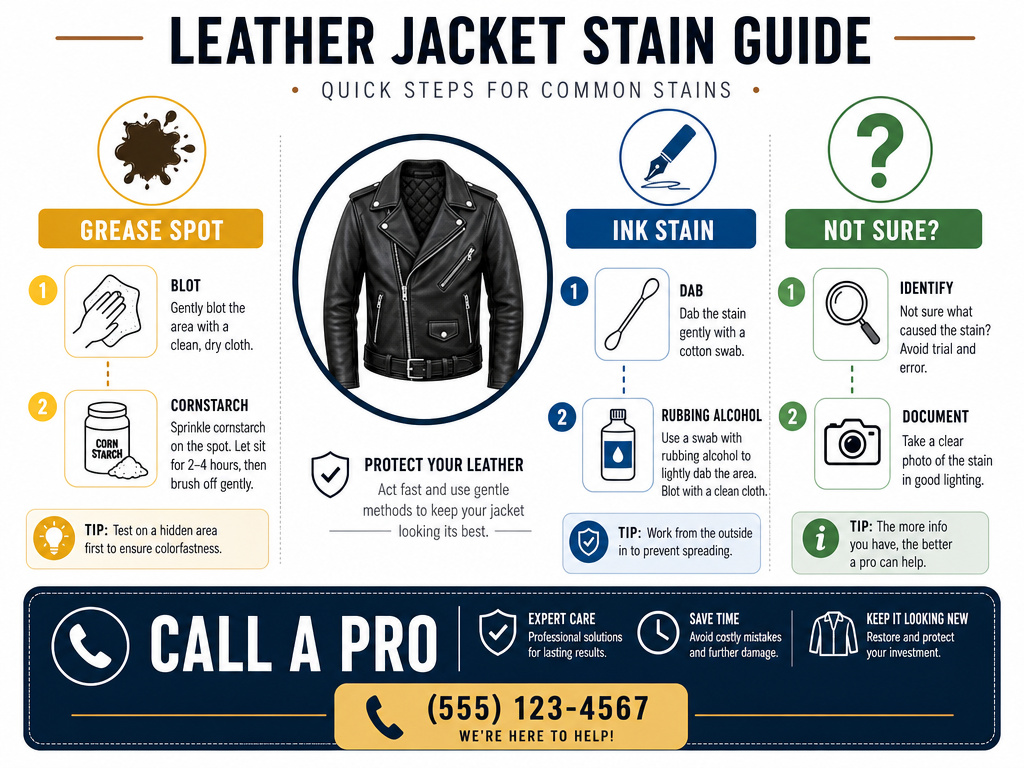 Stains require a cooler head and quicker action. The protocol changes slightly.
Grease or Oil: Blot, don’t rub, with a clean cloth to absorb excess. Sprinkle cornstarch or talc on the spot to draw out the oil, leave it overnight, then brush away. The powder acts like a dry sponge. Only after this do you move to a cleaner if a shadow remains.
Waxed Leather: This is a hard stop. Brands like Belstaff treat their waxed leather with a specific oil-and-wax blend for a controlled patina. Applying a standard conditioner disrupts this. Their official advice is to use a specialist partner for reconditioning. Listen to them.
Detachable Liners: If your jacket has a removable liner, take it out. Clean it separately according to its own fabric care label. Throwing the whole jacket in with the liner inside twists the leather and stresses the seams during a wash cycle.
| Stain Type | Immediate Action | When to Call a Pro |
|---|---|---|
| Food/Grease | Blot, apply cornstarch. | If a dark, oily shadow remains after 24 hrs. |
| Ink | Blot with a dry cloth. | Almost always—ink dyes are designed to penetrate. |
| Blood/Salt | Damp cloth with distilled water. | Immediately—these can set and attract moisture. |
| Unknown Set-In Stain | Stop. Dry brush only. | Always—guessing the wrong cleaner sets it permanently. |
The practical takeaway? For everything but simple dust and dry dirt, your best tool is the phone number of a cleaner certified by the Leather Institute. The cost of a professional clean is less than the cost of a new jacket.
Conditioning: The Non-Negotiable Follow-Up
Cleaning without conditioning is like showering without moisturizing. You’ve stripped away the dirt and some of the skin’s natural lipids. Now you must replenish.
Choose a conditioner matched to your leather. For most finished jackets, a light cream like Saphir Médaille d’Or or Bickmore Bick 4 works. For aniline or thirsty leathers, a pure oil like pure neatsfoot oil (sparingly!) is better. The process is simple: 1. Ensure the jacket is bone-dry. 2. Apply a dime-sized amount of conditioner to a cloth. 3. Massage into the leather in circular motions, covering the entire surface evenly. 4. Let it absorb for 15-30 minutes. 5. Buff off any excess with a clean, dry cloth.
A conditioned jacket will have a subtle, healthy sheen and feel supple, not stiff. This is where patience pays. Rushing to wear it before the conditioner absorbs leaves oily spots on your clothes.
The standard advice is to condition every six months. I followed that for a client’s bag stored in a humid climate, and it led to over-conditioning, a greasy, dark feel. We pulled back to once a year, and the leather balanced out. The leather will tell you what it needs. In dry, heated homes, twice a year might be right. In a humid closet, once a year is plenty.
Frequently Asked Questions
Can you use soap and water on a leather jacket?
You can use a tiny amount of a pH-neutral leather soap, like those from Saphir or Lexol, diluted in distilled water and applied via cloth. Never use dish soap, hand soap, or bar soap. Their degreasers and perfumes are too harsh and will leave a residue that attracts dirt.
How do you clean the lining of a leather jacket?
Check the lining’s care label first. For common polyester linings, you can gently spot-clean with a mild fabric cleaner and a soft brush. For silk, rayon, or quilted linings, professional cleaning is safest to avoid shrinkage or watermarks that bleed through to the leather.
Can you get sweat stains out of a leather jacket?
Yes, but act fast. As soon as you notice them, let the jacket air dry, then dry-brush the area. For set-in stains, a light pass with a cloth dampened with a leather cleaner can help. Persistent salt rings from sweat may require a professional’s touch, as the salts can crystallize inside the leather.
How often should you clean a leather jacket?
For light wear, a thorough dry brushing once a month and a full clean-and-condition once a year is sufficient. If you wear it daily in an urban environment, bump the full clean to every six months. The key is to never let grime build up to the point where it requires aggressive cleaning.
What’s the best way to store a clean leather jacket?
On a wide, padded hanger in a cool, dark closet with good airflow. Never store it in a plastic bag, which traps moisture and promotes mold. For long-term storage, clean and condition it first, then place it in a breathable cotton garment bag.
Before You Go
One rule most guides skip: if your jacket has gone more than a year without care and feels stiff, don’t jump straight to a heavy conditioner. Clean it first. Conditioning over old, impacted dirt seals that grime in, accelerating the breakdown of the fibers. The sequence matters more than the product.
The most common failure point isn’t the cleaning itself, it’s the drying stage. That faint, sweet smell of warm leather as it dries by a radiator? That’s the scent of its lifespan shortening. Give it a full day indoors, away from light and heat. Your patience will be preserved in the patina.
Understand leather better to make confident choices. If you remember one thing, let it be this: start dry, escalate slowly, and when in doubt, put the bottle down and pick up the phone to a specialist. A well-maintained jacket doesn’t just look good; it tells a better story with every year you wear it.
