
How to Condition a Leather Jacket With the Right Products
This post contains affiliate links. As an Amazon Associate, we earn from qualifying purchases.
This post contains affiliate links. As an Amazon Associate, we earn from qualifying purchases.
To condition a leather jacket, match the conditioner to the leather type, apply it to clean, dry leather in thin layers, and allow it to absorb fully at room temperature before buffing. Using the wrong product, like mink oil on fine lambskin, can permanently darken and damage the hide.
That last part about matching the product is essential for a jacket that develops a rich patina over decades rather than turning into a stiff, spotted mess after two years. Leather is skin, and just like skin, it needs the right kind of nourishment.A thick, oily dressing works on rugged work boots but will drown and distort the delicate fibers of a fashion jacket.
What follows is a breakdown of that matchmaking process: how to read your leather’s needs, the short list of conditioners that actually work, and the physical cues that tell you when you’ve applied too much or not enough. By the end, you’ll be able to look at any jacket and know exactly what it needs.
Key Takeaways
- Match conditioner to leather type. Oil-based Leather Honey is for thick cowhide; water-based Bickmore Bick 4 is a safer all-rounder for fine leathers like lambskin and goatskin.
- Condition based on feel, not a calendar. The “every six months” rule is nonsense. A jacket in a stable, low-humidity room might go years; one worn daily in a dry climate might need it every three months.
- Never condition dirty leather. Wipe the jacket with a damp cloth first. Conditioning over dirt seals grime into the pores, leading to a dull, patchy finish.
- Allow full absorption. Thin layers need 20–30 minutes at room temperature; thick horsehide or very dry leather can take 30–40 minutes or overnight. Never use heat to speed it up.
- Store in the right environment. Aim for 15–20°C (59–68°F) and 40–55% relative humidity. A damp basement or a hot attic will dry leather out faster than any amount of wear.
The Right Conditioner for Your Leather Type
The most common mistake is using a product that’s fundamentally wrong for the leather you own, not under-conditioning. Let’s be clear about one thing: mink oil is for saddles and heavy work boots.Using it on a delicate aniline leather jacket is like using a firehose to water a seedling. I tried it on a vintage piece years ago, and it darkened the leather permanently, leaving a greasy residue that never fully absorbed. The leather felt supple for a week, then stiffened up worse than before.
A conditioner’s job is to replenish the natural oils lost through wear and evaporation. Different leathers lose those oils at different rates and need different replacements.
Full-grain cowhide is the densest and most oil-retentive of the common jacket leathers. Condition every 4 to 6 months under normal wear. If you ride a motorcycle regularly and the jacket is exposed to wind and weather, move to every 3 months. Cowhide can handle most quality conditioners including heavier oil-based products like Leather Honey.
Lambskin loses moisture about 35 percent faster than cowhide of equivalent thickness. It needs a gentle, lightweight conditioner every 2 to 3 months. Goatskin is more porous than cowhide but has a tighter grain; it likes lighter, more frequent applications with a product like Bickmore Bick 4 every 3 to 4 months. Horsehide, the most durable, needs conditioning only every 6 months but absorbs conditioners slowly, allow 30 to 40 minutes.
For suede or nubuck, never use a standard liquid conditioner. It will flatten the nap permanently. Only use sprays specifically formulated for these finishes, like Kiwi Suede Protector.
| Conditioner | Type | Cowhide | Goatskin | Lambskin | Horsehide | Suede | Best For |
|---|---|---|---|---|---|---|---|
| Leather Honey | Oil-based | ✓ Excellent | ✓ Good | ⚠ Test first | ✓ Excellent | ✗ No | Thick cowhide & horsehide |
| Bickmore Bick 4 | Water-based | ✓ Excellent | ✓ Excellent | ✓ Good | ✓ Good | ✗ No | All smooth leathers, safest all-rounder |
| Chamberlain’s Leather Milk | Emulsion | ✓ Excellent | ✓ Excellent | ✓ Excellent | ✓ Good | ✗ No | All types, best for lambskin |
| Pecard Leather Dressing | Wax-based | ✓ Good | ⚠ Light use only | ✗ Not recommended | ✓ Excellent | ✗ No | Heritage & thick motorcycle leathers |
| Kiwi Suede Protector | Spray | ✗ No | ✗ No | ✗ No | ✗ No | ✓ Yes | Suede & nubuck jackets only |
The practical takeaway? If you own one nice jacket and don’t want to overthink it, Bickmore Bick 4 is the one to beat. It’s a water-based, pH-neutral conditioner that nourishes without over-saturating or darkening most leathers. It’s the default.
How to Know When Your Jacket Needs Conditioning
Ignore the marketing copy that tells you to condition on a rigid schedule. The “condition every six months” rule is nonsense. I’ve had a leather couch in a stable, low-humidity room that only needed conditioning once in five years. Your jacket will tell you what it needs.
You condition based on feel, not the calendar. Do the pinch test. Take a small fold of the leather between your thumb and forefinger, try an inside seam or the bottom hem. If it feels stiff, dry, or papery, it’s time. If it still feels supple and resists creasing easily, it’s fine. Another sign is visible lightening or a chalky white cast on high-flex areas like the elbows and collar; that’s the leather’s oils depleting.
Your local climate dictates a lot. A jacket worn daily in Arizona’s dry heat might need conditioning every three months. The same jacket worn occasionally in the humid Pacific Northwest might only need it once a year. This is why a one-size-fits-all conditioning schedule doesn’t work. You have to observe.
The Tools and Prep Work You Can’t Skip
You need three things: the right conditioner, and two clean, lint-free cloths. Microfiber cloths work perfectly. Avoid paper towels or old t-shirts; they can shed lint or be too abrasive.
The first step you must take is to clean your leather jacket.com/how-to-clean-a-leather-jacket/) before conditioning. Always. Conditioning over dirt or dust traps that grit in the leather’s pores. It creates a dull, patchy finish and can grind into the hide over time, causing premature wear. Just wipe the entire jacket down with a cloth dampened with water, no soap needed for a simple dusting. For tougher grime, use a dedicated leather cleaner. Let the jacket dry completely at room temperature before you even open the conditioner bottle.
Where this goes sideways: Skipping the cleaning step. You’ll seal in salt rings from winter wear or body oils around the cuffs. That spot will darken permanently and feel tacky long after the rest of the jacket has absorbed the conditioner.
Find a hidden spot to patch test your new conditioner. The inside of a belt loop or an interior seam is perfect. Apply a dime-sized amount, let it absorb for an hour, and check for darkening or texture change. Some darkening is normal with oil-based products, but it should be minimal and even. If the test spot turns black or feels gummy, that product isn’t right for your jacket.
Step-by-Step Conditioning Guide
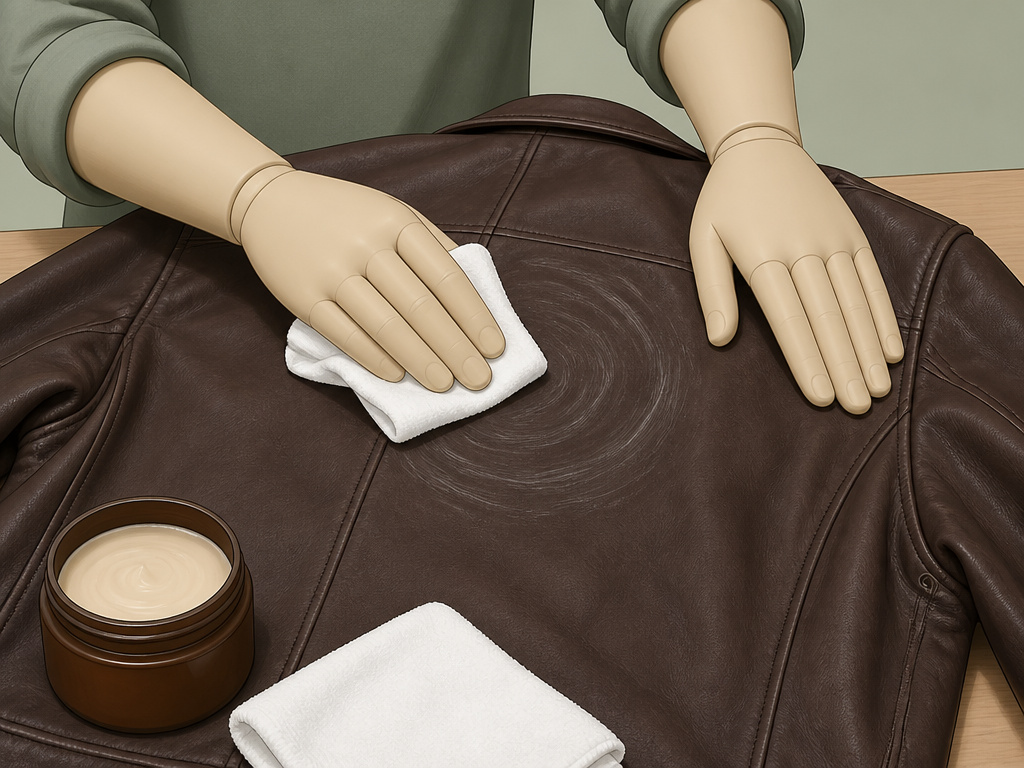 This process requires patience and thin, even layers rather than strength.
1. Work in a clean, ventilated space. Lay the jacket flat on a clean table or hang it on a wide, padded hanger. You want to see what you’re doing.
2. Apply a small amount to your cloth. Less is more. Put a quarter-sized dab of conditioner on one of your lint-free cloths and fold the cloth to saturate it evenly. Never pour conditioner directly onto the leather.
3. Work in circular motions, panel by panel. Start with the back panel, then move to the sleeves, front panels, and finally the collar. Use gentle, circular motions to work the conditioner into the leather, covering every surface. Pay extra attention to high-stress areas, elbows, shoulders, the back of the neck, as they lose oils fastest. Don’t forget the seams.
4. Let it absorb. This is the step everyone rushes. Hang the jacket in a well-ventilated room at room temperature. Let the conditioner absorb for a minimum of 20 minutes. For thicker full-grain cowhide or horsehide, allow 30 to 40 minutes. For very dry leather, you can leave it overnight. Never place the jacket near a heater, in direct sunlight, or use a hair dryer. Heat causes uneven absorption and can actually draw the conditioner back out of the fibers.
5. Buff with a clean, dry cloth. After the absorption time, take your second clean, dry cloth. Buff the entire surface in long, even strokes. You’re removing any conditioner that didn’t absorb, which prevents a greasy, sticky finish that attracts dirt. The jacket should feel supple, not slick. If it still feels tacky, give it another round of dry buffing.
What if you applied too much? You’ll see dark, saturated spots and the leather will feel cool and wet. Don’t panic. Just keep buffing with the dry cloth. If it’s really saturated, let it hang for another few hours and buff again. It will eventually absorb.
Storing a Conditioned Leather Jacket
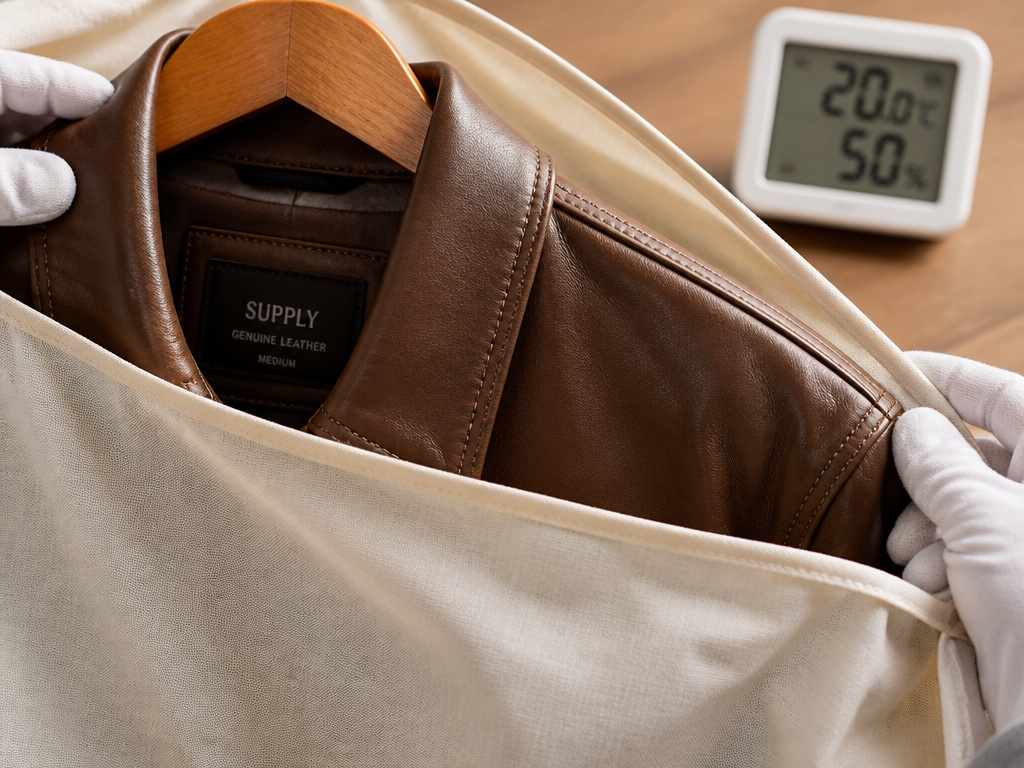 How you store the jacket matters almost as much as the conditioning process itself. The goal is to maintain the moisture balance you just restored.
The specs from brands like Vault & Hide are specific: aim for a storage environment of 15–20°C (59–68°F) and 40–55% relative humidity. That means away from direct sunlight, heating vents, radiators, or exterior walls that see big temperature swings. A damp basement is too humid and encourages mold. A hot attic will bake the oils right out.
Always hang the jacket on a wide, padded hanger. A skinny wire hanger will crease the shoulders permanently under the weight of the leather. Use a breathable cotton garment bag, never a plastic bag. Plastic traps moisture and prevents the leather from breathing, which leads to mildew.
If you’re storing the jacket for a season, more than three months, give it one light conditioning treatment before it goes into the bag. Leather stored dry will continue to lose moisture. A little nourishment upfront prevents a stiff, crackly reunion in the spring.
Edge Cases and Problem Solving
Not every jacket follows the standard script. Here’s what to do when things are already dry, stiff, or stained.
Excessively Dry or Stiff Leather
If the pinch test reveals cardboard-like stiffness, you need a more aggressive approach. Apply a generous amount of a pH-neutral conditioner. Let it absorb fully, this could take an hour or more. Then, repeat the application the next day. For severely dry leather, you might need two or three sessions over a week. The leather will drink it up slowly. Rushing with a heavier oil or multiple thick coats will just sit on top and go rancid.
After the Jacket Gets Soaked
If your jacket gets caught in a downpour, hang it at room temperature and let it dry naturally. Once it’s fully dry, and this is critical, condition it. Water strips out the natural oils, so you need to replenish them. This is also the time to consider a waterproofing treatment if you live in a rainy climate.
Dealing with Salt Stains
Winter road salt is brutal. Remove salt deposits as soon as possible. Dampen a cloth with water, wipe the area gently, and let it air dry. Then condition. If you let salt crystallize on the leather, it acts like sandpaper every time you move.
Scratches and Scuffs
For surface scratches on pigmented leather, sometimes just rubbing gently with a clean fingertip will reduce their visibility. Your body heat and the skin’s natural oils can help. For deeper scratches, a color-matched leather cream can fill them in. For major gashes, you’re looking at professional jacket repairs.
Frequently Asked Questions
Can you use coconut oil to condition a leather jacket?
I don’t recommend it. Coconut oil is a food product, not a leather conditioner. It can go rancid, attract dirt, and doesn’t contain the blend of oils and waxes that leather needs for long-term flexibility. It’s a shortcut that often leads to a sticky, smelly mess. Stick to products designed for the job.
How long does it take for leather conditioner to dry?
It’s not really about “drying” but absorbing. A thin, even coat of a conditioner like Lexol or Leather Honey will absorb into the leather fibers within 20 to 40 minutes at room temperature. You should be able to buff it off after that time. The jacket is safe to wear once buffed, though for optimal results, letting it rest for a few hours is better.
Does conditioning a leather jacket darken it?
It can, especially with oil-based conditioners like Leather Honey. This darkening is usually temporary and will lighten back close to the original shade over 24-48 hours as the oils fully integrate. Water-based conditioners like Bickmore Bick 4 darken leather much less, which is why they’re recommended for light-colored or delicate leathers. Always patch test.
Can you over-condition a leather jacket?
Absolutely. Over-conditioning clogs the leather’s pores, making it unable to breathe. This leads to a greasy surface that attracts dirt, weakens the fibers, and can actually cause the leather to rot from the inside out. If your jacket feels slick or looks splotchy after buffing, you’ve used too much. The fix is time, wear it and let the excess work its way out.
Before You Go
Here’s the one action to take this week. Find your jacket and do the pinch test. If it feels dry, schedule 45 minutes to clean and condition it following the steps above. If it feels supple, check your storage spot. Is it in a closet against an outside wall or in a room that gets afternoon sun? Move it. That single change will do more for your jacket’s longevity than any product.
And remember the core principle: leather conditioning is about replacing what the leather loses in a way it can accept, not applying a magic potion. Match the product to the hide, apply with patience, and let the material guide you.Do that, and your jacket won’t just last, it’ll get better.
