
How to Remove Oil Stains from Leather: The Right First Move
This post contains affiliate links. As an Amazon Associate, we earn from qualifying purchases.
This post contains affiliate links. As an Amazon Associate, we earn from qualifying purchases.
Remove oil stains from leather by first absorbing the oil with a dry powder like cornstarch or baking soda, do not use water. For fresh stains, blot the excess with a clean, dry cloth. Then, depending on your leather type, apply an absorbent powder overnight or use a pH-balanced leather degreaser, working from the outside in to prevent rings.
Most guides rush to the cleaner. They skip the physics. Oil is hydrophobic; it repels water. Dousing a fresh grease spot with any water-based cleaner just pushes the oil deeper into the leather’s fibers. The stain sets. The fix gets ten times harder.
What follows is the opposite of a quick tip sheet. It’s a three-part breakdown: why the standard advice fails, the exact sequence for your specific leather type (aniline, pigmented, or nubuck), and the one branded degreaser I reach for when a home remedy isn’t enough. By the end, you’ll be able to look at a stain and know not just what to do, but why that step comes before the next.
Key Takeaways
- Water is your enemy on a fresh oil stain. It drives the grease deeper.
- For unfinished leathers (aniline), cornstarch is your first and most powerful tool. Let it sit overnight and watch it turn yellow as it pulls the oil out.
- Pigmented (finished) leathers have a protective topcoat. You often need to degrease through that layer, which can require a dedicated product like Italian Leather’s Liquid Leather Degreaser.
- Always work from the outside of the stain toward the center. This contains the mess and prevents a telltale ring.
- Test every cleaner, even cornstarch, on an inconspicuous spot first. A colorfastness check takes five minutes and saves a piece.
The First Rule: No Water, No Suds, No Panic
The instinct to grab a wet cloth is strong. It’s also exactly wrong.
Leather is a porous, fibrous material. Think of it like a dense sponge. When you introduce a water-based liquid to an oil-based stain, you create a battle of surface tension. The oil wins. The water droplets can’t penetrate the grease, so they flow around it, carrying the oil further into the leather’s core. What was a small, concentrated spot becomes a larger, fainter, and much more deeply embedded stain. The surface might look cleaner, but the damage is now structural.
Common mistake: Reaching for soap and water on a fresh grease mark. The surfactants can break the oil into smaller droplets, spreading it across a wider area inside the leather. You’ll see the stain bloom outward within an hour.
Instead, your first move is always dry and passive: blotting. Use a clean, absorbent microfiber cloth or paper towel and press, don’t rub, onto the stain. You’re trying to lift any excess, unabsorbed oil from the surface. Rubbing grinds it in. This buys you time to diagnose the leather and choose your real weapon.
Identify Your Leather: The Treatment Changes Completely
Not all leather is created equal, and a one-size-fits-all approach ruins more items than it saves. You need to know what you’re working with. There are three main categories, and your cleaning protocol forks here.
Aniline Leather is the most natural and porous. It’s dyed with soluble dyes but has no protective pigment topcoat. It feels soft and shows natural markings. It’s also the most vulnerable. Water and cleaners can darken it permanently, and grease soaks in fast.
Pigmented (or Finished) Leather has a polymer coating applied over the dyed hide. This gives it a uniform color and a protective barrier. It’s what you find on most car interiors, bags, and durable furniture. The finish resists stains initially, but deep grease can work its way underneath.
Nubuck and Suede are created by buffing the grain side of the hide, creating a velvety nap. They are extremely absorbent. Grease stains on nubuck are a different beast, often requiring specialized brushes and powders.
A simple test: put a tiny drop of water on an inconspicuous area. If it darkens immediately and soaks in, you likely have aniline or nubuck. If it beads up and sits on the surface, you have pigmented leather. Let’s match the method to the material.
The Cornstarch Method for Unfinished Leather
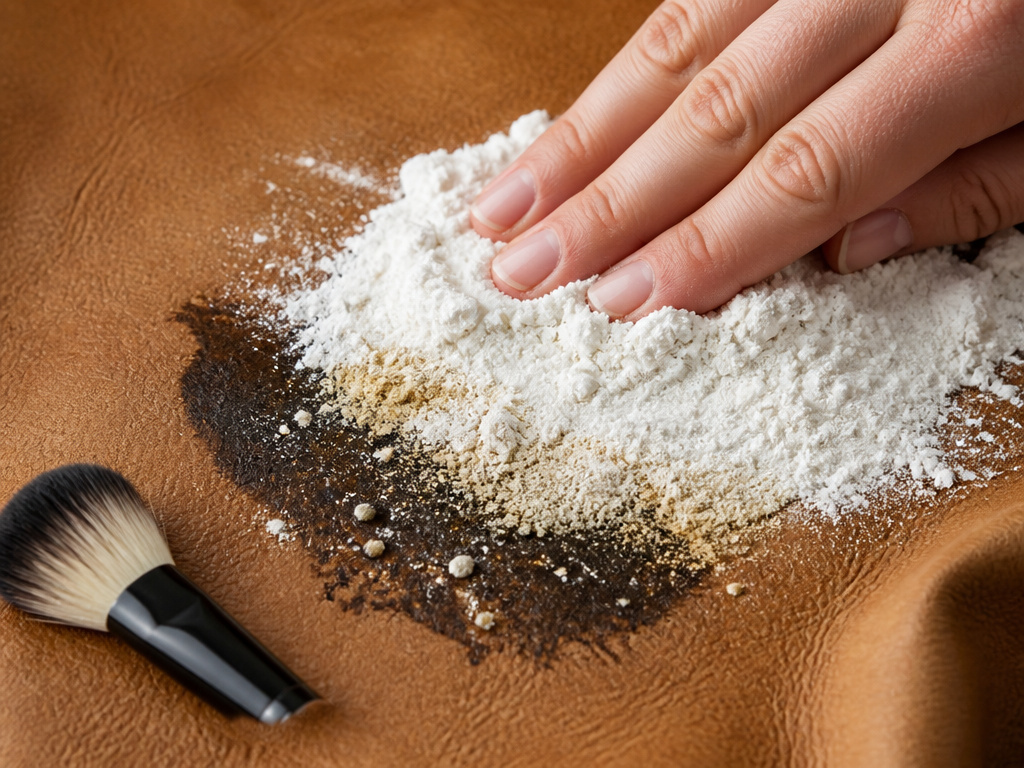 For aniline leather or any unfinished, porous hide, the goal is to pull the oil out, not push it around. This is where kitchen physics beats a cabinet full of chemicals.
Sprinkle a generous amount of plain cornstarch, baking soda, or talcum powder directly onto the stain. You want a heap about a quarter-inch thick, completely covering the affected area and a little beyond. Gently pat it down with your finger, don’t rub. Then, walk away. Leave it for at least eight hours, preferably overnight.
Here’s what’s happening. The powder acts as a desiccant, drawing the oil out of the leather fibers through capillary action. You’ll see the proof in the morning: the powder over the stain will have turned a yellowish or darker shade. That’s the oil.
I learned this lesson reconditioning a vintage aniline leather chair. A client had tried to wipe a hand lotion stain with a damp cloth, only to see it triple in size. We applied cornstarch for two full nights, brushing it away and reapplying fresh powder each morning. By the third brushing, the powder stayed white. The stain was gone, leaving only a slightly darker patina that blended in completely within a week.
Steps for the Cornstarch Method:
- Blot any surface oil with a dry cloth.
- Cover the stain thickly with cornstarch.
- Wait 8-12 hours. The powder will change color as it absorbs oil.
- Brush away the powder with a soft, dry brush (a clean makeup brush works perfectly).
- Inspect. If a stain shadow remains, repeat the process. It may take 2-3 cycles.
What happens if you skip the patience? If you brush the powder away after an hour, you’ve only pulled surface oil. The core of the stain remains, now dried and set, making subsequent removal far harder. This method works because leather breathes slowly. You have to let it.
Pigmented (Finished) Leather Procedure
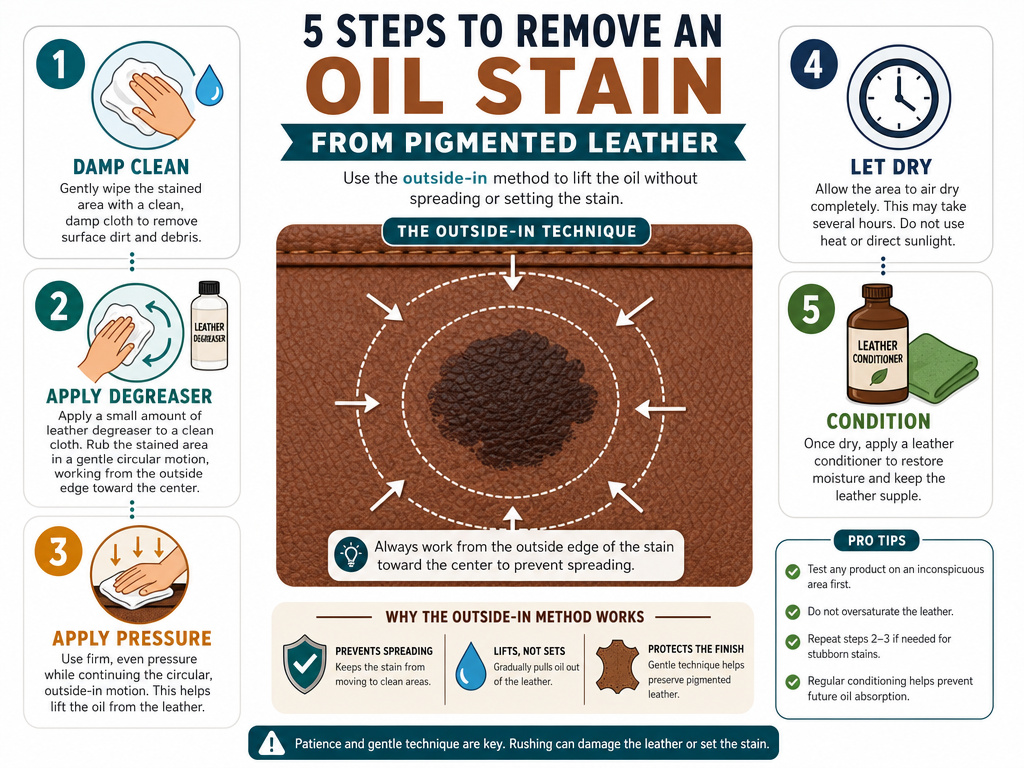 That protective topcoat on pigmented leather is a blessing and a curse. It stops spills from immediately soaking in, but it also stops absorbent powders from pulling oil out. For light grease, you might get away with the cornstarch trick. For anything that’s soaked through the finish, you need a degreaser that can break through.
The principle here is chemical, not absorptive. A solvent-based leather degreaser, like Italian Leather’s Liquid Leather Degreaser, works by dissolving the grease bonds and suspending the oil so a cloth can lift it away. The technique is meticulous.
| Step | Action | Why It Matters |
|---|---|---|
| 1. Clean the Surface | Wipe the area with a damp cloth to remove any surface dirt. | A dirty surface can grind grit into the leather during the degreasing rub. |
| 2. Apply Degreaser | Put a small amount on a microfiber cloth. Rub in a tight circular motion, starting outside the stain and moving inward. | Starting at the edges contains the stain and prevents a visible “cleaned ring” around it. |
| 3. Apply Pressure | Use firm pressure as you rub. The heat and friction help the solvent work. | Gentle wiping just moves the grease around on the finish; pressure helps the degreaser penetrate. |
| 4. Dry & Repeat | Let the area dry completely. If a dark shadow remains, repeat the process. | One pass rarely does it. Drying lets you see the true remaining stain. |
| 5. Condition | After the stain is gone and the leather is fully dry, apply a light conditioner. | Degreasers can strip natural oils. Conditioning prevents the leather from drying out and cracking. |
The Liquid Leather Degreaser is pH-balanced for leather. That’s not marketing. Leather is a protein fiber (collagen). Extreme pH levels, highly alkaline or acidic, break the peptide bonds that hold those fibers together, leading to permanent stiffness and cracking. A pH-balanced cleaner maintains the fiber integrity while it works on the grease.
For heavily contaminated pigmented leather where the grease is under the finish, the manufacturer recommends using Leather Prep first to remove the topcoat, then applying the degreaser to the bare leather beneath. This is a more advanced restoration technique.
When to Use a Commercial Leather Degreaser
The cornstarch method is free, safe, and remarkably effective for unfinished leathers. But it has limits. You need a dedicated product when: * The stain is old and set. * The leather is pigmented and the stain has visibly darkened. * You’ve tried absorbent powders twice with no improvement. * The stain is from a heavy grease like automotive grease or cooking oil.
My go-to is Fiebing’s Deglazer or Angelus Easy Cleaner for general use because of their controlled evaporation rates and lack of oily residues. For heavier jobs, the Italian Leather Liquid Leather Degreaser is specifically formulated for the task. The key is to follow the label instructions for application and, without fail, to follow up with a conditioner. A degreased patch of leather is vulnerable to drying out.
Where this goes sideways: Using a household degreaser like Simple Green or an acetone-based nail polish remover. These can strip the dye right out of the leather, leaving a bleached spot that’s more noticeable than the original grease stain. The fix then becomes a re-dyeing project.
One 250ml bottle of a product like the Liquid Leather Degreaser is enough for an average armchair. Store it between 8°C and 25°C, and use it within three years once opened. These solvents lose potency over time.
Nubuck and Suede: A Different Game Entirely
The fuzzy nap of nubuck and suede is a grease trap. Powders can work, but they are harder to brush out completely from the fibers. For light grease, a dedicated KERALUX Cleaning Cloth N is designed to lift surface grime without wetting the leather. For anything more persistent, you often need a professional.
The standard advice for greasy nubuck is to use a KERALUX Degreaser Spray, followed by a KERALUX Strong Cleaner, and then re-protect with a KERALUX Protection Spray N. This is a multi-step, product-specific system. Attempting to scrub nubuck with a regular cleaner and cloth will mat the nap and create a permanent, shiny bald spot.
The rule here is simple: if a dry, absorbent powder doesn’t lift the stain from nubuck after two attempts, consult a professional leather cleaner. The risk of ruining the texture is too high.
Frequently Asked Questions
Can I use vinegar to remove oil from leather?
No. Vinegar is acidic and can damage leather’s protein structure over time, especially on delicate aniline leather. It’s also a water-based solution, which will drive oil deeper as it tries to clean. Stick to dry methods or pH-balanced leather-specific products.
How do you get old, set-in oil stains out of leather?
For old stains, the oil has oxidized and bonded with the leather fibers. Start with the cornstarch method for 24 hours. If that fails, a leather degreaser is your next step. Apply it repeatedly, allowing full drying between applications. Old stains may lighten but not disappear completely, becoming part of the leather’s patina.
Does baking soda work better than cornstarch?
They work on the same principle. Cornstarch is often finer and easier to brush out of the leather’s pores. Baking soda is more alkaline, which carries a slight risk of affecting pH-sensitive dyes over very long contact times. For a weekend treatment, either is fine. For a multi-day soak on valuable aniline leather, I prefer cornstarch.
Will removing an oil stain leave a watermark?
It can, if you use a liquid cleaner incorrectly. Watermarks (rings) form when the cleaner evaporates at different rates from the stained area versus the surrounding leather. This is why you work from the outside in with degreasers and use powders on unfinished leather, they don’t introduce liquid. If you do get a ring, sometimes lightly conditioning the entire panel can even out the appearance.
Can I use dish soap on leather grease stains?
I don’t recommend it. Dish soap is designed to cut grease on non-porous surfaces like plates. On leather, it can leave a soapy residue that attracts more dirt and dries out the hide. It’s also almost always used with water, triggering the initial problem. A dedicated leather cleaner or degreaser is a more targeted, safer solution.
Before You Go
Let me share what I’ve learned from years at the workbench: the most powerful tool for stain removal isn’t in a bottle. It’s the pause between seeing the spill and taking action. That moment lets you choose blotting over rubbing, cornstarch over soap, and the right method for your leather type over a desperate guess.
The one threshold to remember: if cornstarch applied twice over 24 hours doesn’t visibly lighten a stain on unfinished leather, stop. The oil is too deep or too old for passive methods. That’s your signal to move to a professional-grade degreaser or consult a restorer. Forcing the issue with home concoctions after that point usually makes the final, professional fix more expensive.
And finally, a clean piece of leather is a vulnerable one. However you remove the grease, powder or solvent, follow it with a light application of conditioner. That replaces the natural oils you’ve just pulled out and keeps the leather supple. The stain is history; the leather should have a long future.
