
Expert Tips for Storing Leather Jackets to Preserve Quality
This post contains affiliate links. As an Amazon Associate, we earn from qualifying purchases.
To store a leather jacket, hang it on a wide, padded wooden hanger inside a climate-controlled closet, maintaining 59–77°F (15–25°C) and 45–55% relative humidity. Cover it with a breathable cotton garment bag, never plastic, and apply a quality leather conditioner before the storage period begins, not after. Check the jacket monthly for stiffness or mold.
The 45–55% humidity range isn’t a suggestion. It’s the physical sweet spot where leather’s collagen fibers stay pliant without feeding mold spores. Go below 40%, and the hide starts surrendering its internal moisture to the drier air, a process that accelerates in warm storage. Go above 60%, and you’re building a terrarium for mildew on a jacket that cost more than your phone.
What follows is the practical breakdown of that one number. This guide explains the two essential tools, the three locations that damage jackets, and the main point of disagreement among leather workers. By the end, you’ll know exactly where to hang that jacket and what to listen for when you check on it.
Key Takeaways
- Humidity is the king variable. Store between 45-55% relative humidity; a simple hygrometer is a more important investment than any fancy conditioner.
- Condition before storage, not after. The oils need to be in the leather during the dormant months to prevent internal drying.
- Wire hangers cause permanent damage. A narrow hanger creates shoulder grooves within one season that no amount of conditioning will fix.
- Plastic is a mold incubator. A breathable cotton bag is mandatory; a plastic dry-cleaning cover traps moisture and guarantees trouble.
- Check the jacket monthly. A five-minute inspection for stiffness or spots prevents damage that only becomes catastrophic at the end of the season.
The Ideal Storage Climate
Forget “cool and dry.” That’s too vague. The real targets are 59 to 77°F (15 to 25°C) and 45 to 55% relative humidity.
Why do those specific numbers matter? Leather is a hygroscopic material, it constantly exchanges moisture with the air around it. At 45-55% relative humidity, the balance is perfect: the hide retains enough internal moisture to stay supple without crossing into the damp territory where mold spores activate. A study tracking full-grain cowhide found that samples stored at 86°F (30°C) and 30% humidity showed measurable surface cracking within eight weeks. The same leather stored at 68°F (20°C) and 50% humidity showed no damage.
The ideal storage climate for a leather jacket is a narrow band: 59–77°F (15–25°C) and 45–55% relative humidity. Maintaining this balance prevents the collagen fibers in the hide from drying out and contracting, which leads to cracks, while also avoiding the elevated moisture that feeds mold growth.
This turns your home’s ordinary spaces into a risk matrix. An attic cycles between winter freeze and summer bake, often with very low humidity, it’s a dehydration chamber. A basement, especially in eastern states, frequently holds humidity above 60% in summer. A garage is a wild card of temperature swings, fumes, and dust.
The straightforward answer is a main-floor closet, away from exterior walls and heating vents. If you’re serious, buy a small digital hygrometer. It costs less than a bottle of conditioner and tells you the truth about your storage space.
The 5 Most Common Mistakes (And Their Consequences)
Most storage damage traces back to a handful of predictable errors. Let me share what I’ve learned about why these are so destructive.
1. Using a plastic bag or cover. This is the fastest route to mold. Plastic isn’t breathable. It traps evaporating moisture from the leather itself, creating a humid microclimate against the surface. In a warm closet, that can spur mold growth within days. The plastic dry-cleaning bag your jacket came home in is not a storage aid, it’s a threat. Always use a breathable cotton garment bag instead.
2. Folding the jacket. Leather has a structural memory. Collagen fibers forced into a bent position under weight will reset that way. A jacket folded in a drawer or under a stack of clothes will develop permanent crease marks at every fold point within 4 to 8 weeks at room temperature. These aren’t wrinkles you can steam out; they’re permanent deformations in the hide.
3. Hanging on a wire or narrow hanger. The entire weight of the jacket concentrates on two tiny points. Over weeks, this pressure creates permanent grooves across the shoulder panels, distorting the silhouette. On a structured jacket, this damage is immediate and irreversible. You need a hanger that spreads the load.
4. Skipping the pre-storage conditioning. A jacket enters storage with a finite amount of oil in the hide. During months of inactivity, with no natural body oils or movement to redistribute them, evaporation and migration still occur. If you start with depleted leather, you’ll end with brittle leather. Condition before storage so the oils are present during the dormant period.
5. Using the wrong storage location. We covered climate, but the principle bears repeating. An uncontrolled garage, attic, or basement subjects leather to punishing cycles of expansion and contraction. Over a single season, this accelerates cracking at seams and stress points. Over years, it destroys leather that would have lasted decades in a proper closet.
Conditioning: Before, After, or Never?
Here’s where the consensus breaks down. Most general guides will tell you to condition before storage. Many professionals agree. But a significant, experienced contingent says the opposite.
STRUM OFFICIAL, a Japanese leather jacket maker, explicitly advises against applying oil before storing jackets, especially in humid climates like Japan. They state that oil acts as “nourishment for mold” and can accelerate growth during long-term storage. Their recommendation is to clean the jacket, store it dry, and only apply oil when you’re ready to wear it again.
So who’s right? It depends entirely on your humidity control.
If you can reliably keep your storage space below 55% RH, pre-storage conditioning is beneficial insurance. The oil replenishes the hide’s natural lipids, protecting it from the slow drying that occurs even in good conditions. Use a light, non-greasy conditioner formulated for your jacket’s leather type. For a motorcycle jacket like those from Indian Motorcycle, their specific Indian Motorcycle Leather Care Dressing is designed for the oil-tanned leather they use.
If your storage is in a basement, a non-climate-controlled space, or any area prone to humidity spikes, the STRUM OFFICIAL approach is the safer bet. Skip the oil, store it clean and dry, and plan to condition as a first step when you retrieve the jacket.
| Conditioning Approach | Best For | Risk If Misapplied |
|---|---|---|
| Condition Before Storage | Climate-controlled spaces (45-55% RH). | In humid storage, oils can feed mold growth on the surface. |
| Store Dry, Condition After | Uncontrolled or humid storage environments. | Leather may dry slightly more during storage, requiring a more thorough conditioning after. |
| Never Condition (Not Recommended) | Only for heavily waxed or finished leathers meant to dry out. | Will lead to irreversible drying and cracking over multiple storage seasons. |
Choosing Your Hanger and Cover
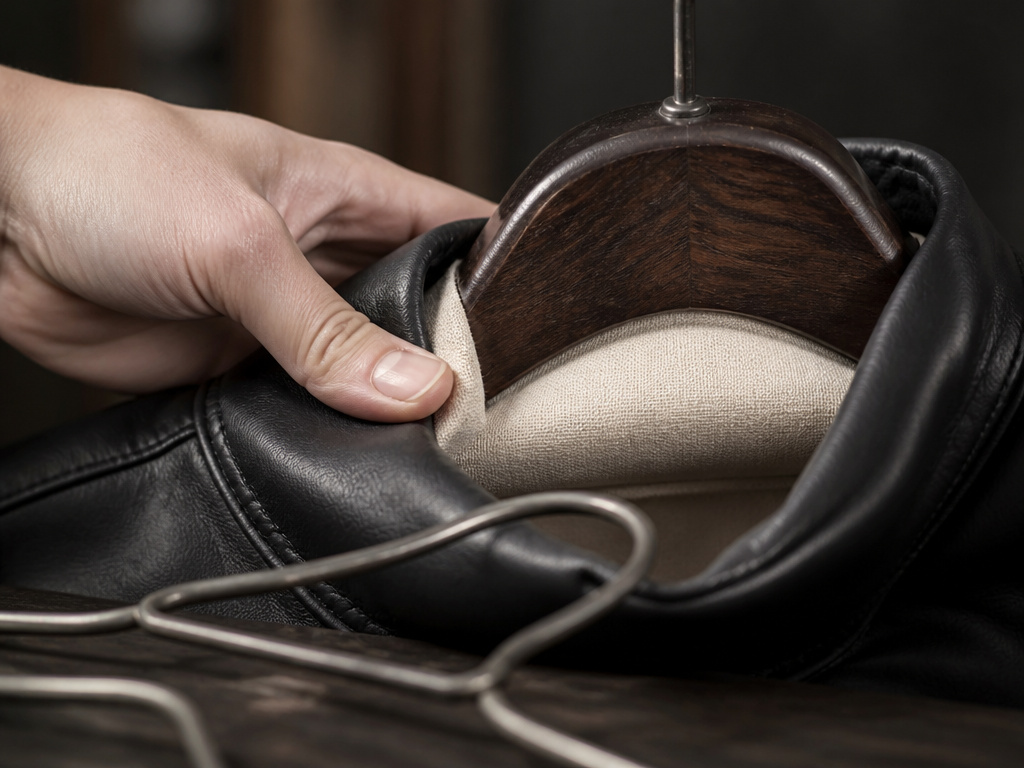
This is not a place to save five dollars. The right hanger does two jobs: it supports the jacket’s shape and distributes weight to prevent point stress.
A wide, padded wooden hanger is the default answer. The width should roughly match the span of your jacket’s shoulders. The padding (usually a soft cotton or felt) prevents creasing at the shoulder seam and provides gentle friction so the jacket doesn’t slide off. Avoid plastic or metal hangers, they lack the necessary width and can have seams that dig into the leather.
For a very heavy jacket, like a horsehide motorcycle style, consider a contoured hanger that mimics the slope of the shoulders. The goal is always to spread the load.
The cover is simpler: 100% cotton. A cotton garment bag is breathable, protects from dust, and buffers against minor knocks from other clothes. It also maintains a slightly more stable microclimate around the jacket. Never use a vinyl, polyester, or non-woven plastic cover. If you don’t have a cotton bag, leaving the jacket uncovered in a clean closet is better than suffocating it in plastic.
Common mistake: Using the wire hanger from the dry cleaner. The grooves it creates are permanent, and they form within weeks, not years.
The Monthly Check-Up Routine

Storage isn’t a “set it and forget it” operation. A jacket left untouched for six months can develop issues you won’t notice until it’s too late. The solution is a quick, monthly check.
Take the jacket out of the bag. Feel the leather, especially on the back and sleeves. Does it feel stiffer or drier than when you stored it? If yes, it might need a very light touch-up conditioning, a tiny amount buffed in can rehydrate the fibers.
Look it over in good light. Check for any faint white or grey speckling, which are early mold spots. If you see any, don’t panic. Take the jacket to a well-ventilated area. Wipe the affected area gently with a soft cloth slightly dampened with a 50/50 mix of water and white vinegar. Let it dry completely in the shade before returning it to storage.
This is also the time to make sure your leather boot storage and leather bag storage are holding up, as the same climate principles apply to all your goods.
Finally, give it a gentle shake and reposition it on the hanger to avoid any persistent folds. This five-minute ritual is the difference between a jacket that ages gracefully and one that surprises you with a crack.
Special Cases and Edge-Condition Jackets
Not all leather is the same, and neither are all situations. Here’s a straightforward guide for the exceptions.
Suede and Nubuck: These fragile surfaces require a cover. Use a breathable bag, but before storing, give them a thorough brushing with a suede brush to lift the nap and remove dust. Never condition these yourself before storage, if they seem dry, take them to a professional cleaner first.
Perforated Leather (Motorcycle Jackets): The holes are a vulnerability. Follow the same steps as regular leather, but be extra vigilant about moisture. Never use a heavy, waxy conditioner that could clog perforations. Alpinestars recommends a light, non-greasy protector.
Wet Jackets: You got caught in a downpour. The absolute rule is no heat. Don’t use a hairdryer, don’t put it near a radiator. Hang the jacket in a well-ventilated room at normal room temperature, ideally with a fan circulating air (not blowing directly on it). Stuff the sleeves with crumpled acid-free paper to help them hold shape as they dry. This can take a day or two. Patience here prevents the leather from shrinking and hardening.
Long-Term Storage (6+ months): For a season-long or multi-year storage, like for a collector, go a step further. After conditioning, place a form inside the jacket to support the chest and shoulders, acid-free tissue paper works. Consider a cedar block in the closet, not for scent, but because cedar wood naturally manages humidity and deters insects. Do not use silica gel packets; they are too aggressive and can over-dry the leather, pulling moisture from deep within the hide.
Frequently Asked Questions
Can I fold my leather jacket if I’m traveling?
For short-term travel, folding is unavoidable. To minimize damage, fold along natural seams (like the side seams) and pad the folds with soft clothing. Unpack and hang it as soon as you arrive. For long-term storage at home, never fold.
What’s the best leather conditioner to use before storage?
Choose a conditioner matched to your leather type. For most aniline and semi-aniline jackets, a light, non-greasy product like Bick 4 or Leather Honey works well. For oil-tanned leathers (common in workwear and many motorcycle jackets), a product like Huberd’s Shoe Grease or the manufacturer’s own conditioner is best. The key is to avoid anything with silicone or heavy waxes that sit on the surface.
My jacket has a musty smell after storage. What do I do?
Mustiness often indicates early-stage mold or trapped moisture. Wipe the entire jacket inside and out with a cloth dampened with a 50/50 water-vinegar solution. Let it air dry completely in a shaded, breezy area for a full day. If the smell persists, professional cleaning is the next step, as the lining may be affected.
Is it okay to store my leather jacket in a vacuum-sealed bag?
Never. Vacuum sealing compresses the leather, guaranteeing permanent creases, and removes all airflow, creating a perfect environment for mold if any moisture is present. Always use breathable, loose storage.
How does proper storage affect the fit of a leather jacket?
Proper storage maintains the jacket’s original drape and shoulder line. Hanging on a wide hanger prevents the shoulders from collapsing or developing indentations, which can make the jacket feel tighter and uncomfortable across the back. Good storage is the first step in preserving the ideal fit you bought.
The Bottom Line
Think of storage not as hiding your jacket, but as putting it into a controlled hibernation. The goal is to press pause on the aging process. That happens at 45-55% humidity, on a wide wooden hanger, under a cotton cover.
Ignore the marketing copy that says you need a dozen specialty products. You need a hygrometer, one good conditioner, and the discipline to check the jacket once a month. Everything else is just protecting the work those three things do.
The leather will tell you what it needs. A slight stiffness on the back panel after eight weeks means your closet is too dry. A faint, sweet smell means humidity is creeping up. Listen to those signals, and you won’t just store a leather jacket, you’ll preserve it.
