
How to Style a Leather Jacket: Expert Tips for Any Outfit
This post contains affiliate links. As an Amazon Associate, we earn from qualifying purchases.
To style a leather jacket, focus on three essential elements: a tailored fit that follows your shoulders and wrists, foundation layers that are simple and slim to avoid bulk, and accessories kept minimal so the jacket remains the focal point. The style of jacket, biker, bomber, aviator, dictates the occasion, from casual weekends to smart evenings.**
The fit is the whole game. A jacket that’s too big looks borrowed; one that’s too small pulls across the chest and restricts movement. Leather doesn’t stretch like knitwear, so the dimensions you buy are the dimensions you live with. Get that right, and the rest, from a white tee to a fine-gauge roll-neck, falls into place.
What follows is a breakdown of the mechanics. We’ll look at the one fit rule that never changes, how to layer without creating a Michelin Man silhouette, and the surprisingly reliable signs of quality hidden in a jacket’s zipper and lining.
Key Takeaways
- Shoulder seams must sit at the edge of your shoulders, and sleeves must end at your wrist bone. Leather doesn’t give, so a tight buy stays tight forever.
- Pair bold jackets with quiet foundations. A plain white tee, dark jeans, and clean boots let the leather do the talking.
- Inspect the zipper brand (YKK, Riri) and lining material before the leather grade. Flimsy hardware and synthetic linings fail years before good leather wears out.
- Store on a wide, padded hanger. A wire hanger will poke permanent dimples into the shoulders within a season.
- Condition based on feel and climate, not a calendar. Dry, stiff leather needs oil; supple leather can wait.
The One Fit Rule That Never Changes
The shoulder seam is your anchor point. It must land exactly where your shoulder bone ends. If it droops down your arm, the jacket is too big and you’ll look swamped. If it rides up toward your neck, the jacket is too small and every movement will feel restrictive.
Sleeve length is the second checkpoint. The cuff should hit the top of your wrist bone when your arms are relaxed at your sides. Any longer and it bunches awkwardly; any shorter and it looks like you outgrew it. You can slightly roll the cuffs for a casual look, but the base length needs to be correct.
Here’s the practical takeaway. Leather has very little mechanical stretch. A jacket that strains across the back when you hug yourself isn’t going to “break in” to comfort, it’s simply the wrong size. When trying on a jacket, move. Reach forward as if grabbing handlebars. Cross your arms. The material should glide, not fight.
A proper leather jacket fit is not a suggestion. The shoulder seams sit at the shoulder bone, the sleeves end at the wrist, and the torso closes without pulling. Deviate from this, and no amount of styling will make the jacket look intentional.
How to Layer Underneath (Without the Bulk)
A leather jacket adds visual weight. The worst thing you can do is add more bulk underneath. The goal is thin, fitted layers that slide under the jacket without altering its silhouette.
Start with the uniform: a fitted white or grey cotton t-shirt. It’s a blank canvas. From there, you can build. A slim-fit button-up shirt in Oxford cloth or chambray works for smart-casual settings. For colder days, a fine-gauge merino wool roll-neck provides warmth without adding inches. The common thread is slimness.
Let’s be clear about one thing. A chunky cable-knit sweater under a leather jacket turns you into a box. The jacket’s front won’t close cleanly, the armholes strain, and the clean lines vanish. If you need heavy warmth, wear the sweater and choose a different, roomier outer layer. The leather jacket’s job is to look sharp, not to act as a parka shell.
Think of layering like making a roux. You need the right fat and a patient heat. The right base layer (the fat) and the jacket’s own insulating property (the heat) combine to create something stable and cohesive. Force it with the wrong ingredients, and you get a lumpy, separated mess.
Your Leather Jacket’s Hidden Quality Report
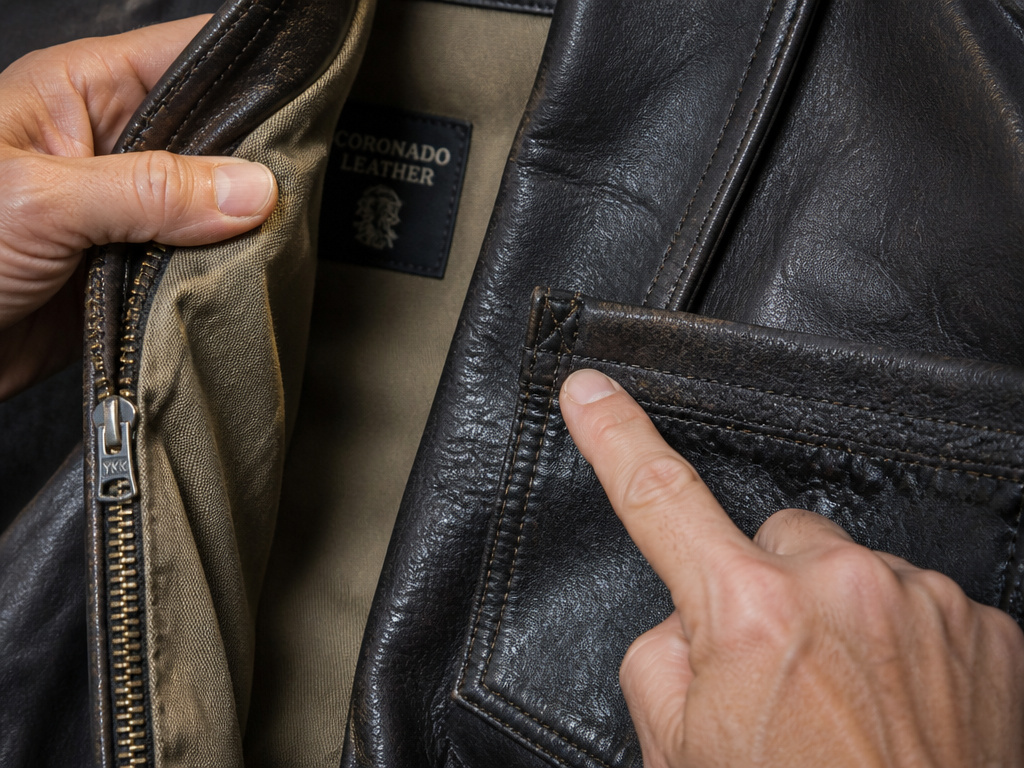
Most people judge a leather jacket by its surface. They look for grain, smell, and softness. Those matter, but the real test of longevity happens in the details you rarely see.
The zipper is the most stressed mechanical part. A plastic tooth will snap. A cheap metal tooth will bend and jam. Check the pull tab for a brand stamp, such as YKK, Riri, or Lampo. Metal teeth are non-negotiable for a jacket meant to last decades. The lining is next. A cheap, non-breathable polyester lining feels clammy and tears at the seams after a few years of wear. Natural linings like viscose or cotton blends breathe, feel better against your skin, and age gracefully.
Common mistake: Prioritizing a perfect leather surface over the zipper and lining. The leather can be conditioned and will patina beautifully, but a broken zipper or a shredded lining requires a costly professional repair long before the hide wears out.
Then there’s the stitching. Hold the jacket up to the light and look at the stitch density. A jacket should have 8 to 12 stitches per inch (SPI). Fewer than that, and the seams are relying on too few anchor points to hold under stress. Check the stress points: the corners of pockets, the underarms, the belt loops. These should have bar tacks or reinforced stitching, not just a single line of thread.
| Component | High-Quality Sign | Red Flag |
|---|---|---|
| Zipper | Metal teeth, branded pull (YKK, Riri) | Plastic teeth, no-name brand |
| Lining | Natural fiber (viscose, cotton blend) | Thin, shiny polyester |
| Stitching | 8–12 stitches per inch (SPI), bar tacks at stress points | Sparse stitching (<6 SPI), loose threads |
| Hardware | Solid-feeling snaps, rivets, and buckles | Lightweight, chrome-plated hardware that feels hollow |
Biker, Bomber, or Aviator: Picking the Right Vibe
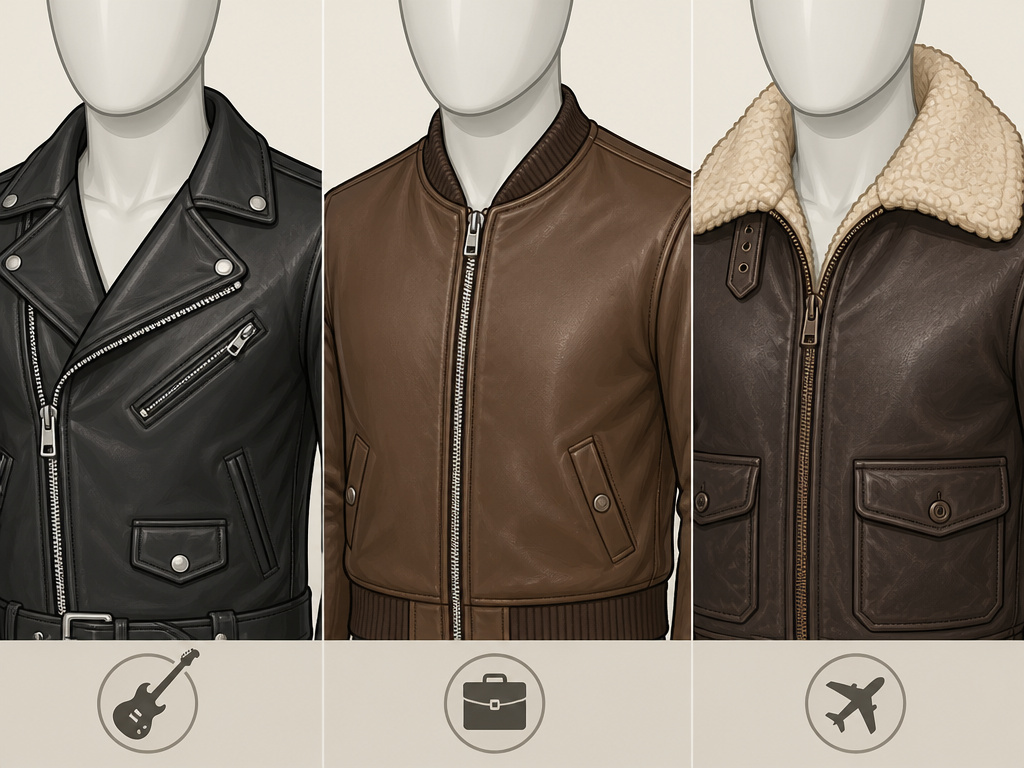
Not all leather jackets go to all places. The silhouette sets the tone. Understanding which style works where saves you from looking mismatched.
The biker jacket, asymmetric zip, wide lapels, often with a belt, carries a rock-and-roll edge. It’s for casual weekends: dark jeans, boots, a plain tee. It’s at home at a concert or a casual bar. The bomber jacket (flight jacket) is shorter, with a ribbed waistband and cuffs. It’s more versatile, sliding into smart-casual territory over a shirt or a thin knit. The aviator jacket, often with a shearling collar, is its own statement of heritage and warmth.
Your choice should start with your existing wardrobe and typical settings. If your life is mostly jeans and t-shirts, a biker jacket is a natural fit. If you need something that bridges weekend and Friday office wear, a clean bomber or a simple racer jacket is a smarter investment. This isn’t about trends. It’s about buying the leather jacket styling that answers the question, “What will I actually wear this with?”
Accessories: The Less, The Better
A leather jacket is a statement. Adding a stack of bracelets, a bulky scarf, and a statement bag creates visual noise. Everything competes. The jacket loses its impact.
Keep it simple. A simple watch with a leather strap complements the material. Clean leather boots or minimalist sneakers ground the look. In cold weather, a plain, fine-knit scarf in a neutral color adds function without fuss. The principle is balance. The jacket adds weight and texture to your upper half, so your shoes should provide a solid, clean foundation.
This is where people overthink it. You don’t need to match your belt to your boots to your watch strap. You just need each piece to be quiet and intentional. If you’re wearing a bold black biker jacket, let it be the boldest thing in the outfit. Pairing it with leather pants can work, but that’s a high-contrast, high-commitment look, best saved for occasions where you want to own the room.
When and Where to Wear It (Yes, Even in Summer)
Leather jackets are not just for fall. A lightweight, perforated leather jacket is made for summer evenings. It works over a linen shirt at a rooftop bar or in heavily air-conditioned restaurants. The key is the weight of the leather and the context.
Rain is the enemy. A light drizzle won’t kill it, but a downpour can cause water stains and, over time, stiffen the hide. If you get caught in the rain, don’t panic. Blot off excess water with a towel and let it dry naturally at room temperature, away from direct heat or sun. Never use a hair dryer or radiator.
The typical rule is to store leather in a cool, dry place. I learned that “dry” needs nuance. A client in an arid climate followed this perfectly, only to find his jacket stiff and crackly after a year in storage. The air was too dry. We added a small humidifier to the closet to maintain a stable environment, and the leather recovered. The material will tell you what it needs.
Care That’s a Check-Up, Not a Ritual
Ignore the online myths about weekly conditioning rituals. You don’t need a ten-step process. You need to observe and respond.
Condition full-grain or top-grain leather only when it feels dry or stiff, roughly every 6 to 12 months for regular wear. Use a small amount of a conditioner with simple ingredients like lanolin or neatsfoot oil and rub it in with a clean cloth. Let it absorb fully, then buff off any residue. Over-conditioning is like overwatering a plant; it leads to a greasy, clogged surface.
For cleaning, start with a damp microfiber cloth. For spot stains, use a tiny drop of mild saddle soap on the cloth, blot, don’t rub, and then wipe with a clean, damp cloth. Always air dry. The worst thing you can do for a leather jacket’s structure is to store it on a flimsy wire hanger, which permanently distorts the shoulders. Use a wide, padded hanger that supports the jacket’s natural shape.
Where this goes sideways: Waiting until you see visible cracking to condition. By then, the leather’s fibers are already damaged and losing strength. Conditioning is preventative maintenance, not a rescue operation.
Frequently Asked Questions
Can you wear a leather jacket in the summer?
Yes, with two caveats. First, opt for a lightweight or perforated leather style. Second, wear it in the evening or in air-conditioned spaces. It’s perfect for a summer dinner out where the temperature drops.
How should a leather jacket fit in the shoulders?
The shoulder seam of the jacket should align exactly with the bony tip of your shoulder. If the seam falls down your arm, it’s too big. If it sits on top of your shoulder near your neck, it’s too small. This is the most critical fit point.
What do you wear under a leather jacket?
Stick to slim, fitted layers to avoid bulk. A plain t-shirt, a slim button-up shirt, or a thin knit sweater all work well. The goal is for the jacket to retain its shape when closed.
How do I know if my leather jacket is good quality?
Check the hidden details first. Look for a metal zipper from YKK or Riri. Feel the lining, natural fibers are better than polyester. Examine the stitching; there should be 8-12 stitches per inch, especially at stress points like pockets and armholes.
The Bottom Line
Styling a leather jacket isn’t about chasing trends. It’s about understanding a few mechanical rules and then trusting the piece. Nail the fit first, shoulders and sleeves are everything. Keep everything else simple. Let the jacket be the star.
When you’re ready to buy, look past the surface. Your fingers should find a metal zipper pull before your eyes get lost in the grain. That’s how you find a jacket that moves from your wardrobe to an heirloom. Everything else is just a coat.
