
A Guide to the Main Types of Leather Belts for Men & Women
This post contains affiliate links. As an Amazon Associate, we earn from qualifying purchases.
Leather belts are classified by three core factors: the leather grade (full-grain, top-grain, genuine), the buckle mechanism (pin, ratchet, reversible), and the construction (single-layer, dual-layer, edge finish). The grade of leather determines durability and aging; the buckle dictates fit and function; the construction reveals craftsmanship quality. A belt’s primary failure point is almost always the buckle attachment, not the leather itself.
That breakdown cuts through the noise. Most guides list twenty-five styles based on width or decorative stitching, but those are surface details. The leather grade, buckle hardware, and how they’re put together are what you’re actually buying. They decide whether a belt lasts two years or twenty.
What follows is a map of the decisions that matter. We’ll walk through the leather specs that manufacturers use, the buckle systems that change how a belt feels, and the construction details that signal quality or planned obsolescence. By the last section, you’ll be able to look at any belt’s product page and know exactly what you’re getting.
Key Takeaways
- “Genuine Leather” is a technical grade, not a quality seal. It describes the lower split layers of a hide, often coated in polyurethane. It’s real leather, but it’s the least durable classification and will crack and peel.
- The buckle attachment is the most common point of failure. A belt with a buckle sewn directly to a thin, un-reinforced strap will fail long before quality leather wears out.
- Full-grain leather develops a patina; other grades deteriorate. Only full-grain, from the hide’s top layer, softens and darkens beautifully with age. Top-grain is sanded smooth and resists patina, while genuine leather simply wears out.
- Belt sizing is not pant size. You find your belt size by adding 2 inches to your pant waist measurement. A size 34 pant needs a 36-inch belt.
- A thick belt is not always a better belt. Dress belts should be 1.25″ to 1.5″ wide and relatively slim; work or casual belts can be 1.75″ and thicker for structure.
The Three Leather Grades That Define Everything
Let’s be clear about this: the term “types of leather” is used two ways. One is about species, cow, bison, alligator. The other, far more important for daily wear, is about the grade of the cowhide itself. This grade is your first filter.
The industry sorts leather into three broad tiers: full-grain, top-grain, and genuine. These aren’t just marketing terms. They describe which part of the animal’s hide was used and how it was processed. This decides everything about the belt’s life span.
Full-grain leather uses the dense, fibrous top layer of the hide, complete with natural grain and markings. Top-grain leather sands that surface smooth for uniformity. Genuine leather comes from the lower split layers, which are weaker and require a synthetic coating to hold together.
Full-Grain Leather: The Durable Standard
This is the outer layer of the hide, untouched by sanding or buffing. You see the hide’s natural grain, including any scars or insect bites. That character is the point.
Because the tight, dense fiber structure remains intact, full-grain is tremendously strong and resistant to abrasion. It also breathes. Over years, oils from your hands and the environment work into those fibers, creating a rich, dark patina. The belt doesn’t look worn; it looks lived-in and unique.
Where this goes sideways: People treat full-grain leather like a fussy museum piece. It’s actually the toughest option on the bench. A quality full-grain leather belt from a maker like Orion Leather Company or Hanks Belts is built for daily hard use. The patina is a badge of that use, not a flaw.
Top-Grain Leather: The Consistent Performer
Top-grain starts as full-grain, but the surface is sanded to remove imperfections. It’s then typically finished with a pigmented coating or a light polymer layer. This creates a uniform, smooth, and sometimes shiny appearance.
It’s still real, durable leather from the top of the hide, so it’s strong. But the sanding removes the densest fibers, making it slightly less tough than full-grain over decades. The surface coating also blocks the deep, organic patina process. It ages more by showing scuffs on its finish than by developing an all-over glow.
This is the standard for many quality leather belts in the mid-range. It offers a clean, consistent look that works well for business attire.
Genuine Leather: The Misunderstood Term
Here’s the thing. “Genuine leather” is a technical term from the leather industry. It simply means the product contains real leather fibers. In practice, it almost always refers to the lower layers of the hide split away from the top.
These split layers are fibrous and spongy. To make them usable, manufacturers bond them with adhesive and coat them with a thick layer of polyurethane or vinyl that’s embossed with a leather-like pattern. This is why “genuine leather” belts feel plasticky and why they fail. The coating cracks, the layers separate, and the belt peels.
I once believed darker leather hid wear better. Then I saw a dark “genuine leather” bag develop shiny, polished scuffs in high-contact areas. The plastic coating wore through to a different color underneath, making the damage more obvious, not less. The lesson wasn’t about color, it was about the material’s fundamental weakness.
| Leather Grade | Source Layer | Surface | Aging Behavior | Best For |
|---|---|---|---|---|
| Full-Grain | Top, outermost layer | Natural, un-sanded; shows grain & marks | Develops a rich, personal patina; softens | Heirloom-quality belts, casual & work wear |
| Top-Grain | Top layer, sanded | Smooth, uniform; often has applied finish | Shows surface scuffs; minimal patina | Dress belts, business-casual belts |
| Genuine Leather | Lower split layers | Synthetic coating over fibrous base | Coating cracks & peels; layers delaminate | Low-cost, short-term fashion belts |
TL;DR: For a belt that ages with you, buy full-grain. For a crisp, consistent dress belt, buy top-grain. See the term “genuine leather” and understand you’re buying the least durable real-leather option.
Buckle Types & Construction: Where Belts Actually Break
You can have the best leather in the world, and a poorly attached buckle will ruin it. The buckle system and how it’s fastened to the strap are engineering problems. Solving them well is the mark of a good belt.
The buckle is the stress concentrator. Every time you bend to sit or tighten the strap, force focuses on the point where metal meets leather. A thin strap punched with a simple hole will stretch and tear. A thick strap with a reinforced, skived, and stitched loop will outlive you.
Common Buckle Mechanisms
The mechanism changes how you use the belt. The three main types are pin, ratchet, and reversible.
A pin buckle is the classic. A metal prong goes through a pre-punched hole in the strap. It’s simple, reliable, and universal. The limitation is the hole spacing, usually one inch, which can make a perfect fit elusive.
Ratchet belts replace holes with a track of plastic teeth on the strap’s underside. A buckle with a spring-loaded pawl clicks onto these teeth, allowing for micro-adjustments. The fit is precise. The trade-off is the introduction of plastic components into an otherwise natural material. The mechanism can also collect lint.
Reversible buckles let you flip the strap to show a different color, often black on one side, brown on the other. The buckle usually attaches via a simple clasp system. The convenience is obvious, but the attachment point is often a weak spot, and the dual-sided strap is usually thinner genuine or top-grain leather.
The Critical Attachment Point
This is where my strong opinion lives: a belt’s primary failure point is almost always the buckle attachment. Look at how the buckle is secured.
The strongest method is when the belt strap is a single, thick piece of leather. The end is skived (shaved thin), folded back, and riveted or stitched to itself, creating a rock-solid loop for the buckle’s bar. This is common on heavy-duty work belts.
Many belts, especially dress belts, use a sewn-on buckle tab. A separate piece of leather is stitched onto the main strap to form the loop. This is fine if the tab is thick enough and the stitching is robust. If the tab is thin or the stitches are few, it will tear.
The cheapest method is a simple metal clip that pinches the strap. It requires no stitching, but it places all the shear stress on a tiny area of leather, which will fray and fail.
Common mistake: Choosing a belt based only on leather grade while ignoring a flimsy buckle attachment. A poorly attached buckle will fail long before even mediocre leather wears out.
How Belts Are Measured & Sourced: The Hidden Specs
When you pick up a belt, you check the size and maybe the width. But behind those numbers are standards and specifications that dictate quality control. For mass-produced belts, especially those from major manufacturing regions, these standards are the blueprint.
Decoding Belt Sizing
Belt sizing is straightforward once you know the rule. Belt size is not your pant size.
A belt is measured from the buckle pin to the center hole (usually the third of five). To find your size, take your pant waist measurement and add 2 inches. If you wear a 36-inch waist pant, you need a 38-inch belt. The extra length accounts for the tail that tucks into the first belt loop after the buckle.
Width is a style and function choice. Dress belts are typically 1.25″ to 1.5″ wide. Casual belts are often 1.5″ to 1.75″. Work or western belts can be 2″ or more. Always ensure the belt fits through your pant loops.
The Role of Manufacturing Standards
If you’ve ever seen a tag referencing a standard like “QB/T 1618-2018,” that’s a direct link to a manufacturing specification. QB/T 1618 is a Chinese light industry standard for “everyday belts.” It doesn’t define style, but it does set baselines for things a consumer would never think to measure.
For example, the older QB/T 1618-1992 standard specified that a leather belt over 20mm wide must be at least 2.5mm thick to be a “qualified product.” It mandated five holes, set the acceptable distance from the tail end (75-105mm), and even defined sewing quality (6-10 stitches per 25mm). A belt conforming to this standard has met a defined set of material and construction tests.
This standard “does not apply to the belt of various special applications.” This is a crucial edge case. Belts for safety harnesses, heavy machinery, or weightlifting have entirely different performance requirements. A dress belt standard says nothing about a belt meant to support 500 pounds.
These standards are why two belts can feel different. One might use the minimum acceptable thickness, while another exceeds it. One might use the minimum stitch count, while another doubles it. The standard sets the floor; a good brand builds above it.
Belt Construction & Edge Details
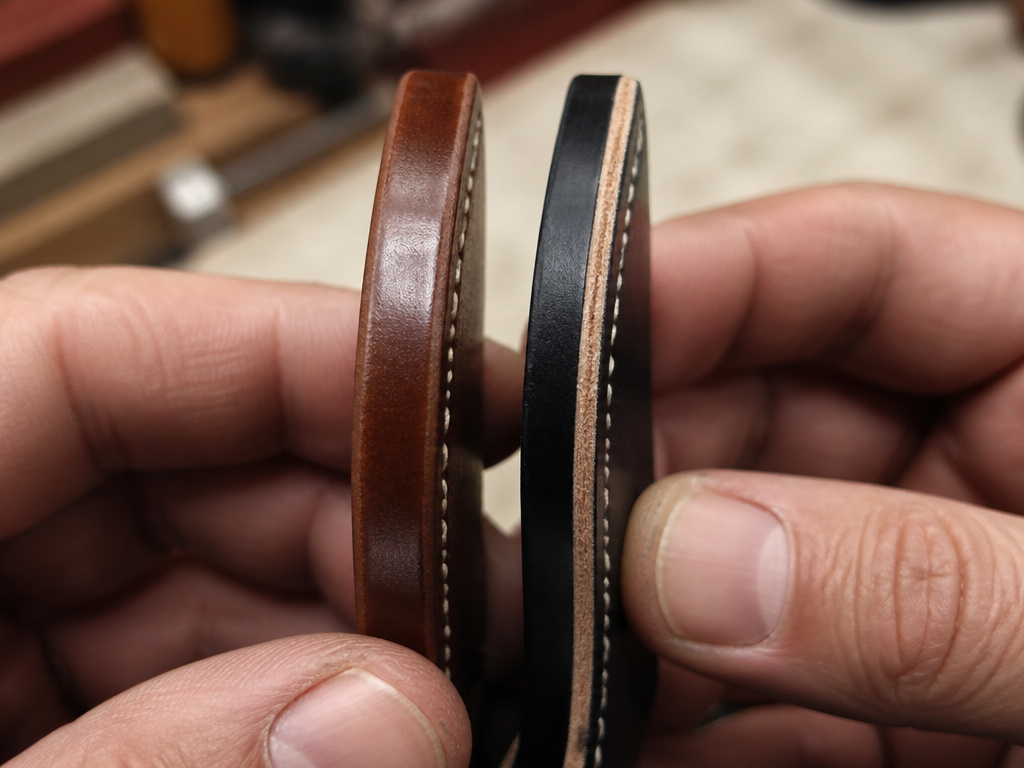 Once you look past the buckle and the leather, the construction details tell the final chapter of the story. This is where craftsmanship shouts or whispers.
Single-Layer vs. Dual-Layer
A single-layer belt is cut from one solid piece of leather. It’s common with thick, sturdy leathers like bridle leather or harness leather. The edges are usually burnished (polished) or painted. This is the simplest, most honest construction. It’s also often the most durable, with no glued layers to separate.
A dual-layer belt has a top-grain face laminated to a backing layer, which might be suede or a lower-grade leather. This allows for a smooth face on a belt that might not be thick enough on its own. It’s common in reversible belts. The risk is delamination, the two layers peeling apart over time, especially if exposed to moisture.
The Truth About Edge Finishing
The edge of a belt is a tiny canvas that reveals a lot. A raw edge is just cut and left alone. It looks rugged but can fray on softer leathers. Burnishing involves rubbing the edge with a tool or wood slicker, sometimes with a bit of wax or gum tragacanth. The friction heats and compresses the fibers, creating a smooth, rounded, glossy finish. It’s a sign of hand craftsmanship.
Edge paint is a thick, colored coating applied to the edge. It gives a very clean, uniform, almost plastic-like look. It’s efficient for factory production and hides the layered cross-section of a dual-layer belt. The downside? Cheap edge paint cracks and chips off in flakes.
Here’s some straightforward advice. Run your finger along the belt’s edge. A burnished edge feels hard, smooth, and warm. A painted edge feels like…paint. It’s a small detail, but it speaks to the maker’s approach. For a belt that will be a daily companion, that approach matters.
Frequently Asked Questions
What type of leather belt is best for daily wear?
For true daily durability, a single-layer belt made from full-grain leather is best. It will develop a patina and soften over time without cracking. Brands like Hanks Belts or The Belt Man specialize in this style. For a more polished look suitable for an office, a top-grain leather dress belt with a clean edge finish is a reliable choice.
Are exotic leather belts like alligator worth it?
Exotic leathers are about aesthetics and status, not performance. A good cowhide belt is often stronger. Alligator, ostrich, or python belts have unique textures that are impossible to replicate. If you love the look and are willing to pay for it, and ensure it’s CITES-compliant, go for it. But for 95% of daily needs, a premium cowhide belt is the more practical and economical exotic leather belt alternative.
How do I stop my leather belt from cracking?
Cracking is usually a sign of dry leather or poor-quality leather. For a quality full-grain or top-grain belt, apply a light, natural conditioner (like pure neatsfoot oil or a beeswax-based cream) once or twice a year. For genuine leather belts, cracking is often the plastic coating failing, which is not preventable. Conditioning might temporarily mask it, but the damage is structural.
Can a belt be too thick?
Yes. The “1/4 inch thick” belt is a selling point for ruggedness, but that thickness is inappropriate for dress belts. A thick, stiff belt is uncomfortable with dress trousers, won’t drape properly, and can distort the waistband. Match the belt’s thickness to its purpose: slim for dress, substantial for casual or work.
What is the most adjustable type of belt?
Ratchet belts offer the finest adjustment, often in increments of a quarter-inch or less. Traditional pin buckles are limited to their hole spacing, usually one inch. Reversible buckles typically use the same pin-and-hole system. For a truly customized fit, especially if your weight fluctuates, a ratchet system is the most precise.
Before You Go
So, the search for the right belt narrows to a few concrete decisions. Ignore the endless lists of “types” based on stitch color. Look for the leather grade on the tag, aim for full-grain or top-grain. Examine the buckle attachment. If it’s a thin piece of leather held by two stitches, put it back. Check the edge. A clean, hard burnished edge beats flaky paint every time.
My final stance most guides won’t give you: thickness is overrated. The pursuit of the thickest belt has left people with uncomfortable, rigid straps that are wrong for half their wardrobe. For a general-purpose belt, 1.5″ wide and 3.5-4mm thick is the sweet spot. It’s substantial enough for jeans, slim enough for chinos, and will break in to fit you alone.
Find a belt built that way, and the type won’t matter. You’ll just have a belt that works.
