
What Is a Minimalist Wallet? The 7-Day Card Count Guide
This post contains affiliate links. As an Amazon Associate, we earn from qualifying purchases.
A minimalist wallet is a slim, front-pocket accessory designed to carry only the cards and cash you used in the last seven days. Its entire purpose is to force an intentional edit of your carry, reducing bulk and improving comfort by fitting the reality of your weekly routine, not the archive of your possessions.
That seven-day window is the part most guides skip. The right fit isn’t about the cards you own; it’s about the ones you actually reach for. A wallet sized for your real weekly use, not a product page’s maximum strained capacity, is what stops a slim design from becoming a stretched, bulky mess within a fortnight.
What follows is a fit-first framework. We’ll walk through the realistic card count that matters, the two thicknesses every wallet has, and how materials like leather, Tyvek, and carbon fiber actually behave in your pocket over months. By the end, you’ll be able to look at any minimalist wallet and know within a minute whether it fits your life or just your aesthetic.
Key Takeaways
- Your true capacity is the number of cards you used in the last week, not the total you own. The average is 4-6 cards.
- Every wallet has an “empty” thickness and a “full” thickness; the loaded feel is what matters in your pocket.
- Leather requires maintenance to avoid cracking; synthetic materials like Tyvek have no break-in period but can “set” to a higher card count.
- An RFID-blocking layer is a conductive shield that must be verified, not assumed, especially with materials like carbon fiber.
- The goal is a wallet that disappears in use, not one that becomes a project to manage.
The 7-Day Rule: Your Real Capacity
Open your wallet right now. Separate the cards you used in the last seven days from the rest. That first pile is your capacity. The other pile is an archive, and archives belong in a drawer, not your pocket.
This is the single most practical filter for choosing a minimalist wallet. In the U.S., the average consumer held 3.7 active credit cards in 2025. Add a debit card, a driver’s license, and a transit pass, and a realistic daily carry lands between four and six cards. A wallet built for twelve is already out of step with the pocket it lives in.
The part nobody mentions: A product’s stated capacity is what it can be made to hold at its most strained, not what it wants to hold. Forcing nine cards into an eight-card wallet doesn’t just create a bulge; it permanently stresses the material.
I learned this the hard way with a early-production sample. The rule is to apply conditioner in small, circular motions with your fingers; the warmth helps it penetrate. I ignored that, slathering it on a test wallet to “speed up the break-in.” The leather didn’t absorb the excess. It stayed greasy for days, and cards slid out with a gentle shake. The wallet was technically broken in, but it was also useless. Overloading a slim design has the same effect: you defeat its entire purpose.
So, your first step isn’t shopping. It’s editing. Dump your current wallet and run the seven-day test.
Empty vs. Full: The Two Thicknesses That Matter
A single thickness figure on a website is marketing. It tells you what the manufacturer wants on the label. It tells you almost nothing about how the wallet lives in your pocket.
Every wallet has two thicknesses. The empty thickness is the one listed, the slim profile in product photos. The full thickness is what you’ll actually feel when loaded with your cards and cash. The difference is usually 3 to 5 millimeters, but it can be as much as 8.
| Wallet State | Typical Thickness | What It Means For You |
|---|---|---|
| Empty | 3-10 mm | The advertised “slim” spec. A starting point, not a promise. |
| Loaded (Realistic) | 8-15 mm | The actual feel in your pocket. This is the number that decides comfort. |
| Overloaded (Strained) | 15+ mm | The wallet is over capacity. Bulge, discomfort, and material damage follow. |
For example, one manufacturer notes their folded wallet is 3 mm empty but about 8 mm full. That 5 mm jump is the reality of your carry. A wallet that’s 10 mm empty will likely hit 15 mm loaded, the threshold where it stops feeling minimalist in a front pocket.
This is why chasing the absolute thinnest empty measurement can be a mistake. A slightly thicker but more structured design might only add 2 mm when loaded, while a flimsy ultra-thin sleeve might balloon by 8 mm. Judge by the loaded spec, not the empty one.
Materials & The Reality of Wear
The material dictates how your wallet ages, fails, and feels. It’s not just an aesthetic choice; it’s a contract for long-term behavior.
Leather is the classic. Full-grain leather develops a patina, molding to your cards and becoming unique. But it’s a living material. Dryness, direct sunlight, and lack of care cause cracking. The leather becomes stiff, folds against the card stack instead of flexing, and splits.
Where this goes sideways: Over-conditioning a slim leather wallet. It turns the leather greasy and soft, which allows cards to slide out. One thin coat, absorbed fully, is worth ten slathered applications.
Tyvek is a synthetic paper-like material that doesn’t tear. It’s incredibly light, some models are 9 grams empty. It has no break-in period, but it does “set” to the number of cards you carry. One early customer carried 16-18 cards for months. When he removed the excess, the remaining cards slipped out because the Tyvek had adapted to the larger shape and didn’t retract. The manufacturer now recommends 6-8 cards for everyday use.
Carbon Fiber offers a modern, rigid shell with a high strength-to-weight ratio. It provides natural attenuation for some RFID signals. However, prolonged UV exposure can alter resin finishes, and severe impacts can delaminate the layers. The feel is unyielding; it won’t mold to your pocket.
Metal (like aluminum) is durable and often RFID-opaque. It’s also rigid, cold, and can be uncomfortable pressed against your leg. Every scratch is permanent damage, not a developing character.
Demystifying RFID: What the Lining Actually Does
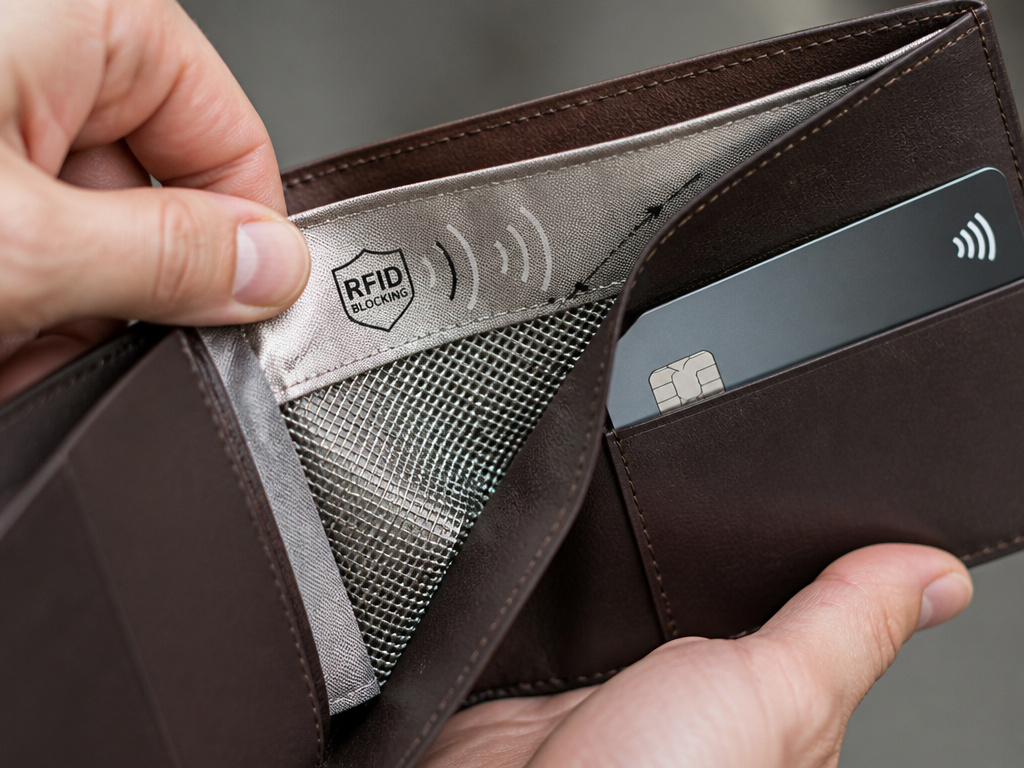
If a wallet claims RFID protection, it deserves a plain explanation, not a scary marketing badge.
Contactless cards operate at 13.56 MHz under the ISO/IEC 14443 standard, with a typical read distance of up to 10 cm (about the width of your hand). An RFID-blocking layer is a conductive mesh or sheet that creates a shield, blocking that signal while the card stays inside the wallet.
A minimalist wallet’s RFID lining is a conductive shield that blocks a contactless read at close range. It’s a technical feature, not magic.
However, not all materials block equally. A solid aluminum wallet is a faraday cage. A carbon fiber plate may attenuate the signal. A wallet with a sewn-in RFID lining must have that layer intact and unbroken to work. Don’t assume; check the manufacturer’s specific claims and any third-party testing.
Some brands, like Decadent Minimalist, deliberately design their DM1 Wallet not to block RFID. Why? So you can keep a building access card or car key fob inside and use it without taking the card out. Know what you need.
How to Choose: A Three-Point Inspection

Forget browsing product galleries for an hour. You can judge a minimalist wallet’s real-world fit with a three-point check that takes under a minute.
- Match Capacity to Your 7-Day Count. If you used five cards last week, look for a wallet with a comfortable capacity of 5-7 cards. Ignore the 12-card maximum. A curated selection of minimalist leather wallets will clearly state realistic ranges.
- Ask for the Loaded Thickness. If the spec sheet only lists empty thickness, that’s a red flag. Email the maker. A quality brand will know the answer, because they’ve tested it.
- Understand the Material’s Long-Term Trade-Off. Are you willing to condition leather? Will you keep your card count consistent with a Tyvek wallet? Does a rigid carbon fiber plate suit your pocket style? Your answer guides you to the right types of wallets.
This inspection cuts through the noise. It moves you from “I like how that looks” to “I know how that will carry.”
Common Pitfalls & The One Upgrade That Matters
The biggest mistake isn’t choosing the wrong color. It’s refusing to edit your carry. Forcing a minimalist wallet to hold a maximalist load defeats its entire reason for existing. You end up with a bulky, stressed version of the slim design you bought.
Other frequent errors: * Ignoring Cash: If you use bills, the cash slot design is critical. A slot that requires triple-folding notes creates a lump that pushes cards out. Look for a design that lets a bill lie flat or fold in half. * Chasing Exotics: Alligator inlays or stingray panels on a wallet are purely decorative. They add significant cost and can be prone to cracking at the seams. For 95% of people, premium cowhide is more practical. * Neglecting the Profile: A wallet that’s a perfect rectangle can feel like a brick. Gently rounded corners or a tapered design adapts to your pocket and leg far better.
The one upgrade that consistently matters is prioritizing full-grain leather from a reputable craftsperson. Brands like Popov Leather, Ashland Leather, and Guarded Goods use it. It ages, it breathes, and it tells a story. It’s the difference between a tool that wears out and a companion that wears in.
For a deeper dive on this choice, our guide on key factors for selecting a leather wallet walks through tannages, stitching, and edge finishing.
Frequently Asked Questions
What is the difference between a minimalist wallet and a cardholder?
Cardholder is typically a single sleeve or plate for cards, often with no dedicated cash space. A minimalist wallet is a broader category that includes cardholders but also encompasses slim bifolds, trifolds, and other designs that may include a discrete cash slot or clip. The core difference is intent: both are minimal, but a wallet acknowledges you might carry a bill or two. You can explore this more in our cardholder vs wallet comparison.
How many cards should a minimalist wallet hold?
The realistic range is 4 to 8 cards. This covers the essentials: ID, primary debit/credit card, a backup card, insurance card, and a transit or loyalty card. Carrying more than 10 usually defeats the purpose and strains the design. Your specific answer comes from the seven-day test.
Are minimalist wallets RFID safe?
They can be, but you must verify. Look for a specific claim about an RFID-blocking layer or material. Solid metal wallets are inherently blocking. Carbon fiber may attenuate signals. Leather wallets require a sewn-in shielding layer. If the product page is vague, assume it does not offer protection.
Can you carry cash in a minimalist wallet?
Yes, but it requires intention. Look for a dedicated cash slot that holds bills folded in half (not thirds), or a discrete metal clip. Avoid designs where cash is meant to be stuffed behind cards, as this creates bulk and makes cards hard to remove.
Are metal or carbon fiber wallets better than leather?
“Better” depends on your priorities. Metal/carbon fiber offers modern aesthetics, often better RFID blocking, and zero maintenance. Leather offers a classic feel, a developing patina, and a softer, molding fit in the pocket. One isn’t universally superior; they are different tools for different tastes.
Before You Go
Let’s be clear about this: a minimalist wallet is a tool for editing, not a magic bullet for organization. The value isn’t in the wallet itself, but in the habit it forces, the weekly audit of what you actually need in your pocket.
The right one will feel like an extension of your routine, not an addition to it. It’s the difference between a wallet you think about and a wallet you forget is there until you need it. Start with the seven-day count. Let that number guide you to a capacity, a material, and a design that fits your life, not just your pants.
If your edited carry lands in the 4-6 card range, you’re in the sweet spot for most slim wallets. If you find yourself consistently needing 8 or more, consider a slim bifold wallet, it’s a more structured way to handle that volume without bulging. The goal is always fit, not dogma.
