
Learn How to Soften Leather Shoes the Right Way, No Cracks
This post contains affiliate links. As an Amazon Associate, we earn from qualifying purchases.
This post contains affiliate links. As an Amazon Associate, we earn from qualifying purchases.
To soften leather shoes, you need to replace the tanning agents and lubricants that leach out over time. This is done with a dedicated leather conditioner, like Bickmore Bick 4 or Nikwax Conditioner for Leather™, applied in thin, repeated layers. Heat, water, and food oils are the three fastest ways to crack and stiffen leather permanently.
The goal is to restore the leather’s natural flexibility so it can move with your foot without resistance. That requires understanding what leather actually needs, not what a quick internet fix promises.
What follows is a process that works for smooth, full-grain leather footwear. This guide explains why leather gets stiff, how to pick a conditioner that works, the step-by-step method, and the exact mistakes that ruin shoes before their time.
Key Takeaways
- Leather stiffens because it loses tanning agents and lubricants, not because it’s “dry” in the simple sense. A water-based conditioner like Nikwax replenishes these without over-softening.
- Never use heat. Hair dryers and radiators evaporate essential oils at around 60°C, leaving the fibers brittle. The damage shows up as micro-cracks within a few weeks.
- Thin coats win. One heavy application of oil sits on the surface, causing stains and mold. Apply a conditioner in two or three light layers, letting each absorb fully.
- Store shoes at 50–60% relative humidity. Below that, leather becomes brittle; above, you risk mold. A breathable cloth bag is better than plastic.
- If shoes are painfully tight in length, they’re the wrong size. Leather stretches in width by maybe 5–7%, but it never stretches in length.
Why Leather Gets Stiff (It’s Not What You Think)
Let’s be clear about this. Stiff leather isn’t just “thirsty.” It’s structurally compromised. During tanning, the hide is loaded with agents that give it shape and lubricants that let its fibers slide against each other. Every time the leather gets wet or sits in a dry, hot room, those elements slowly leach out.
The fibers then lock together. They can’t move freely, so the shoe feels rigid. According to the British Shoemakers’ Guild, almost 70% of the discomfort in new shoes comes from this break-in period where your foot is working against those locked fibers. Your job is to gently persuade them to move again, not to force them.
A water-based conditioner like Nikwax Conditioner for Leather™ works by replenishing the tanning agents and lubricants that water leaches out. It’s absorbed into the fibers where needed and stops once the leather is treated, preventing the over-softening that damages support.
This is why soaking shoes or using a hair dryer backfires spectacularly. Water carries away more lubricants, and heat bakes them out. You’re accelerating the very problem you’re trying to solve.
The Right Conditioner (and The Wrong One)
Your conditioner choice decides everything. I want to help you make confident choices here, because the market is full of products that do more harm than good.
For most smooth leather shoes, dress shoes, boots, casual footwear, you want a modern, water-based conditioner. My go-to is Bickmore Bick 4. It’s pH-balanced, doesn’t darken leather, and absorbs completely. For boots with waterproof membranes like Gore-Tex®, Nikwax Conditioner for Leather™ is formulated specifically to maintain that DWR (Durable Water Repellency) without clogging pores.
Here’s some straightforward advice on what to avoid:
| Product Type | Why It’s a Problem | Likely Outcome |
|---|---|---|
| Silicone-based “protectors” | Creates a seal that blocks future conditioning | Leather dries out underneath, becomes brittle |
| Animal-fat based oils (neatsfoot, mink) | Can over-soften, darken leather dramatically, go rancid | Permanent dark stains, greasy feel, mold risk |
| Food oils (olive, coconut) | Go rancid, attract microbes, don’t penetrate properly | Bad odor, stains, leather degradation |
| “All-in-one” cleaner/conditioners | Cleaners dry leather; conditioners can’t work on dirty leather | Ineffective cleaning, poor conditioning |
I stopped recommending silicone-based sprays years ago. They leave a residue that feels slick, but it acts like a plastic wrap. No subsequent conditioner can get through it. The leather underneath eventually dries out and cracks, and you never see it coming until the damage is done.
This is a timeless material. It needs to breathe. Your job is to feed it, not suffocate it.
Step-by-Step: The Safe Softening Process
Throw out the idea of a single, magical application. Softening leather is a conversation, not a command. Follow this sequence, and give each step the time it requires.
- Clean the shoes. Use a damp cloth or a dedicated leather cleaner to remove surface dirt. Dirt acts like sandpaper, grinding into the leather as you flex it. Let the shoes dry completely at room temperature if you used water.
- Apply the first thin coat. Put a dime-sized amount of your chosen conditioner on a soft cloth. Rub it into the leather using circular motions, covering the entire surface. You shouldn’t see a thick, glossy layer, just a slight darkening as it soaks in.
- Wait. Then apply again. Let the shoes sit for at least two hours, or overnight. If the leather has absorbed all the conditioner and still feels stiff, apply a second identical thin coat. Dense, full-grain leather often needs two.
- Flex by hand. Once the final coat is mostly absorbed (not sticky), take the shoe in your hands and gently bend it at the ball of the foot and the ankle collar. You’re manually encouraging those fibers to start moving. Don’t force it.
- Wear them, but briefly. Put the shoes on with the socks you’ll normally wear and walk around your house for 15-30 minutes. This is the first real test. The goal is to continue the gentle flexing you started with your hands.
- Use shoe trees. After wearing, insert cedar shoe trees. They maintain the shape as the leather relaxes and absorbs the conditioner fully over the next 24 hours.
The part nobody mentions: Rushing from Step 2 to Step 5 is how you get deep, permanent creases instead of gentle rolls. The conditioner needs time to migrate between the fibers. Skipping the wait means you’re bending dry, unoiled fibers against each other.
What Absolutely Will Not Work (And Why)
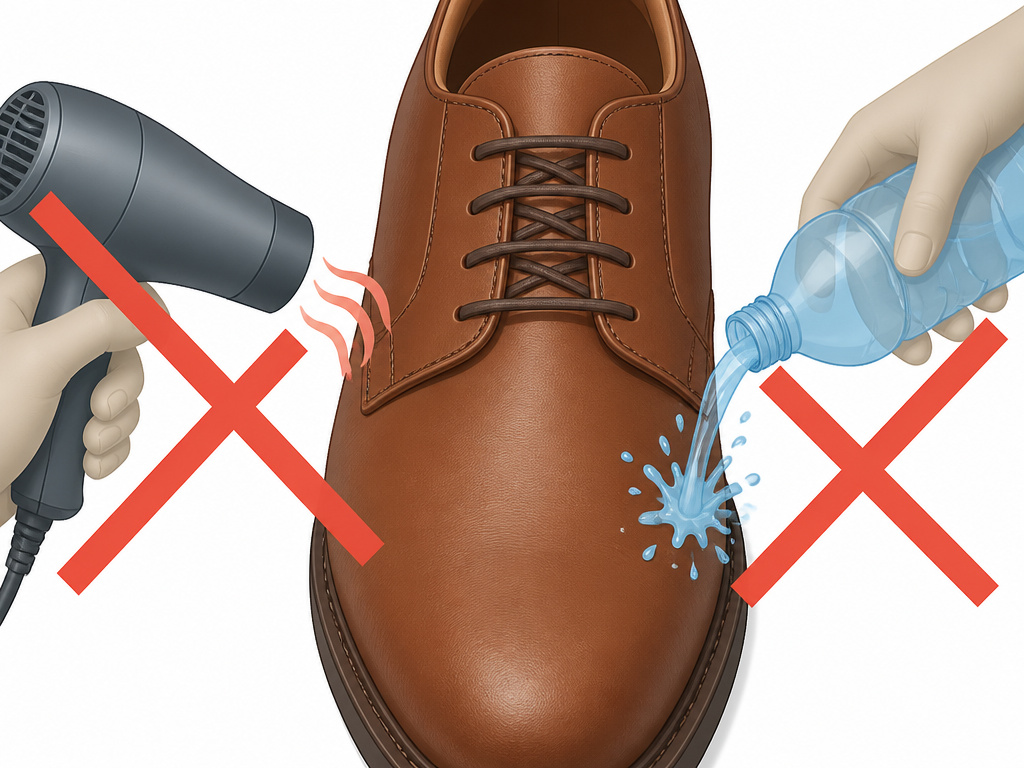
The internet is a graveyard of good leather ruined by bad advice. Let’s untangle the three most destructive myths.
Common mistake: Using a hair dryer on stiff shoes. At temperatures above 60°C, the factory glue holding the sole begins to soften and the natural oils in the leather evaporate. The shoes might feel pliable for a day, but the leather will be brittle and the sole may separate within two weeks.
Soaking or the “wet sock” method is equally bad. Water swells leather fibers. As they dry, they contract and tighten further, pulling the tanning agents out with the evaporating water. The result is a shoe that’s even stiffer than before, often with water stains and a warped shape.
Food oils are for salads, not shoes. Olive oil, coconut oil, even vinegar solutions go rancid. They spoil, creating a foul smell and providing a food source for mold and bacteria that will literally eat the leather from the inside out. The stains they leave are permanent.
Practically speaking, if a method seems too fast or too simple, it’s wrong. Leather conditioning is a slow, deliberate craft.
When Softening Isn’t the Answer
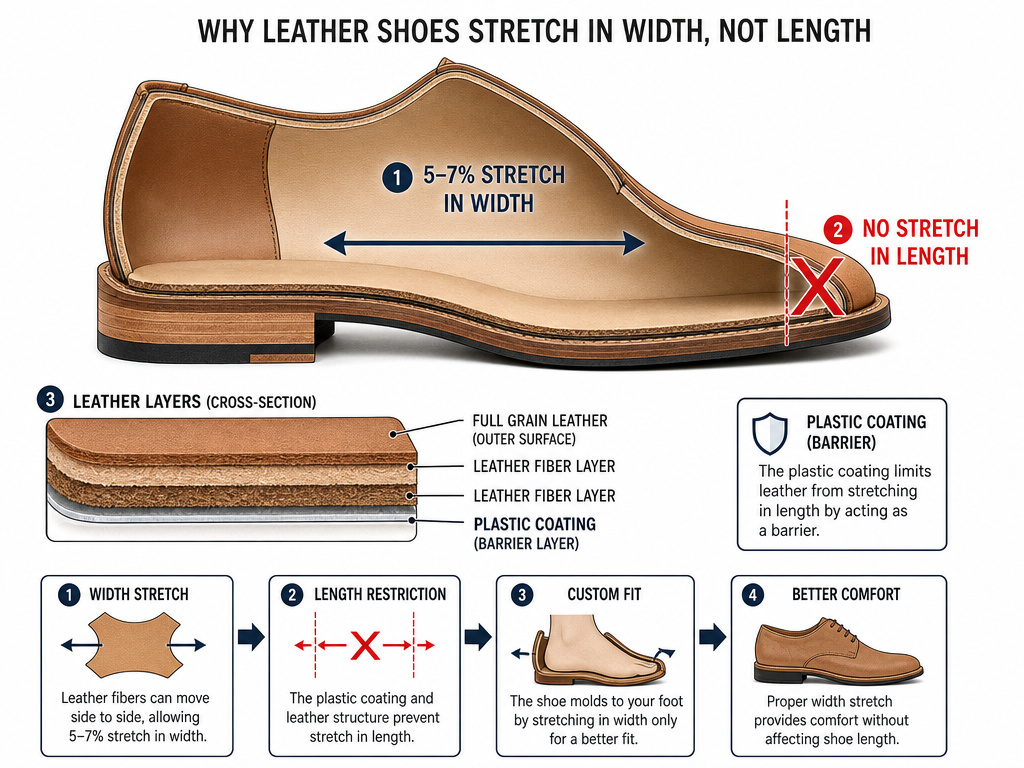
Here’s the thing. Sometimes, a shoe can’t be softened enough because the problem is fit. Leather can be coaxed to stretch in width by about 5–7%.It will never, ever stretch in length.
If your toes are jammed against the front of the shoe, you need a different size. Trying to “break in” a shoe that’s too short will only deform the toe box and cause foot problems. For minor width issues, a professional shoe stretching service with calibrated equipment is safer than home remedies.
Similarly, if the stiffness is from a plastic coating (common on patent leather or some cheap corrected-grain leather), no amount of conditioner will penetrate. The barrier is on the outside. Your only option is very gentle, mechanical flexing.
Storing for Suppleness
Your work isn’t done once the shoes are soft. Storage determines whether they stay that way. An environment with 50–60% relative humidity is ideal. Too dry, and the leather loses moisture and becomes brittle. Too damp, and you invite mold.
Store leather shoes in a cool, dark place. Use breathable cloth bags, never plastic, which traps moisture and causes mildew. Cedar shoe trees are the best investment you can make, they absorb moisture, maintain shape, and keep the leather gently tensioned so it doesn’t dry into a crumpled state.
Avoid direct sunlight, radiators, and hot cars. Think of leather like wood. Stable, moderate conditions keep it happy for decades.
Frequently Asked Questions
Can I use Vaseline to soften leather shoes?
No. Vaseline (petroleum jelly) is a petroleum byproduct that does not absorb into leather. It sits on the surface, attracts dirt, and can degrade some leather finishes and stitching over time. It will make a greasy mess and block proper conditioners from ever penetrating.
How long does it take to soften leather shoes?
With the conditioner method, you can achieve noticeable improvement in 24-48 hours. Full break-in, where the shoe conforms perfectly to your foot, typically takes 1-2 weeks of intermittent wear following the conditioning. Rushing this process risks damage.
Will conditioner darken my light-colored leather shoes?
Some conditioners, especially oil-based ones like mink oil, will darken leather permanently. Water-based conditioners like Bickmore Bick 4 are formulated to minimize darkening. Always test any product on a small, hidden area (like inside the tongue) first and let it dry fully to see the true color change.
Can I soften suede or nubuck shoes this way?
No. Suede and nubuck have a raised nap and require completely different care. Use a conditioner specifically made for suede/nubuck, applied with a soft brush. The methods for smooth leather will mat and ruin the nap.
Is it okay to wear new leather shoes in the rain to soften them?
This is one of the worst things you can do. As the Nikwax research shows, water leaches out the very tanning agents and lubricants that keep leather supple. While the shoe may feel softer while wet, it will dry stiffer and more prone to cracking. Always rely on conditioner, not weather.
Before You Go
One rule most guides skip: if a pair of leather shoes has been left bone-dry in an attic for years, test their structural integrity before you invest time in conditioning. Gently flex the upper. If you hear a cracking sound or see white lines appear, the leather fibers have already started to break. Conditioner can help, but it can’t reverse advanced dryness decay.
The real secret is patience. Apply thin coats.Wait. Flex gently. Wear for short periods. This isn’t about forcing leather to obey; it’s about collaborating with a natural material. Do that, and your shoes will soften, mold to your feet, and last for decades. Try to win a fight against them, and you’ll end up with a cracked, uncomfortable loss.
