
Card Holder vs Wallet | The Critical 3-Factor Pocket Test
This post contains affiliate links. As an Amazon Associate, we earn from qualifying purchases.
Choosing between a card holder vs wallet comes down to three things: capacity (how many cards you carry daily), closure (whether you need a flap or zip to secure contents), and pocket profile (the exact thickness and shape that disappears in your front or back pocket). A card holder is a slim sleeve, often with a quick-access mechanism, for 4-8 cards. A wallet adds a folding enclosure, a flap, bifold, or zip, to organize more cards, cash, and sometimes coins.
That capacity number is the hinge. Cross the line from 8 to 10 daily-carry items, and a sleeve turns into a overstuffed envelope. The mechanism you pick to manage that load, a simple slot, a metal ejector, a folding flap, or a full zip, dictates everything else: the materials that can support it, the pocket it fits, and how long it lasts before stretching out of shape.
What follows: a three-point checklist to diagnose your own carry, a material breakdown that separates marketing from mechanics, and the one pocket test that proves your choice before you buy.
Key Takeaways
- The line between card holder and wallet is the closure. No moving parts = card holder. A flap, fold, or zip = wallet.
- Ignore “slim” claims without a loaded thickness spec. A 5mm empty wallet becomes a 12mm brick with 8 cards.
- Leather needs a break-in period; a stiff flap that won’t lie flat on day one usually softens within two weeks of use.
- RFID protection is a binary: it’s either a full-spectrum shield built into the material (like RFID Data Armor) or it’s not there. “RFID-safe” labels are meaningless.
- For front-pocket carry, vertical bifolds (like the COLDFIRE Flex One) and card protectors (like Secrid) create a smaller, more stable footprint than traditional horizontal billfolds.
The Core Functional Difference: A 3-Point Checklist
Let’s be clear about this. The difference isn’t about style; it’s about engineering for a specific volume of stuff. A card holder is a container. A wallet is a system with a closure. You can diagnose which you need with three questions.
First, count your daily carry. Not your “sometimes” cards, the ones you use weekly. If the number is 8 or fewer, a card holder works. At 9 or 10, you’re in a gray zone. Over 10, you almost certainly need the organization of a wallet with multiple compartments. An overstuffed card holder is a mess; cards bind, edges catch, and you fight it every time you need your ID.
Second, how do you carry cash? A single folded bill can slip behind cards in a holder. If you regularly carry multiple bills or receipts, the built-in bill pocket of a bifold or the zip compartment of a travel wallet is essential. The leather billfold exists for this reason.
Third, where does it live? Front pocket carry demands a slim, hard-edged profile that won’t bulge. Many modern minimalist wallets are built for this. Back pocket or jacket carry allows for a slightly thicker, traditional bifold shape.
A card holder manages access. A wallet manages containment. The first is a tool for retrieval; the second is a system for organization under motion.
If your answers point to a wallet, the next choice is which wallet types fit your habits. That’s where the real split happens.
| Your Daily Carry | Leans Toward | Why | Risk If You Choose Wrong |
|---|---|---|---|
| ≤ 8 cards, cash rarely | Card Holder | Minimal bulk, fastest access. | Cards spill if overfilled; no cash organization. |
| 8–12 cards, cash sometimes | Slim Bifold / Card Protector | Balanced organization while keeping profile slim. | Can feel bulky in front pocket; may stretch over time. |
| 12+ cards, cash & receipts regular | Traditional Bifold / Travel Wallet | Maximum organization, dedicated compartments. | Too thick for front pocket; “wallet bulge” in back pocket. |
Material Reality Check: Thickness Isn’t Just Leather
Here’s the thing. A wallet’s thickness on a product page is almost always the empty measurement. The number that matters is the loaded thickness, how fat it gets with your stuff inside. This is where material science kicks marketing out the door.
Traditional full-grain leather stretches. It’s a feature, not a bug; it molds to your cards. But over years, that stretch can turn a slim leather bifold into a saggy pouch. That’s why brands like COLDFIRE use a Carbitex carbon fiber layer laminated to leather. The carbon fiber doesn’t stretch. The wallet’s profile on day one is its profile on year five. The leather (often K-Leather, kangaroo hide) stays supple for the feel.
For a card holder, the choice is often between full leather and a metal/composite chassis. The Ekster Cardholder Pro uses recycled 6061 aluminum for its skeleton. That gives the click-button card ejection a precise, mechanical action that plastic can’t match. The leather wrap is just a sleeve; the structure is metal.
Where this goes sideways: Picking a wallet based on empty thickness alone. A 5mm empty wallet that loads to 15mm is a brick. A 8mm wallet that loads to 10mm is engineered.
Vachetta leather, used by Ekster, starts stiff. A new wallet’s flap might not lie perfectly flat. That’s normal. The leather needs about two weeks of daily handling to soften and conform. Don’t force it. The patina, the darkening from skin oils and light, is the record of that break-in. If you want zero break-in, look for pre-finished or lined leathers.
The Pocket Test: Front vs. Back vs. Jacket
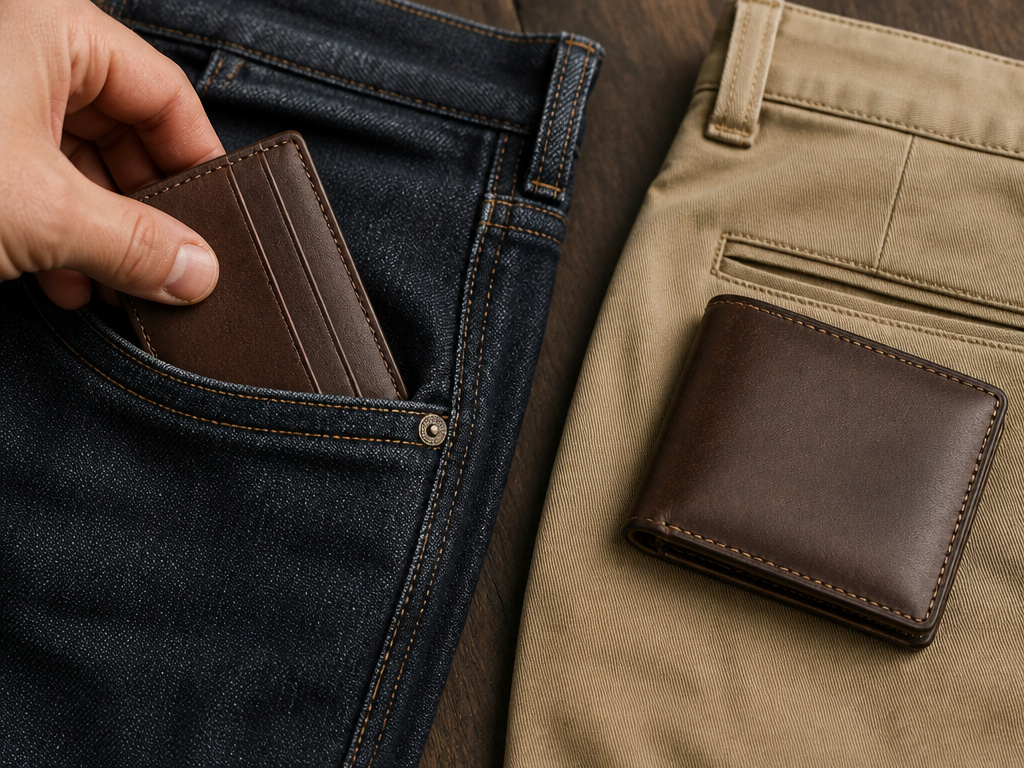 The proof is in the pocket. A wallet that works in theory but bulges in practice is a failure. This is a sensory check, you have to feel it.
For front pocket carry, the goal is to forget it’s there. This favors vertical designs. A vertical bifold, like the COLDFIRE Flex One, aligns with your thigh and creates less of a visible block than a wide horizontal one. Card protectors like the Secrid Miniwallet also excel here; the aluminum casing is slim and the cards fan out without removing the wallet. The benefits of a minimalist wallet are most apparent in this position.
Back pocket carry is more forgiving on thickness but risks sitting on a hard object. A traditional horizontal bifold spreads the pressure. Look for rounded edges and a leather that will soften, not crack, under pressure. This is where a well-made leather card case can also work if you’re a true minimalist.
Jacket or bag carry opens up the most options. Here, a dedicated travel wallet with a zip, like the COLDFIRE Navigator, makes sense. It’s too thick for a pants pocket but perfect for keeping passports, tickets, and foreign currency together. The closure is everything; a zip is secure, a flap is fast, a slip pocket is a gamble.
My rule of thumb? Before you buy anything, take your current stack of cards and cash, measure its thickness with a caliper (or a careful eye), and add 3-4mm for the wallet’s own structure. That’s your realistic loaded thickness. Now put a stack of books or your phone in your pocket to that same depth. Walk around. Sit down. That’s your answer.
Mechanism Deep Dive: Ejectors, Flaps, and Zips
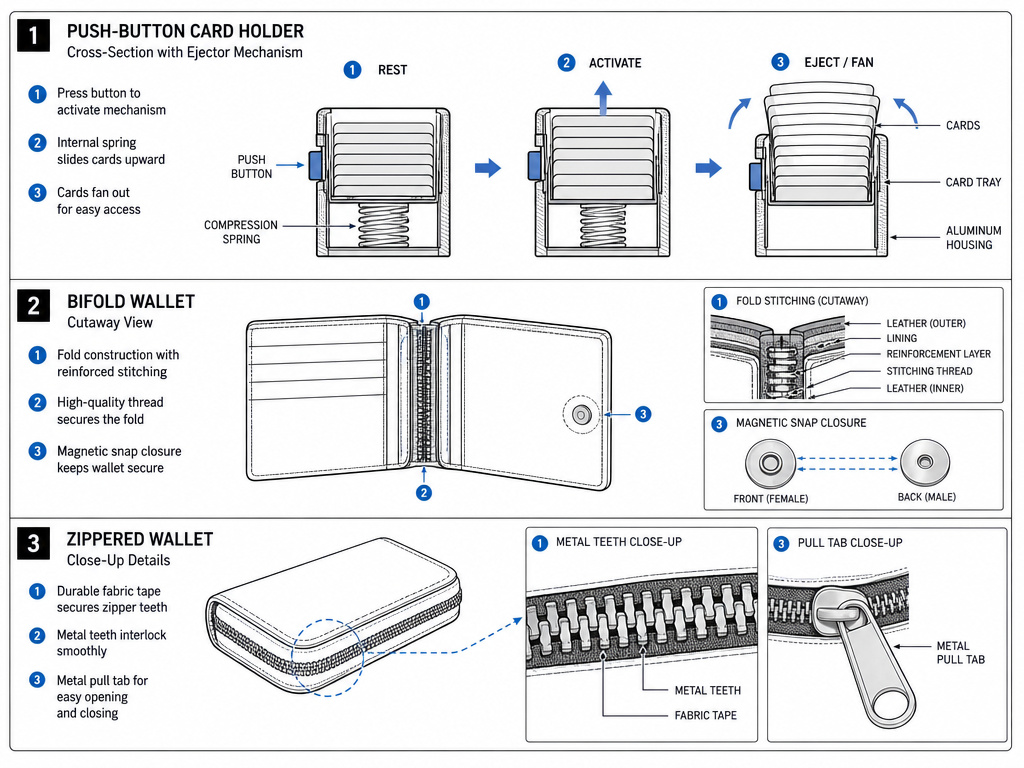 The mechanism is the wallet’s engine. It’s what you interact with every time you pay. There are three common types, and each has a failure mode.
Push-Button Ejectors (Ekster, some Secrid models): A metal button fans cards out. The upside is one-handed, blind access. The downside is mechanism complexity. It’s a moving part in an otherwise static object. Dirt and pocket lint are the enemies. The feel is a crisp, metallic snick when it works. A gritty, hesitant push means it needs cleaning.
Folding Flaps & Bifolds: The classic. Its reliability is in its simplicity, no moving parts beyond the fold. The failure point is the stitch line at the fold and the closure (snap, magnet, or friction). A snap will eventually wear through the leather it’s set into. A magnetic closure can demagnetize or interfere with hotel key cards. The bifold vs trifold debate usually centers on how many compartments you need versus how slim you want the final fold to be.
Zip Enclosures: The most secure, the bulkiest. A full-zip wallet like a travel model is a vault. The zipper itself is the wear item. A cheap plastic coil zip will fail long before the leather. Look for metal teeth or high-quality molded plastic. The tungsten pull on the COLDFIRE Navigator isn’t just for show; it’s weighty enough to operate with gloves on.
Common mistake: Prioritizing a novel mechanism over material quality. A fancy ejector in a cheap plastic chassis will fail. A simple flap in full-grain leather will outlive it.
When you’re choosing a wallet, operate the mechanism dozens of times in the store or imagine doing so daily for five years. Does it feel robust or fragile? That feeling is usually right.
The Verdict: Which Should You Choose?
So, card holder or wallet? It’s not a style preference. It’s a logistics decision. Let me share what I’ve learned from testing both.
If your life fits in 8 cards and you live in jeans, get a card holder. The best leather card holders combine a protective material with a smart form factor. The Secrid Miniwallet is a standout for its genius card-protector core. The Ekster Cardholder Pro is for the person who values a mechanical, satisfying action above all else.
If you carry 8-12 items (cards, cash, a receipt), you need a slim wallet. This is the sweet spot for modern design. Look at the COLDFIRE Flex One or a Victorinox Altius Secrid. These are slim functional wallets that borrow the best from both categories.
If you carry more, or if organization is paramount, you need a true wallet. A full bifold or a dedicated travel wallet. Your choice in wallet leather now matters most, as the structure will be under more stress. This is where traditional craftsmanship pays off.
One final, non-negotiable point: RFID. If you want it, it must be built-in, full-spectrum shielding like RFID Data Armor. A removable “RFID blocking card” is a placebo that takes up a slot. A wallet that claims “RFID safe” without naming the standard or technology is likely not blocking anything. Your cards’ security is binary, either the signal is blocked or it isn’t.
Frequently Asked Questions
Is a card holder better than a wallet?
Card holder isn’t “better,” it’s more specialized. It’s better only if your daily carry is 8 or fewer cards and you prioritize a slim front-pocket profile above all else. For most people carrying cash, multiple IDs, and receipts, the organization of a wallet is better.
What is the disadvantage of a card holder?
The main disadvantages are limited capacity and poor cash organization. An overstuffed card holder is difficult to use, and cash must be folded and tucked loosely behind cards, where it can easily fall out. It also offers less physical protection for your cards than a wrapped bifold.
Can a card holder hold cash?
Yes, but awkwardly. You can fold bills once or twice and slide them behind the card stack. This works for one or two bills in a pinch, but it’s not secure or organized. If you regularly carry cash, a wallet with a dedicated bill compartment is a wiser choice.
What is the point of a card holder?
The point is minimalism and speed. A card holder reduces bulk to the absolute minimum required to transport your essential cards. Many designs, like those with push-button ejectors, allow for one-handed, blind access to your cards, useful when you’re holding something else.
Are metal card holders bad for your cards?
They can be. Cheap metal holders with rough interior edges or tight tolerances can scratch the magnetic stripes and chip contacts on your cards over time. A metal holder made from 6061 aluminum, like the Ekster, has smoothed, rounded interior channels specifically to prevent this. The risk is low with a well-made product.
Before You Go
Skip the “card holder vs wallet” debate and start with the pocket test. Assemble your actual daily carry, measure its stack, and see which pocket it fits. The right choice will feel obvious.
If you’re still torn, buy the simpler, less expensive option first. It’s easier to upgrade from a card holder to a wallet after learning your habits than to downsize from a bulky bifold you’ve come to resent. The goal isn’t the perfect choice on day one. It’s the choice that gets out of your way and lets you forget about it. That’s the sign you’ve picked right.
