
What is PVC Leather? Its Composition, Lifespan & Standards
This post contains affiliate links. As an Amazon Associate, we earn from qualifying purchases.
This post contains affiliate links. As an Amazon Associate, we earn from qualifying purchases.
PVC leather is a synthetic material made by coating a fabric base with a layer of polyvinyl chloride (PVC) plastic, then embossing it to mimic real leather. It’s cheap, waterproof, and durable for 2 to 5 years in typical use before the plastic coating can crack or peel.
That lifespan isn’t a guess. It’s the outcome documented alongside the new mandatory Chinese national standard, GB/T 8948-2025, which now requires specific tests for color bleeding and cold cracking that earlier versions didn’t cover. A sofa or car seat made with PVC leather isn’t just a style choice; it’s a product with a chemical shelf life and a predictable failure mode.
This guide walks through what PVC leather actually is, how it’s made, and the new standards that define its minimum performance. By the end, you’ll be able to read a product spec and know whether you’re buying a two-year disposable item or something built to last.
Key Takeaways
- PVC leather is a plastic (PVC resin) laminated onto a fabric backing, not a leather product.
- Its main advantages are low cost, high water resistance, and ease of mass production.
- Under normal use, expect a functional lifespan of 2 to 5 years before the plasticizer-depleted coating may crack or peel.
- The new GB/T 8948-2025 standard mandates tests for color migration and cold resistance, classifying some products for use down to -10°C.
- Compared to PU leather, PVC is generally stiffer, less breathable, and contains more concerning plasticizers, but it’s also cheaper.
What is PVC Leather? A Plastic-Coated Fabric
Let’s be clear about one thing: PVC leather contains no leather. The name is a marketing convenience, like calling a sugar-free drink “juice.” The full name is polyvinyl chloride artificial leather. It’s a synthetic material built by applying a plastic layer to a textile base.
The core material is polyvinyl chloride (PVC) resin, the same plastic used in pipes and shower curtains. This resin is mixed with liquid plasticizers, often phthalates, to make it flexible, along with stabilizers and pigments. This cocktail is turned into a paste called a plastisol, which is then spread onto a fabric base like polyester or non-woven material. An embossing roller stamps a leather-like grain onto the surface before it cools.
The result is a uniform, consistent sheet. That predictability is its strength for manufacturers and its visual weakness for buyers seeking character. You’ll never see the natural grain variation of a cowhide on a PVC roll because every square inch comes from the same machine stamp.
How is PVC Leather Made?
The production process is a marvel of industrial efficiency, which explains its low cost. It’s not craft; it’s chemistry and engineering scaled up.
The standard manufacturing process for PVC artificial leather involves coating a fabric substrate with a PVC plastisol, followed by gelling, embossing, and finishing, as outlined in industry production guides.
It starts with the plastisol. PVC resin powder is mixed with plasticizers, heat stabilizers, and pigments in a large kneader. This creates a viscous, dough-like paste. For softer items like car seat upholstery, a chemical foaming agent is added to this mix. When heated later, this agent creates a spongy middle layer for cushioning.
The base fabric, usually a knit, woven, or non-woven material, is fed through a coating machine. The plastisol is applied onto this fabric using a doctor blade or a roller, ensuring an even thickness. This sandwich then travels through a heated tunnel, a process called gelation or fusion, which melts the PVC particles into a continuous, flexible film bonded to the fabric.
Next, the still-warm sheet passes under an embossing cylinder. This metal roller is engraved with a pattern, pebbled grain, ostrich, linen, and it presses that texture permanently into the soft PVC surface. Finally, the material is cooled, wound onto giant rolls, and sometimes given a final topcoat for gloss or matte effects.
The whole sequence takes minutes and produces kilometers of material. This scalability is why you find PVC on budget furniture, entry-level car interiors, and low-cost bags.
The Layers and Lifespan of PVC Leather
A cross-section of PVC leather reveals its simple, laminated anatomy. This structure dictates both its performance and its eventual failure.
| Layer | Composition | Primary Function | Failure Mode |
|---|---|---|---|
| Topcoat (Optional) | Urethane or acrylic | Adds gloss/matte finish, improves scuff resistance | Wears thin with abrasion, revealing the layer below. |
| PVC Coating | PVC resin, plasticizers (phthalates), pigments, stabilizers | Provides leather-like appearance, color, and water resistance | Plasticizers migrate out over 2-5 years; coating becomes brittle and can crack or peel. |
| Foam Layer (Optional) | PVC with chemical blowing agents | Adds cushioning and thickness for items like car seats | Can collapse with prolonged compression, losing loft. |
| Fabric Substrate | Polyester, cotton, or non-woven fabric | Provides tensile strength and tear resistance | Generally durable; failure usually starts in the coating above. |
The weakest link is the PVC coating itself. The plasticizers that keep it supple are not chemically bonded to the PVC resin. They slowly evaporate or migrate out of the material, a process accelerated by heat and sunlight. An office chair in a sunny spot might show stiffness in 18 months; a car interior might last four years.
When the plasticizer content drops below a certain level, the PVC coating loses flexibility. It can’t handle repeated bending and stress. That’s when you see the characteristic fine cracks, followed by sections of the plastic film peeling away from the fabric base underneath. Once peeling starts, there’s no repair that restores the original integrity.
The Mandatory 2025 Standards (GB/T 8948-2025)
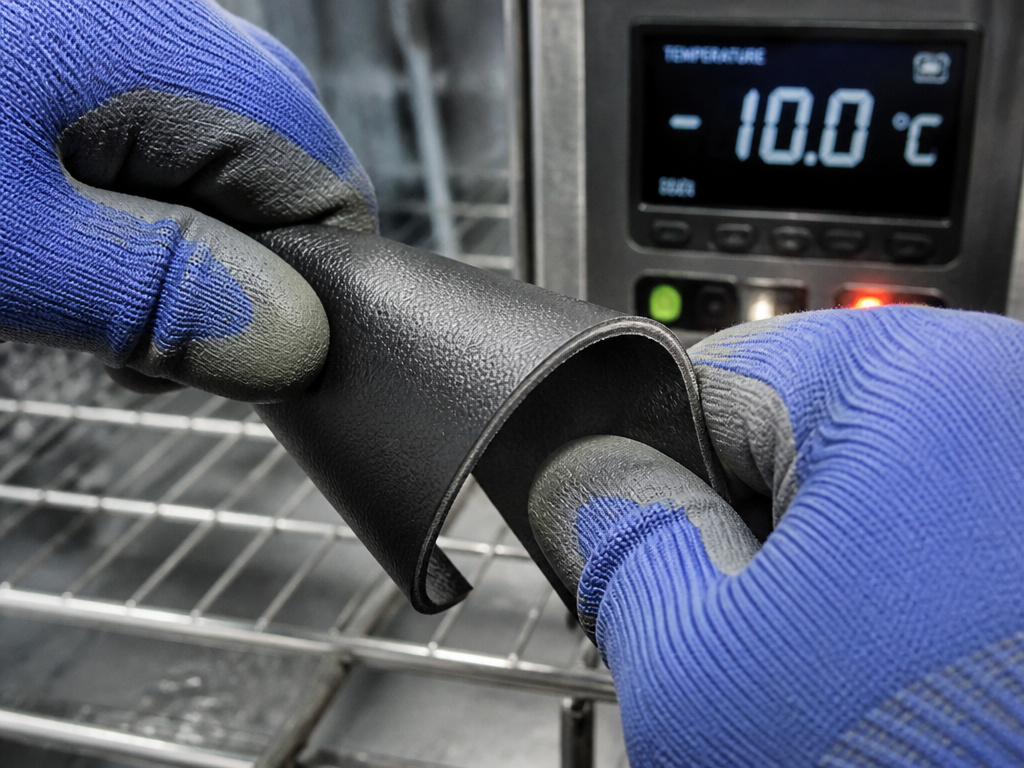
If you’re buying a product made with PVC leather today, especially from a major manufacturer, its performance is likely governed by a updated set of rules. The Chinese national standard GB/T 8948-2025 replaced the 2008 version and came into effect in 2025. For a global supply chain, this standard is a de facto benchmark.
It’s a mandatory standard, not a suggestion. It introduces several key tests that address real-world failures older specs ignored.
Color Migration: This is a newly mandatory inspection. It tests whether the dyes in the PVC will bleed onto adjacent materials, like a black car seat staining light-colored clothing, under hot, humid conditions. The test runs at 50°C and 95% relative humidity for 24 hours. To pass, the staining must be rated at level 4 or higher on a grey scale. This directly prevents “color bleeding” accidents in composite products like sofas and car interiors.
Cold Resistance: The standard now formally classifies products as “cold-resistant” or “ordinary.” A cold-resistant PVC leather must show no cracks when bent at -10°C. An ordinary product has no such requirement, which means it will likely become stiff and prone to cracking in freezing temperatures. This is critical for automotive interiors in cold climates or outdoor furniture.
Heat Aging Resistance: To simulate long-term exposure to heat (like a car dashboard in summer), a sample is baked at 100°C for 24 hours. After this, its color change must be minimal, and the surface must show no cracks. Cold-resistant products then undergo an additional bend test at -5°C.
These aren’t marketing terms. They are verification of performance against measurable, repeatable tests. A manufacturer claiming compliance with GB/T 8948-2025 is giving you a data sheet, not a sales pitch.
PVC Leather vs. PU Leather and Other Alternatives
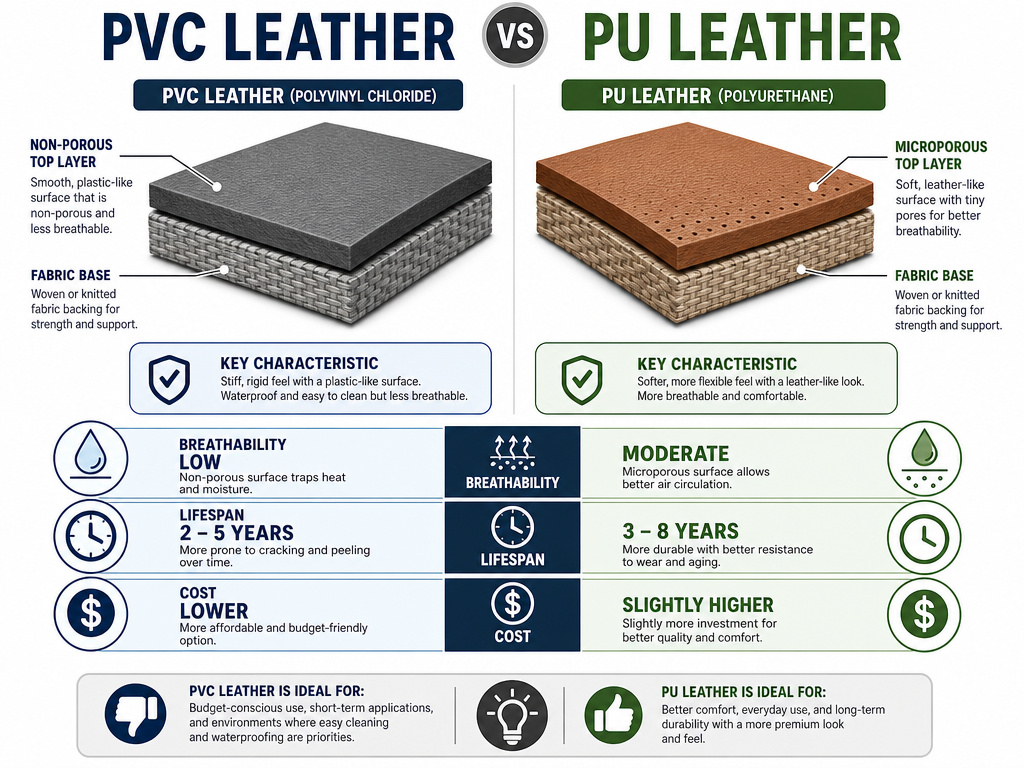
When you’re looking at synthetic materials, the choice often narrows to PVC or its more modern cousin, PU leather (polyurethane). Understanding the difference saves you from buyer’s remorse.
PU leather uses a polyurethane coating over a similar fabric base. The chemistry difference is substantial. PU is generally more flexible and breathable than PVC because it can be made with a microporous coating. It also tends to use safer, phthalate-free plasticizers.
Here’s a quick, practical comparison:
| Aspect | PVC Leather | PU Leather |
|---|---|---|
| Base Material | Polyvinyl Chloride (PVC) resin | Polyurethane (PU) resin |
| Hand Feel | Often stiffer, can feel plasticky | Softer, more pliable, closer to real leather drape |
| Breathability | Very low (non-porous coating) | Moderate (can be microporous) |
| Environmental Concern | Higher (often uses phthalates, chlorine-based) | Lower (often phthalate-free, no chlorine) |
| Typical Lifespan | 2-5 years before embrittlement | 3-8 years; more resistant to cracking |
| Cost | Lower | Slightly higher |
So, is vegan leather automatically better? Not necessarily. Both PVC and PU are vegan, they contain no animal products. The ethical question shifts to environmental impact and durability. A PVC bag that peels in two years and sits in a landfill is arguably less ethical than a long-lasting genuine leather item, even if no animals were used.
For truly durable synthetic options, microfiber leather is a step up. It uses a ultra-fine polyester fiber base that mimics the texture of suede, often with a more durable polyurethane topcoat. It’s more expensive, but it resists peeling far better.
Common Uses and How to Spot PVC Leather
PVC leather is the economic choice for manufacturers where low cost, water resistance, and high volume are priorities.
You’ll find it in: * Budget Furniture: Office chairs, hotel room furniture, and low-cost sofas. * Automotive Interiors: Entry-level car seat covers, door panel inserts, and dashboards. * Low-Cost Goods: Inexpensive bags, wallets, shoes (especially rain boots), and protective gear covers. * Commercial Spaces: Hospital waiting room chairs, school auditorium seating, and stadium seats where cleaning with harsh chemicals is frequent.
Spotting it is straightforward once you know what to check. 1. Check the Label: Look for “PVC,” “Polyvinyl Chloride,” or “Vinyl.” Legitimate manufacturers must list the material. 2. Feel and Fold: It often feels uniformly smooth with a slight plastic coolness. Bend a hidden corner sharply. PVC tends to show a pronounced white stress line or fine cracks along the fold line almost immediately; real leather or higher-quality faux leather will simply wrinkle. 3. Examine the Edge: Look at a cut edge. PVC leather will show a perfect, sealed plastic edge. Real leather has fibrous, rough edges. 4. The Smell Test: Give it a sniff. PVC has a distinct, chemical plastic or vinyl smell. Real leather has an organic, earthy scent.
Caring for (and Managing Expectations with) PVC Leather
Caring for PVC leather is simple, mostly because there’s so little you can actually do to extend its life. The degradation is chemical, not superficial.
Clean it with a damp cloth and a mild, non-abrasive detergent. Avoid harsh solvents, alcohol, or oil-based cleaners, as they can accelerate plasticizer loss or cloud the surface.
Never use a leather conditioner or oil. This is the most common mistake. These products are designed to feed the protein fibers in real leather. Applying them to plastic is like watering a plastic plant, it does nothing for the material and can leave a greasy residue that attracts dirt and degrades any adhesives underneath.
The best care is preventative: keep it out of direct sunlight and away from intense heat sources like radiators. Heat dramatically speeds up the evaporation of plasticizers.
Manage your expectations. You are maintaining a plastic product with a finite functional lifespan. When the coating eventually cracks or peels, it cannot be restored. This inherent limitation is a key reason many move to PU leather or other synthetic leather alternative materials for items they hope to keep longer.
Frequently Asked Questions
Is PVC leather durable?
It has moderate durability. It’s highly resistant to water, stains, and abrasion initially. However, the plasticizers that keep it flexible evaporate over 2 to 5 years of normal use. After that, the material becomes brittle and prone to cracking and leather peeling, which is not repairable.
Is PVC leather vegan?
Yes, by definition. It contains no animal-derived materials. It is a 100% synthetic product made from plastic and fabric. However, the environmental impact of its production and its lack of biodegradability are significant concerns for many seeking ethical materials.
Is PVC leather toxic?
The PVC material itself is stable, but the plasticizers used to soften it, often phthalates, are a concern. These chemicals can migrate out of the product and are linked to potential health risks. Modern regulations like REACH and RoHS restrict certain phthalates, and newer formulations use alternative plasticizers. The production process of PVC can also generate harmful dioxins.
What’s the difference between PVC and pleather?
“Pleather” is a portmanteau of “plastic leather,” a casual term covering all plastic-based leather imitations, including both PVC and PU leather. PVC is a specific type of pleather using polyvinyl chloride resin. So, all PVC is pleather, but not all pleather (like PU) is PVC.
Can PVC leather be recycled?
Recycling is challenging. It’s a composite of plastic and fabric, which are difficult to separate. Most municipal recycling streams do not accept it, so it typically ends up in landfills where it does not biodegrade. Some specialized industrial programs exist for PVC waste.
Before You Go
PVC leather is a tool, not an heirloom. Its value is in providing a specific look and function at a very low cost for a predictable, if limited, period.
If your goal is a cheap, waterproof cover for a chair you’ll replace in a few years, PVC does the job. If you’re looking for a material that ages gracefully, develops character, and can last decades, this isn’t it. The new GB/T 8948-2025 standards at least let you verify the minimum performance you’re buying, check if the product is specified as “cold-resistant” or passes the color migration test.
For a longer-lasting synthetic option, your next stop should be a comparison of PU leather and microfiber leather. Both represent a step up in durability, breathability, and often, environmental profile. And if longevity is the ultimate goal, sometimes the calculus leads you back to well-maintained, vegetable-tanned real leather after all. The leather will tell you what it needs, but first, you have to choose a full-grain or top-grain leather.
