
What is Vegan Leather? Unveiling Its Short Lifespan Truth
This post contains affiliate links. As an Amazon Associate, we earn from qualifying purchases.
This post contains affiliate links. As an Amazon Associate, we earn from qualifying purchases.
Vegan leather is a marketing term for a wide range of synthetic and plant-based materials designed to mimic animal leather, primarily made from polyurethane or polyvinyl chloride plastic coatings. These plastics are bonded to a fabric backing and cannot be repaired once the surface coating cracks. Many plant-based versions use the same plastic binders, which is why products like mushroom or apple leather bags have reported lifespans as short as two years and end up in landfills.
The term sounds modern and ethical. It promises a material that spares animals and the planet. That promise is where the confusion starts. I’ll break down the details for you, starting with the fact that most of what’s sold as vegan leather is a petroleum-derived plastic film. The leather-like feel is just a convincing embossed finish over a fabric core, and the performance is fundamentally different from a natural hide.
Let me share what I’ve learned. The choice between real and fake leather involves a trade-off between two different environmental burdens and two very different product life cycles. Understand leather better to make confident choices.
Key Takeaways
- Most vegan leather is made from polyurethane (PU) or polyvinyl chloride (PVC), both petroleum-based plastics bonded to a polyester or cotton fabric backing.
- Plant-based “vegan leathers” like Piñatex or cactus leather are often just thin layers of plant fibers reinforced with plastic binders, making them non-compostable and prone to the same cracking failures as purely synthetic versions.
- Unlike genuine leather, which can be conditioned and repaired, vegan leather fails when its surface coating cracks or peels and is almost always impossible to fix, leading to a much shorter usable lifespan, sometimes under two years.
- The ISO definition of leather specifically requires a preserved animal hide; “vegan leather” is a marketing contradiction because, by definition, leather is an animal product.
- If your goal is longevity and lower lifetime waste, a well-made, full-grain leather item you maintain will outlast multiple vegan leather replacements, despite the initial environmental cost of cattle farming and tanning.
The Core Materials: PU, PVC, and Plants
Forget the fancy names on the tag. At the bench, you’re looking at three basic constructions. The first two are purely synthetic. The third pretends it isn’t.
Polyurethane (PU) and Polyvinyl Chloride (PVC) are plastic polymers applied as liquid coatings to a woven fabric substrate, usually polyester or cotton. The coating is embossed with a leather-like grain pattern while curing, creating a waterproof, uniform, and colorfast surface that lacks the breathability and fibrous structure of tanned animal hide.
Polyurethane is the current default for most furniture, accessories, and mid-range fashion items. It’s softer and more pliable than PVC, and the manufacturing process is less directly toxic. Polyvinyl chloride, the old “pleather,” is stiffer and cheaper. Its production and eventual breakdown release dioxins and rely on plasticizers like phthalates. You’ll still find it in ultra-cheap goods and some automotive interiors.
Then there are the plant-based heroes: pineapple leaves, apple pulp, mushroom roots, cactus, grapes. These are fascinating materials. But here’s the practical takeaway: raw plant fibers are too weak for daily wear. A shoe made from pure pineapple fibers would disintegrate in a week. So manufacturers layer those fibers onto a plastic polyurethane binder or a polyester mesh backing. The final product is often 80% plastic, 20% plant.
That mushroom leather bag isn’t a mushroom. It’s a mushroom facade glued to a plastic sheet. This isn’t me being cynical; it’s the material science required to make something that can handle being a bag. This construction is why these items cannot be composted. You’re throwing a plastic laminate into the bin, with a decorative plant layer on top. The Wikipedia entry on vegan leather categorizes these accurately as subsets of artificial leather.
The difference between a pure PU jacket and a cactus leather jacket is marketing, not mechanics. Both will fail the same way.
Why the Surface Cracking is a Death Sentence
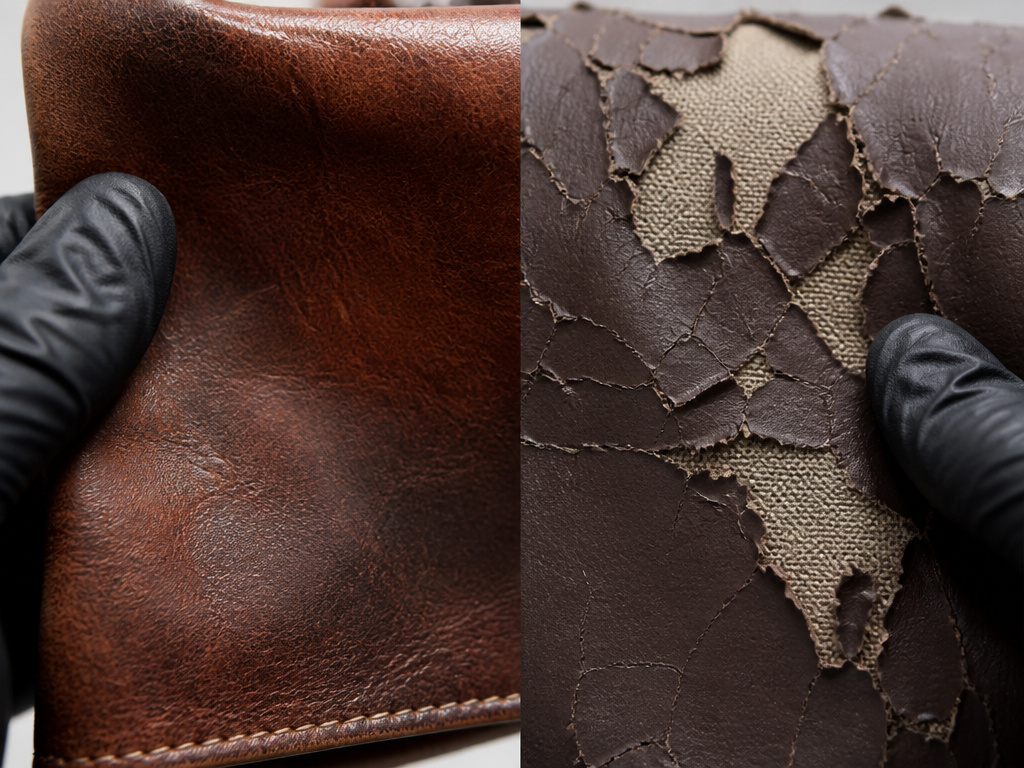
Genuine leather ages. Vegan leather deteriorates. This is the single most important functional distinction.
A full-grain leather belt will develop a patina, a rich, darkening sheen from oils, light, and use. The leather itself, the fibrous collagen network, remains intact for decades. You can scratch it, and the mark becomes part of its story. You can condition it with a mineral oil to replace lost fats.
Now, feel a piece of polyurethane leather. That smooth, cool surface is a monolithic plastic film. There’s no fibrous structure beneath to absorb conditioner or distribute stress. When that film is flexed thousands of times, on a shoe crease, a bag strap, a jacket elbow, it fatigues. Micro-cracks form. They connect. Then the coating peels up in a sheet.
Once it peels, the fabric backing is exposed. Dirt gets in. The peel spreads. There is no fix. Leather glue won’t bond to the slick plastic back of the coating. A patch will just highlight the damage. You can’t sand and refinish it like you can with a worn leather edge. The item is dead.
This peeling is a direct source of microplastic pollution. Those plastic flakes wash off and enter the environment.I’ve seen this on “high-quality” vegan leather goods that are barely two years old. The user expects a decade. They get a landfill trip.
The Green Trap: Debunking Sustainability Claims
“Vegan” and “sustainable” are not synonyms. One describes an ingredient list, no animal products. The other describes a product’s total environmental impact from creation to disposal. Conflating the two is the heart of the greenwashing problem.
Let’s be clear about one thing. A polyurethane leather handbag is a fossil fuel product. Its production involves extracting oil, refining it, and synthesizing polymers in a chemical plant. At end-of-life, it will sit in a landfill for centuries, slowly fragmenting.
Now, compare that to the burden of real leather. Yes, cattle farming produces methane and uses land. Chrome tanning, the most common method, uses toxic chemicals and creates polluted wastewater. It’s a heavy industrial process. The counter-argument is that leather is a co-product of the meat industry; the hide is upcycled from an existing system. A full life-cycle analysis is complex, but groups like Cascale, which developed the Higg Index, note that the long lifespan of a durable leather good can lower its per-year impact significantly.
The plant-based leathers try to split the difference. They aim to reduce plastic and animal use. But the Trends in Biotechnology engineered materials study highlights the challenge: creating true, high-performance leather-like materials without petrochemicals is still a major biotechnological hurdle. Most commercial “plant leather” is just a green veneer on a plastic core, inheriting the worst disposal fate of plastic while adding agricultural inputs. A brand might trumpet its “apple leather,” but if that bag fails and is thrown away in two years, it’s less sustainable than a leather bag used for twenty.
Sustainability is measured in years of use, not words on a tag.
Vegan Leather vs. Real Leather: A Performance Breakdown
| Aspect | Genuine Leather (Full-Grain) | Vegan Leather (PU/Plant-based) |
|---|---|---|
| Core Material | Tanned animal hide (collagen fibers) | Plastic polymer coating on fabric |
| Aging | Develops a patina; character deepens | Coating cracks, scuffs, and peels |
| Repairability | High: can be conditioned, patched, re-dyed, re-soled | Very low: peeling coating cannot be adhered |
| Breathability | Naturally porous; wicks moisture | Non-porous plastic film; traps heat/sweat |
| End of Life | Biodegrades over time (if vegetable-tanned) | Landfill plastic; fragments into microplastics |
| Material Feel | Warm, supple, varies with each piece | Consistently cool, uniform, can feel plastic-like |
This table is about matching material to need. If you want a waterproof, wipe-clean surface for a rarely used guest chair, a synthetic leather makes pragmatic sense.Its durability in that static context is fine.
If you’re buying a daily wallet, shoes, or a jacket you hope to wear for a decade, the calculus changes. The plastic will fail at the stress points. The leather will mold to you. This is the core of any honest vegan vs real leather comparison. The leather alternative might be easier to clean initially, but it has a hard expiration date stamped into its chemical structure.
What About the New Alternatives? Mirum, Cork, and Waxed Canvas
The conversation gets more honest when we step away from the term “vegan leather” altogether and look at other durable, non-animal materials.
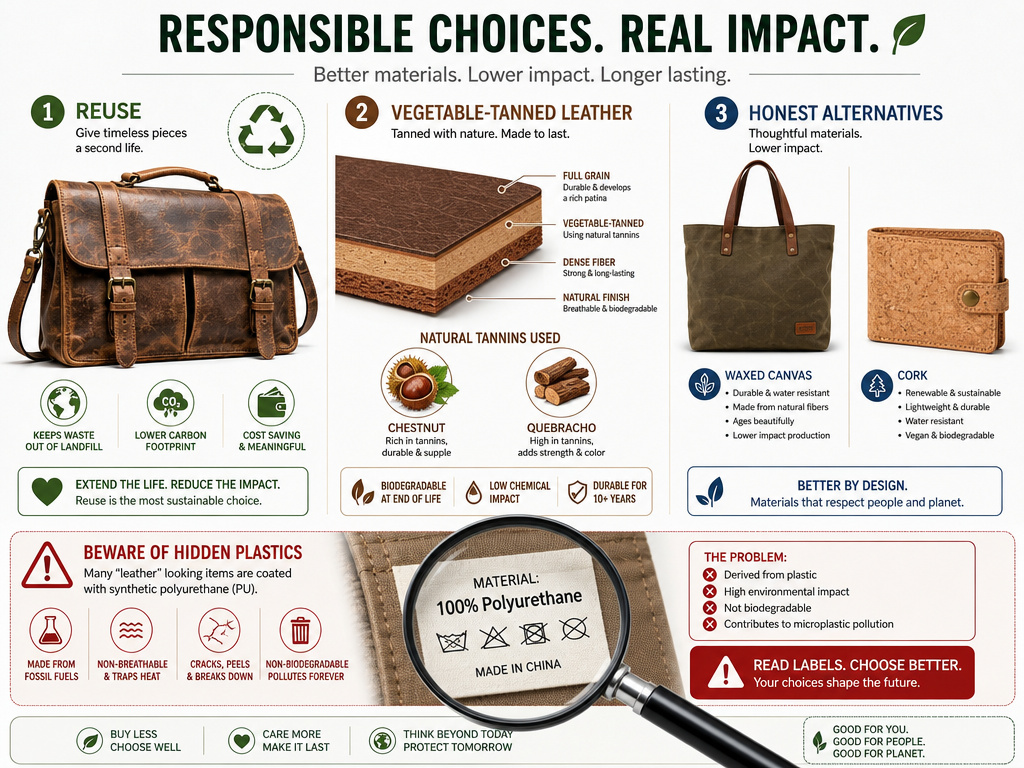
- Mirum (by Natural Fiber Welding): This is one of the few I’m cautiously optimistic about. It’s a composite of natural rubber, plant oils, and minerals, with no plastic binders. It’s fully biodegradable at end-of-life and is being used by brands like Bellroy. It’s still new, and the long-term wear data is limited, but the chemistry is fundamentally different from a PU laminate.
- Cork Leather: A true natural material. Thin sheets of cork oak bark are laminated to a fabric backing, often using a non-toxic adhesive. It’s lightweight, water-resistant, and unique. Its limitation is abrasion resistance; it’s not ideal for high-friction areas like shoe soles.
- Waxed Canvas: My personal favorite underrated alternative. It’s heavyweight cotton impregnated with wax. It’s rugged, waterproof, develops character, and is completely repairable, you can re-wax it, patch it, and stitch it indefinitely. For bags, tool rolls, and outerwear, it’s often a superior choice to both leather and plastic leathers.
These aren’t trying to be leather. They’re being their own excellent materials. That honesty is why they often outperform the faux leather versus vegan debate.
How to Make a Responsible Choice
You have the facts. The choice is yours, but let me frame it with the long view.
First, identify your actual priority. Is it avoiding animal products at any cost? Is it minimizing your lifetime waste? Is it buying something that will last? These goals can conflict. A cheap PU bag satisfies the first, fails the second and third.
If longevity is your goal, consider these paths: 1. Buy Vintage Leather: This is the single most sustainable option. The animal and environmental cost is decades old. You’re giving a durable material a second life. Learn a few simple tests for genuine leather to shop confidently. 2. Buy New, High-Quality Vegetable-Tanned Leather: Support tanneries using natural extracts (like chestnut or quebracho) instead of chrome. The leather ages beautifully and is less toxic to produce. 3. Choose an Honest Alternative: Pick waxed canvas, cork, or a promising plastic-free composite like Mirum. Understand what you’re buying, a fabric, a bark, a rubber composite, not a leather imitation.
For specific items, the best vegan leather bags or vegan leather jackets are those that acknowledge their material limits and are designed for style over decades of hard use. A microfiber leather car interior is a sensible, durable choice for that specific, low-abrasion application.
Ignore the marketing copy. Look at the care label. If it says “100% polyurethane” or “PVC-coated polyester,” you know exactly what you’re getting: a plastic shell on a countdown timer. If it says “apple leather,” ask what the other 70% of the material is.
Frequently Asked Questions
Is vegan leather real leather?
No. According to the International Organization for Standardization (ISO), leather is specifically defined as a tanned animal hide. “Vegan leather” is a marketing term for materials that look and feel similar but are made from plastics or plant-plastic composites. It is, by definition, an artificial leather alternative.
What is vegan leather made of?
Most vegan leather is made from a plastic coating, usually polyurethane (PU) or polyvinyl chloride (PVC), applied to a fabric backing like polyester. Newer “plant-based” versions use materials like pineapple leaves or cactus, but these are almost always laminated or embedded within a plastic binder to provide strength.
Does vegan leather last as long as real leather?
Generally, no. High-quality full-grain leather can last for decades with proper care and can be repaired. Vegan leather’s plastic surface is prone to cracking and peeling, often within 2-5 years of regular use, and cannot be effectively repaired once this happens.
Is vegan leather better for the environment?
It’s complicated. Vegan leather avoids the environmental burdens of animal farming and chrome tanning. However, most vegan leather is a petroleum-based plastic, creating fossil fuel dependence and microplastic pollution at disposal. Plant-based versions with plastic binders share these disposal problems. True sustainability depends more on a product’s total lifespan and end-of-life than its “vegan” label.
Before You Go
One rule I’ve learned from years at the bench: a material’s true cost is revealed in its second life, not its first. A plastic-coated bag has no second life. It’s trash.
If you choose vegan leather for ethical reasons, do it with eyes open. Buy the best vegan leather pants or jacket you can afford, understanding it’s a fashion item with a limited functional timeline. Don’t treat it with leather conditioner; you’re just oiling plastic.
If your goal is to consume less, period, then the most radical choice is often to buy nothing. The next best is to buy something that already exists, or something built to outlive you. That path rarely leads to a petroleum-based plastic, no matter what the tag calls it. The leather, or the honest alternative like waxed canvas, will tell you what it needs. A plastic coating just eventually tells you it’s done.
