
Deerskin vs Cowhide Work Gloves: Key Differences Explained
This post contains affiliate links. As an Amazon Associate, we earn from qualifying purchases.
Deerskin and cowhide gloves serve different masters: deerskin wins on softness, flexibility, and abrasion resistance for high-dexterity tasks, while cowhide dominates in brute-force tear resistance and insulation for heavy-duty work. The choice isn’t about quality, it’s about matching the leather’s molecular structure to the job your hands actually do.
That structural mismatch explains why a perfect motorcycle glove fails on a demolition site, and vice versa. Collagen fibers and glycosaminoglycans arrange differently in each hide, creating distinct physical trade-offs a spec sheet can’t fully capture.
What follows: a breakdown of the collagen science, the three key spec numbers that matter, and where each leather type consistently outperforms the other. By the end, you’ll know whether your next pair should be buttery deerskin or armored cowhide.
Key Takeaways
- Deerskin’s “wavy” collagen fibers and high oil content make it exceptionally soft and abrasion-resistant, perfect for gloves needing feel and flexibility.
- Cowhide’s straight, dense collagen fibers give it nearly double the tear strength of deerskin, making it the default for gloves facing puncture and ripping hazards.
- For cold-weather insulated gloves, cowhide’s thickness is an asset; for deerskin, it’s a liability that kills the dexterity it’s famous for.
- The best deerskin gloves for riding or dress use come from American whitetail or European red deer; the best cowhide work gloves specify “top grain” and Kevlar stitching.
- Pulling any leather glove off by the fingertips stretches the collagen network permanently. Always remove them by the cuff.
The Core Difference: Collagen Structure, Not Just Thickness
Look at a work glove’s thickness rating. That number is a consequence, not a cause. The real divide between deerskin and cowhide lives in the microscopic architecture of their collagen fibers and the glycosaminoglycan (GAG) filaments that bind them.
Deer skin contains large, “wavy” collagen fibres made of small-diameter fibrils, linked by regular arrays of large, uniformly distributed glycosaminoglycan filaments. Cow hide has larger collagen fibrils, diverse GAG distribution, and a higher proportion of tetravalent crosslinks, resulting in straight collagen fibres.
This peer-reviewed finding from a comparative structural analysis explains the glove experience. Those “wavy” deer fibers give under stress and spring back, translating to flexibility. The straight, densely crosslinked cow fibers resist deformation entirely, translating to rigidity and tear resistance.
Here’s how those structures manifest in measurable specs, drawn from the same lab analysis:
| Property | Deerskin | Cowhide | What It Means for Gloves |
|---|---|---|---|
| Average Thickness | ~1.6 mm | ~4.6 mm | Cowhide is inherently bulkier. Deerskin achieves strength without heft. |
| Tensile Strength | 28.3 N/mm² | 29.2 N/mm² | Statistically equal. Both resist pulling apart under steady pressure. |
| Tear Strength | 130.1 N/mm² | 228.9 N/mm² | Cowhide is 75% stronger. It resists ripping from a nick or puncture. |
| Grease/Oil Content | 3.7% | 5.8% | Deerskin still feels supple with less conditioning. Cowhide can feel drier. |
The tear strength number is the sleeper. You can pull on a deerskin glove as hard as you want, it won’t stretch out. But catch it on a sharp screw thread, and that nick runs. Cowhide laughs at the same screw thread, but it won’t mold to your knuckles over time.
Deerskin Gloves: Where They Shine (and Falter)
Deerskin excels in applications where the hand needs to feel, grip, and move without interference. Its high natural oil content means it starts soft and stays supple with minimal maintenance.
Best Fit Uses:
- Motorcycle & Driving Gloves: American whitetail deerskin is the benchmark here. The fiber density provides abrasion resistance a thinner goatskin can’t match, while the natural oils maintain suppleness. A brand like Legendary USA builds its reputation on this specific material.
- Dress & Fashion Gloves: For unlined dress gloves, deerskin is a premier choice. Brands like Chester Jefferies use it for gloves that feel broken-in from the first wear. The breathability is superior to calfskin.
- Fine Work & Craft Gloves: Tasks requiring dexterity with sharp tools, like woodworking or electronics assembly, benefit from deerskin’s tactile feedback. It’s protective without being clumsy.
The Sensory Reality:
A new deerskin glove feels cool and dry to the touch, with a distinct, pebbly grain. After a few hours of wear, it warms and conforms, developing slight creases at the joints that don’t crack. The break-in is measured in days, not weeks.
Where this goes sideways: Using deerskin for insulated winter gloves. The leather’s virtue is thinness and flexibility. Adding a thick thermal lining forces the glove to be bulky, canceling deerskin’s primary advantage and putting you in a clammy, clumsy mitt. That’s a design mismatch.
The Maintenance Truth:
Deerskin’s lower grease content is a plus for care. You condition it once, maybe twice a year. Over-conditioning is a real risk, it can oversoften the leather, making it stretchy and reducing its durability. Collonil Leather Care Milkamazon.com/dp/B0BJFBFZKV?linkCode=osi&th=1&psc=1&tag=leathergenesis-20)** is sufficient.
Cowhide Gloves: The Heavy-Duty Default
When the job involves sharp metal, coarse lumber, abrasive concrete, or sub-freezing temperatures, cowhide is the default for a reason. Its thickness and straight collagen fibers are a built-in armor.
Best Fit Uses:
- Construction & Demolition Work: Handling rebar, cinder blocks, or power tools demands tear resistance. The Klein Tools 60603 cowhide glove, with its dual-layer reinforced palm, is engineered for this.
- Cold-Weather & Insulated Work: Cowhide’s thickness provides inherent windbreaking and insulating properties. Brands like RefrigiWear use split cowhide lined with fiberfill for gloves rated down to -25°F.
- Welding & Heavy Machining: The sparks and sharp edges in these trades require a sacrificial layer. Top-grain cowhide takes the abuse and protects the often-Kevlar-stitched seams beneath.
The Bulk Compromise:
That protection comes at the cost of dexterity. A top-grain cowhide work glove will never feel like a second skin.
Common mistake: Choosing cowhide for a task that requires fine motor skills. User reviews for insulated cowhide models often cite this: “The insulation is so thick on the palm side that I cannot grip the ladders I need to climb.” The glove is doing its job, but it’s the wrong job for the material.
Why “Top Grain” Matters:
For work gloves, always look for “top grain” cowhide. This means the strongest, outermost layer of the hide is used. “Split” leather, made from the lower layers, is softer but far less durable. The best cowhide gloves combine a top-grain palm with a split-leather or flexible back for some mobility.
Side-by-Side: Choosing Your Material
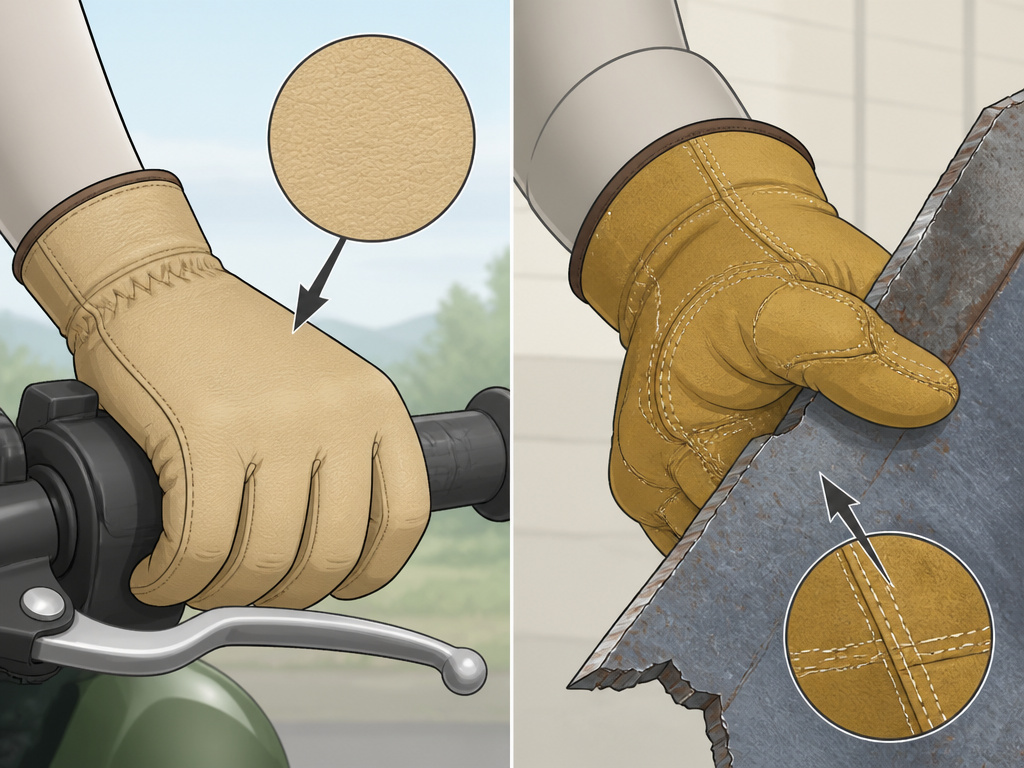 This decision matrix cuts through the marketing. Match your primary task to the leather that prioritizes the right property.
| Your Primary Need | Best Choice | Key Reason | Look For |
|---|---|---|---|
| Abrasion Resistance & Feel (e.g., motorcycle riding, driving) | Deerskin | Tighter fiber density resists road rash while maintaining softness. | American whitetail or European red deer hide. |
| Tear & Puncture Resistance (e.g., construction, metalwork) | Cowhide | 75% higher tear strength prevents nicks from becoming rips. | Top-grain palm, Kevlar stitching, reinforced thumb crotch. |
| Warmth in Extreme Cold (e.g., freezer work, logging) | Cowhide | Thickness provides inherent insulation; holds heavy linings. | Split cowhide construction with rated insulation (e.g., 160g fiberfill). |
| Dexterity & Unlined Comfort (e.g., dress gloves, shooting) | Deerskin | “Wavy” collagen structure allows stretch and recovery at the knuckles. | Unlined or lightly lined construction from a specialist like Hestra. |
| Durability on a Budget | Cowhide | More hide per animal means lower cost for high-strength material. | Grain cowhide palm drivers glove from industrial suppliers. |
| Low-Maintenance Suppleness | Deerskin | Higher natural oil content retains temper with less conditioning. | Vegetable-tanned or chrome-tanned deerskin with a natural finish. |
The Verdict: For tasks where your hands are tools that need to feel, choose deerskin. For tasks where your hands are assets that need shielding, choose cowhide.
Care and Longevity: Two Different Paths
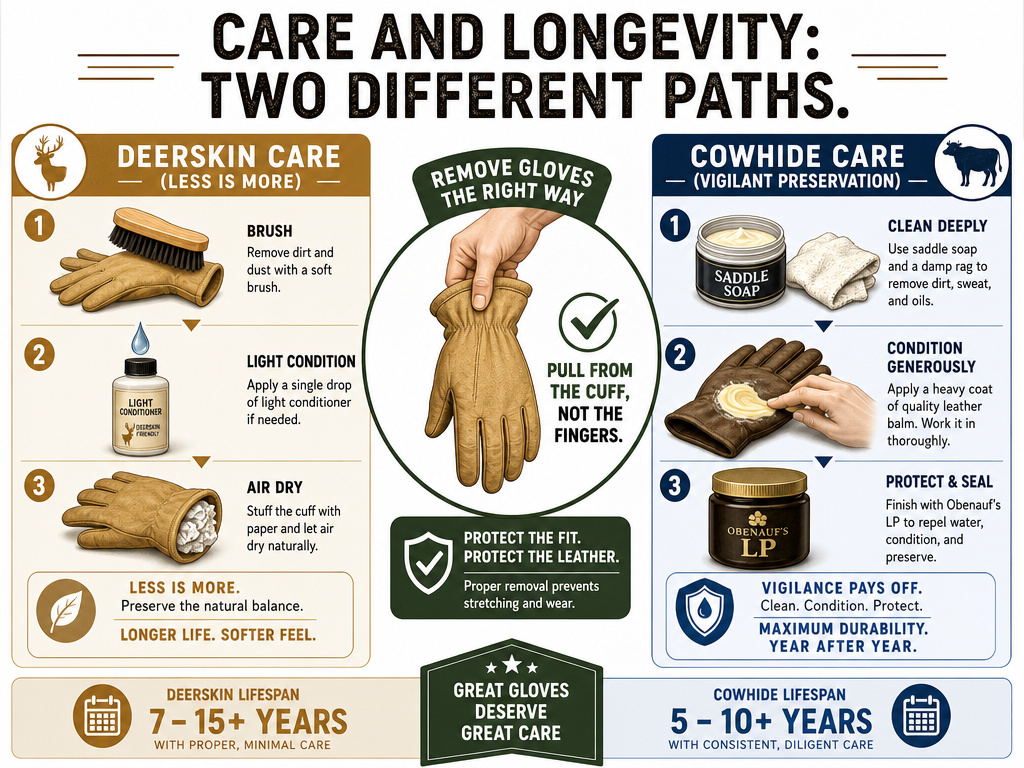 Treating these gloves the same way will shorten the life of one or both. Their structural differences demand different care philosophies.
Deerskin Care (Less is More):
- Cleaning: Brush off dry dirt. For spots, use a barely damp cloth. Never soak deerskin.
- Conditioning: Apply a thin coat of a light conditioner (like Bickmore Bick 4) only when the leather feels dry, often just once at season’s start.
- Drying: Air-dry at room temperature, away from heat. Stuff with paper to hold shape.
- Storage: Keep in a breathable cotton bag, not plastic.
Cowhide Care (Vigilant Preservation):
- Cleaning: Use saddle soap for heavy grime, but rinse the residue thoroughly. For daily grime, a damp cloth works.
- Conditioning: Cowhide benefits from more regular conditioning to prevent drying and cracking, especially after cleaning. Use a heavier balm like Obenauf’s Heavy Duty LP for work gloves.
- Drying: Same as deerskin, slow air drying is critical. Heat will bake in stiffness.
- Storage: Keep them dry. Lightly condition before off-season storage to prevent moisture loss.
The part nobody mentions: Conditioning mostly treats the surface. It can’t repair the collagen structure underneath once it’s been fatigued by stress or dried out. Conditioning prevents damage; it doesn’t reverse significant wear.
A final, universal rule: always remove gloves by pulling from the cuff, not the fingertips. Pulling from the tips stretches the collagen fibers in a way they cannot recover from, permanently deforming the glove.
Frequently Asked Questions
Are deerskin gloves warmer than cowhide?
No, the opposite is generally true. Cowhide is thicker and less breathable, providing more inherent wind resistance and a better base for insulation. Deerskin’s thinness and breathability make it better for moderate temperatures where overheating is a concern.
Can deerskin gloves get wet?
They can withstand light moisture, but they are not waterproof. Wet deerskin should be air-dried slowly away from heat. Repeated soaking will strip natural oils and lead to stiffness. For wet conditions, a dedicated waterproof glove with a membrane is a better choice than either deerskin or standard cowhide.
Which type of glove lasts longer?
It depends entirely on the abuse. In high-abrasion, high-dexterity use (like motorcycling), a deerskin glove will outlast a cowhide glove that would be too stiff to wear properly. In a high-tear, high-impact environment (like a construction site), a cowhide glove will outlast a deerskin glove that could be easily punctured. The lifespan is defined by the appropriateness of the match.
Is deerskin more ethical or sustainable?
Not inherently. Ethics depend on sourcing and tanning practices, not the animal species. Both materials can be byproducts of the meat industry. Some brands, like Billy Tannery, specialize in traceable, sustainable deerskin from UK deer populations, turning a potential waste product into leather. Look for transparency, not just a species name.
How do I break in new leather gloves?
Wear them for short periods initially. For stiff cowhide work gloves, flexing them repeatedly in your hands can help soften the fibers. For deerskin, simply wearing them is best. Never use heat or harsh chemicals to accelerate break-in, you’ll damage the collagen structure and shorten the glove’s life. Our guide on how to break in leather gloves details safe, effective methods.
The Bottom Line
Stop looking for a “best” leather glove. Start looking for the right one.
If your day involves throttle hands, steering wheels, or fine tools, the properties of deerskin, its fiber density and oil content, make it the superior choice. If your day involves jagged metal, biting cold, or heavy loads, the tear strength and bulk of cowhide are essential.
Most people choose based on thickness, thinking thicker equals better. That’s how you end up with clumsy hands on a motorcycle or shredded gloves on a job site. The choice is structural, not stylistic. Match the collagen to the chore.
