
Defining Deerskin Leather: A Surprisingly Durable Material
This post contains affiliate links. As an Amazon Associate, we earn from qualifying purchases.
Deerskin leather is a soft, strong, and lightweight leather made from the skin of deer, known for its supple hand-feel and exceptional tensile strength, nearly matching cow hide, despite being roughly one-third the thickness.
The numbers surprise most people. Deerskin’s tensile strength is statistically identical to cow hide’s, per peer-reviewed testing. That means it can handle substantial pulling force before it tears. Its secret lies in a different internal architecture, one that trades brute-force thickness for a complex web of molecular support.
It breaks down the science behind that strength, covers the practical trade-offs like its lower tear resistance, and gives you the facts to choose deerskin for the right project. You’ll learn which applications it dominates, where it falters, and how its unique properties have been validated by leather technologists and museums for centuries.
Key Takeaways
- Deerskin’s tensile strength matches cow hide’s, debunking the idea that “thin” means “weak”.
- Its tear strength is significantly lower than cow hide’s, making it prone to snag-and-rip damage in high-abrasion uses.
- The softness and “drape” come from a loose, open collagen structure and specific tanning, making it ideal for garments, linings, and comfortable gloves.
- Like all chrome-tanned leathers, deerskin is not ideal for direct, repeated metal contact (like knife sheaths) due to potential corrosion.
- Always source from reputable tanneries like Horween; quality depends more on the tannery’s process than the broad label “deerskin”.
The Deerskin Leather Composition: A Structural Breakdown
Forget thickness as the only measure of strength. The real story of deerskin happens at the molecular level, in the arrangement of collagen fibers and their supporting structures. A 2019 study presented to the International Union of Leather Technologists and Chemists Societies (IULTCS) compared the architecture of deer skin and cow hide directly. The findings reframe how we think about “soft” leathers.
Deer skin and cow hide have different structural and molecular make up which are reflected in their physical properties particularly strength. Glycosaminoglycans are important for the organisation of collagen fibrils… Deer skin and cow hide contain different ratios of collagen natural crosslinks which are essential for collagen stability.
Deerskin collagen fibers are described as “large and ‘wavy'” and made of fibrils with small diameters. Think of a robust, flexible rope made of many tiny, intertwined cords. These fibrils are linked by uniform arrays of large glycosaminoglycans (GAGs), which act like a structured gel filling the spaces, providing resilience. Cow hide fibrils, in contrast, are large and straight, with a more diverse GAG distribution, resulting in a denser, stiffer matrix.
The practical upshot? Deerskin achieves its strength through a flexible, interconnected network. Cow hide uses a thicker, denser packing of material. One isn’t inherently better; they’re engineered differently. This molecular reality explains the core physical specs that separate deerskin from other leathers.
Physical Properties: The Numbers That Matter
Here is where the lab data tells a clear story. According to the comparative study, which follows standardized testing methods like ISO 3376:2011 for tensile strength, the results are counterintuitive.
| Property | Deerskin (Average) | Cow Hide (Average) | Practical Implication |
|---|---|---|---|
| Thickness | 1.6 mm | 4.6 mm | Deerskin is about 3x thinner, leading to a lighter, more pliable material. |
| Tensile Strength | 28.3 N/mm² | 29.2 N/mm² | Virtually identical. Deerskin can withstand similar pulling force per square mm. |
| Tear Strength | 130.1 N/mm | 228.9 N/mm | Deerskin tears more easily once a nick or cut is present. |
The tensile strength figure is the stunner. It means that, gram for gram, deerskin is an incredibly efficient material. You get cow hide-level resistance to stretching and pulling in a much lighter package. However, the tear strength tells the other side of the story. That lower number is why deerskin isn’t sent into battle as a work boot toe cap. A sharp snag or existing cut can propagate more easily.
The Sensory and Handling Reality
On the bench, this science translates to a distinct experience. Deerskin feels warm and almost cloth-like. It drapes over a form instead of resisting it. When you pull a piece, it has a quiet, deep give, not a stiff, crackling resistance. Craftsmen working with it note the inconsistency; thickness can vary across a single hide by half a millimeter, and the material is stretchy. You have to adjust your expectations for precision, focusing on the final beauty of the piece rather than obsessing over a minor dimensional variance.
Common Uses and Who Should Buy Deerskin
Given its property profile, high tensile strength, low tear strength, soft hand, excellent drape, deerskin carves out specific, high-value niches. It’s a specialist, not a generalist.
Ideal Applications (Where Deerskin Excels):
- High-End Gloves: This is its classic home. The softness prevents blisters, the breathability keeps hands comfortable, and the strength ensures longevity. It’s the reason you’ll find deerskin gloves recommended for driving, dress, and fine work.
- Garment Linings and Lightweight Apparel: Jacket linings, vest interiors, and even lightweight outerwear benefit from its warmth-without-weight and soft feel against the skin.
- Luxury Accessories: Wallets, folios, and small bags that live in a pocket or purse. It molds to the body and develops a beautiful patina without the bulk of cowhide.
- Fringe and Lacing: Its supple nature means fringe hangs beautifully and doesn’t stiffen, while lace made from it is strong and easy to work with.
Poor Applications (Where to Avoid It):
- High-Abrasion Items: Don’t make work boots, tool belts, or motorcycle jackets from it. The tear strength is too low.
- Items with Metal Contact: As a chrome-tanned leather, direct, prolonged contact with steel (like in a knife sheath) risks corrosion transfer. The tannery guide from Northern Arizona University notes the reactive nature of chrome salts.
- Structural Components: Any part bearing constant, point-loaded stress (bag handles, strap attachments) is better served by a denser leather.
Where this goes sideways: Using deerskin for a hard-use knife sheath. The chrome tanning can corrode the blade, and a sharp edge will easily tear the leather upon drawing. Within a dozen draws, you’ll have a frayed, damaged sheath.
So, who is the deerskin buyer? It’s someone prioritizing comfort, elegance, and specific performance over brute-force durability. The buyer of quality leather gloves or a bespoke vest lining understands the material’s language.
How Deerskin Leather Is Made and Selected
The journey from raw skin to finished leather involves critical choices that define the final product’s quality. The reputation of the tannery, like Horween Leather Company or Wickett & Craig, matters far more than the generic term “deerskin.”
Tanning Methods: Chrome vs. Vegetable
Most deerskin on the market is chrome-tanned. This process uses chromium salts, is relatively quick, and yields a leather that is: – Very soft and supple right out of the drum. – Highly water-resistant. – Less prone to water staining. – Potentially reactive with metals.
Vegetable-tanned deerskin is rarer and more expensive. It uses natural tannins from bark and fruits. The result is a firmer, more moldable leather that ages and patinas dramatically. It’s the choice for artisans who want to tool, shape, or create heirloom pieces that evolve over decades.
Ensuring Consistency: The Tannery’s Sampling Protocol
Because individual hides vary, reputable tanneries and testing bodies follow strict sampling protocols to ensure batch consistency, especially for garment production. The Society of Leather Technologists publication on deer leather for outerwear specifies two key rules for meaningful quality control: 1. Sampling Position: Test samples should be taken “near the backbone at approximately the fore leg position.” 2. Number of Hides: Three hides from a batch are the minimum recommended to describe the physical properties relevant to garment making.
This scientific approach is what separates a premium material from a commodity one. It guarantees that the deerskin leather gloves you buy in one season will perform the same as those bought the next.
Care and Maintenance for Deerskin Goods
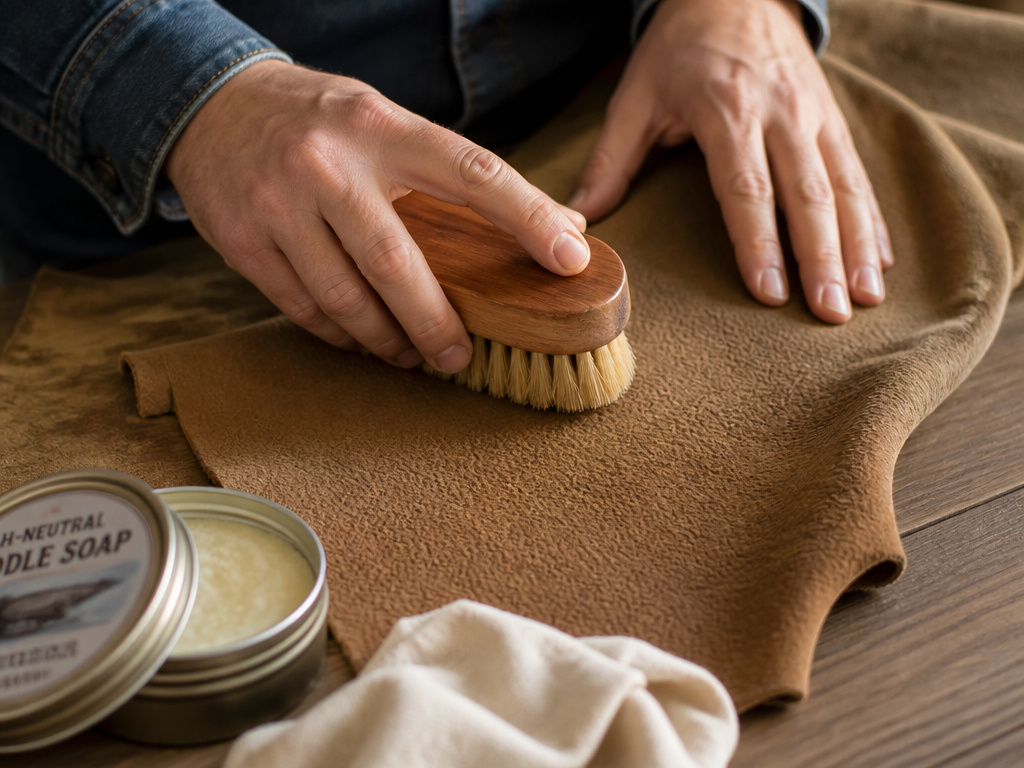 Deerskin requires a gentle, informed approach. Its soft finish and chrome tanning mean harsh cleaners and heavy conditioners can do more harm than good.
The Basic Care Routine:
- Regular Brushing: Use a soft horsehair brush to remove surface dust and dirt. This prevents abrasive particles from grinding into the grain.
- Spot Cleaning: For stains, use a barely damp cloth with a pH-neutral saddle soap. Work in small circles and let it dry completely away from direct heat.
- Conditioning (Sparingly): Use a light, non-greasy leather conditioner like a brand-specific cream. Apply a tiny amount with a soft cloth, let it absorb for an hour, then buff off any residue. Over-conditioning will clog the leather’s pores and make it feel tacky.
Common mistake: Using mink oil or heavy beeswax paste on deerskin. These products are designed for thick, vegetable-tanned work leathers. On deerskin, they oversaturate the fibers, leading to a stiff, darkened, and sometimes sticky result that never fully recovers its original hand.
For specific guidance on preserving delicate items, our dedicated guide on care for leather gloves covers the nuances of cleaning and reconditioning.
Deerskin Compared to Other Soft Leathers
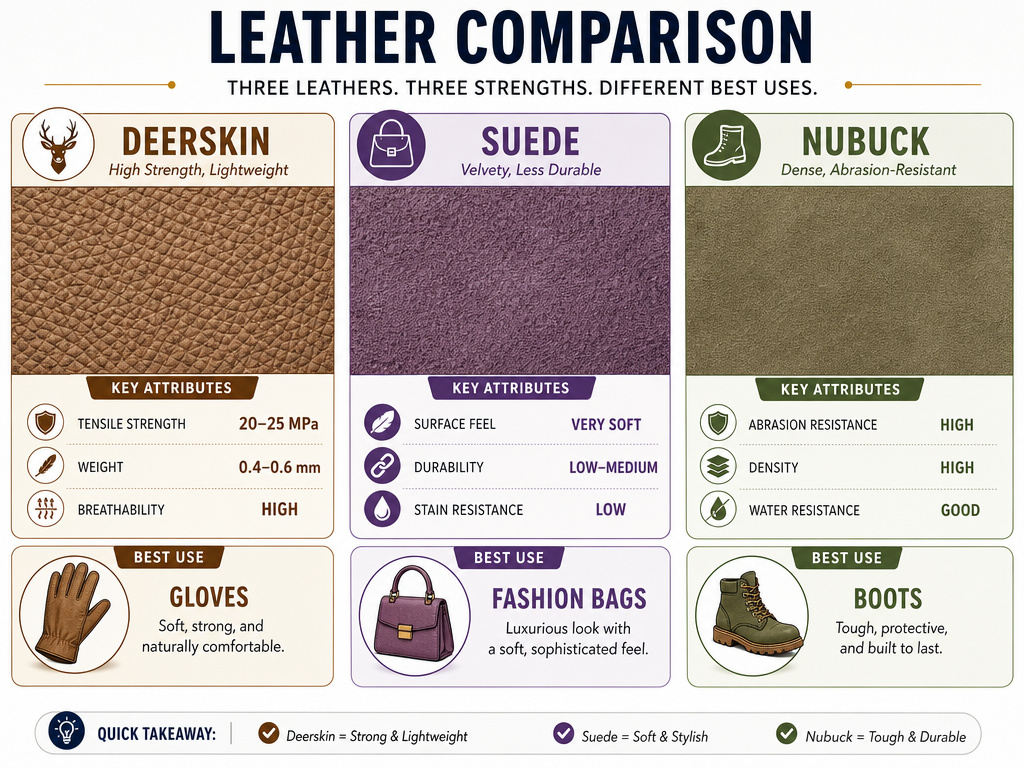 It’s easy to lump all soft leathers together, but deerskin, suede, and nubuck are distinct materials with different origins and best uses.
| Leather Type | Source | Surface | Key Characteristic | Best For |
|---|---|---|---|---|
| Deerskin | Full grain, chrome-tanned | Smooth, pebbled grain | High tensile strength, lightweight, excellent drape | Gloves, garment linings, luxury accessories |
| Suede Leather | Split layer of any leather (often cowhide) | Napped, fuzzy | Velvety texture, less durable, absorbs stains | Fashion items, linings, low-abrasion applications |
| Nubuck Leather | Top grain of leather (often cowhide) | Brushed, slight nap | Denser than suede, more abrasion-resistant, shows scuffs | Casual shoes, bags, jackets where a rugged-yet-soft look is desired |
Deerskin wins on strength-to-weight ratio. Suede offers a specific look at a lower cost but sacrifices durability. Nubuck provides a tougher, more casual finish. The choice isn’t about quality, but about matching the material’s inherent properties to the job.
Frequently Asked Questions
Is deerskin leather durable?
Yes, but in a specific way. Its tensile strength makes it highly resistant to pulling apart, so it wears well in applications like gloves that experience stretching. Its lower tear strength makes it vulnerable to cuts and snags, so it’s not durable in high-abrasion, high-impact scenarios.
Is deerskin leather real leather?
Absolutely. It is the tanned hide of a deer. The term “genuine leather” is a broad, often misleading marketing term. Deerskin is a specific type of real leather with verifiable properties, unlike bonded leather which contains ground-up fibers and plastics.
Why is deerskin leather so soft?
The softness comes from a combination of its thinness (1.6mm average), the naturally loose, “wavy” structure of its collagen fibers, and the chrome-tanning process which keeps the fibers lubricated and flexible. This structure is documented in conservation resources like the CAMEO museum materials database entry on deerskin.
How do you clean deerskin leather?
Clean it gently. Brush off dry dirt, then use a damp cloth with a tiny amount of pH-neutral soap for spots. Never soak it. After cleaning and drying, apply a minimal amount of a light conditioner designed for soft, chrome-tanned leathers. Avoid oils and waxes.
Can deerskin leather get wet?
It can handle moisture better than many leathers due to chrome tanning, but it’s not waterproof. Water will darken it temporarily and can leave spots if it dries unevenly. It’s best to let it dry naturally at room temperature, stuffed with paper to hold its shape.
Before You Go
Understanding deerskin leather means moving past the simplistic “soft and nice” label. It’s a material engineered by nature and refined by tanneries to excel in a specific set of conditions. Its hidden strength is a lesson in looking deeper than thickness.
When you’re evaluating any leather, from deerskin to cowhide, the process is more revealing than the label. A rigorous method to test leather, checking for consistent thickness, dry feel, and a clean smell, will tell you more than the words stamped on it. If you’re comparing it directly to its bovine counterpart, our detailed analysis on deerskin vs cowhide breaks down the choice by application.
For your next project, ask what the leather needs to do. If the answer involves comfort, flexibility, and elegant strength under tension, deerskin is a compelling, expert-grade choice. Just give it the right job.
