
Defining Cowhide Leather: What It Is & Key Quality Factors
This post contains affiliate links. As an Amazon Associate, we earn from qualifying purchases.
This post contains affiliate links. As an Amazon Associate, we earn from qualifying purchases.
Cowhide leather is tanned bovine hide, typically from adult cattle, processed to be imputrescible (rot-resistant) and defined by standards like EN 15987:2022 as having an intact original fibrous structure. Its defining traits are exceptional tear resistance from long, interwoven fibers, durability, and breathability, with quality varying dramatically by hide part (croupon vs. Flank) and processing method.
That definition isn’t marketing. It’s the legal and industrial baseline that separates leather from coated fabric. Ignore it and you’re shopping blind.
What follows is a breakdown of the definition’s moving parts, the tannage, the hide geography, the grading, and the one visual test that cuts through sales copy. By the end, you’ll read a spec sheet in ten seconds and know whether you’re holding a lifetime material or a disposable product in disguise.
Key Takeaways
- The legal term “leather” requires an intact natural fiber structure and rot-resistant tanning; surface coatings thicker than 0.15 mm disqualify it per EN 15987:2022.
- The “croupon” (back) of the hide yields the strongest, most durable leather, while the flank and neck are softer and less dense.
- “Genuine leather” is a legally broad term that includes the lowest-quality bonded leathers, it is not a grade or mark of quality.
- Chrome tanning produces soft, water-resistant leather ideal for shoes and bags; vegetable tanning creates firm, patina-developing leather for belts and saddles.
- A quick thumb test: press your thumb into the leather. High-quality full-grain will resist denting and spring back slowly; low-quality or heavily coated leather will show a permanent crease or feel plastic-hard.
The Industry’s Definition of Leather (And Why It Matters)
Forget everything you’ve heard about “real leather.” The industry operates on a written standard, not a feeling. The European Standard EN 15987:2022 defines leather as an animal hide or skin with its original fibrous structure more or less intact, tanned to be imputrescible. The surface coating, if any, cannot exceed 0.15 mm in thickness.
Anything with a thicker plastic layer is a coated textile, not leather. That’s not snobbery, it’s a material science distinction with real consequences for durability, breathability, and repair.
A product’s surface coating must not exceed 0.15 mm to be classified as leather under EN 15987:2022. This threshold ensures the natural fiber structure remains the dominant material, preserving its inherent properties of breathability, strength, and the ability to develop a patina over time.
This standard matters because it’s the line between a material that ages and a material that merely wears out. A true leather jacket will soften and mold to your body. A vinyl-coated “leather” jacket will crack along stress points within a few seasons. The definition is your first filter.
Where Your Cowhide Leather Actually Comes From
Cowhide leather starts as a raw byproduct of the meat industry. After the hide is removed, it’s cured with salt to prevent decay before reaching the tannery. This isn’t a single, uniform material. Think of it more like a topographic map.
The highest-quality leather comes from the croupon, the back of the animal. This area has a denser, tighter fiber weave because it carries the animal’s weight and muscle. Leather from the croupon is firmer, more tear-resistant, and shows less stretch. It’s what tanneries like Horween Leather Company or Wickett & Craig reserve for their premium lines, like belt straps or durable bag panels.
The flanks (belly) and neck yield softer, more pliable leather. The fiber structure here is looser. It’s perfect for garments or parts of a bag that need to flex, but it won’t carry the same long-term structural load as the croupon.
Then there’s the vertical split. A thick hide can be sliced horizontally into layers. The grain split is the top layer, complete with the natural pore pattern. It’s the most valuable. The flesh split or core split beneath it becomes suede. This is why “full-grain” (using the unsplit grain layer) and “suede” can come from the same hide, they’re just different floors of the same building.
Chrome-Tanned vs. Vegetable-Tanned: The Two Roads
All leather is tanned to prevent rot, but the chemical path chosen defines its character. The two main roads are chrome tanning and vegetable tanning.
Chrome tanning uses chromium salts. It’s fast, taking about a day. The resulting leather is soft, pliable, and highly water-resistant right out of the drum. It’s what you find in most modern shoes, handbags, and car upholstery. The leather often has a bluish-grey hue (“wet blue”) before dyeing. It’s stable and consistent, but it doesn’t develop a patina in the same way vegetable-tanned leather does.
Vegetable tanning uses natural tannins from tree bark, leaves, and fruits. It’s a slow process, often taking weeks. The leather it produces is firm, stiff, and molds to pressure over decades. It ages dramatically, darkening and developing a rich gloss with use. This is the leather of heritage wallets, saddles, and tooling projects. Brands like Conceria Walpier (Buttero) are renowned for it.
| Tanning Method | Best For | Aging Behavior |
|---|---|---|
| Chrome Tanning | Shoes, bags, furniture, garments | Stays relatively uniform in color; develops creases but not a deep patina. |
| Vegetable Tanning | Belts, saddles, archival-quality goods, tooling | Darkens and develops a rich, personal gloss (patina) over years of use and handling. |
My stance? For any item meant to last a lifetime and tell a story, vegetable-tanned leather is almost always superior. Chrome-tanned has its place for weather-ready utility, but it lacks the soul.
The Grain Truth: Full-Grain, Top-Grain, and Suede
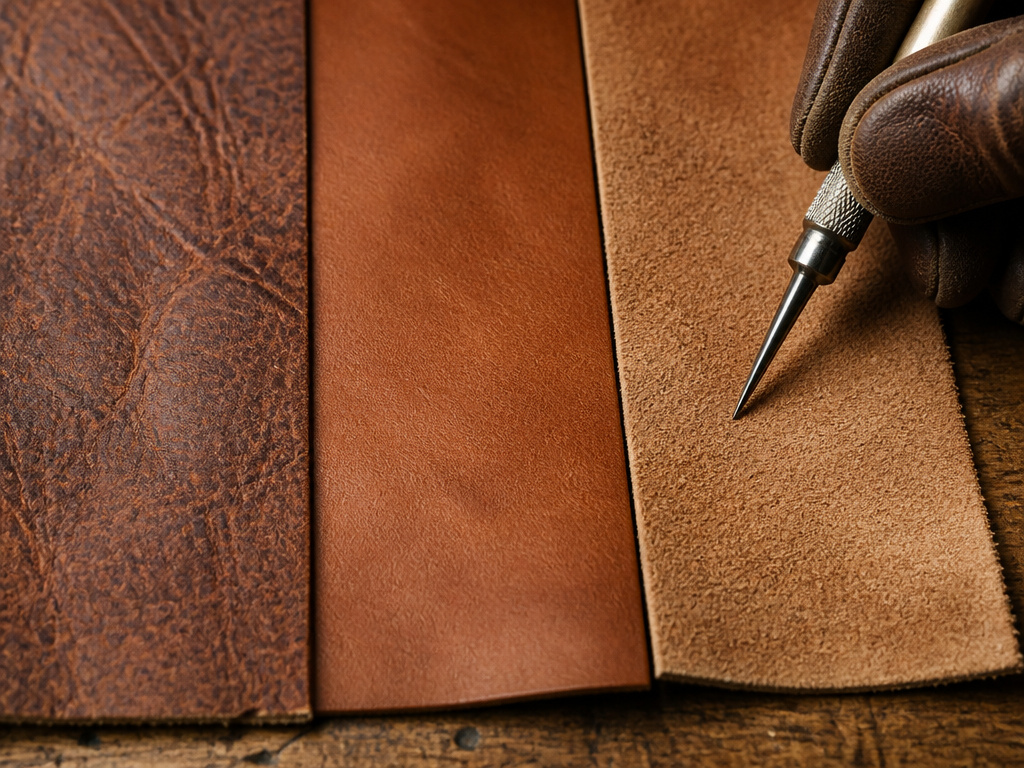
Here’s where marketing thrives. Let’s clear it up.
Full-grain leather is the grain split, untouched. It has the hide’s natural markings, pores, and texture. It’s the strongest and most durable because the tight surface fibers are intact. It will develop a patina.
Top-grain leather is the grain split that’s been lightly sanded or buffed to remove surface imperfections. It’s more uniform and easier to work with in mass production, but it’s slightly less durable than full-grain. A high-quality top-grain from a good tannery can outperform a poorly processed full-grain.
Genuine leather is a minefield. Legally, it just means some leather is present. It often refers to the flesh split (suede) or, worse, bonded leather, a pulp of shredded fibers glued together and coated. “Genuine” is not a grade. It’s a red flag that demands further inspection.
Suede is created from the flesh split or core split. It’s napped for a soft feel. It’s not inherently low-quality, a suede from the croupon’s split is strong, but it lacks the surface density of grain leather and stains easily.
Where this goes sideways: Buying based on the phrase “genuine leather.” It includes the lowest-quality bonded leathers, which delaminate and crack within two years under regular use.
The obsession with ‘full-grain’ has become a misleading mantra. I’ve seen expertly processed and corrected top-grain leather from a reputable tannery outlast and outperform a cheap, poorly tanned full-grain hide. The tannery’s reputation matters more than the broad label.
How To Judge Quality Beyond The Label
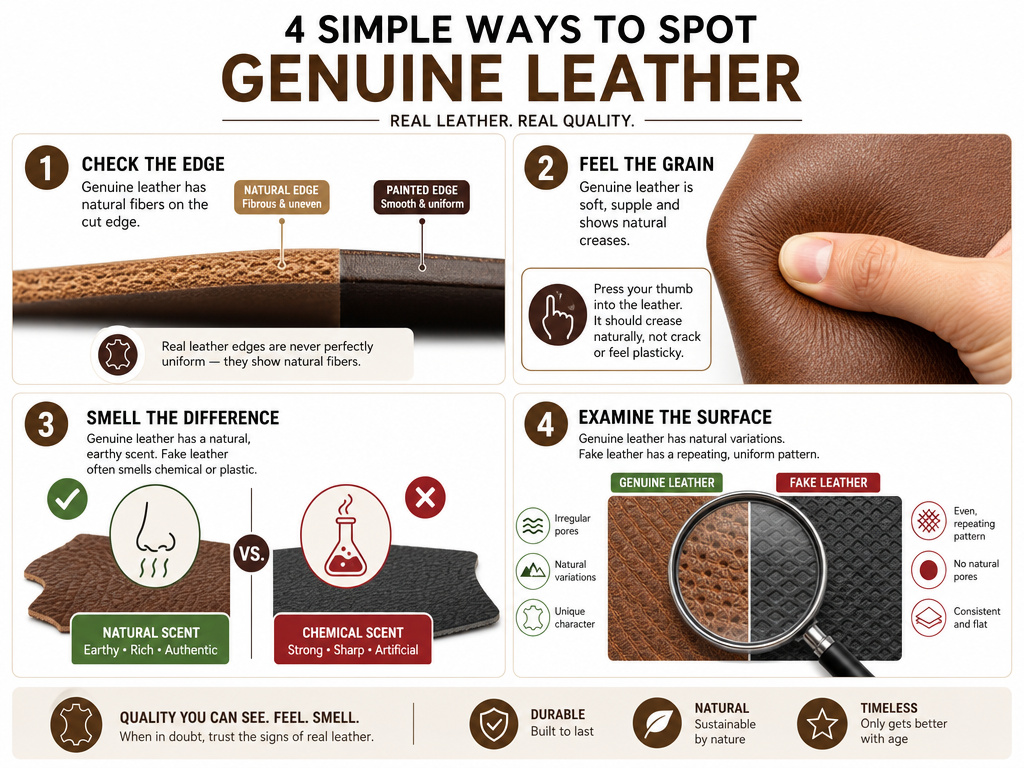
You don’t need to be an expert. You need a minute and your senses.
First, look at the edge. Real leather has a rough, fibrous edge. Bonded or synthetic leather will have a perfectly uniform, cardboard-like edge. If the edge is painted over or feels suspiciously smooth, be wary.
Second, do the thumb test. Press your thumb firmly into the leather. Quality full-grain will resist. It might show a slight crease that slowly vanishes. Cheap leather or heavy plastic coating will either dent permanently and stay dented, or feel rock-hard with no give.
Third, smell it. Real leather has a distinctive, organic smell. It’s hard to fake. Plastic-coated materials smell like chemicals or new car interior.
Fourth, check the pores. Bring it close to a light. Natural grain leather has irregular pores. Fake “leather” often has a perfectly repeating pattern stamped into it.
These tests work because they probe the material’s structure, not its finish. A high-quality leather like Horween’s Chromexcel might feel supple but will pass the thumb test with authority. A stiff, cheap belt might fail it instantly.
Cowhide vs. Other Leathers: Strength, Softness, and Use
How does cowhide stack up? It’s the workhorse.
Compared to lambskin, cowhide is far stronger and more durable, but less soft and supple out of the box. Lambskin is for luxury gloves and lightweight jackets; cowhide is for boots, work gloves, and bags that see daily use. You can see a detailed lambskin vs cowhide breakdown for more.
Next to deerskin, cowhide is heavier and stiffer. Deerskin has an incredible strength-to-weight ratio and natural softness, making it a secret champion for linings and flexible gloves. For a lightweight alternative, our guide on deerskin leather covers its unique properties.
Against horsehide or buffalo leather, the differences are subtler. Horsehide is often denser and has a distinctive grain pattern. Buffalo leather is thicker and more rugged with a pronounced pebble grain. Cowhide is generally more uniform and widely available, which is why it’s the default.
The general reference for cowhide notes its global abundance, which is why it’s one of the most common and affordable true leathers. Its versatility is its superpower.
Frequently Asked Questions
Is cowhide leather real leather?
Yes, cowhide leather is real leather by definition. It is tanned bovine hide. The confusion often arises with the term “genuine leather,” which is a broad legal category that can include lower-quality bonded leathers. True cowhide, especially full-grain or top-grain, is the durable, breathable material people imagine.
Is cowhide leather good quality?
It can be, but the quality range is vast. High-quality cowhide from the croupon (back) of the hide, vegetable-tanned or well chrome-tanned by a reputable tannery, is exceptionally durable and long-lasting. Low-quality cowhide from the flanks, poorly tanned or heavily corrected, can be weak and prone to premature wear. The label “cowhide” alone doesn’t guarantee quality.
What are the disadvantages of cowhide leather?
The main disadvantages are weight and stiffness, especially in thicker cuts and vegetable-tanned forms. It requires a break-in period for items like boots. Lower-quality cowhide can also be stiff without becoming supple. Compared to softer leathers like lambskin, it lacks immediate luxury softness.
Is cowhide better than calfskin?
It’s not better, it’s different. Calfskin, from younger animals, has a finer, tighter grain and is softer and lighter. Cowhide, from mature animals, is thicker, stronger, and more robust. Calfskin is preferred for formal shoes and delicate bags; cowhide is chosen for work boots, saddles, and heavy-duty luggage where maximum durability is needed. For a comparison of another robust hide, see how it differs from buffalo leather.
The Bottom Line
Cowhide leather is the default for a reason. It’s strong, available, and when well-made, it lasts generations. But the name is just the starting point.
The real decision happens in the details. Look for the tannery name (Horween, Wickett & Craig) over the generic grade. Feel for the dense resistance of the croupon, not the spongy give of the flank. Understand that a full-grain leather from a good maker beats a “premium” label from an unknown source every time.
One final, practical rule: if you can’t see the natural leather grain or feel the fibrous edge, you’re probably not holding a material that will age. You’re holding one that will be replaced. Choose accordingly.
