
How to Care for a Leather Watch Strap | The Complete Guide
This post contains affiliate links. As an Amazon Associate, we earn from qualifying purchases.
Care for a leather watch strap with a three-part routine: clean with a dry cloth, condition with a dedicated balm every 2-3 months, and store it flat away from heat and light. Daily sweat and flex mean even the best strap is a consumable; brands like Jaeger-LeCoultre recommend replacement around the 12-month mark under normal use.
That timeline isn’t a failure. It’s the nature of the material. Leather is a porous skin that soaks up your body’s oils and salts, dries out from air conditioning, and stiffens under a watch case that never stops bending it. A care routine doesn’t make it immortal. It manages the decay, keeps the strap supple and presentable, and stretches those 12 months into 18 or 24.
What follows is the no-nonsense system I use, pulled straight from the service manuals of brands like Omega and anOrdain. We’ll cover the exact steps, the products that actually work, and the common mistakes that accelerate wear. By the end, you’ll have a simple calendar alert and the confidence to handle a $300 strap without ruining it.
Key Takeaways
- Leather watch straps are consumables. Jaeger-LeCoultre’s official guidance is to plan for replacement around 12 months with daily wear.
- The core care cycle is clean, condition, store. Use a dry microfiber cloth for cleaning and a light leather balm (like anOrdain’s balsam or Saphir Médaille d’Or) for conditioning every 2-3 months.
- Water is the enemy. Getting the strap wet and letting it dry contorted on your wrist is the fastest way to shrink and misshape it.
- Condition the top grain only. Never apply conditioner to the soft lining or flesh side, as it can degrade adhesives and stiffen the strap.
- Quick-release spring bars are a worthwhile upgrade. They make strap changes tool-free, which encourages rotating straps and gives each one a rest period.
The Core Three-Step Care Routine
Forget complicated rituals. Effective care boils down to three actions you perform on a schedule: clean, condition, and store correctly. This isn’t about restoring a neglected strap; it’s about maintaining one that’s still in good shape.
Clean the strap with a dry, soft cloth after wearing. Apply a thin coat of leather balm to the grain side every 2-3 months, avoiding the lining. Let it absorb for at least 10 minutes, then buff. Store the strap flat or curved in a breathable pouch, away from heat and sunlight.
I set a calendar reminder for this. Without it, three months slip into six, and you’re wondering why the leather next to the buckle looks grey and parched.
Step 1: Dry Cleaning After Wear
This is the most important habit. As soon as you take the watch off, give the strap a quick wipe with a dry, lint-free microfiber cloth. You’re removing salts from sweat, skin oils, and dust. That daily grime is abrasive and acidic. Leaving it on there lets it work into the leather, drying it out and discoloring it from the inside. You don’t need soap or water for this, a dry cloth provides enough friction.
Step 2: Conditioning on Schedule
Conditioning replaces the natural oils that wear and evaporation strip away. Don’t wait for the leather to look dry. By then, the fibers are already starting to weaken.
- Frequency: Every 2-3 months for most leathers. Oily leathers like Horween can go 4-6 months.
- Product: Use a dedicated leather balm or cream. AnOrdain specifies a balsam for their straps. I keep a small tin of Saphir Médaille d’Or Renovateur on hand, it’s a reliable benchmark.
- Method: Apply a pea-sized amount to a cloth, not directly to the strap. Work it into the top grain in small circles. This is where you must be disciplined: avoid the lining and the flesh side completely. Conditioner on the lining can break down adhesives and attract more dirt.
- Drying Time: Let it sit for a minimum of 10 minutes. For thicker or oil-tanned straps, give it 30. Then buff gently with a clean part of the cloth to remove any surface residue. If the strap feels at all tacky after an hour, you used too much.
Step 3: Smart Storage
When the strap is off the watch, don’t just toss it in a drawer. Store it flat or gently curved in the cotton pouch it came in, or a soft cloth. The goal is to let it breathe while keeping it dust-free. An airtight plastic box or bag traps moisture and can promote mold. Keep it in a drawer or closet, somewhere dark, dry, and at room temperature.
What Most People Get Wrong
The standard advice online is a minefield of well-intentioned mistakes. Here’s where I see owners, and even some brands, steer people wrong.
Common mistake: Using saddle soap or general leather cleaners. These are for lifting heavy, ground-in dirt from work boots and saddles. They’re far too harsh for the delicate finishes and dyes on a watch strap and will prematurely dry it out.
Where this goes sideways: Getting the strap wet and wearing it tight until it dries. The leather absorbs water, swells, and then dries under tension. It sets in that shrunken, deformed shape, often pulling away from the spring bars or creating a permanent crease.
| Mistake | Why It’s Harmful | The Right Move |
|---|---|---|
| Using “waterproofing” sprays | Clogs the leather’s pores, preventing it from breathing and trapping moisture inside. | Embrace the patina. Use a conditioner that nourishes without sealing. |
| Conditioning the lining/flesh side | Degrades adhesives, attracts dirt, and can stiffen the strap. | Condition the top grain leather only. |
| Storing in direct sunlight | UV radiation breaks down dyes and oils, causing fading and accelerated cracking. | Store in a dark, dry place like a drawer. |
| Using isopropyl alcohol or household cleaners | Strips all oils and dyes immediately, leaving the leather bone-dry and discolored. | For stains, use a damp (not wet) cloth with a drop of pH-neutral soap. |
Let me share what I’ve learned the hard way. I once conditioned a suede item with a standard cream. It matted the nap and left dark, greasy spots that never came out. The lesson transferred directly to watch straps: the product must match the material’s specific needs. A watch strap isn’t a boot.
Choosing the Right Leather and Products
Not all leathers age the same, and the strap’s construction dictates its care needs. This changes your buying decision as much as your maintenance routine.
Vegetable-Tanned Leather
This is the classic choice from makers like Colareb. It’s stiffer initially and develops a rich, dark patina from exposure to light and skin oils. It’s also more susceptible to water stains. Care is straightforward: the dry-cloth wipe is critical to manage patina evenly, and a light balm like Obernauf’s Leather Oil works well. Expect it to darken noticeably over time, that’s the point.
Shell Cordovan
Used by brands like Veblenist and Bulang & Sons, shell is incredibly durable and develops a glossy roll instead of creasing. It’s naturally more water-resistant. You can condition it less frequently, maybe every 6 months. A tiny amount of a pure wax-free conditioner like Saphir Cordovan Cream is all it needs.
Lined vs. Unlined Straps
A lined strap has a layer of leather or fabric on the inside against your skin. It’s more comfortable but more delicate. The cardinal rule: never condition the lining. It serves a different purpose and can’t absorb the oils, leading to a greasy, dirty feeling.
For a deeper dive on the options, our guide to the types of leather watch straps breaks down the pros and cons of each.
The “Why” Behind the Rules
 You can follow steps blindly, but understanding the mechanics makes you better at adapting them. Here’s what’s happening inside the leather.
Why Water Causes Permanent Damage
Leather fibers swell when wet. If the strap dries while bent around your wrist or a watch roll, the fibers lock into that swollen shape as the moisture leaves. They can’t return to their original length, resulting in a strap that’s shorter, tighter, and warped. This is why Panerai explicitly says not to use a hairdryer, forced, uneven heat bakes in the distortion.
Why Over-Conditioning is Worse Than Under-Conditioning
Leather needs to breathe to regulate moisture from your skin. Slathering on thick coats of conditioner clogs the microscopic pores. This traps sweat and heat against your skin, which then can’t escape. The trapped moisture then works on the leather from the inside, accelerating rot. A tacky feel is your first warning sign.
Why Sunlight Fades and Brittles
UV radiation doesn’t just bleach dyes. It breaks down the long-chain molecules in the leather’s natural oils, turning them from pliable plasticizers into a brittle, powdery residue. The leather loses its flexibility and strength from the outside in. This is a chemical process, not just a cosmetic one.
For more on the science of preserving the material, our article on how to prevent leather from cracking goes into the structural details.
When to Repair, When to Replace
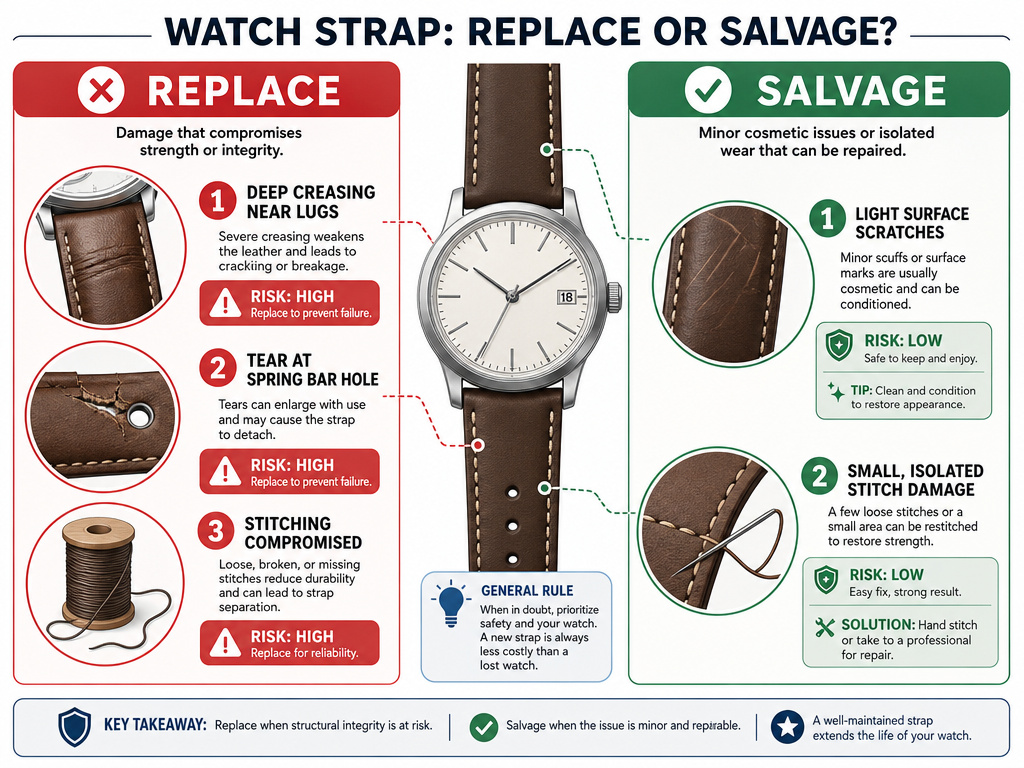 Despite your best care, a strap will eventually wear out. The decision point usually comes at the 12-18 month mark with daily use. Here’s how to diagnose.
Signs It’s Time for a New Strap:
- Deep, permanent creasing near the lugs that makes the strap buckle awkwardly.
- The smell won’t go away. A persistent sour odor means sweat and bacteria have penetrated beyond the surface.
- Structural failure: The keepers break, the stitching unravels extensively, or the leather tears at the spring bar hole.
- It’s just too stiff. If conditioning no longer restores any pliability, the fibers are too degraded.
What You Can Salvage:
Minor surface scratches blend into the patina. Light discoloration can sometimes be evened out with careful conditioning. If the stitching is coming loose in one spot, a local cobbler can often re-stitch it for a few dollars, buying you more time.
If you’re facing significant wear, our guide on how to restore leather covers more intensive revival techniques for straps that are worth the effort.
Frequently Asked Questions
Can you shower with a leather watch strap?
No. You should never shower with a leather watch strap. Hot water, soap, and constant steam will saturate the leather, leading to swelling, dye loss, and a high risk of the strap drying in a deformed shape. The heat and humidity also degrade adhesives.
How often should you condition a leather watch band?
Condition a leather watch band every 2 to 3 months under normal wear. If you live in a very dry climate or sweat heavily, you might need to condition every 6-8 weeks. For oil-tanned leathers like Horween, you can extend that to every 4-6 months. Let the leather’s suppleness be your guide, not a rigid calendar.
What is the best conditioner for leather watch straps?
The best conditioners are light balms or creams made for fine leather goods. AnOrdain’s own balsam is formulated for their straps. Saphir Médaille d’Or Renovateur and Leather Honey are other reliable, widely available options. Avoid anything labeled as a “waterproofer” or “sealer.”
Why does my leather watch strap smell?
Leather watch strap smells because it has absorbed sweat, skin oils, and bacteria over time. The porous material traps these elements, and bacteria break them down, creating a sour odor. Regular wiping with a dry cloth after wear is the best prevention. Once the smell is deep-set, it’s very difficult to remove completely.
Can you fix a cracked leather watch strap?
You cannot truly fix a cracked leather watch strap. Cracks mean the top grain layer has split, and the underlying fibers are broken. Conditioner can temporarily mask minor cracks by plumping the surrounding leather, but the split remains. Once cracking starts, the strap’s structural integrity is compromised, and replacement is the only permanent solution.
The Bottom Line
Think of a leather watch strap as a consumable with a 12-month warranty from day one. Your care routine is the maintenance schedule that keeps it running smoothly right up until the replacement date. Clean it daily with a cloth, condition it weekly with a balm, and store it properly when it’s off duty.
Invest in quick-release spring bars. That one $10 upgrade makes rotating straps effortless, which is the single best thing you can do for the longevity of any single strap. It gives the leather time to dry and recover its shape.
Finally, don’t fight the patina. A little darkening at the edges, a soft sheen where it bends, that’s the strap recording its time with you. Your job isn’t to keep it looking new. It’s to keep it from cracking before its story is finished.
