
Types of Leather Watch Straps: Materials & Real Lifespans
This post contains affiliate links. As an Amazon Associate, we earn from qualifying purchases.
Leather watch straps are defined by their source animal, tanning method, and finish. The core types are calfskin (soft, versatile), shell cordovan (durable, develops a glossy patina), and exotic leathers like alligator (formal, patterned). Vegetable-tanned leather ages with character; chrome-tanned is softer and more common. Your climate and how often you wear the watch decide which type makes sense, leather is a consumable, not a heirloom, with lifespans ranging from one to ten years.
That lifespan range isn’t a guess. It’s the documented outcome of sweat, flex, and UV exposure on different hides. A strap isn’t just an accessory; it’s the point where your watch meets the real world.
What follows is a breakdown of the leathers you’ll actually find, the numbers behind how long they last, and the straightforward choices that keep a strap with a folded and glued edge from failing early. We’ll move from the everyday calfskin to the near-indestructible shell cordovan, and touch on when to skip leather altogether.
Key Takeaways
- Calfskin is the default, but expect to replace a daily-worn strap every 12-24 months. Shell cordovan can last 5-10 years with minimal care.
- Water is leather’s enemy. A single serious soaking, especially in salt or chlorine, can permanently stiffen and distort a strap within a week.
- Your local climate dictates the material. In humid or tropical environments, FKM rubber or nylon are smarter daily choices than any leather.
- Quick-release spring bars are the single best upgrade for any strap collection, preventing lug scratches and making changes effortless.
- Rotating between two or three straps can double the functional lifespan of each by allowing them to fully dry and recover between wears.
The Leather Strap Hierarchy: From Common to Coveted
Not all leather is created equal. The difference between a strap that lasts a season and one that lasts a decade comes down to the animal, the part of the hide, and how it was tanned.
Calfskin is the workhorse. It’s supple from the first wear, breathes well, and takes dye evenly, which is why you find it on everything from a beginner’s timepiece to a dressy Cartier Tank. The feel is a soft, slightly pebbled texture that warms up quickly on the wrist. The catch is its lifespan. Under daily wear, especially in a warm climate, the constant friction against your skin and the salt from sweat break down the fibers.
Calfskin leather straps have a typical daily-wear lifespan of 1 to 3 years. In hot, humid conditions, this can drop to 6–18 months before the leather loses its structural integrity and develops permanent odor.
Shell cordovan is a different beast. It’s not a type of animal, but a specific part: the fibrous flat muscle beneath the hide on a horse’s hindquarters. Tanneries like Horween in Chicago process it for months, resulting in a leather that has almost no visible grain. It feels smooth, almost glossy, and is remarkably dense. This density is why it resists water and creasing so well. It doesn’t develop a wrinkly patina like calfskin; instead, it gains a deep, reflective shine with wear. It’s the one leather that genuinely bridges the gap between dressy and durable.
Then you have the exotics. Alligator, with its distinctive large belly scales, is the pinnacle of formal wear. It’s stiff at first, resistant to creasing, and carries a price tag to match its rarity. Lizard offers a finer, more uniform scale pattern for a slightly less bold look. These aren’t daily drivers; they’re for occasions where the strap is part of the statement.
Tanning: The Process That Defines Character
The tanning method decides how the leather will behave and age. The two main paths are chrome and vegetable tanning, and your strap’s personality hinges on which one was used.
Chrome tanning uses chromium salts. It’s a fast process, taking about a day, and it produces about 80% of the world’s leather. The result is leather that’s incredibly soft, pliable, and uniform in color. It’s also more resistant to water in the short term. Most affordable leather straps are chrome-tanned. The downside is that it can feel less substantive, and it ages with less character, it generally just gets darker and softer.
Vegetable tanning uses natural tannins from tree bark, like mimosa or quebracho. This process takes weeks. It produces a firmer, more rigid leather that starts with a lighter, natural hue. This is the leather that tells a story. It darkens dramatically with exposure to light and oil, developing a rich, personal patina that chrome-tanned leather can’t replicate. It’s also more environmentally benign. The trade-off is care: it’s more susceptible to water stains and requires a longer break-in period.
Here’s a quick comparison of the two methods:
| Tanning Method | Process Time | Resulting Feel | Aging Behavior | Best For |
|---|---|---|---|---|
| Chrome Tanning | ~1 day | Soft, supple, uniform | Softens further, darkens evenly | Everyday straps, comfort-first designs |
| Vegetable Tanning | Several weeks | Firm, rigid, substantive | Develops a deep, unique patina; darkens with light | Heritage, vintage-style, and collector pieces |
The Lifespan Reality: What Wears Out and When
A strap is a consumable. Accepting that fact saves you from disappointment and helps you plan. The lifespan numbers below aren’t marketing; they’re averages drawn from watchmakers and long-term wearers.
Sweat and constant flex are the killers. The bend where the strap meets the buckle weakens the fibers every time you put the watch on or take it off. Salt from sweat accelerates this, drying out the leather and making it brittle. You’ll see the signs first as small cracks in the finish, then as a whitish, dried-out look along the edges, and finally as a spongy softness where the structure has given way.
Climate dictates the timeline. That same calfskin strap that lasts two years in a dry, temperate climate might not make it through a single humid summer if it’s worn daily. The leather never fully dries, staying damp and becoming a breeding ground for bacteria that cause permanent odor.
This table lays out the realistic expectations. These figures assume daily wear without rotation.
| Material | Typical Lifespan (Daily Wear) | Primary Wear Factors | Climate Warning |
|---|---|---|---|
| Calfskin Leather | 1–3 years | Flex fatigue, sweat, abrasion | Lifespan halves in high humidity |
| Shell Cordovan | 5–10 years | Edge wear, surface scuffs | Highly resistant to moisture degradation |
| Alligator/Crocodile | 3–7 years | Scale lifting, finish cracking | Avoid prolonged moisture |
| Suede/Nubuck | 1–2 years | Staining, water marks, pile matting | Ruined by a single heavy rain |
| FKM Rubber | 5+ years | UV exposure, buckle hole stretch | Excellent in all climates |
| Nylon (NATO) | 1–2 years | Fraying at holes, fading | Dries fast, good for wet environments |
The lesson is in the right-hand column. If you live somewhere hot and sticky, the numbers for leather shift from years to seasons. This is why collectors in those climates often keep a leather strap for formal evenings and rely on something like FKM rubber or a nylon NATO for daily duty. The right material for your life isn’t about fashion first; it’s about physics.
Why Construction Details Aren’t Just Decoration
 You can have the best leather in the world ruined by poor construction. The details that separate a good strap from a great one are often hidden in plain sight.
Stitching is the first tell. Machine stitching is fine, but look for tight, even stitches with thread that matches or complements the leather. The gold standard is a saddle stitch, done by hand with two needles. It’s not just rustic charm; if one part of the thread breaks, the rest of the stitch stays locked. I’ve used the same simple four-stitch saddle stitch for every high-stress seam on my own projects because that locking mechanism is incredibly strong and durable. You’ll find this on straps from makers like Bulang & Sons.
Edge finishing is the second. Raw, cut leather edges are a sign of cost-cutting. They’ll fray and become fuzzy. A strap with a folded and glued edge will last longer than one with a raw edge. This seals the edge, looks clean, and lasts.
The lining matters for comfort. A cheap strap might have a rough, unfinished back that absorbs sweat and sticks to your skin. A lined strap uses a thin, soft leather (like calf or goat) on the underside. It feels better, wicks moisture slightly, and adds to the strap’s longevity. Unlined suede can be comfortable but is a sponge for sweat.
Finally, the hardware. Buckles should be solid, with a crisp, clean engraving if they’re branded. The buckle tang should fit snugly in the holes without forcing them. But the spring bar system is the most important improvement.
Easy to miss: Standard spring bars require a tool for removal, which almost always scratches the inside of the watch lugs. Quick-release spring bars have a tiny integrated lever you push with a fingernail.
Quick-release bars make the entire concept of a strap wardrobe practical. You can swap from a leather Colareb to a nylon NATO in ten seconds without marring your watch. It’s the single most underrated feature in modern straps.
The Right Strap for Your Life (Not Just Your Watch)
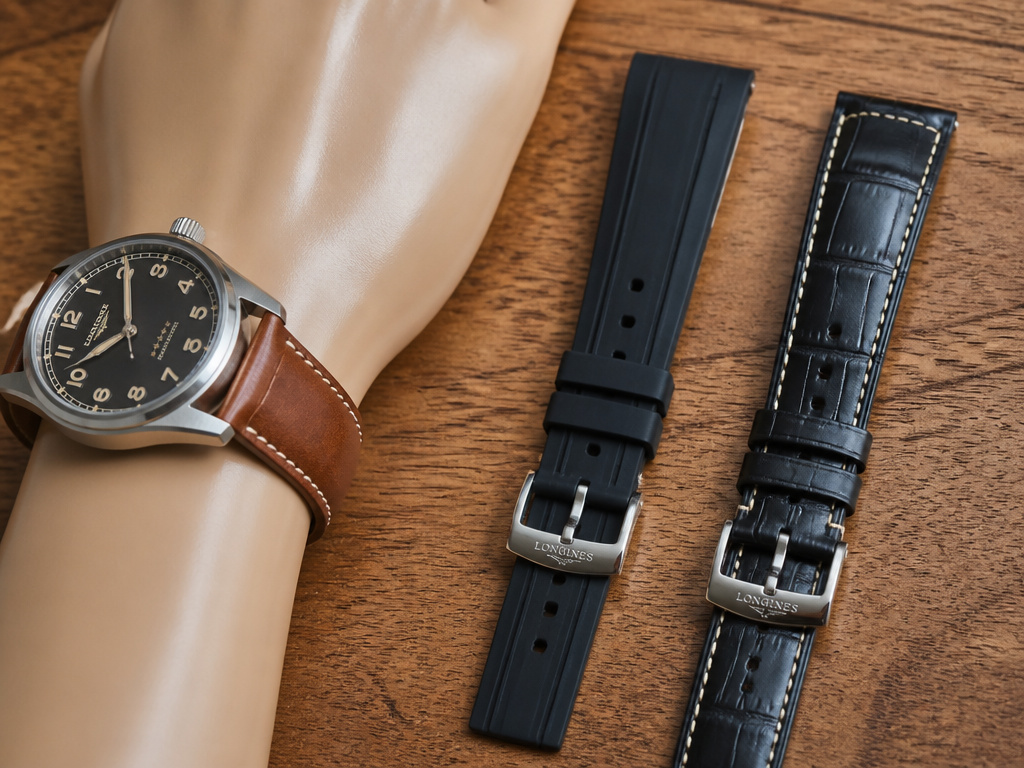 Matching a strap to your watch’s style is the easy part. Matching it to your actual life is where the smart choice happens. This is where the theoretical meets the practical.
Let’s start with the daily grind. If your watch is on your wrist from morning until night, through commutes, work, and errands, comfort and resilience are key. For leather, that means a supple, lined calfskin or a broken-in shell cordovan. Thickness matters here, anything over 3.5mm can feel bulky and prevent the watch from sitting flat. For true durability, however, you step out of leather. A fitted FKM rubber strap, like those from Veblenist for specific Rolex or Omega models, is the practical choice. It handles sweat, rain, and accidental sprays without a second thought.
Formal wear is where leather reigns. A black or dark brown alligator strap on a dress watch is the unspoken uniform for a reason. It’s sleek, quiet, and communicates a finished look. For a slightly less formal but still sharp appearance, a smooth box calf or a polished shell cordovan strap works perfectly. This is where you pay for the details: a significant taper, hand-stitching, and that flawless edge finish.
Then there’s the active life. If your routine includes the gym, swimming, or outdoor sports, leather is the wrong tool for the job. Full stop. Water, chlorine, salt, and constant sweat will destroy it. A silicone or FKM rubber strap is designed for this. A nylon NATO is another excellent option, it dries in minutes, and if it gets funky, you can throw it in the washing machine. Trying to make a leather strap work here is how you end up with a stiff, misshapen, foul-smelling band within a month.
Your local climate is the final, essential filter. The guide to choosing a leather watch strap always circles back to this. In humid or tropical climates, the porosity of leather works against you. It will stay damp, promoting mold and accelerating rot. In these environments, elastomers (FKM, silicone) and textiles (nylon, sailcloth) are the default. Save the leather for air-conditioned rooms and dry seasons.
How to Care for the Strap You’ve Chosen
Care isn’t about making leather immortal. It’s about helping it reach its full, intended lifespan with grace. The basics are simple, but they’re often drowned out by product marketing.
First, keep it dry. This is the cardinal rule. Take the watch off before washing your hands, showering, or swimming. If the strap does get wet, don’t panic and don’t put it on a radiator. Blot it gently with a towel, then let it air dry at room temperature, shaped as it should be. Forcing heat on it will cook the fibers and cause irreversible hardening and shrinkage.
Conditioning is not a monthly chore. Over-conditioning is as bad as neglect; it saturates the leather, weakens it, and can attract dirt. For a strap in regular rotation, a light conditioning every 4-6 months is plenty. Use a tiny amount of a quality product like Saphir.amazon.com/dp/B004ECWBZW?linkCode=osi&th=1&psc=1&tag=test-20), a pea-sized drop for the entire strap, rubbed in thoroughly and then buffed off. Never use silicone-based “conditioners”; they sit on top and clog the pores.
Where this goes sideways: Using mink oil for waterproofing. It can darken leather dramatically and is often too heavy for thin watch strap leather, leading to a greasy feel and attracting dirt.
Storage extends life. When you’re not wearing a strap, give it a rest. Don’t store it tightly coiled in a drawer; lay it flat or hang it loosely. This prevents permanent creases. A leather watch roll is ideal for this, keeping straps organized and protected from dust and light. Avoid direct sunlight, which will fade colors and dry out the material.
Finally, listen to the strap. When the edges start to fray uncontrollably, the leather feels spongy and loses its shape, or a smell won’t go away no matter how you clean a leather watch band, it’s time to retire it. No amount of proper care for a leather watch strap can reverse structural failure.
Frequently Asked Questions
What is the most durable type of leather watch strap?
Shell cordovan is the most durable common leather, with a lifespan of 5-10 years. Its dense, non-porous structure resists water, creasing, and abrasion far better than calfskin. For ultimate durability in all conditions, however, high-quality FKM rubber outperforms any leather.
Can you get a leather watch strap wet?
You can, but you shouldn’t. Water, especially salt water or chlorinated pool water, will soak into the leather, causing it to swell, stiffen as it dries, and eventually crack. It also breaks down the stitching and lining. If it gets wet, dry it immediately with a soft cloth and let it air dry away from heat.
How often should I condition my leather strap?
For a strap in regular use, condition it sparingly every 4 to 6 months. Over-conditioning can saturate and weaken the leather. Use a very small amount of a high-quality cream or lotion, apply it evenly, and buff off any excess. Suede and nubuck should never be conditioned with standard products; use a dedicated suede protector spray instead.
What’s the difference between 20mm and 22mm straps?
The number refers to the width in millimeters between the watch’s lugs, where the strap attaches. A 20mm strap will not fit a watch designed for a 22mm strap, and a 22mm strap on a 20mm watch will leave unsightly gaps. Always measure your lug width precisely with calipers or a ruler before buying a replacement. Our guide on 20mm leather bands can help if that’s your size.
Are quick-release spring bars reliable?
Yes, modern quick-release spring bars from reputable manufacturers are very reliable. They use the same internal spring mechanism as traditional bars but integrate a small lever for tool-free removal. They are just as secure when installed correctly and prevent scratches to your watch lugs, making changing a strap a simple, safe task.
How long does a leather watch strap last?
With daily wear, expect 1-3 years from a good calfskin strap, 3-7 years from alligator, and 5-10 years from shell cordovan. These lifespans assume proper care and can be significantly shortened by exposure to sweat, water, and humid climates. Rotating between multiple straps is the most effective way to extend the life of each one.
The Bottom Line
Choose leather for its character and comfort, not for its invincibility. A strap is a partner to your watch, and it will show the miles. The most practical advice is to own more than one. Have a durable FKM rubber or nylon strap for active, wet, or humid days. Keep a shell cordovan strap, maybe from Colareb, for when the context allows it to shine and age gracefully.
Think in cost per year. A $30 strap that lasts one year costs $30 annually. A $150 shell cordovan strap that lasts eight years costs less than $19 annually and looks better with each passing season. The initial investment is higher, but the long-term value and satisfaction are undeniable. Start by measuring your lug width, then build a small, thoughtful collection that fits your actual life. The right strap doesn’t just hold your watch to your wrist; it completes the story.
