
Your Guide on How to Care for a Leather Weightlifting Belt
This post contains affiliate links. As an Amazon Associate, we earn from qualifying purchases.
This post contains affiliate links. As an Amazon Associate, we earn from qualifying purchases.
To care for a leather weightlifting belt, follow a four-part system: clean the inner surface with a damp cloth after every use, condition the exterior once or twice a year with mink oil, store it flat in a dry room-temperature environment, and inspect the buckle and screws for tightness. This routine, which takes about ten minutes every few weeks, prevents salt degradation, fiber drying, and structural failure.**
That ten-minute routine is the difference between a belt that lasts two years and one that lasts two decades. The leather isn’t just a strap; it’s a dense matrix of collagen fibers that respond predictably to salt, heat, and oil. The process is mechanical.
What follows is the system, built on material science and service manuals, not gym folklore. This guide explains the exact cleaning frequency, the one conditioner most people overuse, the storage mistake that creates a permanent weak spot, and how to handle the white fuzz of mold before it etches the leather.
Key Takeaways
- Clean the belt’s inner surface after every session with a damp cloth to remove sweat and salt; a full clean with saddle soap is needed only every 2-4 weeks.
- Condition sparingly—once a year is often enough. Over-conditioning with oils like mink oil can oversoften and weaken the leather’s fiber structure over time.
- Never use artificial heat to dry the belt. Air drying at room temperature takes 1-3 hours; a hair dryer can cause permanent stiffening and cracks in the collagen matrix.
- Store the belt flat or hanging to maintain its natural curve. Folding it or leaving it tightly rolled creates a permanent crease that becomes a failure point.
- For belts with lever or screw buckles, check and gently tighten the fasteners every few months to prevent them from loosening under load.
The 4-Part Care System (And the One Step Everyone Skips)
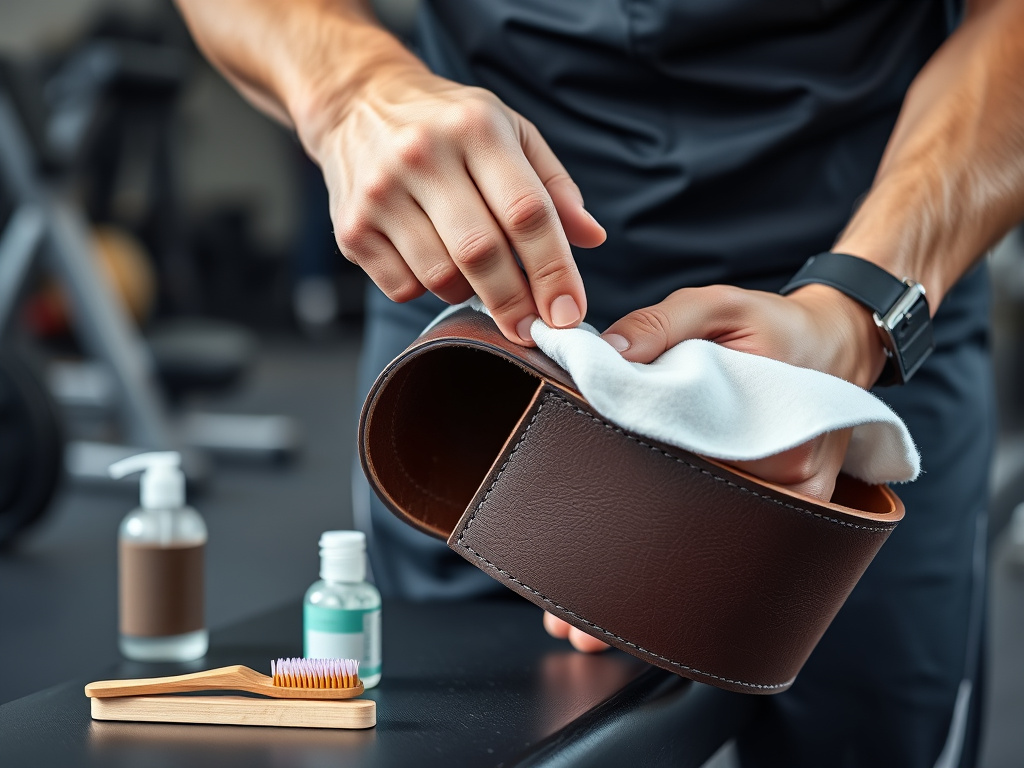
A belt isn’t something you clean when it looks dirty. You maintain it on a schedule because the damage happens invisibly first. Salt crystals from sweat work into the fiber weave like microscopic glass. Heat from a car trunk bakes out the leather’s natural moisture. The system below intercepts those processes.
Proper leather belt care is a preventative maintenance schedule, not a reactive cleaning. Research on leather material science confirms that thermal stress from artificial drying and salt crystallization from sweat are among the most damaging factors for natural fiber integrity.
The goal is to preserve the belt’s ability to do its job: provide a rigid, consistent surface for bracing. A belt that’s rotten, cracked, or warped is a decorative piece, not a tool.
1. Cleaning: Fight the Invisible Enemy (Salt)
You wipe your brow after a set. You should wipe your belt, too. The inner surface, pressed against your sweating back, is the frontline.
Start dry. Brush off loose chalk and debris with a soft cloth. If chalk is packed into the grain, a soft-bristle toothbrush works without scratching. Wetting chalk first turns it into a paste that’s harder to remove.
For the weekly clean, dampen a cloth with lukewarm water. If you need more power, use a leather-specific cleaner or a tiny amount of saddle soap lathered on the cloth. Work in circular motions, focusing on the inner side. Never soak the belt or dunk it in water.
Here’s what happens if you skip it: Salt absorbs ambient moisture and holds it against the leather, promoting bacterial growth. Within months, the affected area loses its tensile strength. It might not crack for a year, but the rigidity is gone.
2. Drying: The Patient Wait
This is the step that breaks most routines. A wet belt is inconvenient. The temptation is to speed it up.
Don’t.
Hang the belt in a room with good airflow. A fan is fine. A hair dryer, radiator, or dashboard is not. High heat causes the collagen fibers to contract violently and lose their bond. The belt comes out stiff as a board, and micro-cracks will appear with the next bend.
Depending on your humidity, this takes 1 to 3 hours. Plan your cleaning session accordingly. A belt that feels dry to the touch on the surface may still be damp inside the 10mm thickness. Give it the full time.
3. Conditioning: The Annual Ritual
Conditioner isn’t food; it’s a moisture supplement. Leather has natural oils. Our job is to replenish what cleaning and oxidation remove.
Where this goes sideways: The belief that more conditioner equals more protection. Over-conditioning softens leather excessively and can weaken the fiber structure over time. Condition until the leather feels supple and slightly richer in color, not until it feels greasy.
Once or twice a year is the standard for most belts in regular use. For a belt used twice a week, once a year is often sufficient. The best products are pure neatsfoot oil or a high-quality commercial conditioner like Bick 4. Apply a thin coat with a cloth, let it absorb for an hour, and buff off any excess.
Think of it like applying a hand-rubbed oil finish to wood. You work in thin, even coats, letting each one be fully absorbed before even thinking about the next.
4. Storage: More Than Just a Dry Place
Where the belt lives between sessions determines its shape. The two worst places are a damp gym bag and a hot car trunk.
Store it in a dry, room-temperature environment. Lay it flat on a shelf or hang it from a peg. This maintains its natural curve.
| Storage Method | Pros | Cons & Long-Term Risk |
|---|---|---|
| Laid Flat | Supports full length, prevents stress points. | Requires shelf space. |
| Hanging | Keeps shape, promotes air circulation. | Must use a wide hook to avoid pinch-point dent. |
| Tightly Rolled | Saves space in a bag. | Creates a permanent crease that becomes a structural weak spot. |
| Folded at Buckle | Seems convenient. | Guarantees a deep, permanent fold that will crack. |
The goal is to avoid creating any new sharp bends. A belt that’s been folded for six months will have a memory. That memory is a fault line.
When Standard Care Isn’t Enough: Edge Cases and Repairs
Sometimes, things go wrong. A belt left in a basement develops a white powdery coating. A buckle starts to wiggle. The standard wipe-down won’t fix these.
Treating Mold and Mildew
That white or fuzzy growth is a fungus feeding on organic material—your belt. Don’t panic, and don’t use bleach.
Mix a 50/50 solution of white vinegar and water. Dampen a cloth with it and gently wipe the affected areas. The acetic acid in vinegar kills the mold spores without damaging the leather fibers like harsh chemicals would. After treatment, let the belt dry completely, then condition that area as the process can be drying.
Lever and Screw Maintenance
For belts with a lever mechanism or screws instead of rivets, hardware security is part of care. Every few months, check each screw. Use the correct size screwdriver and give each one a gentle, quarter-turn tighten. Overtightening can strip the thread in the leather.
This is about the metal parts shaking loose over hundreds of heavy deadlifts. A loose screw means a shifting buckle, which means inconsistent support.
When to Use the Warranty
Brands like Adidas and Rogue offer strong warranties because they build belts to last. Know what’s covered.
The Adidas Leather Weightlifting Belt has a lifetime warranty against manufacturing defects. The Rogue 3″ Ohio Belt has a limited lifetime warranty on structure, leather, and buckle. Both explicitly exclude damage from neglect—like cracks from heat drying or rot from never cleaning sweat out.
If a seam splits on a two-month-old belt with normal use, that’s a claim. If the leather is cracked because you dried it on a heater for a year, that’s on you. The warranty is for defects in craft, not a replacement for the four-part care system.
Choosing Your Tools: Cleaners and Conditioners Decoded
Walk into a store and the options are overwhelming. Most are marketing. You need two things: a mild cleaner and a simple conditioner.
- For Cleaning: A dedicated leather cleaner or a saddle soap. Saddle soap is stronger, designed for filthy saddles. For a gym belt, a milder leather cleaner is often a better choice to avoid over-stripping oils.
- For Conditioning: Neatsfoot oil (traditional, penetrates deeply), mink oil (softens noticeably), or a modern conditioner like Leather Honey or Bick 4 (easy to apply, less greasy).
- What to Avoid: Dish soap, hand soap, rubbing alcohol, silicone-based “conditioners,” and anything not made for leather. These strip natural oils or coat the surface in a plastic-like film that prevents the leather from breathing.
A client once followed a simple regimen of wiping down and annual conditioning for a year. When they showed me their belt, it had developed a gorgeous, even patina—a deep, rich color that proved the oils were distributed and the leather was healthy from the inside out. That’s the visual proof the system works.
Frequently Asked Questions
How often should I clean my leather weightlifting belt?
Wipe down the inner surface with a dry or damp cloth after every use. Perform a full cleaning with a leather cleaner every two to four weeks, depending on how much you sweat. A belt used daily needs weekly attention; one used twice a week can go a month.
Can I use mink oil on my weightlifting belt?
Yes, but sparingly. Mink oil is an excellent conditioner that softens leather. The risk is overuse. Applying it too often can oversoften the belt, reducing its supportive rigidity. Once a year is a safe frequency for mink oil on a thick lifting belt.
My belt is very stiff. How can I soften it?
Use it. The best way to break in a stiff belt is through controlled, moderate-weight sessions. You can also manually flex and roll it gently. Avoid drastic measures like soaking it in water or oil, which can weaken the fibers. For a structured guide, our article on softening a leather belt covers safe, effective methods.
Is my leather belt ruined if it gets moldy?
Not necessarily. Mold on the surface can be treated. Use a 50/50 vinegar and water solution on a cloth to wipe the area, then let the belt dry fully away from heat. Condition afterward, as the vinegar can be drying. The belt is only ruined if the mold has deeply rotted the leather, which feels spongy and falls apart.
What’s the best way to store a belt long-term?
Clean and condition it first. Then store it flat in a cool, dry, dark place—like a closet shelf. Do not seal it in a plastic bag, as trapped moisture encourages mold. Let it breathe. For more on preserving all kinds of leather, our general leather care principles apply here too.
Before You Go
The single biggest mistake is inconsistency. A belt treated perfectly three times and then forgotten for a year is worse off than one receiving a simple, regular wipe-down.
If you take one action this week, make it this: after your next session, take 60 seconds to wipe the inside of your belt with a dry cloth and hang it over a chair back to air out. That tiny habit, repeated, does more than any annual deep-clean marathon.
And if you’re shopping for a new belt, remember that care starts with the purchase. A belt from Inzer, which stands behind its product with a real warranty, is easier to maintain because the materials are right. Our review of the best leather weightlifting belts separates the marketing from the genuinely durable options.
