
How to Choose Leather Furniture for Your Lifestyle & Home
This post contains affiliate links. As an Amazon Associate, we earn from qualifying purchases.
To choose leather furniture, match the leather’s protective finish to your household’s wear level, verify the frame and cushion construction uses hardwood and high-density foam, and always test the seat depth and back height in person. The right choice balances durability specs with daily comfort, not just aesthetics.
That balance point is where most buying guides stop. They’ll list leather types and tell you to sit on it. The part they skip is the mechanical reality of why one sofa sags in three years and another holds its shape for fifteen. It’s not magic. It’s the interaction between a 20 Newton tear strength rating, the flex of an eight-way hand-tied spring base, and how often your dog jumps onto the same cushion corner.
What follows is a breakdown of the three decision layers: the leather surface you touch, the hidden structure that supports you, and the fit for your room and life. By the end, you’ll be able to read a product spec sheet and know whether you’re looking at a decade-long companion or a short-term placeholder.
Key Takeaways
- The finish dictates care. Aniline leather shows a beautiful patina but marks easily; pigmented (protected) leather resists stains and is the practical choice for homes with kids or pets.
- Construction overrides looks. A sofa with a kiln-dried hardwood frame and high-resiliency foam cushions will outlast one with a particleboard frame and low-density foam, regardless of how expensive the leather looks.
- Warranties tell a truth. A one-year warranty on the leather is industry standard and sufficient, real defects show up fast. A longer warranty on the frame (5+ years) signals confidence in the build.
- Measure twice, buy once. Use painter’s tape to map the sofa’s footprint in your room, and always test the seat depth and back height for your body. A beautiful sofa that’s uncomfortable is a permanent mistake.
- Synthetic “leathers” like bonded leather have a predictable failure mode: the surface layer peels at high-contact points within a few years. They are a cost-saving choice, not a durable one.
The Leather Finish is Your First Filter
Forget “genuine leather. Your first real filter is the finish, the treatment applied to the top layer of the hide. This determines how the furniture will look, feel, age, and survive your daily life.
The international standard ISO 16131:2012 sets minimum performance benchmarks for upholstery leather. For instance, it requires a tear strength of at least 20 Newtons and specifies colour fastness ratings for rubbing and light. These are the hidden specs that separate durable leather from decorative covering.
Full grain and top grain refer to the hide’s quality, but the finish decides its personality. Here’s how the common types break down in practical terms.
Aniline & Semi-Aniline: The Natural Look
Aniline leather is dyed with soluble dyes but has no protective pigment topcoat. This lets the hide’s natural grain and markings, scars, insect bites, stretch marks, show through vividly. It’s the most breathable and develops a rich, unique patina over time.
The trade-off is fragility. Aniline leather absorbs oils and spills readily. A splash of water will leave a dark spot. Denim can transfer dye onto it.
- Best for: Low-traffic, adult-only spaces like a formal living room or a study. It’s for those who cherish natural character and are willing to baby the furniture.
- The catch: I once stored a leather jacket in a plastic bag for a season, thinking it was safe. Trapped moisture led to mildew. Aniline leather needs airflow and a careful owner.
Semi-aniline leather gets a light protective topcoat, just enough to add some stain resistance and colour consistency without fully masking the grain. It’s the middle ground: you still see natural variation, but a spilled drink won’t necessarily become a permanent tattoo if wiped up quickly.
Pigmented (Protected) Leather: The Family Workhorse
This is the default for a reason. A layer of pigment and a clear protective topcoat are applied to the surface. This creates a uniform colour and a barrier against spills, oils, UV light, and abrasion.
It feels slightly different, less like raw hide, more like a coated surface. The grain is often embossed for consistency. The benefit is immense practical durability. It’s the finish you want for a family-friendly leather sofa that sees daily use.
| Finish Type | Best For | Feels Like | Ages By |
|---|---|---|---|
| Aniline | Collectors, low-traffic rooms | Soft, warm, natural | Developing a deep, personal patina |
| Semi-Aniline | Those wanting character with less worry | Soft with a slight surface sheen | Gentle patina, more colour consistency |
| Pigmented | Families, high-use spaces, pets | Smooth, consistent, slightly coated | Resisting change; may show wear as gloss loss |
Common mistake: Choosing aniline for a primary family room because it looks “richer.” The first juice box spill or pet scratch will deliver a permanent, costly lesson in material science.
Bonded & Synthetic Leathers: The Short-Term Option
Bonded leather is a pulp of leather fibers bonded with polyurethane and layered onto a fabric backing. PU leather is entirely polyurethane. They look like leather initially and are easy to clean.
Here’s the predictable failure mode, confirmed by furniture retailers: the surface peels and flakes at high-contact points, armrests, seat edges, within a few years. They are a budget-conscious choice for temporary furniture, not a heirloom. If longevity matters, invest in real hide.
The Frame & Cushions Hold It All Up
A beautiful leather hide draped over a weak frame is a waste. The structure is everything. You can’t see it once the sofa is assembled, so you must ask or research.
The frame is the skeleton. Kiln-dried hardwood (like oak, ash, or maple) is the gold standard. It’s stable and resists warping. Avoid frames made from particleboard, fiberboard, or plastic composites. They lack the long-term structural integrity and can squeak or fail under stress.
The suspension supports the seat. Eight-way hand-tied springs are the traditional, durable choice. Sinuous (S-shaped) spring systems are also common and robust. A simple webbing or mesh base is often found in lower-cost models and may not provide the same long-term support.
The cushions define comfort. High-resiliency (HR) foam is dense and bounces back. A density rating of 1.8 to 2.A density of 5 pounds per cubic foot is a target for durability. Low-density foam compresses quickly, leading to permanent “body dents.” Down-wrapped foam cushions offer luxurious softness but require regular plumping.
When you test a sofa, don’t just sit, flop. Sit squarely in the middle of a cushion, then on the very edge. Does the frame feel solid, or does it flex? Do the cushions bottom out? This physical test tells you more than any spec sheet.
The Three-Step Fit Test (Before You Buy)
A sofa is a spatial commitment. Getting the fit wrong makes your room feel awkward every single day.
- Tape the Floor. Before you go shopping, measure your desired sofa’s dimensions and mark its footprint on your floor with painter’s tape. Include the full depth. Live with the tape outline for a day. Walk around it. Does it block natural pathways? Does it make the room feel cramped? This prevents the #1 post-delivery regret: “It’s too big.”
- Test the Personal Fit. Seat depth and back height are not one-size-fits-all. A standard seat depth is about 21 inches. If you’re tall, look for 23-24 inches so your thighs are supported. The back should hit between your shoulder blades for proper lumbar support. Always, always sit in it.
- Match the Configuration to the Room. A large sectional can anchor an open-plan living room. A standard sofa or loveseat offers more flexibility for rearrangement. Consider a leather sectional if you need maximum seating, but only if the room’s shape and traffic flow can accommodate its permanent L-shape.
How to Read a Warranty (And What It Really Covers)
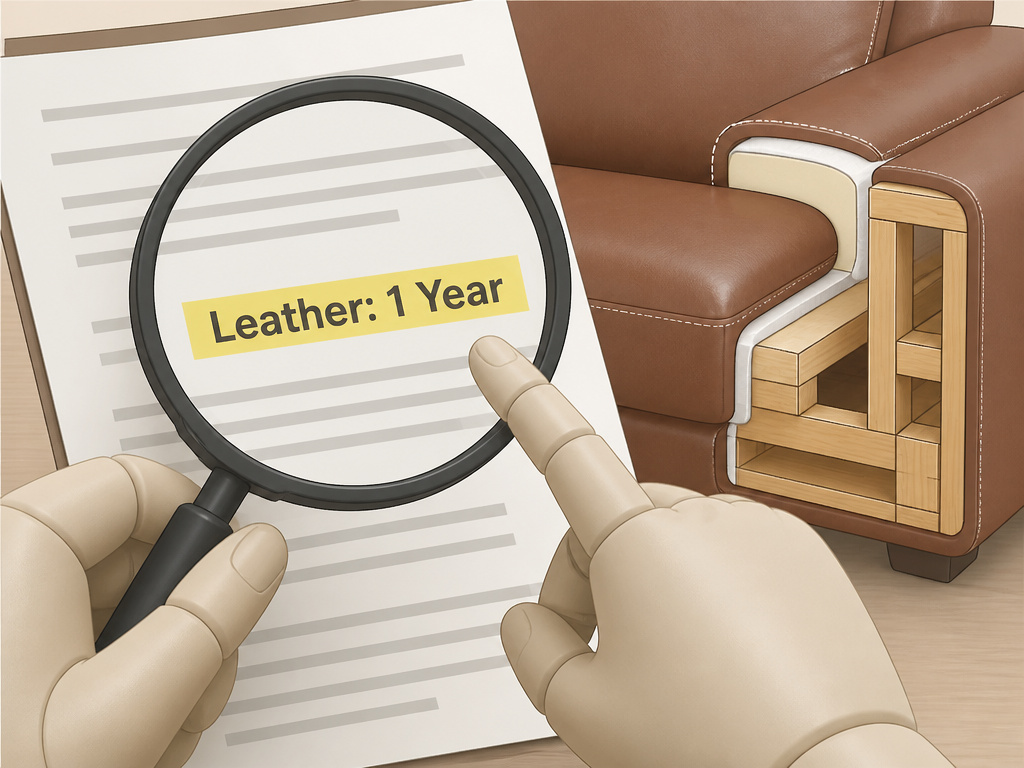 Warranties show a manufacturer’s confidence, but they are not a full insurance policy.
Most quality manufacturers offer a long-term warranty on the frame and suspension, often 5 years to a lifetime. This is because a well-built frame shouldn’t fail under normal use.
The warranty on the leather itself is typically only one year. And that’s actually sufficient. As one furniture guide notes, a year is “plenty of time for a leather defect to show itself.” Manufacturing flaws in the dyeing or finishing process become apparent quickly. Warranties almost never cover damage from spills, scratches, or sunlight, those are care issues.
Where this goes sideways: Assuming a 10-year “fabric” warranty applies to leather. Read the fine print. Coverage is almost always segmented: frame, springs, cushions, leather. Know which part is covered for how long.
When evaluating a leather sofa, a strong frame warranty is more meaningful than a long leather warranty.
The Long-Term Care Non-Negotiables
!Essential leather furniture care tips for durability.jpg) Your choice of leather dictates your care routine. This isn’t periodic deep cleaning, it’s the daily and weekly habits that prevent damage.
- Keep it out of direct sunlight. UV light is the fastest way to fade any leather, especially aniline. Use blinds or curtains.
- Dust and vacuum weekly. Grit and dust act as abrasives, grinding into the finish over time. Use a soft brush attachment.
- Clean spills immediately. Blot, don’t rub. For protected leathers, a damp cloth is often enough. For aniline, you may need a dedicated, pH-balanced leather cleaner.
- Condition only when needed. Modern pigmented leathers rarely need conditioning. Over-conditioning can soften the substrate and attract dirt. If the leather feels stiff or looks dry, use a product like Leather Master’s Protection Cream sparingly.
- Rotate and flip cushions every few months to ensure even wear.
For a detailed routine, our guide on how to care for leather furniture walks through the products and techniques.
Frequently Asked Questions
Is top grain leather better than full grain for furniture?
For furniture, not necessarily. “Full grain” means the entire top layer of the hide, including the natural grain, is intact. “Top grain” is sanded to remove imperfections. In upholstery, top grain is often used for pigmented finishes where a uniform surface is desired. Both are excellent, durable choices. The finish (aniline vs. Pigmented) is a more important daily-use differentiator than the grain classification.
Can leather furniture be pet-friendly?
Yes, if you choose a high-density polyurethane foam. Pigmented (protected) leather is your best bet. It resists scratches from claws better than aniline and is easier to clean. Keep your pet’s nails trimmed, and use a throw blanket on their favorite spot. Avoid ultra-soft, aniline leathers if you have cats or large dogs.
How long should a good leather sofa last?
Well-constructed leather sofa with a hardwood frame and quality cushions should last 15 to 25 years with proper care. The leather itself will develop a patina and soften, but it should not crack or peel. The failure point is usually the cushion foam compressing or the frame loosening, not the leather wearing out.
Is bonded leather ever a good buy?
Only in very specific, temporary scenarios. Bonded leather can be a cost-effective choice for a college apartment, a short-term rental, or a piece of furniture you know you’ll replace in 2-3 years. Understand you are buying a decorative surface with a limited lifespan.
What’s the most important thing to check when buying online?
Construction details and return policy. Reputable online retailers will list the frame material, cushion foam density, and leather type/finish. If those specs are vague or missing, be wary. Always order a physical leather swatch to check colour and texture. Finally, understand who pays for return shipping if the piece doesn’t fit or look right in your space, it can be prohibitively expensive.
The Bottom Line
Choosing leather furniture is a series of intentional trade-offs. You trade the sublime, high-maintenance beauty of aniline for the rugged practicality of pigmented leather. You trade a lower upfront cost for the long-term value of a hardwood frame.
The one non-negotiable is fit. A sofa that’s too deep, too tall, or too big for the room is a daily annoyance. Tape it out. Sit in it. Let the practicalities of your life, kids, pets, movie nights, guide the finish you select.
Start with the leather type and finish that matches your household’s reality. Then, invest your budget in the best frame and cushion construction you can find within that category. That’s the formula for a piece you’ll live with happily for decades, not just a few years.
