
Learn How to Choose a Leather Sofa: Key Factors Explained
This post contains affiliate links. As an Amazon Associate, we earn from qualifying purchases.
To choose a leather sofa that lasts, ignore the showroom gloss and focus on three verifiable specs: the leather label (full-grain or top-grain, not “genuine”), the frame material (kiln-dried hardwood with corner-blocked joinery), and the foam density (minimum 1.8 PCF, with 2.5 PCF for a decade-plus of firmness). A sofa missing any one of these will show wear within a few years.
That checklist seems simple, but the furniture industry thrives on vague labels that obscure those exact details. The difference between a sofa that softens beautifully and one that peels unattractively isn’t about price alone—it’s about the technical breakdown hidden behind marketing terms.
What follows is a walkthrough of the physical checks you can perform. We’ll decode leather grades and finishes, explain how to test a frame’s integrity, and define the cushion specs that prevent sagging. By the end, you’ll be able to read any product description and know whether you’re looking at a long-term investment or a short-term placeholder.
Key Takeaways
- The label “Genuine Leather” is a bottom-tier classification; insist on “Full-Grain” or “Top-Grain” and ask for a written materials breakdown to avoid “leather match” on hidden panels.
- Lift one front corner of the sofa. A quality kiln-dried hardwood frame won’t twist or creak; a frame that flexes is a warranty claim waiting to happen.
- Seat cushions need foam with a density of at least 1.8 PCF (pounds per cubic foot). For a sofa that stays firm beyond five years, look for 2.5 PCF.
- For users under 5’6″, a seat deeper than 22 inches can cause lower back strain because your feet won’t reach the floor to support your posture.
- That “new sofa smell” is off-gassing VOCs from adhesives and finishes; unwrap the sofa immediately and ventilate the room for several days.
The Single Most Important Spec: Leather Labeling
Let’s be clear about this. The most common mistake is trusting the word “leather” on a tag. The industry uses specific, tiered terms that tell you everything about durability. “Genuine leather” is the lowest grade, coming from the fibrous layers of the hide split after the top is removed. It’s often sanded, embossed with an artificial grain, and coated heavily. This is the stuff that cracks and peels within a few years.
You want full-grain or top-grain leather. Full-grain is the entire, un-sanded outer layer of the hide, complete with natural markings and grain. It develops a rich patina over decades. Top-grain is the same outer layer, lightly sanded to remove imperfections, resulting in a more uniform look while retaining most of the strength. Both are legitimate investments.
Common mistake: Assuming “100% Leather” or “Genuine Leather” indicates quality. Historically, these labels have indicated a split or damaged hide that has been heavily corrected and coated. The underlying material degrades quickly.
Here’s where it gets tactical. Always ask: “Can you provide a written materials breakdown?” Many sofas use a “leather match” construction—top-grain leather on the seat, arms, and back cushions, paired with a synthetic or bonded leather on the side panels, rear, and underside. Brands like Ashley or Wayfair should disclose this, but you must ask. That synthetic material will age and wear differently, creating a two-tone effect.
| Leather Label | What It Actually Means | Real-World Longevity |
|---|---|---|
| Full-Grain | The entire top layer of the hide, unsanded. Shows natural markings. | 15+ years with proper care; develops a patina. |
| Top-Grain | The top layer, lightly sanded for uniformity. Still durable. | 10-15 years; more stain-resistant than full-grain. |
| Corrected-Grain / “Genuine” | Heavily sanded split leather with an artificial grain embossed on top. | 3-7 years; prone to cracking and peeling at high-contact points. |
| Bonded Leather | Pulverized leather fibers bonded with polyurethane onto a fabric backing. | 1-3 years; will flake and peel consistently. |
Your first stop for a deeper dive on this should be our guide on full grain vs top grain leather, which breaks down the tactile and visual differences.
Finish Determines Care and Character
Once you know the leather grade, the finish dictates how it will look, feel, and handle your life. There are three main types, and your choice here is a balance between natural beauty and practical durability.
Aniline finishes soak dye directly into the leather with little to no protective topcoat. This gives you the softest, most natural hand-feel and allows the hide’s unique grain to shine. The trade-off? It’s the most absorbent. Spills must be blotted immediately, and sun exposure will fade it more noticeably. It’s a purist’s choice.
Semi-aniline finishes add a light protective layer (usually a light pigmented coating) over the aniline dye. You get about 80% of the natural look and softness with significantly better stain and fade resistance. For a primary family sofa, this is the balanced, recommended choice.
Pigmented finishes have a thicker, colored polymer coating on the surface. This creates a very uniform, durable, and easy-to-clean leather that resists scratches, spills, and sun. The downside is it can feel plasticky and won’t develop a natural patina. It’s often used on contract-grade furniture for hotels and offices.
A quick hidden-spot test: more protected leathers tend to bead moisture longer, while more absorbent aniline finishes will darken faster where water touches.
The finish also determines your care routine. Aniline leather needs specialized, pH-balanced cleaners. Pigmented leather can handle milder soaps. This is a permanent decision, so choose based on your household’s reality. For a detailed comparison, our article on aniline vs pigmented leather is essential reading.
Sit on It, Then Shake It: Testing Frame and Suspension
Good leather cannot rescue a weak build. The frame is the skeleton, and you need to test it like one. When you’re in a showroom, don’t just sit—perform a rack test. Lift one front corner of the sofa about six inches off the ground. A well-built frame will feel solid, with minimal twisting or creaking. If it groans or flexes easily, the joinery is insufficient. That frame will loosen over time, leading to wobbles and squeaks.
What are you looking for in the specs? Kiln-dried hardwood is the standard for stability—oak, maple, and beech are common. Kiln drying removes internal moisture to prevent the wood from warping later. Avoid frames made from softwoods like pine, particleboard, or excessive use of staples.
The joinery matters as much as the material. Look for frames assembled with a combination of dowels, screws, and corner blocks (triangular wood pieces glued and screwed into the joints for reinforcement). This is the hallmark of quality construction.
Under the cushions, the suspension system supports your weight. The two main types are sinuous springs (continuous, serpentine-shaped wire) and 8-way hand-tied springs (individual coils tied together in eight directions). A well-made sinuous spring system is perfectly fine for most homes. The “8-way hand-tied” label is often marketed as superior, but execution is everything. A poorly executed one is worse than a good sinuous system. Sit down firmly. You should feel even support across the seat, not a hard edge or a sudden drop.
The Foam Density Rule That Prevents Sagging
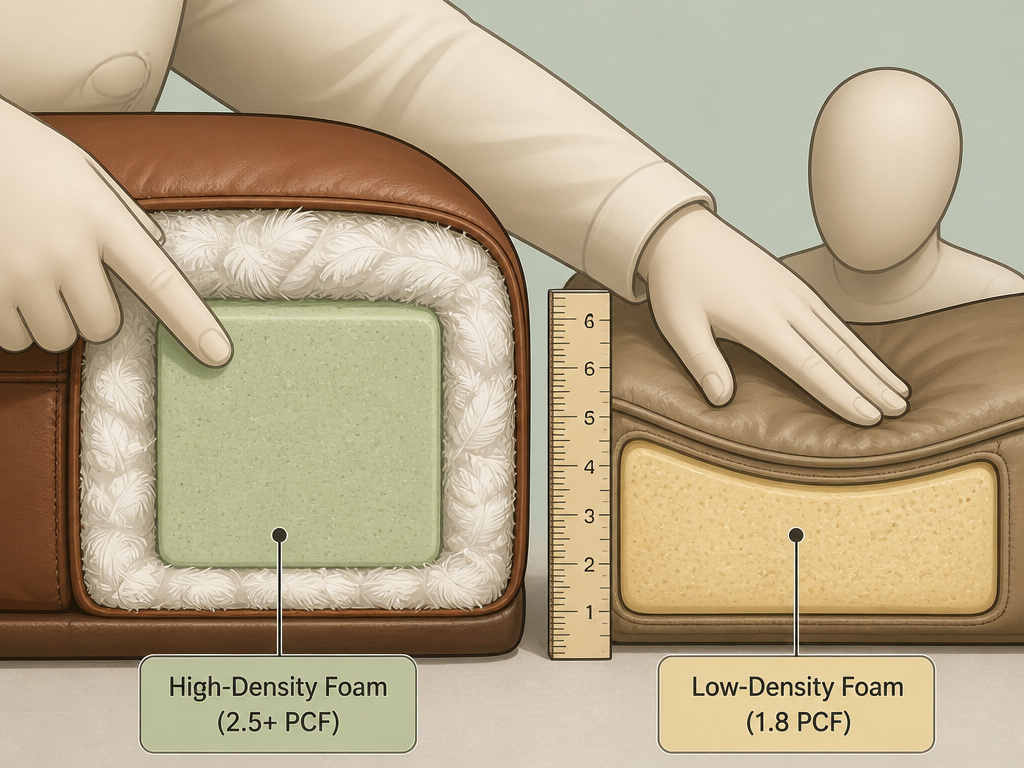 Cushions are where comfort meets physics. The filling determines how the sofa feels today and how it will hold up in five years. The critical number is foam density, measured in pounds per cubic foot (PCF). This is not the same as firmness.
Most mid-range sofas use foam with a density of about 1.8 PCF. This is the accepted minimum for a cushion that won’t bottom out too quickly. If you want a sofa that retains its shape and support for a decade or more, you need to look for a density of 2.5 PCF or higher. Higher-density foam resists compression fatigue, meaning it springs back year after year.
Where this goes sideways: Choosing a cushion by feel alone. A soft, low-density foam cushion feels plush initially but will compact into a hard, shapeless slab within two years. A firmer, high-density foam will break in gracefully and maintain its structure.
Common fillings include: – High-Density Foam: The workhorse. Provides lasting support and shape retention. The higher the PCF, the longer it lasts. – Down-Wrapped Foam: A core of high-density foam wrapped in a down blend. Offers a plush, sink-in feel with underlying support. Requires regular fluffing. – Polyester Fiberfill: A budget option that flattens quickly. Avoid it in primary seating areas.
When testing, don’t just perch on the edge. Sit all the way back, then get up. Watch how quickly the cushion decompresses. A quality cushion will regain most of its shape within a minute. If the dent remains, the foam is low-quality.
This is a core part of any complete leather furniture guide.com/how-to-choose-leather-furniture/), as the principles apply to chairs, sectionals, and sofas alike.
Measuring for Reality, Not Just the Room
 A sofa that fills two-thirds of its wall space anchors the room visually. But you must measure for two spaces: the room it lives in, and the path it takes to get there. I’ve seen more delivery disasters from ignored hallway corners than from any other mistake.
First, measure your room. Leave at least 30 inches of walking room between the coffee table and the sofa for comfortable circulation. For the wall itself, the two-thirds rule is a reliable starting point.
Second, create a delivery path map. Measure: – Doorway widths (especially the final doorway into the room) – Hallway widths and heights – Any stairwells, landings, or elevator dimensions – Sharp corners in the path
A general rule: the sofa’s narrowest dimension (usually the height if tipped sideways) needs to clear the narrowest point on the path with at least two inches to spare. If clearance is tight, confirm if the sofa disassembles. Many sectionals ship in multiple pieces, and some sofas have removable legs or arms.
Seat depth is a personal comfort spec with real ergonomic consequences. A depth of 20-22 inches is standard for upright sitting. Deeper seats of 23-26 inches are for lounging. Here’s the critical caveat: if anyone in your home is under 5’6″, a deep seat can be uncomfortable. Their feet won’t reach the floor to provide support, leading to slouching and lower back strain during a movie. Always test-sit for at least ten minutes.
Choosing the right type is part of the sizing equation. Our breakdown of leather sofa types covers the pros and cons of standard sofas, sectionals, and apartment-sized models to match your space.
The Long-Term Value Calculation
Price is a signal, but not a guarantee. A high price can reflect better materials and labor, or it can reflect brand markup and designer labels. Your goal is to ensure you’re paying for the former.
Break down the cost drivers: 1. Leather: Full-grain aniline leather is the most expensive. Top-grain semi-aniline is a cost-effective, high-performance choice. Corrected-grain is cheaper. 2. Frame & Suspension: Kiln-dried hardwood and 8-way hand-tied springs add cost. Plywood and sinuous springs reduce it. 3. Cushions: High-density foam (2.5 PCF+) costs more than low-density foam. 4. Labor: Hand-tufting, detailed stitching, and complex designs increase labor costs.
The warranty is the manufacturer’s confidence shown in writing. Look for a minimum 10-year warranty on the frame and at least a 3-year warranty on the cushions and leather. Read the exclusions. A “limited” warranty that only covers frame splintering is useless. A good warranty covers joint failure, spring failure, and significant foam degradation.
A strong warranty reflects the manufacturer’s confidence in their sofa’s quality and longevity.
Finally, consider the timeline. Bonded leather will look tired in under three years. A quality top-grain, semi-aniline leather sofa on a solid frame should look and feel great for a minimum of ten years with basic care. That’s the real value equation—cost per year of good use. For a specialized piece like a recliner, the value factors shift, which is why we have a dedicated leather recliner guide.
Frequently Asked Questions
Is a leather sofa a bad choice if I have pets?
It depends on the finish. Pigmented or semi-aniline leathers are excellent with pets—they resist scratches and are easy to wipe clean. Avoid aniline leather, as claw marks will be more visible and stains harder to treat. Trim your pet’s nails regularly, and a leather sofa can outlast a fabric one that traps hair and odors.
How do I get rid of the strong “new sofa smell”?
That smell is off-gassing from VOCs in adhesives, foam, and finishes. It’s not just unpleasant; in high concentrations, it can cause headaches. Unwrap the sofa immediately in a well-ventilated room. Open windows and run fans for 3-5 days. The odor should dissipate significantly. If it persists for weeks, contact the manufacturer.
Can I condition my new leather sofa to keep it soft?
Don’t condition a new sofa for at least the first six months. Modern leathers, especially protected finishes, come with factory-applied coatings that conditioners can’t penetrate. Over-conditioning can actually soften the supportive substrate underneath the leather, leading to premature sagging. For the first year, just dust and dry-clean with a soft cloth.
What’s better for a family room: leather or fabric?
This is a classic debate. Leather wins for durability, ease of cleaning (spills wipe up), and resistance to allergens and pet hair. Fabric offers more color/pattern variety and can feel warmer. For active families, a protected leather (semi-aniline or pigmented) is often the more practical, long-term choice. We explore this in detail in our leather vs fabric comparison.
Are there ethical or environmental concerns with leather sofas?
Leather is a byproduct of the meat industry. The main environmental impact comes from the tanning process, specifically chrome tanning, which uses heavy metals. Look for suppliers that mention vegetable tanning or chrome-free tanning for a more eco-friendly option. Some brands now offer leather certified by the Leather Working Group (LWG), which audits environmental practices.
The Bottom Line
Choosing a leather sofa is an exercise in ignoring the surface and investigating the substance. Forget the sales pitch about “rich, buttery leather.” Your three essential questions are: “Is it full-grain or top-grain?”, “What is the foam density?”, and “Can I see the frame construction details?”
If you remember one thing, let it be this: the label “genuine leather” is your cue to walk away. It’s the industry’s least informative term for its least durable product. Invest in a spec, not a story. A sofa built with honest materials won’t be the cheapest option, but its cost per year of comfortable, beautiful use will be the lowest you’ll find.
For your next step, pull out a tape measure and map your delivery path. That single act will eliminate half the stress of the entire process before you even start looking.
