
How Often to Condition Leather: The Ultimate Care Schedule
This post contains affiliate links. As an Amazon Associate, we earn from qualifying purchases.
This post contains affiliate links. As an Amazon Associate, we earn from qualifying purchases.
Condition leather based on use and environment, not just a calendar. For most items in average conditions, apply a conditioner like Lexol or Bickmore every three to six months. Leather in daily use, dry climates, or direct sunlight needs it more often, sometimes monthly. Storage pieces in stable humidity might go a year between treatments. The leather itself will tell you when it’s thirsty.
Forget the rigid “every six months” rule. That advice works until it doesn’t, and when it fails, you get a greasy bag or a cracked jacket. The right interval isn’t a date; it’s the outcome of three things working together: what the leather is, where it lives, and how you use it. A work boot worn on salted winter streets has a different hunger than a handbag stored in a closet.
What follows is a breakdown of those three variables, the physical signs that should trigger your next conditioning session, and the one mistake that does more long-term damage than neglect.
Key Takeaways
- Read the leather, not the calendar. Stiffness, faint cracking, and a dry, papery feel mean condition now. A greasy film or tackiness means you’ve gone too far.
- Type dictates treatment. Full-grain vegetable-tanned leather soaks up conditioner; delicate aniline-dyed leather needs gentle, sparing creams. Using the wrong product for the type accelerates damage.
- Environment cuts the schedule in half. Heated homes, arid climates, and direct sun pull moisture from leather fibers, demanding conditioning as often as every 2-3 months for items in use.
- Over-conditioning is a silent killer. Saturating leather clogs its pores, weakens fiber strength, and creates a gummy residue that attracts dirt. More is not better.
- Always test first. Apply any new conditioner to a hidden spot (inside a belt, under a flap) and wait 48 hours. Check for unacceptable darkening or texture change before treating the whole piece.
The Leather Type Decides the Schedule
Not all leather drinks conditioner at the same rate. The tanning process and final finish determine its porosity and oil retention, which in turn dictates how often, and with what, you should feed it. Using saddle soap on a delicate aniline leather is like using a firehose to water a bonsai tree.
Think of conditioning like building a roux. You need the right fat and a patient, low heat to build a stable foundation without it turning gummy. The “fat” is your conditioner, matched to the leather’s needs.
A proper conditioning schedule starts with identifying your leather. Full-grain, vegetable-tanned leather will absorb more oil, more frequently, than a heavily pigmented, corrected-grain leather designed for high durability and stain resistance.
Here’s a straightforward guide to match frequency with the most common leather types you’ll encounter:
| Leather Type | Best Conditioner Type | Typical Frequency | What Happens If You Overdo It |
|---|---|---|---|
| Full-Grain, Vegetable-Tanned (Belts, holsters, tool sheaths) | Pure oils (Obenauf’s Leather Oil) or heavy balms | Every 1-3 months with heavy use | Leather becomes overly soft, loses shape, and can darken permanently. |
| Full-Grain, Aniline-Dyed (High-end jackets, fine furniture) | Light, absorbing creams (Bickmore Bick 4, Chamberlain’s Leather Milk) | Every 4-6 months | Can darken unevenly, feel tacky, and lose its natural, dry hand. |
| Corrected-Grain / Pigmented (Most car seats, durable bags) | Balanced cream conditioners | Every 6-12 months | Creates a superficial, greasy film that peels and attracts dirt. |
| Nubuck & Suede | Specialist sprays and brushes | Only when visibly dry; often yearly | Conditioner can mat the nap, creating dark, permanent spots. |
This table is your starting map. The “Typical Frequency” column assumes average indoor use in a temperate climate. Now, let’s layer in the real-world factors that shift those numbers.
Your Climate and Use Are the Real Schedule
I learned the limits of a standard schedule the hard way. The advice is to condition every six months. For a client’s bag stored in a perpetually humid climate, that routine led to over-conditioning, the leather developed a persistent greasy feel and started to attract lint. We pulled back to a once-a-year schedule, and the leather stabilized. The environment changed the game.
Your local climate and how often you use the item are the dials that fine-tune the frequency. A pair of leather boots worn through a wet, salty Canadian winter needs more attention than the same boots worn occasionally in Arizona’s dry heat.
Dry, Heated, or Sunny Environments: Indoor heating and air conditioning suck moisture from the air, and from your leather. Direct sunlight does the same while also breaking down dyes. In these conditions, a leather couch by a window or leather shoes worn daily might need conditioning every two to three months during peak season.
Humid or Stable Environments: Consistent, moderate humidity (45-55%) is leather’s best friend. In this setting, a stored leather bag or lightly used leather jacket can easily go 9 to 12 months between treatments without any risk of drying.
High-Use Items: Anything in daily contact wears faster. The oils from your skin, friction, and exposure to elements strip away natural lubricants. This is why the conditioning process for a daily-wear wallet or a favorite chair is more aggressive than for a decorative pillow.
The Ford Owner’s Manual for its leather seats provides a practical, real-world benchmark. It recommends regular cleaning and conditioning to maintain appearance, noting that after cleaning and ensuring the leather is dry, you should “apply a nickel-sized amount of conditioner to a clean, dry cloth, rub until it disappears, allow to dry, and repeat.” That’s a manufacturer telling you that even durable, pigment-finished automotive leather needs a routine.
Signs Your Leather is Thirsty (and Signs It Isn’t)
The leather will tell you what it needs. You don’t need a schedule if you learn to read its physical language. Running your hand over the surface is the most reliable test.
Condition now, it’s thirsty.
- Dryness or Stiffness: The leather feels rigid, inflexible. A jacket sleeve doesn’t drape softly; a bag feels boardy.
- Fine Lines or Cracks: Look closely, especially in high-flex areas like shoe creases or armrests. Small, shallow cracks are the first sign of fiber starvation.
- Faded, Chalky Appearance: The color looks washed out and dull, even after a clean. This is dry leather losing its depth.
Wait, it’s fine.
- Supple and Cool to the Touch: Healthy leather feels firm but pliable, and slightly cool.
- Consistent Sheen: It has a soft, natural luster, not a high gloss or a dry matte finish.
- No Resistance to Flex: When you gently bend it, it moves smoothly without creaking or feeling brittle.
Stop, you’ve over-conditioned.
- Greasy or Tacky Film: Your fingers leave marks or feel slight resistance when wiped across the surface. This is excess conditioner sitting on top, unable to absorb.
- Darkened Spots: Uneven, dark patches where conditioner pooled and saturated the leather.
- Attracts Dirt and Lint: The sticky surface acts like a magnet for dust and debris.
The Right Products for the Job
 Reaching for the wrong conditioner is how good leather goes bad. Most commercial leather conditioners contain far more filler and silicone than actual nourishing oils. They create a superficial shine but don’t nourish the fibers, leading to long-term dryness.
For Rugged, Vegetable-Tanned Leather: Think belts, work boots, and outdoor gear. These are thirsty. Obenauf’s Leather Oil or a pure neatsfoot oil (sparingly) penetrate deeply to weatherproof and nourish. Understand that these will darken the leather, that’s part of the deal.
For Fine Garments and Aniline Leathers: Jackets, gloves, and fine furniture need a lighter touch. Bickmore Bick 4 or Chamberlain’s Leather Milk are absorbing creams that moisturize without dramatically altering color or creating a greasy residue.
For General Maintenance on Pigmented Leathers: Car seats, most bags, and shoes with a shiny finish do well with a balanced cream like Lexol. It replenishes oils without compromising the protective topcoat.
Common mistake: Using mink oil as a universal conditioner. It darkens significantly, can go rancid over time, and attracts dirt. It’s suitable only for rugged, utilitarian work boots where darkening and a heavy wax build-up are acceptable trade-offs for waterproofing.
Let me share what I’ve learned about application. It’s not that one product is bad, it’s that another is better suited because of how the leather was tanned and finished. Applying a leather balm designed for dry, vegetable-tanned leather to a delicate aniline couch will oversaturate it in one treatment.
Why Over-Conditioning Weakens Leather
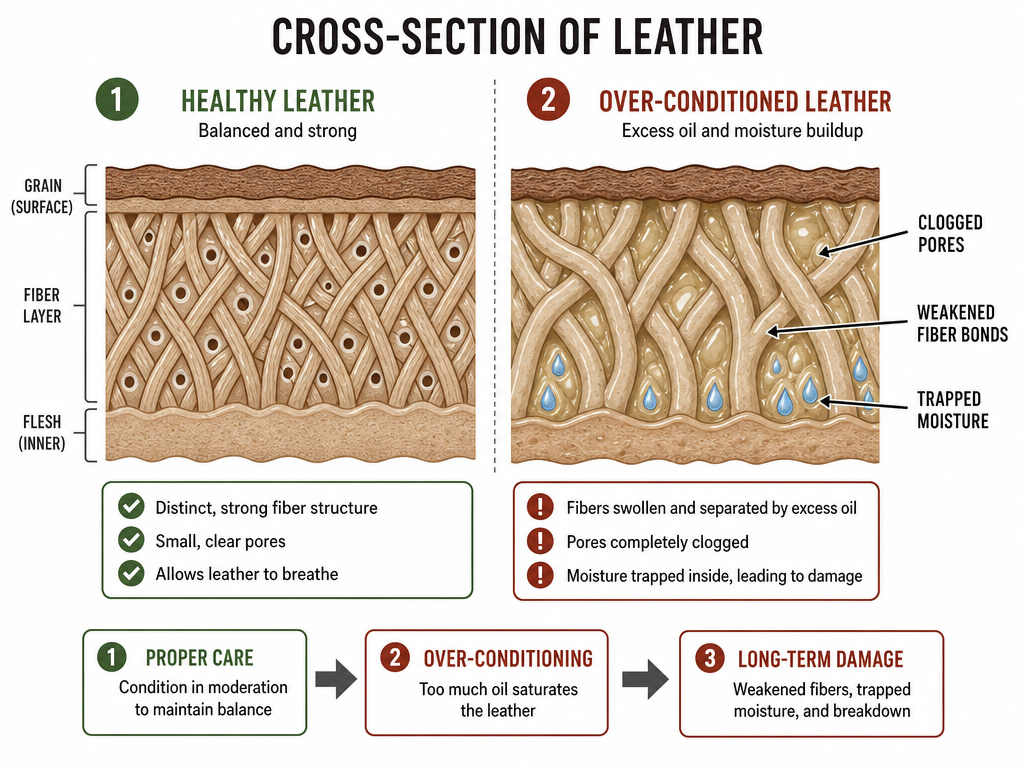 The “more is better” philosophy fails with leather. Saturating the fibers doesn’t make them stronger; it weakens the bonds between them and clogs the material’s natural pores.
Leather needs to breathe. Its breathability is what makes it comfortable to wear and sit on for long periods. When you clog its pores with too much oil or wax, you trap moisture against the skin of the hide, which can promote rot from the inside out. An over-saturated fiber becomes overly soft and loses its tensile strength, the very thing that makes leather durable.
The mechanism is simple: leather fibers are lubricated by natural oils. The goal of conditioning is to replenish those oils. Add too much, and the excess sits between the fibers, acting as a solvent that breaks down their structural bonds over time. You end up with leather that is paradoxically both greasy and weak.
A Step-by-Step Conditioning Session
When the signs point to thirsty leather, here’s how to quench it correctly. This process ensures the conditioner works its way into the fibers where it’s needed, not just sits on the surface.
- Clean First. Always start with a clean surface. Dust and grime act as a barrier. Use a damp microfiber cloth for light dust or a leather-specific cleaner for soils. For my own sports gear, a drop of glycerin saddle soap in a damp microfiber cloth cleans a leather basketball’s deep channels without a shot-altering residue. Let the piece dry completely.
- Apply Sparingly. Apply a small amount of conditioner to a clean, dry cloth, a nickel-sized dollop for a car seat, a pea-sized amount for a boot. Rub the conditioner into the cloth first to distribute it.
- Work It In. Using a circular motion with moderate pressure, work the conditioner into the leather. Focus on high-wear areas first. You should see the leather darken slightly as it absorbs the product, then lighten to its normal shade as you buff.
- Let It Rest. Walk away. Let the conditioner absorb for at least 30 minutes, preferably overnight. This patience allows the oils to migrate deep into the fibers.
- Buff Off Residue. Take a fresh, dry microfiber cloth and buff the entire surface. This removes any excess conditioner that didn’t absorb, leaving a clean, natural finish with no film. If any greasy spots remain, you used too much, buff more vigorously.
Skip the buffing step at your peril. The leftover film will attract every speck of dust in the room and feel unpleasant to the touch within a day.
Frequently Asked Questions
Can you condition leather too much?
Absolutely. Over-conditioning clogs leather’s pores, weakens the fibers by oversaturating them, and creates a greasy film that attracts dirt. Leather that feels tacky or looks unevenly dark is often over-conditioned. It’s harder to fix than under-conditioning.
Does conditioning leather darken it?
Most quality conditioners will cause a slight, temporary darkening as the oils absorb, which fades as the leather dries. Pure oils like neatsfoot or mink oil cause significant, permanent darkening. Always test any new product on a hidden area first and wait 48 hours to see the final effect.
How do I know if my leather needs conditioning or cleaning?
Run your hand over it. If it feels gritty, dusty, or has visible stains, it needs cleaning. If it feels dry, stiff, or shows fine cracks when flexed, it needs conditioning. Often, it needs both, clean first, then condition.
What’s the best leather conditioner?
There is no single “best.” For fine, aniline-dyed leathers and garments, Bickmore Bick 4 is excellent. For rugged, vegetable-tanned work leather, Obenauf’s Leather Oil is a top choice. For general-purpose care on pigmented leathers like car seats, Lexol Conditioner is a reliable standard.
Can I use olive oil or coconut oil to condition leather?
No. These kitchen oils can go rancid, attract pests, and permanently stain leather. They also lack the specific lubricants and tanning agents that leather loses, which products like Nikwax Conditioner for Leather™ are formulated to replace.
Before You Go
The most useful rule isn’t a time interval. It’s this: condition leather when it asks for it, not when a calendar says you should. Develop the habit of checking your favorite pieces every month or so, flex the leather, feel its surface. That tactile check is worth more than any preset reminder.
If you’re unsure, err on the side of under-conditioning. You can always add another light coat if the leather still feels dry after a day. Fixing over-conditioning, however, often requires a professional’s help to strip back the excess without damaging the hide. Your leather goods are an investment. This is based on years of practical experience: listen to them, and they’ll last for decades.
