
How to Soften a Leather Watch Band: A Proven Wear-In Guide
This post contains affiliate links. As an Amazon Associate, we earn from qualifying purchases.
To soften a leather watch band, you need to apply a dedicated leather conditioner in thin coats, manually flex the strap to break in its fibers, and wear it regularly. The goal is to add suppleness, not moisture. Shell cordovan and vegetable-tanned leathers respond best; genuine leather or bonded straps may not soften much at all before failing.
The process hinges on understanding the leather’s structure. Think of it like breaking in a baseball glove. You’re not trying to soak it. You’re working oils into the collagen fibers so they slide against each other more easily, which reduces stiffness and prevents cracking at the bend points.
What follows are the three methods that actually work, a diagnostic chart to tell if your strap is worth the effort, and the specific mistakes that shrink or discolor leather during the break-in.
Key Takeaways
- Condition with purpose-built products like Bickmore Bick 4 or Saphir Médaille d’Or Renovateur; avoid saddle soap, mink oil, or silicone-based sprays that can clog pores or over-soften.
- Manual flexing, gently bending the strap back and forth at the lugs and buckle, physically realigns leather fibers and is more effective than just wearing it.
- A strap that is already cracked, heavily discolored from sweat, or made of bonded “genuine leather” likely won’t soften meaningfully and should be replaced.
- Heat and water are destructive shortcuts; a strap dried too quickly or against the wrist will shrink and harden permanently.
- For long-term comfort, choose straps made from vegetable-tanned leather or shell cordovan, which are built to develop a soft patina.
The Core Softening Methods: Conditioning, Flexing, and Wear
The first step is almost always conditioning. But here’s the thing: most people grab whatever bottle says “leather” on it. That’s a mistake. For a watch strap, you need a light, penetrating conditioner. I reach for Bickmore Bick 4 because it doesn’t darken leather and absorbs fully. Saphir Médaille d’Or Renovateur is the premium choice for shell cordovan.
Apply a dime-sized amount to a soft cloth. Work it into the leather, focusing on the inside (where it touches your skin) and the sharp bend points near the lugs and buckle. You should not see a greasy residue after five minutes. If you do, you used too much. Wipe the excess off.
Let it absorb for at least an hour, preferably overnight.
The Technical Snippet: Leather softens when conditioner replenishes lost natural oils, allowing collagen fibers to slide. The ideal product is a pH-balanced emulsion of oils and waxes with a penetration index suitable for garment-weight leathers (1.5–3.0mm thickness). Avoid alkaline cleaners (saddle soap) or pure oils (neatsfoot, mink) that can degrade fibers or oxidize.
Manual flexing is next. After conditioning, take the strap in your hands. Gently but firmly bend it backward at the point where it meets the watch lug. Hold for a few seconds, then release. Do this along the entire length, especially where the strap folds through the buckle. You’re not trying to crack it. You’re listening for a soft, papery sound, the sound of fibers loosening. If you hear a sharp creak, stop. The leather is still too dry.
Finally, wear it. But not for a full day right away. Start with an hour. Then two. The warmth and subtle movement of your wrist do the final work. This is where patience pays. A full-grain leather strap takes a week of consistent wear to fully conform.
The Leather Softening Diagnostic Chart
Not every stiff strap can be saved. Applying conditioner to a doomed piece just wastes product. Use this chart to decide your next move.
| Strap Symptom | Likely Cause | Can It Be Softened? |
|---|---|---|
| Uniform stiffness, new strap | Unbroken tannins, factory finish | Yes – Prime candidate for conditioning & flexing. |
| Stiff only at bend points | Fiber compression, early fatigue | Yes, but monitor – Condition heavily at bends. |
| White/gray crust at pores | Salt/sweat crystallization | Maybe – Clean first, then condition. May be brittle. |
| Deep cracks at creases | Fiber fracture from dry flexing | No – Structural failure. Replace. |
| Stiff, with glossy, plastic feel | Plastic coating (corrected grain/bonded) | No – The coating prevents absorption. |
| Spongy, discolored feel | Rot from chronic moisture | No – Leather integrity is compromised. |
The “plastic feel” test is a giveaway. Run your fingernail lightly across the surface. If you get a white scratch that buffs out, that’s a protective topcoat. If your nail slides without marking and the surface feels synthetic, you have a coated or bonded leather. Let’s be clear about this: no amount of conditioner will penetrate that layer. Your softening journey ends there.
Why Heat and Water Are Shortcuts to Ruin
You’ll see advice to use a hair dryer or to soak the strap. This is where I let out a long-suffering sigh. Heat dries leather from the inside out. It can cook the natural oils, making the fibers brittle. The strap might feel supple while warm, but it will harden into a warped, cardboard-like state as it cools.
Water is just as bad unless you’re dealing with a specific, unfinished leather. Submerging a typical dress strap swells the fibers. As it dries, especially if you wear it tight to “mold” it, those fibers contract and bind together more tightly than before. The strap shrinks, becomes misshapen, and often develops permanent water stains.
The Google Pixel Watch manual explicitly states not to submerge leather bands in water, as they aren’t water-resistant. Seiko warns that moisture accelerates deterioration. They aren’t being overly cautious. A wet strap tightened against your wrist sets into a shrunken, uncomfortable shape. I’ve seen it turn a 120/80mm strap into a 115/75mm strap in one afternoon. That’s a one-way trip.
Selecting a Strap That Softens Well
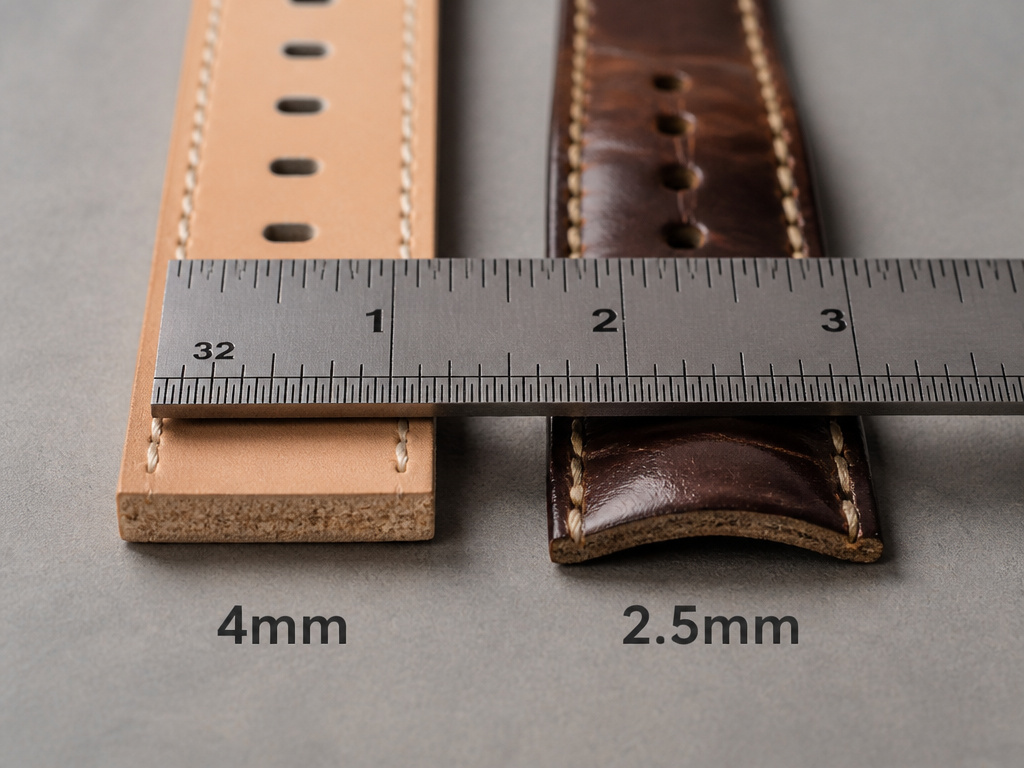 If you’re buying a new strap, you can avoid this whole struggle by choosing the right leather from the start. Your goal is a material designed to wear in, not just wear out.
Vegetable-tanned leather is the classic choice. It starts stiff and light and slowly darkens and softens with exposure to light, oils, and time. It develops a personal patina. The break-in requires more initial effort, but the result is a strap that molds uniquely to your wrist.
Shell cordovan is in a league of its own. It’s not a leather from a cow’s shell; it’s a dense membrane from a horse’s hindquarters. It has almost no fibrous grain, so it doesn’t crack at creases, it forms gentle rolls. It’s naturally lustrous and highly resistant to water spotting. A shell cordovan strap from Bulang & Sons or Veblenist is an investment, but it will outlive and outperform any cowhide strap.
Where this goes sideways: Buying straps based on thickness alone. A 4mm thick “dress” strap won’t soften properly and will keep your watch sitting awkwardly high on your wrist. For comfort and proper drape, aim for 2.5mm to 3.5mm.
Quick-release spring bars are the underrated hero here. They let you swap straps in seconds without tools. Why does this matter for softening? It allows you to rotate multiple straps, giving each one a rest day to recover its shape and fully absorb conditioner. It also prevents the scratches to your watch lugs that happen when you’re fumbling with a spring bar tool on a stiff, uncooperative strap.
Step-by-Step: The Safe Softening Protocol
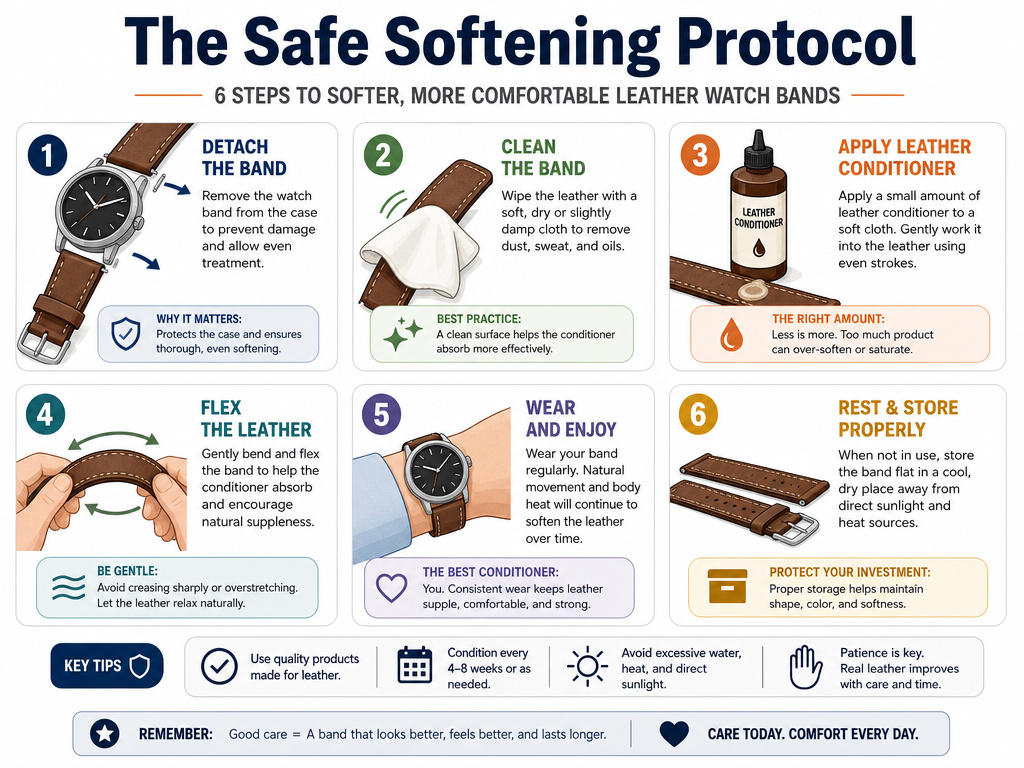 Follow this sequence. Rushing or skipping steps leads to a damaged strap.
- Remove the strap. Use quick-release spring bars or a spring bar tool. Working on the strap alone gives you proper control and protects your watch.
- Clean if necessary. Dirt acts as sandpaper. Dampen a cloth with water, wring it out completely, and wipe the strap down. For heavier grime, use a drop of mild, pH-neutral soap. Dry fully with a towel, then let it air-dry for an hour. Never use alcohol or disinfectant wipes.
- Apply conditioner. Use a dedicated product like Bickmore Bick 4. A thin, even coat is all you need. Massage it into the leather, inside and out.
- Flex manually. After the conditioner is absorbed (touch-test for no residue), gently work the leather with your hands. Focus on the stress points.
- Wear in intervals. Reattach the strap and wear it for a few hours. Repeat the conditioning and flexing process every other day for a week.
- Store properly. When not wearing it, keep the strap flat or loosely rolled in a cool, dry place. Don’t store it bent in a closed watch case.
Easy to miss: Conditioning the underside of the strap. The side against your skin loses oils to sweat and friction fastest. Neglecting it creates a stiffness differential that leads to cracking on the top grain.
When to Give Up and Replace the Strap
Leather is durable, but it’s not immortal. Recognize the signs of terminal stiffness.
- Deep, structural cracks: These look like canyons in the leather, usually at the main bend. The fibers are torn. Conditioner can’t glue them back together.
- Brittleness: If the leather feels like stiff cardboard and emits a dry, cracking sound with any flex, it has lost too much of its fibrous structure.
- Bonded or “genuine leather”: As a classification, “genuine leather” is a bottom-tier material. It’s often a laminate of leather dust and polyurethane on a fabric backing. It doesn’t have the grain structure to absorb conditioner and will delaminate instead of soften.
- Severe sweat damage: A strap that’s been saturated with sweat for years may have salt crystals deep in the pores and a permanently altered pH. It will feel spongy and weak, not just stiff.
Replacement isn’t failure. It’s the realistic lifecycle of a consumable item. For a reliable, ready-to-wear option, I recommend exploring our guide to the best leather watch bands for vetted suggestions.
Frequently Asked Questions
Can I use olive oil or coconut oil to soften my watch strap?
No. Cooking oils are not formulated for leather. They can go rancid, attract dust, and over-soften the leather to a mushy state. They also oxidize and can darken the leather unevenly. Always use a product designed for leather care.
How long does it take to soften a new leather watch band?
With consistent daily wear and one or two conditioning sessions, a vegetable-tanned strap from a brand like W.H. Earl will become noticeably more comfortable in about a week. It reaches its fully broken-in, supple state in about a month. Thicker straps take longer.
Will softening my strap make it look worn out?
Proper softening should enhance its appearance, not degrade it. A conditioner containing mink oil or beeswax will enrich the color and bring out the natural grain. The strap will develop a patina, a soft sheen and gentle creasing that signifies character, not damage. Avoiding this process for fear of patina is like never driving a car to keep the miles low.
My strap got wet. What now?
Blot it gently with a dry, absorbent towel. Do not rub. Then let it air-dry at room temperature, away from direct heat or sunlight. Keep it flat. Do not wear it or bend it until it is completely dry. Once dry, condition it to replenish any oils that were washed out. This is a core part of how to care for a leather watch strap.
What’s the difference between softening and stretching?
Softening increases pliability; the leather becomes more flexible. Stretching permanently increases its dimensions. You generally don’t want to stretch a watch strap, as it can distort the buckle holes and shape. Proper methods for softening leather focus on flexibility, not size.
Before You Go
One rule most guides skip: if your strap is older than three years and has been worn daily, softening might be a temporary fix. The leather’s lifecycle is finite, especially under constant sweat and flex. A deep conditioning might buy you another six months of comfort, but start looking at replacements.
Your first step this week should be to take the strap off and inspect it against the diagnostic chart. Is it salvageable? Bickmore Bick 4 is under twenty dollars, and commit to the week-long protocol. If the chart says no, use our guide on how to choose a leather watch strap to select a better-built successor.
The goal isn’t to fight the material. It’s to work with its nature. A little knowledge turns a frustrating chore into a simple, satisfying part of ownership.
