
Learn How to Soften Leather Boots the Right, Non-Damaging Way
This post contains affiliate links. As an Amazon Associate, we earn from qualifying purchases.
This post contains affiliate links. As an Amazon Associate, we earn from qualifying purchases.
To soften leather boots, you need a patient, mechanical process, conditioning is just one part of it. Use a water-based leather conditioner like Bickmore Bick 4 or Lexol Leather Conditioner on clean, dry boots, focusing on high-stress areas. Then, wear them for short, frequent periods with thick socks. The leather’s collagen fibers need time to flex and relax under gentle, repeated pressure. Rushing with heat, soaking, or over-conditioning permanently damages the leather’s structure.
That gap between applying a conditioner and the leather actually feeling softer is where most people go wrong. They see a stiff boot, reach for a bottle, and think more product equals a faster result. It doesn’t.
What follows is a breakdown of why leather stiffens, the one physical process that softens it, and a step-by-step plan that prioritizes the boot’s long-term health over a quick, damaging fix.
Key Takeaways
- Conditioning is maintenance, not magic. It replaces lost lubricants between leather fibers but cannot force fibers to stretch and relax, only wear and flexing does that.
- Full-grain and vegetable-tanned leathers take the longest to soften because their dense, natural fiber structure is what makes them durable. This is a feature, not a bug.
- Over-conditioning saturates and weakens leather. Cobbler Brett Viberg warns this is a common cause of permanent damage, as soaked fibers lose their supportive structure.
- Heat is the enemy. Using a hairdryer or hot water cooks the collagen proteins that give leather its strength, creating a stiff, brittle shell that will never recover.
- The safest tool is time. Plan for 2–3 weeks of short, frequent wear sessions. A boot that softens in a day is often a boot that will fail in a year.
The Mechanical Process Behind Softening
Leather is a fibrous network, mostly collagen, that gets its flexibility from the way its fibers slide against each other, not from absorbing softness like a sponge. When new, or when dried out, the fibers are tight and bound.
Leather softens when mechanical action, the bending of your foot, gently stretches and relaxes the collagen fiber network. Conditioners work by replenishing the natural lubricants lost during tanning or drying, reducing friction between fibers so they can move more freely. This is why you can’t condition a boot on a shelf into softness.
Think of it like a stiff new rope. You can oil it (condition it), but until you work it back and forth in your hands (flex it), it stays rigid. The oil just lets the strands slide without fraying. Your foot provides the necessary, repeated flexing.
Here’s what happens at each stage:
| Stage | What’s Happening in the Leather | The Right Action | The Wrong Action |
|---|---|---|---|
| New & Stiff | Fibers are densely packed and starched from tanning. Lubricants are minimal. | Apply a thin coat of conditioner to high-stress areas (ankle, vamp). Begin short wear sessions. | Slathering conditioner over the entire boot. Wearing for a full day immediately. |
| Breaking In | Fibers are beginning to stretch and separate at specific flex points. Lubricants are being distributed. | Wear for 1-2 hours daily. Hand-flex the boots when off. Re-condition only if areas become dry. | Using a hairdryer to “speed up” the process. Applying more conditioner weekly. |
| Soft & Supple | Fiber network is relaxed and moves easily. Lubricants are evenly distributed. | Maintain with conditioner 1-2 times a year. Store with boot trees to hold shape. | Assuming no further care is needed. Storing in a plastic bag or hot attic. |
The sensory cue you’re listening for is the absence of a sharp, creaking resistance when you bend the vamp. A properly softening boot will have a muffled, yielding flex.
Why “Quick Fixes” Cause Permanent Damage
The internet is full of ways to ruin a pair of Red Wing boots in an afternoon. These methods promise softness but deliver a breakdown of the leather’s fundamental structure.
Heat Exposure: This isn’t just about melting glue. Heat denatures the collagen proteins themselves. It’s like cooking an egg, the transformation is permanent. The leather may feel pliable while warm, but as it cools, those proteins solidify into a stiff, brittle matrix. You’ll hear a cardboard-like crunch when you bend it afterward.
Over-Conditioning and Saturation: This is the silent killer. Leather needs to breathe. Drowning it in oil or conditioner clogs the pores, traps moisture against the footbed, and creates a soggy environment where fibers rot from the inside out. Brett Viberg, the third-generation bootmaker, specifically warns against dousing boots to speed up softening for this exact reason.
Water Soaking and Rapid Drying: Getting caught in the rain is one thing. Deliberately soaking a boot washes out the very tanning agents and lubricants that give it structure. If it then dries quickly, the fibers contract and clump together, creating a permanent, sandpaper-like stiffness. The boot will never drape over your foot correctly again.
Where this goes sideways: Using a hairdryer on stiff spots. The localized heat doesn’t just dry the leather; it cooks the collagen at that specific fold line. You’ll create a permanent, sharp crease that cracks within a dozen more wears.
The reality is, leather has a memory. A shortcut that forces a dramatic change teaches it the wrong shape, a shape of weakness.
Choosing and Applying Conditioner Correctly
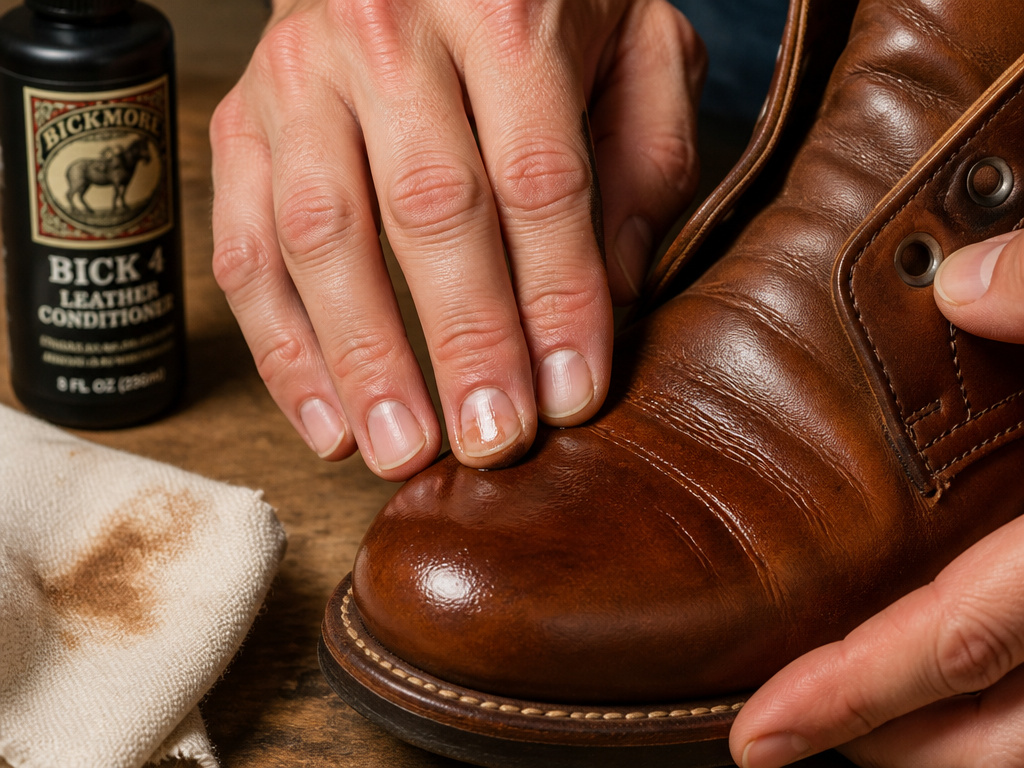
Not all conditioners are created equal, and more is never better. Your goal is to replenish, not overwhelm.
For most boots, I reach for a water-based conditioner like Bickmore Bick 4 or Lexol Leather Conditioner. Why? They’re formulated to carry lubricants into the leather without clogging pores with heavy waxes or fats. Nikwax Conditioner for Leather™ is another excellent choice, specifically designed for waterproof leathers like Gore-Tex, because it conditions without over-softening.
Traditional oils like neatsfoot or mink oil have their place, but they darken leather significantly and can over-soften if over-applied. They’re a tool for specific, dry climates on oil-tanned leathers, not a universal softener.
Here’s the straightforward application process:
- Clean the boots first. Any dirt on the surface will get ground into the leather pores during conditioning. Use a damp cloth and let them dry completely.
- Apply a thin coat. Use a clean cloth or your fingers. Work a small amount into one section at a time, focus on the high-stress vamp and ankle areas first.
- Let it absorb fully. This takes a few hours. The leather should look nourished, not shiny or wet. If it’s still glossy after 30 minutes, you used too much. Buff off the excess with a dry cloth.
- Wait before judging. The leather will feel slightly softer immediately, but the real effect happens over the next 24-48 hours as the conditioner fully integrates.
You don’t need to condition the entire boot every time. If the shaft is still soft, just hit the flex points. This targeted approach prevents over-saturation of areas that don’t need it.
A Step-by-Step Plan That Actually Works
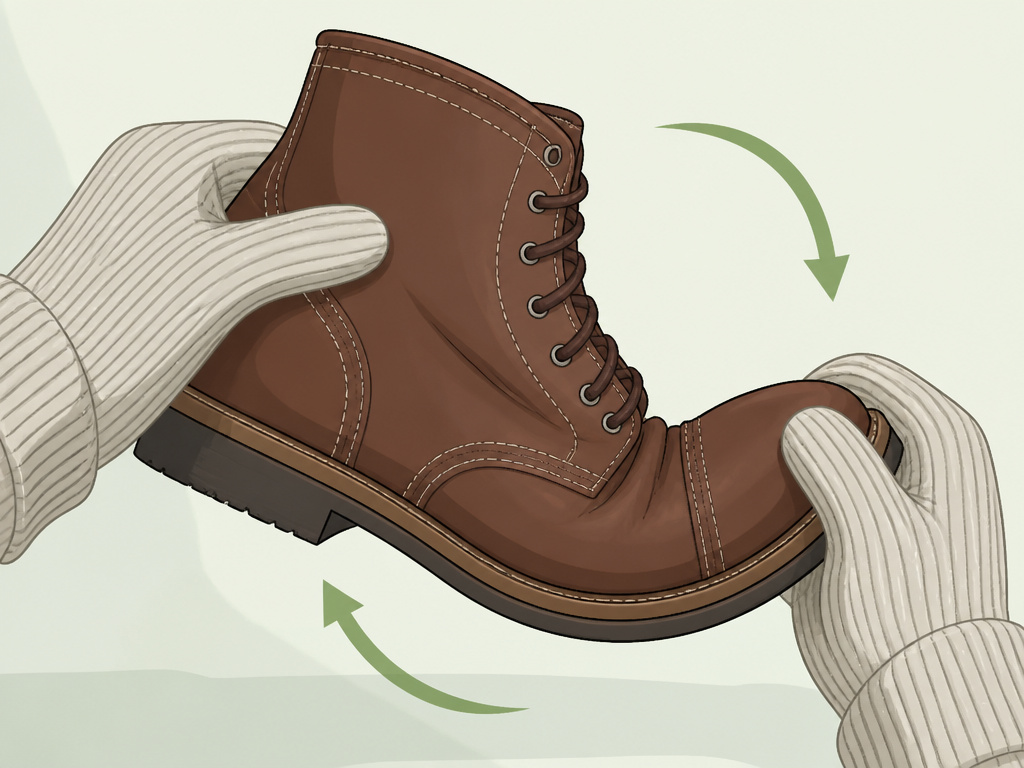
This process is a short daily ritual to be performed over a few weeks. Patience here is the difference between a boot that molds to you and one that fights you.
Week 1: Introduction & Flexing
- Day 1: Clean and apply a light conditioner to the vamp and ankle. Let dry overnight.
- Day 2-7: Wear the boots indoors for 30-60 minutes each day with the thick socks you plan to wear with them. When you take them off, don’t just set them down. Grab the toe and heel and gently flex the boot forward and back a dozen times by hand. This mimics walking stress without taxing your feet.
Week 2: Building Duration
- Extend wear sessions to 1-2 hours. Start venturing outside for short walks. Pay attention to specific pinch points. If a spot is rubbing, that’s the area needing more focused flexing, not more conditioner.
- If the leather at a flex point looks dry or pale (a sign of fiber stress), apply a tiny dab of conditioner just to that spot.
Week 3 & Beyond: Integration
- By now, the boots should feel noticeably more accommodating. You can wear them for half-days.
- This is the critical maintenance window: Once they are comfortable, stop conditioning for a while. Let the leather settle into its new shape. Your next conditioner application should be in 4-6 months.
What about boot stretchers? They are a tool for addressing a fit problem, a pinching toe box, not a softness problem. If you use one, pair it with a light conditioner and turn the knob only until you feel slight resistance. Leave it for 24 hours, then reassess. Cranking it hard overnight will stretch the leather past its elastic limit, creating a permanently baggy area.
What Type of Leather Are You Working With?
The leather’s personality dictates your timeline and approach. A one-size-fits-all method will disappoint you.
- Full-Grain Leather: This is the tough, durable stuff. It has the densest, most intact fiber structure, so it takes the longest to soften, often a full month of consistent wear. Don’t fight this. Its resistance is what gives it a decades-long life. Condition lightly and let time do the heavy lifting.
- Vegetable-Tanned Leather: Initially very stiff and prone to dramatic patina. It softens through a combination of flexing and natural oxidation from exposure to air and light. Conditioning is crucial to prevent it from drying out and cracking during this long break-in.
- Corrected-Grain or “Genuine Leather”: These layers have been sanded and coated. They may soften faster initially because the top fibrous layer is thinner or the coating is flexible. However, they are far less responsive to conditioning and have a lower ceiling for how supple they can become. Over-conditioning can break down the surface coating.
The takeaway? If your expensive, full-grain boots are taking forever to soften, that’s a sign of quality. The fast-softening “genuine leather” boot won’t be on your feet in five years.
Frequently Asked Questions
Can I use coconut oil to soften leather boots?
You can, but I wouldn’t recommend it for quality boots. Coconut oil is a saturated fat that can go rancid, attract mold, and dramatically darken leather. It’s also difficult for the leather to absorb fully, often leaving a greasy residue. For a material you want to last, use a product formulated for the job, like Bickmore Bick 4.
How long does it take to soften leather boots?
For quality full-grain leather, plan on 2-3 weeks of short, daily wear to achieve a comfortable, broken-in feel. A complete, custom mold to your foot can take up to 80-120 hours of total wear time. Rushing this process is the most common cause of damage.
Will my boots stretch as they soften?
Yes, but in a specific way. They will stretch marginally in width as the fibers relax, but the length is largely set by the sole and last. You might gain a quarter-size in length at most. Softening is primarily about pliability, not significant dimensional change. If a boot is painfully tight, it’s likely the wrong size.
Is it normal for new leather boots to be very stiff?
Absolutely. High-quality boots are built for structure and longevity, which requires a robust, stiff leather to start. A premium boot that feels like a slipper right out of the box is an anomaly, not the standard.
The Bottom Line
Soften your boots by working with the material, not against it. Your feet are the best tool you have, use them in frequent, short sessions. Condition to maintain, not to force.
One rule most guides skip: if you ever feel the leather getting hot to the touch from friction or an external heat source, stop. That’s the threshold where permanent damage begins. Everything above assumes the leather’s structure is intact. A heat-cooked or oil-saturated fiber network is faster to replace than to revive.
