
How to Waterproof Leather Using Wax, Oil, and Spray Sealants
This post contains affiliate links. As an Amazon Associate, we earn from qualifying purchases.
You waterproof leather by applying a protective barrier, wax, oil, or spray, after first cleaning and conditioning the piece. The choice between a closed waterproofing (a complete barrier) and an open waterproofing (a breathable net) decides whether your leather stays comfortable or turns into a sweaty, stiff shell.
That gap between a wall and a net is the whole game. A closed waterproofing fills every fiber gap, which stops water dead but also stops your foot or body from breathing. Leather already absorbs and transports water vapor naturally, it can hold 25% of its dry weight in moisture before it even feels damp. A good waterproofing job preserves that function while adding a rain shield. A bad one blocks it completely.
What follows is a breakdown of the three physical properties you’re manipulating, the two waterproofing methods you’re choosing between, and the one rule about leather density that determines which method will even work. We’ll cover waxes for heavy-duty boots, conditioners for daily shoes, and sprays for suede, ending with a clear default pick for most situations.
Key Takeaways
- Leather can absorb 25% of its dry weight in water vapor before feeling damp, effective waterproofing works with this property, not against it.
- Closed waterproofing (think heavy wax) creates an impermeable barrier but kills breathability; open waterproofing (modern silicone sprays) forms a porous, hydrophobic net.
- The density of your leather dictates its breathability; leather above 1.2 g/cm³ (like rolled sole leather) has near-zero permeability, making “breathable” waterproofing a moot point.
- Always clean and condition leather before applying any waterproofing product; dirt and dried-out fibers repel treatment unevenly.
- For general-purpose, breathable waterproofing on smooth leather, a silicone-based spray or cream like Nikwax Conditioner for Leather is the safest, most effective default.
Leather Isn’t a Sponge: It’s a Climate Control System
Most people think of waterproofing as sealing pores. That’s only half the story, and it’s the half that ruins good leather. Think of quality leather as a passive climate system. Its fibrous structure absorbs water vapor from your skin, transports it through the material, and releases it to the outside air. This is water vapor permeability.
The ISO 5403 standard measures dynamic water resistance, but the more important number for comfort is the Water Vapor Permeability Rate (WVPR). A minimum WVPR of 20 is needed for leather to be described as truly water vapor permeable. Lightly finished chrome leather has a permeability around 12 mg/cm²/h. That’s decent. But crank the density up to 1.2 g/cm³, common in stiff, rolled sole leather, and permeability drops to nearly zero.
So the first question isn’t “how do I seal it?” It’s “how do I add a rain shield without wrecking the HVAC?”
Leather can absorb up to 25% of its dry weight in liquid water without feeling damp. Once it surpasses that threshold and feels wet, it becomes difficult to dry and starts losing the tanning agents that keep it supple.
The Real Cost: Waterproofing vs. Breathability
Here’s where the trade-off gets physical. There are two fundamental methods: open and closed waterproofing. Your choice dictates whether your feet stay dry from rain or damp from sweat.
Closed waterproofing fills every microscopic gap between leather fibers with a water-repellent substance, think thick waxes or heavy oils. It creates a solid, impermeable wall. The upside is phenomenal liquid water resistance. The downside is that the wall blocks gases, too. Your sweat vapor has nowhere to go. This is why heavily waxed boots can feel swampy inside, even when dry outside.
Open waterproofing works differently. It coats the individual collagen fiber bundles, leaving the spaces between them open. This creates a porous, hydrophobic net. Liquid water beads and rolls off, but water vapor can still pass through. Modern silicone or fluoropolymer-based sprays (like Nikwax) specialize in this. The leather stays breathable.
The need for perfect leather quality is higher with open waterproofing. Every hole in the net is a potential leak. Closed waterproofing is more forgiving of imperfections because it just floods the entire zone.
| Waterproofing Type | How It Works | Best For | Breathability Cost |
|---|---|---|---|
| Closed (Waxes/Oils) | Fills all fiber gaps with a repellent substance. | Extreme wet conditions (hiking, work boots), where liquid resistance is paramount. | Severe reduction. Can feel “swampy.” |
| Open (Silicone/Polymer Sprays) | Coats individual fibers, leaving a porous net. | Everyday use (shoes, jackets, gloves) where comfort and weather resistance are balanced. | Minimal reduction when applied correctly. |
| Conditioner-Based | Replenishes natural oils and adds mild repellency. | Maintaining new or dry leather, adding light protection to shoes and accessories. | Improves breathability by keeping leather supple. |
The 3-Step Process: Clean, Condition, Protect
Skip the first two steps and you’re just waterproofing dirt. Dirt particles fill the very pores you’re trying to treat, and dried-out leather absorbs products unevenly.
1. Clean. Use a leather-specific cleaner like Nikwax Footwear Cleaning Gel. Conventional soaps leave a water-attracting film that undermines water repellency. For suede or nubuck, use a soft brush and a specialized cleaner. The goal is a neutral, dry surface.
2. Condition. This is non-optional for leather that sees regular use. Water leaches out the tanning agents and lubricants that keep leather flexible. A conditioner like Nikwax Conditioner for Leather replaces them. It’s water-based, so it stops absorbing once the leather is saturated, you can’t over-apply it the way you can with old-school oils. This step alone can restore a dried-out leather jacket or stiff shoes.
3. Protect. Now you choose your shield based on the leather and the threat. * Smooth Leather for Harsh Conditions: A wax-based product like Nikwax Waterproofing Wax for Leather. Rub it into clean, dry leather, concentrating on seams. * Smooth Leather for Everyday Wear: A silicone-based waterproofing spray or cream. Apply in a well-ventilated area, let it dry, then buff lightly. * Suede or Nubuck: A dedicated spray like Nikwax Nubuck & Suede Proof. Hold the can 6 inches away and apply in a light, even coat.
Common mistake: Applying waterproofing to dirty or bone-dry leather. The treatment sits on top of the grime or gets sucked into parched fibers in uneven patches, leaving weak spots that fail first in the rain.
Picking Your Weapon: Wax, Oil, or Spray?

The product categories aren’t marketing fluff. They correspond directly to the open vs. Closed waterproofing methods.
Waxes (Beeswax, Paraffin) are the classic closed waterproofing agents. Brands like Otter Wax or Sno-Seal fall here. They are superb for creating a hard, durable barrier. They’re my go-to for leather work boots that will see mud, snow, and prolonged wetness. The trade-off is breathability and a stiffened feel. Don’t use these on a soft leather jacket you want to stay drapey.
Silicone/Polymer Sprays & Creams are the modern open waterproofing champions. Nikwax is the leader here. These products form that breathable, hydrophobic net. They are less visible, don’t significantly alter the leather’s hand, and are ideal for most leather shoes, gloves, and jackets. They’re also the only sane choice for suede.
Oils (Mink Oil, Neatsfoot) sit in a weird middle ground. They can behave like a closed waterproofant if applied heavily, but they primarily condition. I’m wary of them for true waterproofing. They can go rancid, attract microbes, and over-soften leather, compromising its support. If you use a mink oil, do so sparingly and only on heavy, utility-grade leather.
The Default Pick
For 90% of people wanting to waterproof their everyday leather shoes or a leather jacket, a silicone-based conditioner like Nikwax Conditioner for Leather is the answer. It does two jobs: it nourishes the leather to prevent drying and cracking, and it adds a durable, breathable water-repellent layer. It’s hard to mess up.
Why Your Leather’s Tanning and Type Matter
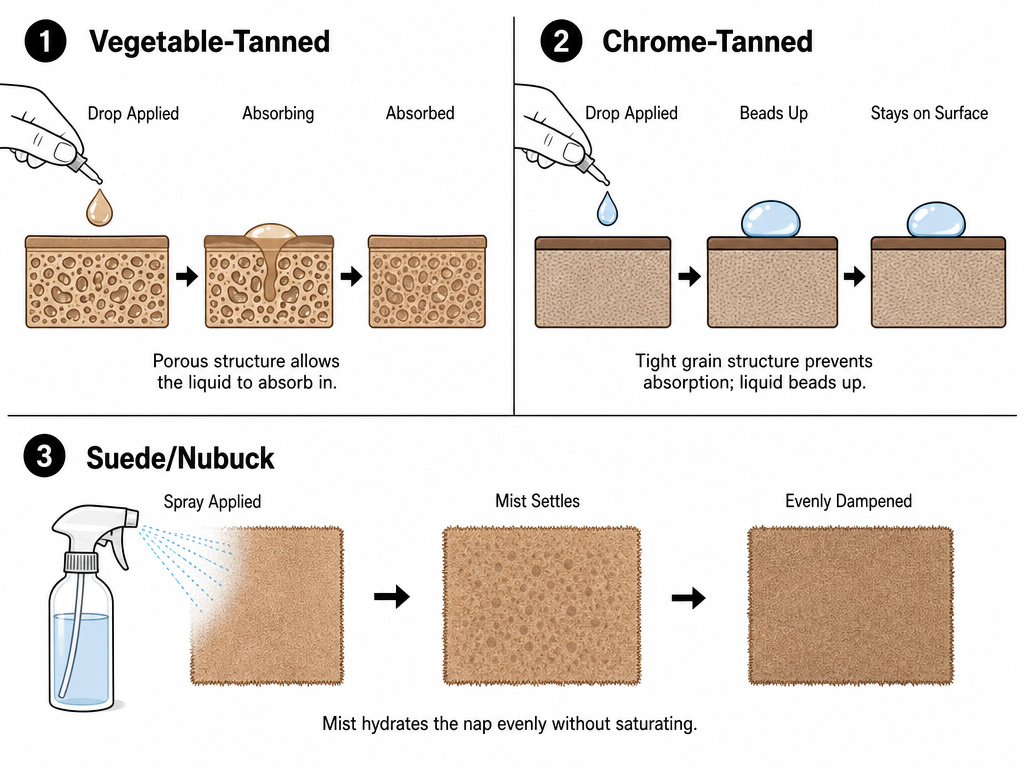
Not all leather is created equal. Its origin story determines how it will react to your waterproofing efforts.
Vegetable-Tanned Leather is porous and absorbent. It will drink up oils and waxes deeply. This can be great for building a patina and a deep waterproof layer, but it’s easy to over-saturate and darken it permanently. Always test on a hidden spot.
Chrome-Tanned Leather is more water-resistant from the start due to its tighter fiber structure. It takes sprays and creams very well. Most modern leather boots and jackets are chrome-tanned.
Suede & Nubuck have a raised nap. Never use a wax or oil, it will mat the nap down irreparably. Only use sprays designed specifically for these materials. The protection will be lighter, but the alternative is ruining the texture.
Here’s the hard lesson I learned that applies directly to this: I once assumed all “medium weight” leather was the same. I started a bag project without checking the thickness with calipers. The leather was too thin and floppy for the structure I needed. The same principle applies here. A thin, garment-weight leather cannot handle a heavy wax, it will stiffen into cardboard. A thick, dense belt leather might not absorb a light spray enough to be effective. Let the leather’s heft guide the product’s weight.
Frequently Asked Questions
Can I use waterproofing spray on suede?
Yes, but only a spray specifically formulated for suede and nubuck. Standard sprays for smooth leather will darken and stain the nap. Apply lightly in a well-ventilated area.
How often should I reapply waterproofing?
There’s no fixed schedule. The sign is when water stops beading on the surface and instead soaks in, a state called “wetting out.” For frequently worn leather boots in wet climates, this might be every few months. For a leather jacket worn occasionally, once a season is plenty.
Does waterproofing leather darken it?
Most products will darken leather slightly, especially initially. Waxes and oils cause the most significant darkening. Silicone-based sprays have a minimal effect. Always do a spot test in an inconspicuous area first.
Is it better to waterproof new leather or wait?
It’s better to waterproof new leather lightly and early. A new pair of leather shoes or boots has its factory finish intact. A light application of a conditioner-protector helps maintain that state from day one, preventing the leather from ever reaching a dried-out, vulnerable stage.
The Bottom Line
Waterproofing leather is not a one-and-done armor spell. It’s ongoing maintenance that balances two needs: keeping water out and letting vapor through. The rule of thumb is to match the product’s intensity to the leather’s job.
If you take one action this week, clean and condition your most-worn leather item. You’ll feel the difference in suppleness immediately. From there, decide if it needs a heavy wax for a winter hike or a light spray for a spring shower. Remember, the goal isn’t to create an impermeable plastic shell. It’s to help a remarkable natural material do its job better, for longer. That’s how you build a patina that tells a good story, not a sad one about cracked seams and stiff silence.
